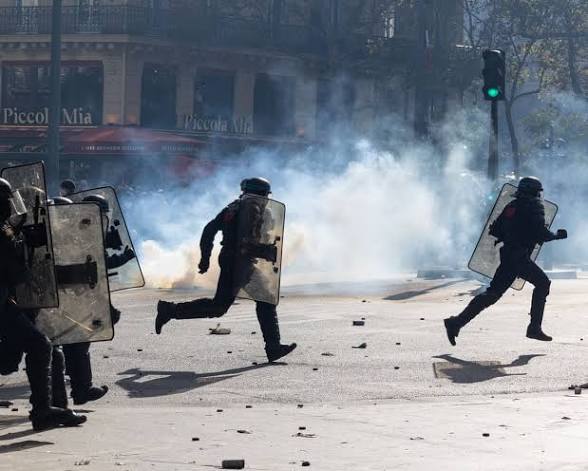
A dramatic live report from Paris has highlighted the dangers facing journalists covering France’s escalating street unrest. GB News reporter Dougie Beattie found himself caught in tear gas as police confronted violent groups during demonstrations that spread across the French capital and other cities.
The reporter described choking air, incoming tear gas canisters and a rapidly deteriorating atmosphere as officers attempted to control confrontations with protesters. His experience offered a direct look at the challenges facing journalists working close to the front lines of civil disorder.
The incident occurred amid a broader wave of demonstrations over rising living costs, economic inequality and concerns about public services. Although many people attended peaceful rallies, some gatherings descended into clashes, vandalism and looting.
According to Reuters’ October 24 report, French authorities estimated that 410,000 people participated in nationwide demonstrations that Saturday. Organisers disputed the official figure and claimed attendance was substantially higher.
The unrest has intensified pressure on the French government while raising questions about public safety, policing and press freedom.
Paris Riot Tear Gas Reporter Faces Dangerous Live Reporting Conditions
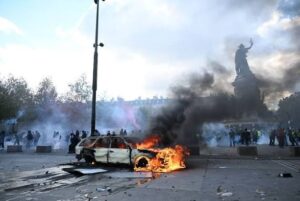
The Paris riot tear gas incident involving Dougie Beattie demonstrated how quickly a journalist’s working environment can change during a confrontation between police and protesters.
According to coverage published by AOL, the GB News reporter was broadcasting near riot police when tear gas spread through the area. Beattie wore protective goggles as he described the escalating situation to viewers.
The reporter explained that the atmosphere was becoming increasingly difficult to tolerate. Tear gas affected both him and his cameraman, making it harder to continue their live coverage safely.
During the broadcast, Beattie described the situation as increasingly dangerous. He also reported seeing fireworks, bricks and bottles being thrown towards police lines.
As the confrontation intensified, officers continued deploying crowd-control measures. Beattie indicated that he and his cameraman would leave the area shortly because the conditions had become difficult to endure.
The incident illustrated a central challenge of live journalism: reporters must communicate what is happening while responding to rapidly changing risks around them.
Unlike journalists working from a studio, correspondents in the field cannot always predict when a peaceful gathering will turn violent or when police will deploy chemical irritants.
Why Did Paris Experience Violent Clashes?
The latest unrest emerged from a wider movement involving students, workers and other demonstrators concerned about living costs, inequality and public services.
Protests that initially focused on school conditions expanded into broader criticism of economic policies and the government’s response to social concerns.
According to Reuters, the October 24 demonstrations included a major gathering on the southeastern outskirts of Paris. Authorities estimated that approximately 110,000 people attended the Paris-area rally.
The demonstration was largely peaceful before confrontations developed later in the day.
Police used tear gas and water cannon against a group of around 500 hooded youths after the main rally ended. Clashes also occurred in Marseille and several other French cities.
The distinction between peaceful demonstrators and people involved in violence is important. A large protest may include thousands of people exercising their right to demonstrate while a smaller group engages in vandalism or confronts officers.
The actions of a minority should not automatically be attributed to everyone attending a demonstration.
At the same time, attacks on police, looting and the destruction of property can create serious safety risks for residents, journalists, shop workers and emergency personnel.
Tear Gas Turns the Streets Into a Dangerous Reporting Environment
Tear gas is a chemical irritant commonly used by law enforcement to disperse crowds. Exposure can cause intense eye irritation, coughing, burning sensations, difficulty breathing and temporary disorientation.
The effects can make it difficult for journalists to see their surroundings, operate equipment or speak clearly during a live broadcast.
For reporters such as Beattie, these conditions create an additional layer of danger. They must monitor the confrontation while trying to explain events accurately to an audience.
Tear gas can also spread beyond the immediate confrontation, depending on wind and street conditions. People who are not participating in violence may therefore experience its effects.
Protective goggles and suitable respiratory protection can reduce some risks, but protective equipment does not eliminate the danger. Journalists also need clear escape routes, communication with their production teams and an understanding of police movements.
The Paris incident reinforced why news organisations increasingly need safety procedures for reporters covering volatile demonstrations.
These procedures can include pre-assigned meeting points, medical support, protective clothing, emergency communication plans and clear instructions about when to leave an area.
The decision to withdraw is particularly important. Continuing a live broadcast should never take priority over a journalist’s immediate safety.
Paris Protests Escalate Despite a Major Police Operation
French authorities deployed a substantial security presence in an effort to prevent a repeat of the previous weekend’s widespread disorder.
Reuters reported that approximately 70,000 police officers and gendarmes were deployed nationwide for the October 24 demonstrations. The operation followed criticism that authorities had underestimated the scale of the unrest during earlier protests.
Officials said the increased deployment was intended to improve preparation and respond more quickly to potentially violent groups.
Nevertheless, confrontations occurred in Paris and Marseille as the evening progressed.
In Marseille, groups of youths reportedly set fire to rubbish bins, blocked roads and threw objects at security forces. Police also reported the ransacking of several shops.
Other cities experiencing clashes included Lyon, Bordeaux, Grenoble, Lille, Rennes, Nantes and Toulouse.
The disruption extended beyond the streets. In Paris, several metro stations were closed, shops took precautions to protect their premises, and major cultural institutions suspended operations for safety reasons.
The closures affected residents and visitors who had not participated in the demonstrations.
The scale of the security operation also demonstrated the logistical challenge of policing multiple large gatherings across a country while preserving access for emergency services and protecting the public.
Foreign Media Capture the Scale of France’s Unrest
International news organisations have paid increasing attention to the French demonstrations as images of burning vehicles, damaged storefronts and tear gas-filled streets circulated worldwide.
A Le Monde analysis published on October 20 examined how foreign newspapers interpreted the unrest.
Coverage highlighted the contrast between the largely peaceful marches and the violence that erupted in some locations. It also reflected concerns about economic pressure, political dissatisfaction and the government’s handling of the demonstrations.
For international audiences, images of unrest in Paris carry particular significance because the French capital is one of Europe’s most recognisable political and cultural centres.
However, dramatic footage does not always capture the full context. A short clip showing a confrontation may not explain what happened before it, how widespread the violence was or what protesters were demanding.
Responsible reporting therefore requires journalists to verify footage, identify the location and time of an incident, and distinguish eyewitness observations from official statements.
Beattie’s experience provided an immediate account of conditions near a confrontation, but understanding the wider crisis requires information from multiple reliable sources.
Journalists Face Growing Risks While Covering Protests
The dangers facing reporters in France extend beyond exposure to tear gas.
On October 17, a Euronews crew covering the demonstrations in Paris reported being assaulted by masked individuals while filming the looting of a supermarket.
In its October 17 report, Euronews said correspondent Estelle Nilsson-Julien and her cameraman were confronted near Place de la République.
Nilsson-Julien said individuals struck the cameraman and attempted to take his microphone. The crew’s camera was also stolen during the confrontation, although it was later returned without its memory card.
Another Euronews correspondent reported a separate incident involving a protester who struck her while she was conducting an interview.
These cases highlight the risks journalists may face from different directions during civil unrest. Police operations can expose reporters to chemical irritants and projectiles, while hostile individuals may target journalists attempting to document looting or violence.
The European Federation of Journalists also raised concerns about incidents involving journalists during French protests.
In an October 13 statement, the organisation reported documenting multiple incidents involving violence or obstruction against media professionals.
Press freedom depends on journalists being able to observe and report on public events without intimidation or unjustified interference.
When reporters are attacked or prevented from recording events, the public may lose access to important information about the conduct of protesters and authorities.
The Economic Grievances Behind the Demonstrations
Although violent confrontations have attracted considerable attention, economic concerns remain central to the broader protest movement.
Rising living costs can put pressure on households that already struggle to pay rent, purchase groceries, cover transport expenses and manage energy bills.
Students may face additional difficulties involving education costs, housing shortages and uncertainty about future employment.
Workers, meanwhile, may worry about purchasing power, job security and the ability to maintain their standard of living.
These pressures can contribute to public dissatisfaction, particularly when people believe political leaders are not responding effectively.
However, economic hardship does not explain every act of violence, nor does it justify attacks on people or the destruction of property.
Understanding the demonstrations requires separating the reasons people participate in peaceful protests from the actions of individuals who engage in criminal behaviour.
The government faces the challenge of addressing legitimate public concerns while maintaining public order and protecting essential services.
Opposition politicians, unions, student groups and civil society organisations may disagree over the best solutions, but the protests have made the underlying questions difficult to ignore.
How the French Government Is Responding
The French government’s response has focused heavily on security and the prevention of further violence.
Interior Minister Laurent Nuñez said authorities had prepared more extensively for the October 24 demonstrations than they had for the previous weekend.
Officials also blamed groups they described as high-risk elements for attempting to provoke confrontations during otherwise peaceful gatherings.
The government’s approach has attracted criticism from people who believe that a strong security response must be accompanied by meaningful engagement with demonstrators.
In an October 26 opinion article, journalist Rokhaya Diallo argued that focusing primarily on disorder risks overlooking the social and educational concerns behind the protests.
That article represents an opinion and should be understood as such. Nevertheless, it reflects a wider debate about whether policing alone can resolve a movement driven partly by dissatisfaction with economic and public-service conditions.
The authorities must protect public safety while ensuring that law enforcement measures remain proportionate and subject to appropriate oversight.
Similarly, peaceful demonstrators should be able to express their concerns without being treated as responsible for every violent act committed nearby.
The effectiveness of the government’s response will depend not only on preventing immediate disorder but also on whether it can address the grievances contributing to continued mobilisation.
What the Paris Riot Means for Residents and Visitors
The unrest has created practical difficulties for people living in and travelling through Paris.
Transport disruptions can make commuting unpredictable, while shop closures and damaged commercial areas affect local businesses.
Tourists may also find that planned visits to museums, cultural institutions and other attractions are disrupted when authorities introduce precautionary closures.
Anyone travelling to Paris during periods of unrest should monitor official transport announcements, local news and guidance from relevant authorities.
Visitors should avoid active confrontations, follow instructions from emergency personnel and leave areas where police are deploying tear gas.
Journalists and photographers should take similar precautions, particularly when crowds begin moving unpredictably or officers establish new lines.
It is also important to avoid assuming that every neighbourhood or public gathering is dangerous. Conditions can vary significantly between locations, and peaceful demonstrations may continue while confrontations occur elsewhere.
Accurate, up-to-date information is therefore more useful than relying on viral clips or general claims that the entire city is in chaos.
Could the Protests Continue?
The future of the demonstrations will depend on several factors, including the government’s decisions, the response of student and labour groups, and whether further confrontations occur.
The October 24 rallies showed that large numbers of people remained willing to demonstrate despite a substantial police deployment.
Reuters also reported that protests had spread beyond France, with demonstrations occurring in Belgium and several Italian cities. This suggests that some concerns about living costs and public services resonate beyond France’s borders, although each country’s demonstrations have their own circumstances.
Continued violence could lead authorities to introduce additional security measures or restrictions around specific events.
However, the long-term direction of the movement cannot be determined from a single weekend of protests.
Political negotiations, changes to public policy, economic developments and the decisions of organisers could all influence what happens next.
For now, the events have placed pressure on French leaders to balance public order with the need to respond to social and economic dissatisfaction.
Conclusion: A Stark Reminder of the Risks of Frontline Journalism
The Paris riot tear gas incident involving GB News reporter Dougie Beattie has illustrated the risks journalists face when reporting from the centre of violent demonstrations.
As tear gas spread and clashes intensified, the reporter and his cameraman found themselves working in conditions that made continued broadcasting increasingly difficult.
The incident formed part of a wider period of unrest involving mass demonstrations, isolated episodes of violence, major police deployments and growing concerns about economic inequality.
Yet the story extends beyond dramatic live television footage. It also raises questions about journalist safety, press freedom, the proportionality of police tactics and the grievances driving public demonstrations.
France’s immediate challenge is to prevent further violence and protect residents, businesses and media workers. Its longer-term challenge is to address the issues that have brought so many people onto the streets.
The coming days will reveal whether stronger security measures can reduce confrontations and whether meaningful political engagement can help ease the tensions behind the unrest.
For journalists working on the front lines, one principle remains essential: reporting the truth matters, but so does ensuring that those documenting dangerous events can do so safely.
Frequently Asked Questions (FAQs)
1. Who was the reporter caught in tear gas during the Paris riots?
GB News reporter Dougie Beattie was caught in tear gas while reporting on the Paris unrest. Coverage published on October 25, 2026, described how the gas affected him and his cameraman during a live broadcast.
2. What happened during the Paris riot tear gas incident?
Beattie was reporting near riot police when tear gas spread through the area. He described choking conditions and escalating confrontations, indicating that he and his cameraman would leave the area shortly.
3. Why were people protesting in France in October 2026?
The demonstrations involved concerns about rising living costs, economic inequality, education funding and public services. The movement included students, workers and other demonstrators.
4. How many people attended the October 24 protests in France?
France’s Interior Ministry estimated that approximately 410,000 people participated in nationwide demonstrations on October 24. Union organisers disputed the official estimate and claimed attendance was considerably higher.
5. Did police use tear gas during the French protests?
Yes. Reuters reported that police used tear gas and water cannon during confrontations in Paris on October 24. Tear gas was also reported during unrest in other French cities.
6. Were all the demonstrations violent?
No. Reports described many demonstrations as largely peaceful before clashes developed in certain locations. Violence, looting and vandalism involved some groups and should not be attributed automatically to every participant.
7. Were journalists attacked during the Paris protests?
Yes. Euronews reported that its correspondent Estelle Nilsson-Julien and her cameraman were assaulted by masked individuals while filming suspected looting in Paris on October 17.
8. How can journalists stay safe while covering riots?
Journalists should assess risks, wear appropriate protective equipment, maintain communication with their teams, identify safe exit routes and follow credible safety guidance. They should leave when conditions become too dangerous.
9. Did the unrest spread beyond Paris?
Yes. Reuters reported clashes in several French cities, including Marseille, Lyon and Bordeaux. Demonstrations also occurred in Belgium and Italian cities during the same period.
10. What happens next in France?
The situation will depend on government decisions, public responses, economic developments and further demonstrations. Authorities are seeking to maintain public order, while critics argue that social and economic concerns also require attention.
About the Author