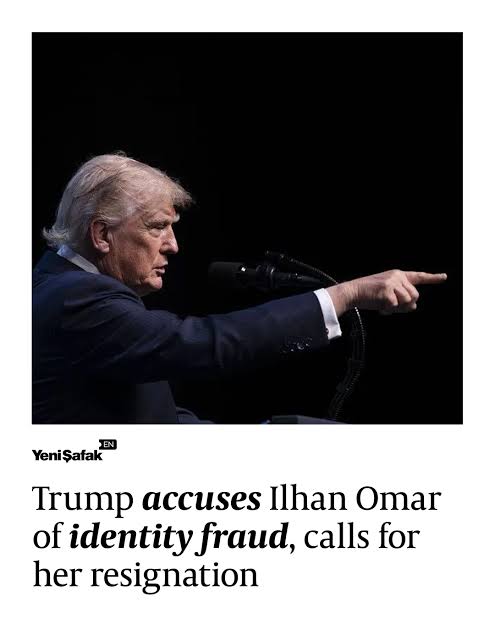
U.S. Representative Ilhan Omar is facing renewed political pressure following a federal investigation into her immigration history and allegations concerning her identity. The controversy intensified in October 2026 after a court filing referenced another name associated with the Minnesota Democrat, prompting President Donald Trump to demand her resignation from Congress.
However, the allegations have not been established as criminal wrongdoing. Omar has denied the accusations, and the Justice Department filing that triggered the latest dispute did not itself establish that she committed identity fraud. Source: Al Jazeera
The controversy has now expanded beyond questions about immigration paperwork. It has sparked a wider debate about congressional eligibility, constitutional protections, the authority of federal investigators, and the distinction between political accusations and proven legal violations.
As the dispute develops, several important questions remain unanswered. Could the investigation affect Omar’s congressional position? What would be required to establish immigration or identity fraud? And can a president force an elected representative to leave office?
Understanding the available evidence is essential to separating verified facts from political rhetoric.
Why Ilhan Omar Is Facing Renewed Resignation Calls

The latest controversy gained momentum after the Justice Department submitted a court filing related to an ongoing investigation. The document referred to Omar as “Ilhan Nur Said Elmi, a/k/a Ilhan Abdullahi Omar.”
The abbreviation “a/k/a” means “also known as.” However, the filing did not explain the relationship between the names or establish that Omar had used a fraudulent identity.
Nevertheless, the reference quickly became a political flashpoint.
Trump subsequently called for Omar to resign, arguing that the name discrepancy raised questions about her eligibility to serve in Congress. Omar’s office rejected the accusation and maintained that Ilhan Omar is her real name. Source: Anadolu Agency
The dispute illustrates how a document produced during an investigation can become the center of a national political confrontation before investigators or a court publicly establish the underlying facts.
Importantly, a reference to another name does not automatically prove identity fraud. People may have different names in different records for various reasons, although investigators can examine whether any discrepancies reflect intentional misrepresentation.
In Omar’s case, the government has not publicly established that the name reference proves criminal conduct.
What Is Known About the Federal Investigation?
The name controversy is connected to a broader federal inquiry into Omar’s immigration history and her family’s records.
On October 12, 2026, federal agents searched Omar’s Washington, D.C., residence under a court-authorized warrant. Reporting by The Washington Post and Reuters linked the search to an investigation into whether Omar or members of her family provided false information on immigration documents when they arrived in the United States. Source: Reuters
According to published reporting, investigators are examining historical questions concerning birth dates, immigration paperwork, and information associated with Omar’s late father.
The investigation could potentially lead to further legal action if authorities uncover sufficient evidence. However, an investigation is not equivalent to an indictment, a conviction, or a judicial finding of wrongdoing.
Why investigators are examining historical records
Immigration and citizenship applications contain information that federal authorities may examine when credible questions arise about eligibility or the accuracy of submitted documents.
In this case, investigators are reportedly reviewing whether information supplied decades ago was accurate and whether any discrepancy was intentional.
That distinction matters.
An incorrect date or inconsistent record does not automatically establish fraud. Prosecutors would generally need to establish the relevant legal elements, including the applicable requirement of knowing or intentional misrepresentation where the offense requires it.
The passage of time can also complicate an investigation. Records may be incomplete, witnesses may be unavailable, and documents created in different countries may use different administrative practices.
These factors do not automatically invalidate an investigation. Nevertheless, they make careful examination of original records and reliable corroborating evidence especially important.
Omar’s response to the allegations
Omar has denied wrongdoing and characterized the investigation as political intimidation.
In an interview reported by the Associated Press on October 22, she said she was confident that she had done nothing wrong. She also criticized the search of her home and said the attention surrounding the operation had made her feel unsafe. Source: Associated Press
Her position directly conflicts with the suspicions being examined by investigators.
At this stage, the public record does not establish that she committed immigration fraud or deliberately misrepresented her identity. Consequently, the allegations should continue to be described as allegations unless reliable evidence or a court decision supports a stronger conclusion.
Does a Name Discrepancy Prove Identity Fraud?
One of the central questions in the Ilhan Omar controversy is whether the alternative name referenced in the court filing demonstrates that she used a false identity.
The answer is no—not by itself.
Names can appear differently across immigration, marriage, education, court, and government records. Some discrepancies result from legal name changes, naming conventions, transliteration, administrative errors, or the use of multiple names.
However, a discrepancy can become legally significant if investigators establish that someone knowingly used false information to obtain a legal benefit or evade a legal requirement.
Therefore, the key issue is not simply whether another name appears in a document. Investigators must determine what the name represents, how it entered the record, and whether it supports an identifiable legal violation.
What evidence would matter?
A thorough investigation could examine several categories of evidence:
- Original immigration and naturalization applications.
- Official records identifying names and dates of birth.
- Documents explaining any changes or inconsistencies.
- Testimony from relevant witnesses.
- Evidence concerning what the applicant knew when submitting particular forms.
- Records establishing whether any disputed information affected immigration or citizenship eligibility.
Each item would need to be evaluated in context.
For example, a different name on a document might warrant further questions, but it would not necessarily establish that the person intended to deceive the government. Conversely, authenticated records and corroborating evidence could become significant if they demonstrate a deliberate and legally material false statement.
Until the relevant evidence is evaluated, claims that Omar’s congressional identity has been proven fraudulent go beyond what the public court filing establishes.
Can Ilhan Omar Be Forced to Resign From Congress?
The controversy has also raised questions about the constitutional requirements for serving in the House of Representatives.
Under Article I, Section 2 of the U.S. Constitution, a House representative must be at least 25 years old, have been a U.S. citizen for at least seven years, and be an inhabitant of the state represented when elected.
These requirements are distinct from the rules governing removal from office.
A president cannot simply declare a congressional seat vacant because of an allegation. Nor does a disputed name in a court filing automatically remove a representative from Congress.
Omar’s situation would have to be evaluated under the applicable constitutional and legal procedures, depending on what evidence emerges and what actions, if any, the relevant authorities take.
Who has the authority to remove a House member?
The Constitution gives each chamber of Congress authority to judge the elections, returns, and qualifications of its own members.
Article I, Section 5 also permits each chamber to expel a member with the concurrence of two-thirds of that chamber.
These provisions are important because they distinguish political demands from formal institutional action.
A president can publicly criticize a representative and call for resignation. However, that demand does not itself remove the representative from office.
Likewise, an investigation does not automatically suspend a member’s congressional duties. Any effort to challenge eligibility or impose consequences must follow the relevant legal and constitutional framework.
Could citizenship questions affect congressional eligibility?
Citizenship is one of the constitutional qualifications for serving in the House. Therefore, a legally established issue concerning citizenship could raise questions about eligibility.
However, the existence of an investigation does not establish that such a problem exists.
Omar became a naturalized U.S. citizen in 2000, according to congressional biographical records and published reporting. The current controversy concerns allegations about historical immigration information and the circumstances surrounding her family’s records.
Whether those allegations have legal merit is a separate question from whether political opponents believe she should resign.
Any potential challenge would depend on the evidence, the applicable law, and the proper legal procedures.
Could the Investigation Affect Omar’s Citizenship?
Another major issue is whether the investigation could eventually threaten Omar’s citizenship.
Reuters reported in October 2026 that investigators were examining allegations involving historical immigration documents and that officials could potentially pursue proceedings affecting her citizenship if the evidence supported such action. Source: Reuters
Nevertheless, the possibility of legal action should not be confused with a decision to revoke citizenship.
Denaturalization is a formal legal process. It is not an automatic consequence of a criminal investigation, a political accusation, or a disputed name in a court document.
The government would have to establish a legally sufficient basis for the requested relief through the applicable process.
Why intent and eligibility matter
A citizenship case can involve questions about whether a person made a material misrepresentation, whether the information was knowingly false, and whether the alleged conduct affected the person’s eligibility for naturalization.
The specific legal requirements depend on the claim being pursued.
In Omar’s case, public reporting indicates that investigators are examining historical questions involving birth dates and immigration records. The full evidentiary record has not been made public.
As a result, it would be premature to conclude that her citizenship will be revoked or that deportation is inevitable.
The outcome depends on what investigators establish and whether any legal action succeeds.
The Earlier Review of Similar Allegations
The latest investigation has also drawn attention because similar allegations were examined previously.
The Washington Post reported on October 15, 2026, that officials scrutinized Omar’s immigration history in 2019. According to former officials cited by the newspaper, that earlier review found insufficient evidence of wrongdoing, and the proposed inquiry was not pursued further. Source: The Washington Post
That history is relevant, but it does not automatically settle the current investigation.
Authorities may reopen or revisit questions if new evidence emerges, circumstances change, or officials identify issues requiring additional examination. At the same time, a renewed investigation should not be treated as proof that earlier concerns were justified.
The relationship between the previous review and the present inquiry raises questions about the evidence being considered, the reasons for reopening the matter, and the standards applied by investigators.
Transparency will be important in answering those questions.
Because some investigative records remain sealed or have not been publicly released, outside observers cannot independently assess every aspect of the government’s case.
Political Fallout Ahead of the Midterm Elections
The timing of the controversy has added another layer to the dispute.
Omar represents Minnesota’s Fifth Congressional District and is seeking reelection in the November 2026 midterm elections. The federal search and subsequent identity allegations have intensified an already polarized political debate.
For Republican critics, the investigation has become an opportunity to demand accountability and question Omar’s suitability for office.
For Omar and her supporters, the timing and public presentation of the allegations raise concerns about political pressure being applied to a prominent critic of the administration.
Neither political interpretation establishes the underlying facts.
The central questions remain whether the allegations can be substantiated, whether the government follows appropriate procedures, and whether any eventual action is supported by evidence.
Why the timing matters
Federal investigations involving elected officials can attract exceptional scrutiny, particularly when major investigative steps occur shortly before an election.
Such scrutiny does not mean investigators should be prevented from pursuing legitimate cases. Nor does it mean an investigation is necessarily politically motivated because it involves a prominent political figure.
Instead, it highlights the importance of consistent standards, documented evidence, procedural safeguards, and clear distinctions between investigative activity and established wrongdoing.
Voters can evaluate the political implications while also recognizing that criminal responsibility must be assessed through legal processes rather than campaign rhetoric.
Constitutional Principles at the Center of the Dispute
The Ilhan Omar controversy involves several principles that are fundamental to the U.S. constitutional system.
First, elected officials are subject to applicable laws and legitimate investigations. Holding public office does not provide immunity from scrutiny over potentially unlawful conduct.
Second, allegations must be evaluated through appropriate legal procedures. A public accusation does not automatically establish guilt.
Third, congressional qualifications and removal procedures are governed by constitutional rules. A president’s demand for resignation does not independently invalidate an election or vacate a seat.
Finally, the government must exercise its investigative powers within the law. Questions about political influence, the handling of evidence, and procedural fairness deserve scrutiny when federal authority is used in a politically sensitive case.
These principles are not mutually exclusive. Accountability and due process can operate together.
If reliable evidence establishes a violation, the law provides mechanisms for addressing it. If the evidence fails to support the allegations, that outcome should also be respected.
What Happens Next in the Ilhan Omar Investigation?
Several developments could shape the next stage of the controversy.
1. Investigators may continue reviewing records
Federal authorities may examine immigration documents, citizenship records, witness statements, and other relevant evidence. The scope and outcome of that work remain uncertain.
2. Additional court filings could clarify the allegations
Further legal filings or decisions concerning sealed records may provide information about the investigation. However, the release of additional documents would not necessarily establish guilt.
3. Prosecutors could decide whether charges are warranted
If investigators identify sufficient evidence of a criminal offense, prosecutors could consider charges. They could also decide that the evidence does not support prosecution.
As of the reporting cited in this article, the available sources do not establish that Omar has been charged with identity or immigration fraud.
4. Political pressure may continue
Trump and other critics may continue to call for Omar’s resignation. Omar and her supporters are likely to continue challenging the allegations and questioning the investigation.
These political developments could affect public debate without determining the legal outcome.
5. Constitutional questions may receive greater attention
If the investigation leads to formal proceedings concerning citizenship or congressional eligibility, constitutional and statutory questions could become more prominent.
For now, however, it is important to distinguish potential future disputes from legal conclusions that have actually been reached.
Conclusion
The Ilhan Omar constitutional seat firestorm has grown out of a federal investigation, a disputed name reference in a court filing, and renewed demands for her resignation.
The controversy raises legitimate questions about immigration records, citizenship, congressional eligibility, and the limits of political power. However, those questions cannot be resolved by headlines or accusations alone.
Omar has denied wrongdoing, and the available public reporting does not establish that she committed identity fraud or that her congressional seat has been invalidated.
The Constitution provides rules for congressional qualifications and removal, while federal law establishes procedures for investigating alleged immigration violations. Both must be applied according to the evidence and the relevant legal standards.
Ultimately, the investigation’s findings and any subsequent court proceedings will matter far more than political demands for immediate resignation. Until the evidence establishes otherwise, allegations should remain clearly identified as allegations.
Frequently Asked Questions
1. Why are people calling for Ilhan Omar to resign?
President Donald Trump called for Omar to resign after a Justice Department court filing referred to her using another name. The filing did not establish that she committed identity fraud, and Omar’s office has rejected the allegation.
2. Has Ilhan Omar been convicted of identity fraud?
No. The reporting cited in this article does not establish that Omar has been convicted of identity fraud. The federal investigation concerns allegations involving historical immigration and identity records.
3. What is the Ilhan Omar identity fraud investigation about?
Published reports indicate that investigators are examining questions involving immigration paperwork, birth dates, citizenship records, and information associated with Omar’s family. The complete evidentiary record has not been made public.
4. Does the alternative name in the court filing prove fraud?
No. A reference to another name does not, by itself, prove criminal conduct. Investigators would need to establish what the name represents and whether any relevant false statement violated the law.
5. Can Donald Trump remove Ilhan Omar from Congress?
A president cannot directly remove a House representative simply by demanding resignation. Congressional qualifications and removal are governed by constitutional procedures, including the House’s authority to judge member qualifications and its power to expel a member with a two-thirds vote.
6. Could Ilhan Omar lose her U.S. citizenship?
Citizenship could become a legal issue if the government pursues an appropriate proceeding and establishes the required grounds. However, an investigation alone does not revoke citizenship, and the final outcome remains uncertain.
7. Was Ilhan Omar investigated over similar allegations before?
The Washington Post reported that federal officials reviewed similar allegations in 2019 and that the earlier review did not produce sufficient evidence to pursue the matter. The current investigation is a separate development, although it revisits some related questions.
8. What does the Constitution say about congressional eligibility?
Article I, Section 2 requires House representatives to be at least 25 years old, to have been U.S. citizens for at least seven years, and to inhabit the state they represent when elected. Questions about eligibility must be assessed under the Constitution and applicable law.
9. Has a court ruled that Omar’s congressional seat is vacant?
The sources cited here do not establish that a court has declared Omar’s seat vacant. Calls for resignation and allegations about citizenship do not automatically remove an elected representative.
10. What happens next in the investigation?
Investigators may continue reviewing records, and prosecutors may evaluate whether further legal action is warranted. Additional court filings could provide more information, but the outcome remains uncertain until the relevant proceedings and evidence establish the facts.
About the Author