IRGC Missile & Drone Attack: Tehran Retaliates, US Air Bases in Jordan Targeted
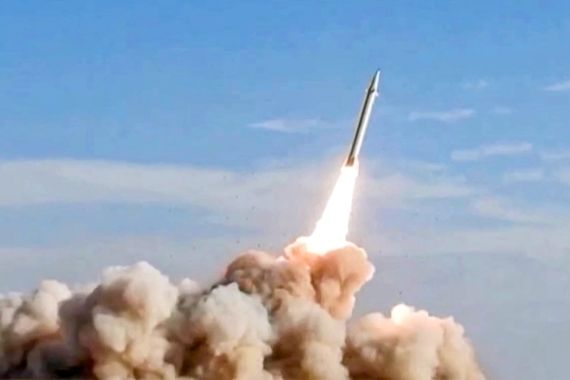
The IRGC missile and drone attack on US military positions in Jordan has sharply escalated tensions between Iran and the United States. Iran’s Islamic Revolutionary Guard Corps said it launched a combined missile-and-drone operation against US military facilities in Jordan after American forces struck Iranian rocket launchers on Larak Island near the Strait of Hormuz.
The latest exchange represents a significant escalation because it involves direct attacks between Iran and the United States after a period of relative restraint. Jordanian authorities said their air defenses intercepted missiles that entered the country’s airspace, while US officials said defensive systems helped prevent serious damage.
Iran, however, presented the operation differently. The IRGC claimed its Aerospace Force targeted two US-linked airbases and said military infrastructure connected to fighter aircraft was hit. Independent assessments of the extent of damage remain limited, making it important to distinguish confirmed events from claims made by the parties involved.
The confrontation comes as the broader Middle East conflict continues to threaten regional security, military bases, shipping routes and global energy markets.
What Happened in the Latest Iran-US Escalation?
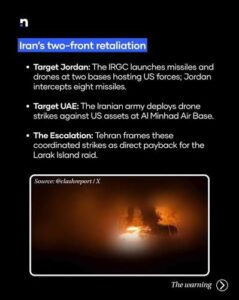
The immediate trigger was a US military strike against Iranian rocket launchers on Larak Island, located near the strategically important Strait of Hormuz.
According to US and international reporting, American forces targeted Iranian launchers that Washington said represented a threat to maritime security and shipping through the Strait of Hormuz. The operation marked the first known direct US military action against Iran in several weeks.
Tehran responded with missile launches against US military positions in Jordan.
The IRGC said the operation involved both ballistic missiles and drones. Iranian statements identified two facilities in Jordan, including the King Hussein and Azraq airbases, as targets. The IRGC claimed that technical, maintenance and fighter-aircraft areas were attacked.
Jordan, meanwhile, reported that missiles entering its airspace were intercepted.
This difference in descriptions is important. Iran has claimed successful strikes and significant damage, while Jordan and US sources have emphasized interception by air-defense systems. At the time of writing, there is no independent evidence establishing the full extent of the damage claimed by Tehran.
Why Did Iran Target US Bases in Jordan?
Iran’s retaliation appears directly connected to the US attack on Larak Island.
Tehran has repeatedly warned that attacks on Iranian military assets could produce retaliation against US forces in the region. The latest IRGC statement follows that pattern.
The Iranian government views American military installations around the Middle East as potential targets in a wider confrontation. Jordan is particularly important because the country hosts US military personnel and infrastructure that support regional operations.
Iran’s decision to target facilities in Jordan also demonstrates how quickly a conflict involving Iran and the United States can spread beyond the two countries.
The attack does not necessarily mean that Iran intends to target Jordan itself. Tehran has generally framed its regional attacks as responses against US military assets rather than against host governments.
Nevertheless, missiles and drones traveling through Jordanian airspace create a direct security challenge for Amman.
Jordan’s Air Defenses Intercept Missiles
Jordan has been placed in an increasingly difficult position as the Iran-US confrontation expands.
Jordanian authorities reported intercepting missiles that breached the country’s airspace. Anadolu Agency reported that Jordan said eight missiles were intercepted before they could pose a threat to civilians or property.
This highlights the importance of Jordanian air-defense capabilities.
The country sits between several major regional conflict zones and has repeatedly faced the risk of missiles, drones and debris crossing its territory.
Even when projectiles are intercepted, falling debris can damage buildings or injure civilians. The government therefore faces pressure to protect its population while also maintaining its military relationship with Washington.
The situation is particularly sensitive because Jordan is a major US security partner in the region.
Which US Bases Were Targeted?
Iran said its latest operation targeted two US-associated airbases in Jordan.
Reports identified the King Hussein and Azraq airbases among the targets described by the IRGC. Iranian officials claimed that areas supporting fighter aircraft and technical operations were targeted.
However, claims about successful hits should be treated carefully.
In an active conflict, governments frequently release information designed to demonstrate military effectiveness. Satellite imagery, independent reporting and official assessments from the opposing side can provide additional evidence, but such information may not become available immediately.
The United States has emphasized the effectiveness of its air defenses.
US President Donald Trump said American defensive systems intercepted the incoming threats and warned that Washington would respond strongly to the Iranian attack.
Trump Warns Iran of a Strong Response
The latest attack has also produced an immediate political reaction in Washington.
US President Donald Trump warned Iran that the United States would respond following the missile and drone attacks against American forces in the region.
His comments raise concerns about another cycle of military escalation.
The pattern is familiar: one side launches an attack, the other responds, and the response creates pressure for another counterattack. Such cycles can quickly become difficult to control.
The current situation is especially dangerous because American and Iranian forces operate across a region containing numerous military installations, shipping lanes and energy facilities.
A further escalation could therefore affect countries far beyond Iran and the United States.
Why the Strait of Hormuz Matters
The Strait of Hormuz is at the center of the latest crisis.
The narrow waterway connects the Persian Gulf with the Gulf of Oman and is one of the world’s most important energy corridors.
The US strike on Larak Island was connected to concerns about Iranian rocket launchers and threats to maritime traffic. American officials have argued that military action is necessary to protect shipping.
Iran, meanwhile, has used its ability to threaten shipping routes as an important strategic tool.
Any prolonged disruption around the Strait of Hormuz could affect:
- Global oil prices
- Natural gas markets
- Shipping costs
- Insurance premiums
- Asian energy supplies
- European energy markets
- Regional economies
The latest military exchanges therefore have economic consequences beyond the battlefield.
Missile and Drone Warfare Changes the Conflict
The IRGC missile and drone attack also demonstrates the growing importance of mixed aerial warfare.
Ballistic missiles can travel long distances at high speeds, while drones can be used for surveillance, saturation attacks and precision strikes.
Combining the two can place significant pressure on air-defense networks.
Defenders must identify incoming threats, determine their trajectory and decide which weapons require interception.
This creates a complicated technological contest between offensive missile systems and defensive systems.
The United States and its regional partners possess sophisticated air-defense capabilities, but no defensive system can eliminate every possible threat under all circumstances.
Iran has therefore continued developing and deploying a broad range of missiles and drones as part of its regional military strategy.
Iran’s “Operation Punishment” Narrative
Iran has presented the latest operation as retaliation rather than an unprovoked attack.
Iranian officials have described the response as punishment for the US strike against Iranian positions.
This messaging serves two purposes.
First, it communicates to domestic audiences that Iran is responding to an American attack.
Second, it sends a warning to Washington that attacks against Iranian military infrastructure could carry consequences for US forces across the Middle East.
The IRGC has also warned that future attacks could trigger stronger responses.
That warning is one of the most important elements of the latest development because it suggests that the confrontation may not end with the current exchange.
Could the Conflict Spread Across the Middle East?
The risk of regional escalation remains high.
US forces operate from multiple locations across the Middle East. Iran also maintains relationships with armed groups and has missile and drone capabilities that can reach targets across the region.
That creates several possible escalation routes.
A future Iranian attack could target additional US military facilities. Washington could then respond with strikes against Iranian missile infrastructure.
Regional governments could become involved if missiles cross their airspace or if military installations on their territory are attacked.
The possibility of attacks on energy infrastructure is another major concern.
The United Arab Emirates, for example, reported intercepting an Iranian drone over its territorial waters while denying an Iranian claim that the Al Minhad Air Base had been attacked.
This demonstrates how quickly the geographic scope of the confrontation can expand.
The Role of Air Defense
Air defense has become one of the most important factors in the latest confrontation.
Jordan’s interception of incoming missiles shows that defensive systems can prevent some attacks from reaching their intended targets.
American forces also rely on layered air-defense systems to protect military personnel and infrastructure.
But missile defense is expensive and technically demanding.
An attacker can potentially launch multiple projectiles at once, forcing defenders to make rapid decisions about which threats pose the greatest danger.
This creates a continuing technological competition.
For Iran, missiles and drones offer a way to threaten distant military facilities without requiring conventional aircraft to penetrate heavily defended airspace.
For the United States and its allies, air defense provides a way to reduce the effectiveness of those attacks.
What Does This Mean for US-Iran Relations?
The latest confrontation makes diplomacy more difficult.
Even if both sides eventually return to negotiations, direct military attacks create additional political obstacles.
Washington is demanding that Iran reduce threats to American forces and regional security.
Tehran insists that it has the right to defend itself against attacks and continues to challenge US military activity in the region.
These positions leave limited room for compromise during periods of active fighting.
At the same time, Iranian President Masoud Pezeshkian has indicated openness to negotiations, creating a potential diplomatic channel despite the military escalation.
The future of that diplomatic possibility will depend heavily on what happens during the next several days.
Global Markets Watch the Crisis
Financial markets are closely monitoring the renewed military confrontation.
The Strait of Hormuz is especially important because disruptions can affect energy supplies and transportation costs.
Higher oil prices can contribute to inflation by increasing the cost of transportation, manufacturing and consumer goods.
For countries that import large quantities of energy, prolonged instability can create additional economic pressure.
The impact would not be limited to the Middle East.
Asia, Europe and other regions could experience higher energy costs if shipping through the Gulf remains restricted.
This means the IRGC missile and drone attack is not simply a military story. It is also an economic and geopolitical development.
What Happens Next?
The immediate question is whether the latest exchange ends with a limited retaliation or becomes the beginning of another major escalation.
Several developments will be important to watch.
1. A US military response
Trump has already warned of a strong response. Any new US strikes against Iranian territory could trigger another Iranian retaliation.
2. Additional Iranian attacks
Iran could launch further missiles or drones against US military positions if it considers the American response unacceptable.
3. Jordan’s response
Amman will likely continue emphasizing its territorial sovereignty and the protection of its airspace.
4. Strait of Hormuz security
Any new military activity near the waterway could further affect global shipping and energy prices.
5. Diplomatic efforts
Despite the escalation, negotiations remain possible. Regional countries and international organizations could attempt to prevent the confrontation from becoming a wider war.
Why This Attack Is Significant
The latest IRGC missile and drone attack is significant because it represents another direct stage in the confrontation between Iran and the United States.
It also demonstrates the strategic importance of Jordan, the vulnerability of regional US military infrastructure and the continuing importance of missile defense.
Most importantly, the incident shows how quickly a localized military action can create consequences across the Middle East.
Iran’s retaliation followed a US attack on Larak Island. Jordan then intercepted missiles entering its airspace. The United States warned of further retaliation, while Iran threatened stronger responses if additional attacks occur.
The situation remains fluid.
As military statements continue to emerge, independent confirmation will be necessary to establish the full extent of damage, casualties and operational success claimed by either side.
For now, the central concern is whether both governments can prevent another round of attacks from turning the latest confrontation into a much broader regional conflict.
Frequently Asked Questions
What is the IRGC missile and drone attack?
The IRGC missile and drone attack refers to Iran’s reported retaliatory operation against US military positions in Jordan following a US strike on Iranian rocket launchers on Larak Island.
Why did Iran attack US bases in Jordan?
Iran said the attacks were retaliation for the US military strike against Iranian rocket launchers on Larak Island near the Strait of Hormuz.
Which US bases were targeted?
The IRGC identified the King Hussein and Azraq airbases in Jordan as targets of its combined missile-and-drone operation.
Did Jordan intercept the Iranian missiles?
Yes. Jordanian authorities said their air defenses intercepted missiles that entered Jordanian airspace. Reports said eight missiles were intercepted.
Were US military personnel killed?
Available reporting at the time of writing has not established significant US casualties from this latest attack. US officials have emphasized that incoming threats were intercepted.
Did Iran also attack the UAE?
Iran claimed it targeted US military facilities in the UAE, but the UAE denied that an Iranian attack struck Al Minhad Air Base. The UAE did confirm intercepting an Iranian drone over its territorial waters.
Could the Iran-US conflict escalate further?
Yes. The risk remains significant because both countries have threatened further action. Additional attacks could create another cycle of retaliation.
Why is the Strait of Hormuz important?
The Strait of Hormuz is a critical global energy and shipping route. Military disruption there can affect oil prices, transportation costs and international energy supplies.
What is the IRGC?
The Islamic Revolutionary Guard Corps, or IRGC, is Iran’s powerful military organization responsible for major parts of the country’s missile, drone and regional military capabilities.
What should readers watch next?
The most important developments include possible US retaliation, additional Iranian missile or drone launches, Jordanian air-defense activity, shipping conditions around the Strait of Hormuz and renewed diplomatic negotiations.
Conclusion
The latest IRGC missile and drone attack has pushed the Iran-US confrontation into another dangerous phase. Tehran says its forces retaliated against US bases in Jordan after Washington struck Iranian rocket launchers on Larak Island. Jordan says its defenses intercepted incoming missiles, while Washington has warned Iran that further attacks could bring a strong response.
The situation remains highly fluid, and conflicting military claims mean that damage assessments should be treated cautiously.
What happens next will depend on whether the United States and Iran choose further military action or return to diplomacy. With Jordan, the UAE, the Strait of Hormuz and global energy markets all potentially affected, the consequences of the latest escalation could extend far beyond the immediate battlefield.
How useful was this post?
Click on a star to rate it!
Average rating 0 / 5. Vote count: 0
No votes so far! Be the first to rate this post.
About the Author

usa5911.com
Administrator
Hi, I’m Gurdeep Singh, a professional content writer from India with over 3 years of experience in the field. I specialize in covering U.S. politics, delivering timely and engaging content tailored specifically for an American audience. Along with my dedicated team, we track and report on all the latest political trends, news, and in-depth analysis shaping the United States today. Our goal is to provide clear, factual, and compelling content that keeps readers informed and engaged with the ever-changing political landscape.