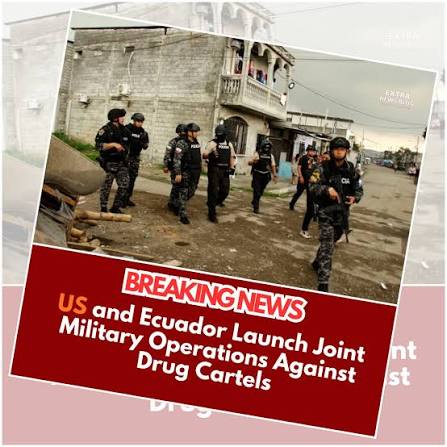
The DEA and SOUTHCOM Ecuador raids have highlighted a major expansion of U.S.-Ecuador security cooperation against powerful criminal organizations operating across the country. Ecuadorian authorities, supported by U.S. agencies, carried out coordinated operations targeting networks connected to Los Lobos and Los Choneros, two of Ecuador’s most prominent criminal groups.
According to the U.S. Drug Enforcement Administration (DEA), Ecuador’s National Police conducted simultaneous operations after a years-long investigation into criminal structures involved in moving cocaine through Ecuador toward Central America, Mexico and international markets.
The operations are significant because Ecuador has become an increasingly important transit hub for international cocaine trafficking. Its location between Colombia and Peru, two of the world’s major cocaine-producing countries, gives criminal organizations access to Pacific maritime routes and international trafficking networks.
The latest crackdown also comes after months of increasing U.S.-Ecuador military and law-enforcement cooperation. U.S. Southern Command, known as SOUTHCOM, has publicly highlighted cooperation with Ecuadorian security forces against organizations designated by the United States as terrorist organizations.
What Happened in the Latest Ecuador Raids?
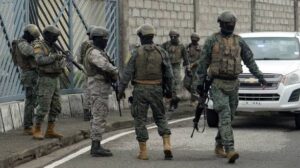
The latest operations involved simultaneous actions by Ecuadorian authorities against criminal networks associated with Los Lobos and Los Choneros.
The DEA said the investigation focused on structures responsible for moving cocaine from Ecuador toward Central America, Mexico and other international destinations. The agency described the operations as a major disruption of a transnational drug-trafficking network.
Reports identified two major operations, known as Operation Factoria and Operation Jerico. The actions reportedly extended across several Ecuadorian provinces, including Guayas, Santo Domingo, El Oro, Los Rios, Manabi and Esmeraldas.
Authorities reported arrests and seizures involving weapons, ammunition, vehicles, communications equipment, drugs and other material allegedly connected to trafficking activities.
The operations are important not simply because of the number of arrests, but because investigators were targeting the infrastructure that allows criminal organizations to move drugs from production areas to international markets.
Why Los Lobos Is a Major Target
Los Lobos has emerged as one of Ecuador’s most powerful criminal organizations.
The group originally developed from Ecuador’s fragmented prison and organized-crime environment. Over time, Los Lobos expanded beyond prison-based activity and became associated with drug trafficking, violence and international criminal networks.
The organization has also been linked by authorities to other forms of organized crime, including extortion and illegal mining.
Its importance to international trafficking is connected to Ecuador’s geographic position. Cocaine produced in neighboring Colombia and Peru can enter Ecuador before being moved toward Pacific ports and maritime routes.
That makes groups capable of controlling logistics, transportation and local territory particularly important to international trafficking networks.
The United States designated Los Lobos and Los Choneros as Foreign Terrorist Organizations in 2025, dramatically changing the legal and security framework surrounding U.S. efforts against the groups.
That designation allows the United States to use additional sanctions and counterterrorism authorities against individuals and networks associated with the organizations.
Los Choneros and the Wider Criminal Landscape
Los Lobos is not the only Ecuadorian organization facing increased pressure.
Los Choneros has also been a central player in Ecuador’s organized-crime crisis. Rivalries between major criminal groups have contributed to prison violence, territorial disputes and broader insecurity.
U.S. authorities have increasingly focused on the connections between Ecuadorian criminal groups and Mexican cartels.
The DEA’s latest announcement specifically described networks linked to Los Lobos and Los Choneros as part of a transnational cocaine-trafficking structure.
This matters because modern drug trafficking rarely depends on a single organization controlling the entire supply chain.
Instead, different groups may handle different stages, including local collection, transportation, maritime movement, logistics, money laundering and distribution.
Consequently, dismantling one network requires cooperation between multiple countries.
What Role Does the DEA Play?
The Drug Enforcement Administration is primarily a U.S. federal law-enforcement agency responsible for investigating and disrupting illegal drug trafficking.
In international cases, the DEA works with foreign law-enforcement agencies by sharing intelligence, supporting investigations and helping identify transnational trafficking structures.
In the Ecuador case, the agency’s involvement reflects a law-enforcement approach focused on identifying the people and infrastructure behind international cocaine shipments.
The latest operation was not simply a spontaneous police raid. The DEA said the Ecuadorian operations followed a years-long investigation.
That distinction is important.
Long-term investigations can involve financial intelligence, communications analysis, information from informants, surveillance and cooperation between international agencies. The objective is to identify the broader network rather than simply seize drugs at the end of the supply chain.
What Is SOUTHCOM’s Role?
The U.S. Southern Command, or SOUTHCOM, oversees U.S. military activities and security cooperation across much of Latin America and the Caribbean.
Its role differs from that of the DEA.
The DEA is a federal law-enforcement organization, while SOUTHCOM is a military command.
U.S.-Ecuador cooperation has increasingly involved military coordination, intelligence sharing and counter-narcotics activities.
In March 2026, SOUTHCOM announced that Ecuadorian and U.S. military forces had launched operations against organizations designated as terrorist organizations by the United States. The command described the campaign as part of a broader effort against narco-terrorism.
The latest crackdown therefore fits into a much larger pattern of cooperation rather than representing an isolated event.
Ecuador’s Growing Security Crisis
Ecuador was once regarded as considerably safer than some neighboring countries. That changed rapidly as organized criminal groups expanded their influence.
The country’s prison system became a major battleground between rival organizations. Violence subsequently spilled into cities, ports and rural areas.
Ecuador’s Pacific coastline is particularly important because maritime routes provide access to international drug markets.
Criminal organizations have exploited fishing and maritime infrastructure to move cocaine northward.
Recent U.S. Treasury action also highlighted the importance of Ecuador’s coastal trafficking networks. U.S. authorities said a network associated with Los Choneros, Los Lobos and Mexican cartels had used fishing vessels and smaller boats to transport cocaine toward Mexico and beyond.
This explains why the latest operations have focused not only on individual suspects but also on transportation systems and logistical infrastructure.
The Importance of Manta and Ecuador’s Pacific Coast
Ecuador’s Pacific coast has become central to the country’s drug-trafficking problem.
The port city of Manta has repeatedly appeared in investigations involving international cocaine trafficking.
Its location provides access to maritime routes leading north toward Central America and Mexico.
According to recent U.S. sanctions reporting, criminal networks based around Manta allegedly used fishing vessels as a cover for moving large quantities of cocaine.
The strategic importance of the region means that Ecuadorian authorities face a difficult challenge.
Controlling ports and coastlines requires more than conventional police patrols. Authorities need maritime surveillance, intelligence gathering, financial investigations and cooperation with international agencies.
Mexico’s Role in the Cocaine Pipeline
The Ecuador crackdown also illustrates how closely Ecuadorian criminal organizations are connected to the broader Latin American drug trade.
Mexico is a major destination and transit point for cocaine moving north toward the United States.
U.S. officials have identified connections between Ecuadorian groups and Mexican organizations, including the Sinaloa Cartel and Jalisco New Generation Cartel.
These relationships can involve transportation, wholesale distribution, financial arrangements and logistical support.
For U.S. authorities, breaking these connections is therefore a strategic priority.
A successful operation in Ecuador can potentially disrupt trafficking activity much farther north.
Why the Latest Raids Matter
The latest raids are important for several reasons.
First, they demonstrate that Ecuadorian authorities are increasingly capable of conducting large-scale coordinated operations against sophisticated criminal organizations.
Second, the operations show the depth of U.S.-Ecuador security cooperation.
Third, they target the infrastructure supporting international drug trafficking rather than focusing exclusively on street-level crime.
Fourth, they demonstrate how the United States is combining law-enforcement tools with military and diplomatic cooperation in Latin America.
The DEA described the operation as a major dismantling of a transnational trafficking network.
However, dismantling one network does not automatically eliminate the broader trafficking market.
Can Raids Really Weaken Los Lobos?
Large-scale arrests can disrupt criminal organizations, but organized crime is highly adaptable.
When senior figures are arrested or killed, lower-ranking members can sometimes reorganize the network. Rival groups may also attempt to seize territory.
This phenomenon has occurred repeatedly in Ecuador.
The fragmentation of major criminal organizations has sometimes produced more competition rather than less.
For that reason, law-enforcement experts generally view arrests as one component of a broader strategy.
Financial investigations, border controls, prison security, judicial capacity and community-level prevention can all influence whether criminal organizations recover after major operations.
The Financial Side of the Crackdown
Drug trafficking is ultimately a financial enterprise.
Criminal organizations need money to purchase drugs, pay transporters, obtain weapons, bribe officials and maintain logistical networks.
That makes financial sanctions an important part of the U.S. strategy.
Recent U.S. Treasury measures targeted individuals and businesses allegedly connected to Ecuadorian cocaine-trafficking networks. Authorities said the networks could move extremely large quantities of cocaine each month.
Financial pressure can make it more difficult for criminal organizations to operate internationally.
If bank accounts, companies, vessels and other assets become inaccessible, traffickers may have difficulty maintaining the infrastructure necessary for large-scale operations.
The Human Cost of Ecuador’s Cartel Violence
The crackdown is taking place against the backdrop of severe violence in Ecuador.
Ordinary residents can become victims of extortion, kidnapping, shootings and territorial disputes.
Fishermen and coastal communities can also find themselves under pressure from criminal organizations.
Recent reporting has described fishermen along Ecuador’s Pacific coast being threatened or coerced into supporting trafficking networks.
This creates a difficult environment for law enforcement.
Authorities must distinguish between criminal organizations deliberately involved in trafficking and ordinary citizens who may be forced to cooperate under threats.
That is one reason intelligence-led investigations are so important.
U.S. Military Operations and Controversy
The broader U.S. campaign against suspected drug-trafficking vessels has generated significant controversy.
SOUTHCOM has described its actions as part of a campaign against narco-terrorist organizations. However, critics and human-rights groups have questioned the transparency and legal basis of some military strikes against suspected trafficking vessels.
Recent reporting has documented concerns about civilian casualties and uncertainty surrounding the identities and activities of some people targeted in maritime operations.
These controversies are separate from the Ecuadorian police raids, which are fundamentally law-enforcement operations.
Nevertheless, they form part of the broader debate about how aggressively the United States should use military power against drug-trafficking organizations.
What Happens Next?
The next stage will likely focus on exploiting intelligence collected during the raids.
Authorities can use seized phones, documents, financial records and communications equipment to identify additional suspects and connections.
Investigators may also trace money flows and identify businesses allegedly used to disguise criminal proceeds.
International cooperation will remain important.
Drug trafficking networks operate across borders, meaning Ecuador cannot solve the problem alone.
Cooperation with the United States, Mexico, Colombia, Peru and other countries could help investigators follow trafficking routes beyond Ecuador.
A Broader U.S.-Ecuador Security Partnership
The latest crackdown reflects a significant change in the relationship between Ecuador and the United States.
Ecuadorian President Daniel Noboa’s government has sought greater international assistance as criminal violence has intensified.
Washington, meanwhile, has increasingly treated Ecuador as a critical partner in combating transnational organized crime.
The partnership includes law enforcement, intelligence sharing, military cooperation and financial sanctions.
In March, SOUTHCOM publicly announced joint U.S.-Ecuador military operations against designated terrorist organizations.
The latest DEA-supported police raids show how that cooperation is expanding across different parts of the security system.
Final Takeaway
The DEA and SOUTHCOM Ecuador raids represent another major step in the campaign against Ecuador’s powerful criminal organizations.
The operations targeted networks associated with Los Lobos and Los Choneros, groups accused by authorities of participating in international cocaine trafficking.
The DEA’s investigation and support for Ecuadorian law enforcement demonstrate the importance of intelligence-driven policing, while SOUTHCOM’s involvement reflects the expanding military dimension of U.S.-Ecuador security cooperation.
But the crackdown is unlikely to end Ecuador’s organized-crime crisis by itself.
Criminal organizations can adapt, replace arrested members and exploit new trafficking routes. Long-term success will depend on whether Ecuador can combine enforcement operations with stronger institutions, prison security, financial investigations, maritime control and international cooperation.
For now, the latest raids send a clear message: Ecuadorian authorities and their U.S. partners are increasing pressure on the criminal networks that have transformed the country’s security landscape.
The coming months will show whether the operations produce a lasting disruption or simply force Ecuador’s criminal organizations to reorganize.
FAQs
What were the DEA and SOUTHCOM Ecuador raids?
The latest operations were coordinated Ecuadorian security actions targeting criminal networks linked to Los Lobos and Los Choneros. The DEA said the investigation focused on structures involved in moving cocaine through Ecuador toward international markets.
Who are Los Lobos?
Los Lobos is a major Ecuadorian criminal organization associated with drug trafficking and other organized-crime activities. The United States designated the group as a Foreign Terrorist Organization in 2025.
What is SOUTHCOM?
SOUTHCOM is the U.S. military command responsible for U.S. defense and security activities across Latin America and the Caribbean. It has increased cooperation with Ecuadorian forces in counter-narcotics operations.
What does the DEA do in Ecuador?
The DEA works with Ecuadorian authorities on investigations into international drug-trafficking networks. Its activities can include intelligence sharing, investigative support and identifying transnational trafficking structures.
Were Los Choneros also targeted?
Yes. The DEA said the latest Ecuadorian operations targeted criminal structures linked to both Los Lobos and Los Choneros.
Why is Ecuador important to cocaine trafficking?
Ecuador lies between Colombia and Peru and has an extensive Pacific coastline. Its geography makes it an important transit location for cocaine moving toward Central America, Mexico and other international markets.
Will the raids eliminate Los Lobos?
Not necessarily. Large arrests and seizures can disrupt criminal networks, but organizations can reorganize and recruit replacements. Long-term success depends on sustained investigations and broader security reforms.
Are the Ecuador raids part of a larger U.S. campaign?
Yes. They come amid broader U.S.-Ecuador cooperation against transnational organized crime, including military and law-enforcement activities. SOUTHCOM announced joint U.S.-Ecuador operations against designated terrorist organizations in March 2026.
Why are Mexican cartels relevant to Ecuador?
U.S. authorities have identified connections between Ecuadorian criminal organizations and Mexican cartels. Ecuador can function as a supply and transit point for cocaine destined for routes leading toward Mexico and the United States.
What happens after the raids?
Investigators can analyze seized evidence, pursue additional suspects, trace financial networks and identify trafficking routes. Continued international cooperation is likely to remain central to the campaign.
About the Author