Donald Trump Makes Waves in Ireland: Backs Unified Ireland, Sparks Protests, Golf Resort Visit
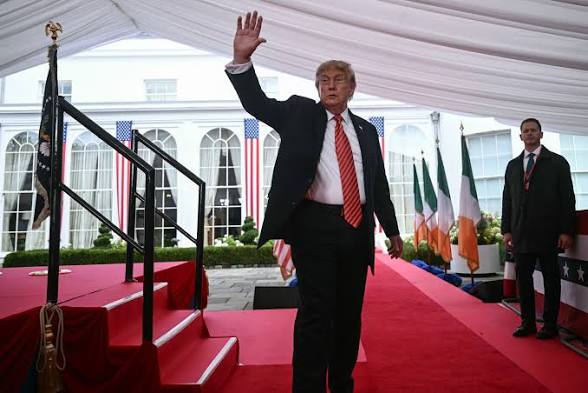
U.S. President Donald Trump has made headlines during his latest visit to Ireland after expressing support for the possibility of a united Ireland, while thousands of protesters took to the streets and Trump traveled to his golf resort in County Clare.
Trump arrived in Ireland on September 12, 2026, for a two-day visit combining diplomatic meetings, economic discussions and his appearance at the Irish Open at Trump International Golf Links & Hotel in Doonbeg. His visit has attracted major political attention because of his comments on Irish reunification and the scale of the demonstrations against his administration.
The trip also highlights the complicated relationship between the United States, Ireland and the United Kingdom. Trump’s comments about Irish unity have particularly drawn criticism from unionist politicians in Northern Ireland, while Irish nationalists have welcomed the idea but remain cautious about Trump’s position.
At the same time, his visit has created a major security operation across Dublin and County Clare.
Donald Trump Says He Would Like to See a United Ireland
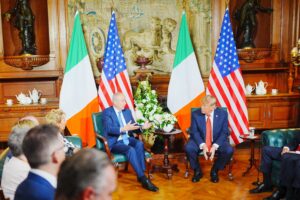
The biggest political development from Trump’s Ireland visit came when he spoke about the future of Northern Ireland.
During his meeting with Irish Taoiseach Micheál Martin in Dublin, Trump said he would “love” to see a united Ireland. He described Irish reunification as a potentially “fantastic” and “very cool” development.
The remarks immediately attracted attention because successive U.S. administrations have generally maintained a careful position on Northern Ireland’s constitutional future.
Trump’s comments therefore represent a significant political intervention.
Northern Ireland remains part of the United Kingdom. Under the 1998 Good Friday Agreement, however, its constitutional status can change if the required democratic conditions are met.
A future border poll would ultimately depend on the constitutional framework and political circumstances outlined in the agreement.
Trump’s comments do not themselves change Northern Ireland’s legal status.
Nevertheless, they have reignited a debate that has remained politically sensitive for decades.
Why Trump’s Irish Unity Comments Matter
The issue of Irish reunification is deeply connected to Northern Ireland’s history.
The island of Ireland was partitioned in the early 20th century. Northern Ireland remained within the United Kingdom, while the rest of Ireland eventually became an independent state.
Decades of political and sectarian violence followed.
The Good Friday Agreement, signed in 1998, became a major turning point. It established a political framework for peace and recognized that Northern Ireland’s constitutional future should ultimately reflect the wishes of its people.
That history makes comments from a U.S. president particularly sensitive.
Trump’s statement therefore generated immediate reactions from unionist politicians.
Democratic Unionist Party leader Gavin Robinson rejected the idea that the territory’s future should be influenced by outside political figures. Reporting from Reuters said unionists emphasized that Northern Ireland’s future should be decided by its people.
For Irish nationalists, however, Trump’s remarks were notable because they appeared more supportive of reunification than the traditionally cautious language used by American presidents.
That does not mean a united Ireland is imminent.
Instead, Trump’s comments have brought the constitutional question back into international headlines.
Trump Meets Irish Leaders in Dublin
Trump’s Ireland visit began with a series of official engagements in Dublin.
He met Taoiseach Micheál Martin and Irish President Catherine Connolly as part of the diplomatic portion of his trip.
The meetings focused on the relationship between Ireland and the United States, including trade, international affairs and wider geopolitical issues.
Trump also highlighted the importance of American companies operating in Ireland.
Ireland has long maintained strong economic connections with the United States. Numerous major American technology, pharmaceutical and multinational companies have significant operations in the country.
As a result, economic relations remain a central part of the U.S.-Ireland relationship.
However, Trump’s meetings were not free from disagreement.
President Catherine Connolly has previously been critical of several Trump administration policies. During their meeting, she also raised concerns relating to war and international conflicts.
That created an unusual diplomatic moment.
Trump’s visit was therefore not simply a ceremonial trip. It involved political disagreements, economic interests and highly sensitive questions about Ireland’s future.
Massive Protests Accompany Trump’s Visit
While Trump met Irish officials, demonstrators gathered in Dublin to protest his visit.
Large crowds marched through central Dublin, with protesters criticizing Trump’s foreign policy and his administration’s approach to international conflicts.
Reports said the demonstrations involved numerous organizations and political groups.
Protesters marched from the Garden of Remembrance toward government buildings while chanting slogans opposing Trump’s visit.
The demonstrations were connected to several issues.
These included:
- U.S. foreign policy
- Ireland’s neutrality
- The Middle East
- Palestinian rights
- Trump’s domestic policies
- Concerns about international law
- Opposition to the Irish government’s relationship with Washington
The protests were significant enough to cause traffic restrictions and rolling road closures in Dublin.
Irish authorities had prepared for the demonstrations well in advance.
The Irish Times previously reported that protest organizers were planning events under the banner of opposition to Trump’s visit.
Security Operation Becomes a Major Issue
Trump’s presence in Ireland triggered one of the country’s largest recent security operations.
Irish police, defense personnel and other security agencies were deployed around key locations.
Security measures affected Dublin, Shannon Airport and Doonbeg.
According to RTÉ, access restrictions were introduced around Doonbeg, while security checks were implemented for people attending the Irish Open. Drone restrictions and maritime controls were also introduced in connection with the visit.
The security operation reflects the challenges involved when a sitting U.S. president visits a relatively small country.
Trump’s movements required extensive coordination.
Road closures, controlled access points and additional policing were necessary around his scheduled locations.
Authorities also warned travelers to allow additional time at Shannon Airport.
Trump Heads to His Doonbeg Golf Resort
After his meetings in Dublin, Trump traveled to County Clare.
The next major part of the trip centered on golf.
Trump is scheduled to attend the Irish Open at his Doonbeg property, which is hosting the tournament from September 10 to September 13.
The resort has long been an important part of Trump’s business interests in Ireland.
His connection with Doonbeg goes back years, and local attitudes toward the resort are mixed.
Supporters point to tourism, employment and economic activity generated by Trump’s investment.
Critics, meanwhile, argue that his presence has brought controversy and additional political attention to the region.
The Irish Open itself provides a major international platform.
Trump’s attendance also ensures that the tournament will receive considerable global media coverage.
Trump’s Golf Visit Creates a Political Balancing Act
Trump’s decision to combine diplomatic meetings with a visit to his own golf property has attracted criticism.
Opponents have described the trip as partly a personal or business visit rather than a traditional presidential engagement.
However, Trump’s supporters argue that his Irish investment has produced economic benefits for the local area.
The situation illustrates the unusual overlap between Trump’s political career and his business interests.
The Doonbeg resort is not simply a golf course associated with Trump’s personal brand. It has also become an important local economic asset.
The Irish Open could bring additional visitors and international attention to County Clare.
At the same time, Trump’s presence requires extensive security arrangements.
That creates an obvious debate over the costs and benefits of hosting a U.S. president at a property connected to his business empire.
Environmental Concerns Surround Trump’s Doonbeg Resort
The controversy surrounding Trump’s Irish property goes beyond politics.
Environmental concerns have also surrounded development plans at the Doonbeg resort.
The Financial Times recently reported that development proposals have faced opposition linked to the presence of the endangered narrow-mouthed whorl snail and concerns about its protected habitat.
Environmental campaigners have questioned aspects of proposed development and landscaping at the site.
The issue has added another layer to the debate surrounding Trump’s Irish investment.
Supporters emphasize economic development.
Opponents highlight environmental protection and planning concerns.
Consequently, Trump’s presence at Doonbeg has become a political, economic and environmental story at the same time.
Why Ireland Is Important to Trump
Ireland has a long-standing cultural and political connection with the United States.
Millions of Americans claim Irish ancestry, creating a powerful historical relationship between the two countries.
Ireland has also become an important destination for U.S. investment.
American companies play a major role in Ireland’s economy, particularly in technology, pharmaceuticals and other high-value industries.
Trump has repeatedly emphasized the importance of trade and investment during his visit.
The U.S.-Ireland relationship therefore goes far beyond cultural connections.
It includes billions of dollars in investment, major corporate operations and significant diplomatic cooperation.
That is why Irish officials have strong reasons to maintain a constructive relationship with Washington, even when political disagreements emerge.
Trump’s Comments Put London in a Difficult Position
Trump’s comments about Irish unity also have implications for the United Kingdom.
Northern Ireland remains part of the UK.
Therefore, any serious discussion about reunification inevitably involves London.
The UK government has maintained that Northern Ireland’s constitutional future must be determined through the democratic process established by the Good Friday Agreement.
Trump’s remarks do not alter that legal framework.
However, the intervention from the U.S. president adds international attention to the debate.
That could create additional political pressure on British leaders, particularly if discussions about a future referendum become more prominent.
For now, British officials have stressed that a referendum is not currently on the political agenda.
Trump has therefore opened a major conversation without creating an immediate constitutional change.
What Happens Next for Irish Unity?
Trump’s comments raise an obvious question: could Irish reunification actually happen?
The answer is complicated.
A united Ireland would require major political and constitutional developments.
Under the Good Friday Agreement, a border poll can be held if the UK government believes it is likely that a majority in Northern Ireland would support leaving the UK and joining a united Ireland.
If such a referendum were held, the outcome would be determined by voters.
Trump cannot decide that outcome.
Neither can the Irish government.
The decision ultimately belongs to the people through the established democratic process.
That is why unionist leaders have emphasized local consent.
At the same time, nationalist parties view demographic, political and electoral changes as reasons to keep the question of reunification on the political agenda.
Trump’s remarks may therefore influence the political conversation, but they cannot by themselves produce a united Ireland.
Trump’s Ireland Visit Is More Than a Golf Trip
Although the Irish Open is a major part of Trump’s itinerary, the visit has developed into something much bigger.
Three separate stories have collided.
First, there is the diplomatic relationship between Washington and Dublin.
Second, there is the constitutional debate surrounding Northern Ireland.
Third, there is the controversy surrounding Trump’s political record and his business interests in Ireland.
That combination explains why the visit has attracted such intense attention.
Trump has managed to generate headlines on both sides of the Irish Sea within hours.
His comments about Irish unity surprised political observers.
The protests demonstrated the strength of opposition to his administration.
And his appearance at Doonbeg brought the focus back to the golf resort that has been central to his Irish connection.
Economic Benefits and Political Controversy
For Doonbeg, Trump’s visit can provide significant international exposure.
The Irish Open is a major sporting event, and hosting it at Trump’s course puts County Clare on the global golf map.
Local businesses can potentially benefit from increased visitor numbers, hotel bookings, restaurants and tourism activity.
However, the economic benefits do not eliminate political disagreements.
Many protesters argue that Ireland should distance itself from Trump’s policies.
Others believe that economic cooperation with the United States should continue regardless of political differences.
That debate is unlikely to disappear after Trump leaves Ireland.
What Trump’s Ireland Visit Means for U.S.-Ireland Relations
Despite the controversy, the visit demonstrates that U.S.-Ireland relations remain strategically important.
Trump’s meetings with Irish leaders showed that both sides have strong reasons to maintain dialogue.
Trade, investment, technology and international security remain important areas of cooperation.
At the same time, disagreements over foreign policy and Ireland’s neutrality continue.
Trump’s comments about Irish unity add another unexpected dimension.
Previous U.S. presidents generally avoided taking a direct position on the constitutional question.
Trump’s willingness to speak openly about reunification could encourage more discussion.
However, it could also create diplomatic complications with the UK and provoke criticism from unionists.
Conclusion: Trump Leaves Ireland With Plenty of Questions
Donald Trump’s Ireland visit has become one of the most politically significant presidential trips to the country in recent years.
His statement that he would like to see a united Ireland immediately reignited debate about Northern Ireland’s constitutional future.
Meanwhile, thousands of protesters demonstrated against his visit and his administration’s foreign policy.
Trump then traveled to County Clare for the Irish Open at his Doonbeg golf resort, combining presidential diplomacy with one of his best-known business interests.
The trip therefore represents much more than a sporting appearance.
It touches on Irish unity, U.S.-Ireland relations, British politics, economic investment, environmental concerns and public opposition.
For now, Trump’s comments have not changed Northern Ireland’s constitutional position.
However, they have placed Irish reunification firmly back in the international spotlight.
As Trump continues his visit, the political debate surrounding his remarks may prove to be just as important as the golf tournament itself.
FAQs About Donald Trump’s Ireland Visit
1. Why is Donald Trump visiting Ireland?
Donald Trump is visiting Ireland for diplomatic engagements and to attend the Irish Open at his Trump International Golf Links & Hotel in Doonbeg, County Clare.
2. What did Trump say about a united Ireland?
Trump said he would like to see Ireland reunified and described the prospect as a potentially “fantastic” and “very cool” development.
3. Is Donald Trump supporting Irish reunification?
Trump has publicly expressed support for the idea of Irish reunification. However, his comments do not change the legal or constitutional process governing Northern Ireland’s future.
4. Why are people protesting Trump’s visit to Ireland?
Protesters have raised concerns about Trump’s foreign policy, the Middle East, Ireland’s neutrality and other policies associated with his administration. Large demonstrations were planned in Dublin and Doonbeg.
5. Where is Trump’s golf resort in Ireland?
Trump International Golf Links & Hotel is located in Doonbeg, County Clare, on Ireland’s west coast.
6. Is the Irish Open being held at Trump’s golf resort?
Yes. The 2026 Irish Open is being held at Trump International Golf Links in Doonbeg from September 10 to September 13.
7. What is the Good Friday Agreement?
The Good Friday Agreement of 1998 established a major political framework for peace in Northern Ireland. It also provides a democratic process for determining the territory’s constitutional future.
8. Can Trump decide whether Ireland becomes united?
No. The constitutional future of Northern Ireland is determined through the democratic and legal framework established by the Good Friday Agreement. Trump’s comments do not themselves change Northern Ireland’s status.
9. Why is Trump’s Ireland visit controversial?
The visit is controversial because of Trump’s foreign policy, his comments about Irish reunification, protests against his administration and the decision to visit his own golf resort while serving as president.
10. What is the biggest takeaway from Trump’s Ireland visit?
The biggest takeaway is that Trump’s comments have unexpectedly pushed Irish reunification back into international political discussion while his visit has simultaneously highlighted the strength of U.S.-Ireland economic ties and domestic opposition to his policies.
How useful was this post?
Click on a star to rate it!
Average rating 0 / 5. Vote count: 0
No votes so far! Be the first to rate this post.
About the Author

usa5911.com
Administrator
Hi, I’m Gurdeep Singh, a professional content writer from India with over 3 years of experience in the field. I specialize in covering U.S. politics, delivering timely and engaging content tailored specifically for an American audience. Along with my dedicated team, we track and report on all the latest political trends, news, and in-depth analysis shaping the United States today. Our goal is to provide clear, factual, and compelling content that keeps readers informed and engaged with the ever-changing political landscape.