US Navy Deployment: Inside Carrier Strike Group Operations, F-35 Nighttime Strikes
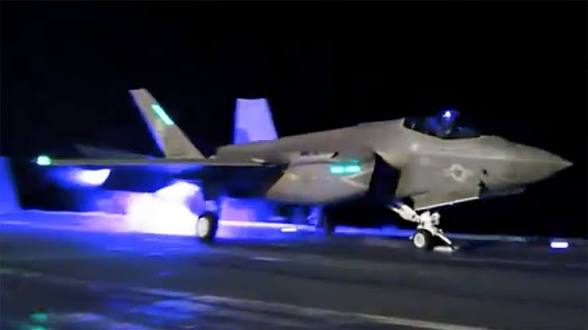
The latest US Navy deployment activity is highlighting the enormous operational reach of American carrier strike groups. From the flight deck of a nuclear-powered aircraft carrier to advanced F-35C Lightning II fighters operating at night, modern naval operations combine airpower, intelligence, electronic warfare, missile defense and maritime security into one highly coordinated force.
Recent developments in the Middle East have placed particular attention on U.S. aircraft carriers and their supporting ships. The USS George Washington, for example, is currently deployed in the U.S. 5th Fleet area of operations, where its F-35C-equipped air wing is supporting maritime security and stability missions.
At the same time, the USS Abraham Lincoln has completed an unusually long deployment that included operations connected to the conflict involving Iran. Reuters reported that the nuclear-powered carrier carried approximately 5,000 personnel and participated in naval and combat operations before making a port visit to Thailand in September 2026.
These developments offer a closer look at how a modern US Navy carrier strike group functions and why nighttime carrier aviation remains such an important capability.
What Is a US Navy Carrier Strike Group?
A carrier strike group, or CSG, is much more than an aircraft carrier.
At its center is a nuclear-powered aircraft carrier. Around it operates a collection of guided-missile destroyers, aircraft, helicopters, logistics vessels and other supporting forces.
The carrier provides the strike group’s main aviation capability. Its air wing can perform several missions, including:
- Air defense
- Maritime surveillance
- Precision strike
- Electronic warfare
- Intelligence gathering
- Anti-surface warfare
- Protection of the carrier and other ships
This structure allows the Navy to operate far from U.S. territory.
A carrier strike group can move into a region without requiring a permanent land base for every aircraft. That mobility is one of the defining advantages of American naval power.
Why Carrier Deployments Matter
A US Navy deployment can serve several purposes at the same time.
One objective may be deterrence. The presence of an aircraft carrier can demonstrate that the United States has significant military capability available in a particular region.
Another objective is maritime security.
Carrier strike groups can support operations designed to protect shipping routes, monitor potentially hostile activity and respond rapidly to emerging threats.
The third major role is combat power.
If ordered to conduct military operations, aircraft launched from a carrier can provide commanders with an airpower option without relying entirely on regional air bases.
This flexibility becomes especially important in regions where access to military bases is politically complicated or where land-based facilities could be threatened.
Inside Carrier Strike Group Operations
The complexity of carrier operations is easy to underestimate.
Every aircraft launch involves numerous people working together. Pilots and aircrew are only one part of the process.
Flight deck crews prepare aircraft for launch. Aviation technicians maintain engines and weapons systems. Aircraft handlers move jets into position. Catapult crews prepare launch systems, while arresting-gear personnel support aircraft recovery.
Air traffic controllers coordinate aircraft movements.
Commanders and intelligence personnel determine how the air wing will be used.
The result is a highly synchronized system in which a carrier can launch and recover aircraft repeatedly.
The Navy’s USS George Washington recently celebrated its 200,000th aircraft recovery, illustrating the enormous operational experience involved in carrier aviation. Navy officials emphasized that successful recoveries depend on pilots, landing signal officers, flight-deck crews, arresting-gear teams and maintainers working together.
The Growing Role of the F-35C
One of the most important developments in modern carrier aviation is the integration of the F-35C Lightning II.
The F-35C is the carrier variant of the F-35 family. Unlike the land-based F-35A, the F-35C is specifically designed for operations from aircraft carriers.
It has larger wings, strengthened landing gear and other features required for catapult launches and arrested landings.
Its importance goes beyond stealth.
The aircraft is designed to combine information from its sensors and share that information with other forces. That makes the F-35C both a strike aircraft and an important part of the carrier group’s information network.
The Navy’s F-35C achieved initial operational capability in 2019, and the aircraft subsequently became part of carrier air wings.
Today, F-35Cs are increasingly visible in U.S. carrier operations.
Recent Navy imagery from the USS George Washington shows F-35C Lightning IIs operating from the carrier in the Middle East area.
How F-35 Nighttime Operations Work
Night operations are among the most demanding activities in carrier aviation.
Landing an aircraft on a moving carrier is difficult during daylight. At night, the challenge becomes even greater.
Pilots have to approach the carrier while dealing with darkness, weather, wind and the movement of the ship.
The flight deck itself becomes a carefully controlled environment.
Lighting systems help pilots identify the carrier and landing area. Landing signal officers provide guidance. Meanwhile, the crew below must ensure that aircraft and equipment are positioned correctly.
The F-35C adds another dimension because of its advanced sensors and stealth characteristics.
However, it is important to distinguish nighttime flight operations from a publicly confirmed specific nighttime strike.
The Navy routinely conducts nighttime carrier operations, and recent official imagery documents F-35C flight activity from USS George Washington. But publicly available information does not necessarily establish that every nighttime F-35C operation was a combat strike.
That distinction is important when reporting on rapidly developing military operations.
Why Nighttime Strikes Are Important
Night operations can provide military commanders with additional tactical options.
Darkness can complicate an opponent’s ability to observe aircraft movements. It can also allow forces to operate at times that may provide an operational advantage.
Modern aircraft do not depend entirely on daylight visibility. Advanced sensors, navigation systems, communications and targeting technologies allow pilots to conduct sophisticated missions in extremely demanding conditions.
For a carrier strike group, night operations also demonstrate readiness.
A carrier cannot simply stop operating when the sun goes down.
Potential threats do not follow a daytime schedule. Ships need protection around the clock, and aircraft may have to launch quickly if a threat develops.
The Carrier as a Floating Air Base
One of the most important advantages of an aircraft carrier is mobility.
A conventional air base is tied to a particular location. A carrier can move.
That means an aircraft carrier can potentially reposition hundreds or thousands of miles depending on operational requirements.
A nuclear-powered carrier also has enormous endurance.
This makes the carrier particularly valuable for extended deployments.
Reuters recently reported that USS Abraham Lincoln had spent an exceptionally long period at sea during its Middle East deployment. The report described the deployment as involving naval blockade and combat operations and noted that the carrier had been at sea for an unusually long period.
Such extended deployments demonstrate both the capability and the cost of maintaining carrier forces at high operational tempo.
The Challenge of Long US Navy Deployments
A powerful carrier strike group still depends on people.
Sailors must maintain aircraft, operate complex machinery, manage supplies and remain prepared for emergencies.
Long deployments can therefore create significant pressure.
Recent reporting has highlighted concerns about the strain created by extended U.S. naval deployments. The Atlantic reported that prolonged operations in the Middle East have placed pressure on readiness, supplies and personnel, while also limiting the Navy’s ability to maintain carrier presence elsewhere.
This creates a strategic problem.
The United States has global military commitments.
A carrier deployed in the Middle East cannot simultaneously provide the same level of presence in the Indo-Pacific.
As a result, decisions about carrier deployments are not only about the immediate crisis. They also affect America’s broader military posture.
Carrier Strike Groups and the Middle East
The Middle East remains one of the most strategically important regions for the U.S. Navy.
The Strait of Hormuz is particularly important because it connects the Persian Gulf with the Gulf of Oman and the Arabian Sea.
Any disruption to shipping through the area could have consequences for global energy markets.
That makes maritime security a major consideration for U.S. naval forces.
Carrier strike groups can provide airpower while destroyers and other ships contribute to surveillance, air defense and maritime security.
The presence of F-35Cs adds another layer of capability.
Their sensors and low-observable design can be particularly valuable in environments where sophisticated air defenses are a concern.
F-35C and Networked Warfare
The biggest advantage of the F-35 may not be its appearance or even its speed.
It is the aircraft’s ability to operate as part of a wider network.
Modern warfare increasingly depends on information.
An aircraft may detect something that another platform cannot see. A ship may identify a threat through radar. Another aircraft may have a better view of the surrounding airspace.
Sharing this information can help commanders develop a more complete picture of the battlefield.
The F-35 is designed around this concept.
Instead of functioning simply as a traditional fighter, it can act as a sensor and information node within a larger force.
That makes the aircraft potentially valuable even when it is not directly launching weapons.
The Importance of Electronic Warfare
Carrier strike groups also rely heavily on electronic warfare.
Aircraft such as the EA-18G Growler can support missions by disrupting or confusing hostile radar and communications systems.
This capability can complement F-35 operations.
A modern strike package may therefore include several different aircraft performing different roles.
One aircraft may focus on intelligence.
Another may conduct electronic warfare.
Others may provide fighter protection.
Strike aircraft can then focus on their assigned objectives.
This layered approach is a key feature of modern naval aviation.
Destroyers Provide Another Defensive Layer
The aircraft carrier is the centerpiece, but destroyers are essential to the strike group’s survival.
Guided-missile destroyers can provide air and missile defense around the carrier.
They can also conduct maritime security missions and support other operations.
This creates multiple defensive layers.
If an aircraft approaches the strike group, it may be detected by sensors from several platforms.
The carrier’s aircraft can respond.
Ship-based missile systems can provide another option.
Electronic warfare can add another layer.
The overall concept is not based on a single weapon system. It is based on a network of ships, aircraft, sensors and personnel.
What Makes Night Carrier Operations So Difficult?
Night carrier operations combine several difficult conditions.
First, the flight deck is moving.
Second, the aircraft is moving quickly.
Third, visibility is reduced.
Fourth, pilots must land within a relatively small area.
Finally, dozens of sailors are working around aircraft, engines, weapons and other dangerous equipment.
The Navy therefore treats carrier aviation as a discipline requiring extensive training.
The fact that the USS George Washington continues to conduct F-35C operations demonstrates how carrier aviation has evolved from earlier generations of naval aircraft. Navy officials recently highlighted the carrier’s ability to recover aircraft at night and in poor weather as part of its long operational history.
What the Latest Deployment Means
The latest US Navy deployment activity demonstrates several broader trends.
First, aircraft carriers remain central to American power projection.
Second, the F-35C is becoming increasingly integrated into carrier air wings.
Third, nighttime operations remain an essential component of carrier readiness.
Fourth, the Middle East continues to require substantial U.S. naval attention.
Finally, extended deployments are testing the endurance of both ships and sailors.
The current environment also highlights a difficult balance for the Navy.
Maintaining powerful forces in one region can reduce availability elsewhere.
That challenge is particularly significant as the United States attempts to maintain a major military presence in both the Middle East and Indo-Pacific.
The Future of US Navy Carrier Aviation
The future carrier air wing is likely to become more connected and more technologically advanced.
The Navy is already preparing for the next generation of carrier aviation.
That includes future aircraft, uncrewed systems and improved networking.
Reuters reported in September 2026 that the Pentagon was preparing to announce a decision on the Navy’s next-generation F/A-XX fighter program. The aircraft is intended to eventually replace the F/A-18E/F Super Hornet and is expected to emphasize stealth, range, endurance and integration with uncrewed systems.
That means the F-35C should be viewed as part of a broader transition.
Future carrier strike groups may combine crewed fighters, stealth aircraft, unmanned platforms, electronic warfare systems and increasingly sophisticated sensors.
The carrier itself will remain the central platform, but the surrounding network will become even more important.
Conclusion
The modern US Navy deployment is about far more than moving an aircraft carrier from one ocean to another.
A carrier strike group represents a sophisticated combination of aviation, surface ships, intelligence, communications, electronic warfare and logistics.
The F-35C Lightning II is becoming an increasingly important part of that system. Its ability to operate from carriers, conduct demanding missions and contribute information to the wider force makes it a key component of future naval aviation.
Nighttime carrier operations demonstrate another critical capability: readiness around the clock.
Recent F-35C operations aboard USS George Washington show that advanced carrier aviation remains active in the Middle East, while the unusually long USS Abraham Lincoln deployment illustrates the enormous demands placed on American naval forces.
At the same time, reports about future F/A-XX aircraft indicate that the Navy is already preparing for the next generation of carrier warfare.
The result is a Navy increasingly built around stealth, sensors, networking and long-range operations.
For the United States, the aircraft carrier remains one of the most visible symbols of global military reach. But behind every nighttime F-35C launch is a much larger system of sailors, aircraft, ships and technology working together.
Frequently Asked Questions
1. What is a US Navy carrier strike group?
A US Navy carrier strike group is a naval formation centered on an aircraft carrier and supported by destroyers, aircraft, helicopters and other vessels. It is designed for missions including maritime security, air defense, deterrence and combat operations.
2. What is the F-35C?
The F-35C Lightning II is the carrier-based variant of the F-35 stealth fighter. It has features specifically designed for aircraft-carrier operations, including strengthened landing gear and larger wings.
3. Can F-35C aircraft operate at night?
Yes. F-35C aircraft are capable of nighttime operations, and U.S. Navy carrier aviation routinely conducts flight operations after dark. Recent Navy material shows F-35Cs operating from USS George Washington.
4. Are all nighttime F-35C flights combat strikes?
No. A nighttime flight does not necessarily mean a combat strike. Carrier aircraft conduct training, surveillance, readiness and other missions after dark. Specific combat missions should be confirmed through official military statements or reliable reporting.
5. Why are aircraft carriers important to the US Navy?
Aircraft carriers provide a mobile airfield capable of moving around the world’s oceans. They allow the United States to deploy substantial airpower without relying entirely on land-based facilities.
6. How long can a US Navy carrier deploy?
Normal carrier deployments can last several months, although operational requirements can result in significantly longer deployments. The USS Abraham Lincoln’s recent deployment has been notable for its exceptional duration.
7. What does an F-35C do in a carrier strike group?
An F-35C can perform multiple roles, including air combat, strike missions, surveillance and intelligence-related tasks. Its sensors and networking capabilities also allow it to contribute information to other forces.
8. What is the future of US Navy carrier aviation?
The Navy is moving toward a combination of advanced crewed aircraft, stealth technology, networking and uncrewed systems. The planned F/A-XX program is expected to become an important part of the future carrier air wing.
9. Why are night carrier landings difficult?
Night landings are challenging because pilots must land on a moving ship in limited visibility while coordinating with flight-deck personnel and landing systems. Training and strict procedures are essential.
10. Why does the US Navy deploy carriers to the Middle East?
Carriers can provide deterrence, maritime security, airpower and rapid-response capabilities. Their presence is particularly important in strategically sensitive areas such as the Persian Gulf and surrounding waters.
How useful was this post?
Click on a star to rate it!
Average rating 0 / 5. Vote count: 0
No votes so far! Be the first to rate this post.
About the Author

usa5911.com
Administrator
Hi, I’m Gurdeep Singh, a professional content writer from India with over 3 years of experience in the field. I specialize in covering U.S. politics, delivering timely and engaging content tailored specifically for an American audience. Along with my dedicated team, we track and report on all the latest political trends, news, and in-depth analysis shaping the United States today. Our goal is to provide clear, factual, and compelling content that keeps readers informed and engaged with the ever-changing political landscape.