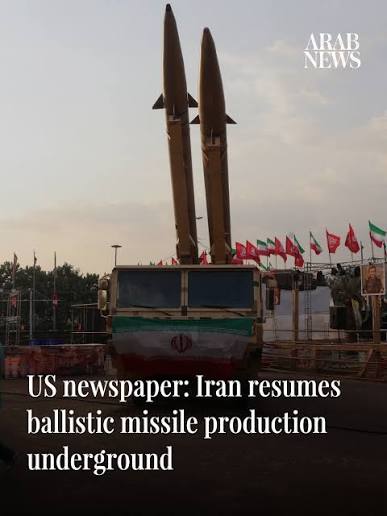
Iran has reportedly resumed limited ballistic missile production inside underground facilities, adding another dangerous dimension to the widening Middle East crisis. The development comes months after US and Israeli strikes heavily damaged several Iranian missile-production sites and launch facilities.
According to reporting by The Wall Street Journal, cited by Reuters, Iran is now assembling ballistic missiles from components that were already stockpiled before the war. The production effort is taking place partly underground and remains smaller than Iran’s prewar manufacturing capacity.
The reported restart is significant because Tehran’s ballistic missile program has long been a central part of its military strategy. Even after major facilities were damaged, Iran appears to be attempting to preserve enough of its missile capability to maintain pressure on the United States, Israel and regional targets.
The latest intelligence also raises a difficult question for Washington: Can military strikes permanently eliminate Iran’s missile infrastructure, or can Tehran continue rebuilding it from protected underground locations?
Iran Resumes Ballistic Missile Production Underground
The most important development is the reported resumption of missile assembly inside underground facilities.
Reuters reported on September 10 that Iran had restarted ballistic missile production using existing components, citing a Wall Street Journal report based on US and Middle Eastern officials. The missiles are reportedly being produced in more limited quantities than before the war.
That distinction matters.
The available reporting does not indicate that Iran has completely restored its prewar missile-industrial capacity. Instead, the evidence points toward a limited rebuilding effort designed to keep the program functioning.
Iran can potentially use components manufactured or stored before the conflict, including missile structures and other systems, while repairing or rebuilding underground production infrastructure.
This approach could allow Tehran to continue producing missiles without immediately recreating the large above-ground industrial facilities that were targeted during the conflict.
Why Underground Facilities Matter
Iran has spent decades developing hardened and underground military infrastructure.
Its so-called underground “missile cities” are designed to protect missiles, equipment and personnel from air attacks. Some facilities are constructed inside mountains or beneath heavily fortified areas.
The strategy presents a major challenge for any military campaign.
Destroying visible factories is considerably easier than eliminating an entire network of underground production, storage and launch facilities.
Earlier in the conflict, US and Israeli attacks damaged several important Iranian missile-production locations. A Washington Post assessment published in March found severe damage at four major production facilities, including sites at Khojir, Shahroud, Parchin and Hakimiyeh.
Those strikes were intended to reduce Iran’s ability to manufacture and launch ballistic missiles.
However, the latest reports suggest that damage to above-ground infrastructure did not necessarily end Tehran’s missile program.
Instead, Iran appears to be relying on redundancy, underground construction and existing inventories.
US Intelligence Faces a New Challenge
The reported production restart is particularly important for US intelligence agencies.
Washington has spent months assessing how badly Iran’s missile program was damaged by the war. Early assessments suggested that major missile-production facilities had suffered substantial destruction.
But rebuilding activity creates a more complicated picture.
The question is no longer simply how many Iranian missile sites were destroyed.
Instead, intelligence agencies must determine:
- How many underground facilities remain operational?
- How many missile components survived the attacks?
- How quickly can Iran assemble new missiles?
- How many production sites can be repaired?
- How many missiles can Tehran manufacture each month?
- Can Iran secretly move components between facilities?
- How much of the remaining missile force is operational?
These questions are strategically important because missile production is not limited to one factory.
A dispersed industrial network can make it much harder for an adversary to permanently disable the overall program.
Iran’s Missile Program Was Already Under Heavy Pressure
The reported restart should not be interpreted as evidence that Iran’s missile program emerged from the war untouched.
Quite the opposite is true.
Earlier reporting found that US and Israeli attacks had significantly damaged Iranian missile infrastructure. The Washington Post reported in March that four major production locations and at least 29 ballistic missile launch sites had been damaged during the opening weeks of the offensive.
Those attacks disrupted Iran’s ability to manufacture and deploy missiles at its previous pace.
The latest development therefore appears to represent recovery rather than a complete restoration.
That distinction is important for understanding the current balance of power.
Iran may have fewer operational missiles and a reduced production rate, but even a limited ability to manufacture new ballistic missiles could provide Tehran with a continuing strategic deterrent.
Stockpiled Components Give Tehran a Temporary Advantage
One of the most important details in the latest reports is Iran’s use of existing components.
Instead of immediately rebuilding every stage of the missile manufacturing chain, Tehran can use components that were already produced before the war.
That could accelerate the return of limited production.
According to the reporting cited by Reuters, Iran is producing missiles in smaller quantities than it did before the conflict.
This means the immediate threat may not be an unlimited missile-production surge.
Instead, the concern is that Iran has found a way to maintain a functioning production pipeline despite major damage.
Over time, however, the situation could become more serious if Tehran successfully restores additional manufacturing capacity.
The Khojir Connection
The Khojir area has been particularly important to assessments of Iran’s missile industry.
Khojir has long been associated with Iranian military production, and previous attacks reportedly caused substantial damage to the site.
The latest reporting indicates that Iran has been working around damaged infrastructure and using underground locations to continue assembly. The Wall Street Journal reported that Iran was also developing additional underground assembly locations to reduce vulnerability to future attacks.
If confirmed, that would represent a major change in the military-industrial strategy.
Rather than simply rebuilding damaged factories in their previous form, Iran could increasingly emphasize facilities that are harder to identify and strike.
That could make future military operations more complicated.
Why Ballistic Missiles Remain Central to Iran’s Strategy
Iran’s ballistic missiles are among the most important elements of its conventional military power.
They give Tehran the ability to strike targets across significant distances without relying exclusively on aircraft.
That matters because Iran faces technologically superior air forces in the region.
Ballistic missiles therefore provide Tehran with a relatively inexpensive method of maintaining long-range strike capabilities.
Iran has also developed a large missile inventory over many years. A 2022 estimate cited by El País put the country’s ballistic missile arsenal at more than 3,000 missiles, although the size of the operational inventory has changed substantially during the 2026 conflict.
The war has consumed missiles while damaging launch infrastructure.
Consequently, production is critical if Iran wants to replenish its inventory.
The Interceptor Problem for the United States
Iran’s ability to produce missiles also creates a broader problem for US forces and regional allies.
Every additional missile launched at an American or allied target may require defensive systems to intercept it.
That creates an economic and logistical challenge.
Advanced missile-defense interceptors are expensive, while Iran can potentially produce or assemble some missiles at a lower cost.
A prolonged conflict can therefore become a war of attrition.
If Iran continues launching missiles while rebuilding its inventory, the United States and its partners must continuously balance offensive operations with defensive requirements.
This is one reason reports of renewed Iranian production are attracting attention in Washington.
The Middle East Conflict Is Expanding Beyond Iran
The missile-production issue is unfolding alongside a broader escalation across the region.
Recent reporting has highlighted renewed threats to energy infrastructure and shipping routes.
The Associated Press reported that an attack on a key Saudi oil pipeline was blamed on Iran-backed militias in Iraq, while Houthi activity has also increased pressure on regional shipping.
The conflict is therefore no longer limited to direct US-Israeli-Iranian military exchanges.
Iran-linked groups across the region can create additional pressure on US allies and critical infrastructure.
That increases the strategic importance of Iran’s ability to maintain missile production.
Strait of Hormuz Adds Another Layer of Risk
The Strait of Hormuz remains one of the most important pressure points in the crisis.
Iran and Oman recently reached an understanding concerning the maritime situation, but Reuters reported on September 12 that the agreement does not provide for the immediate reopening of the Strait. The reopening reportedly depends on conditions Tehran has presented to Washington.
The situation matters to the global economy because the Strait is a major route for international energy shipments.
Any prolonged disruption can affect oil prices, shipping costs and global supply chains.
Iran’s missile capabilities and its ability to threaten maritime infrastructure therefore have consequences far beyond the battlefield.
Iran’s Nuclear Program Is Also Under Scrutiny
The missile developments are occurring at the same time as international concerns about Iran’s nuclear program.
On September 9, the International Atomic Energy Agency’s board voted to refer Iran to the United Nations Security Council over concerns related to its cooperation with the agency and questions surrounding undeclared nuclear material.
Iran has rejected allegations of pursuing nuclear weapons and says its nuclear activities are peaceful.
Nevertheless, the combination of nuclear uncertainty and renewed missile production is particularly concerning to Western governments.
Ballistic missiles are capable of serving conventional military roles, but their potential connection to strategic weapons makes them an important part of broader security calculations.
Could Iran Rebuild Its Entire Missile Program?
That remains uncertain.
The current evidence suggests Iran has restarted production on a limited scale. It does not demonstrate that Tehran has completely restored its prewar missile industry.
Several factors will determine how quickly the program can recover.
Availability of Components
Stockpiled components can support production in the short term. However, inventories are finite.
Eventually, Iran would need to restore manufacturing of critical parts if it wants sustained production.
Damage to Industrial Infrastructure
Repairing heavily damaged factories can take months or longer.
Underground facilities may reduce vulnerability but also present engineering and logistical challenges.
Intelligence Pressure
US and allied intelligence agencies will likely increase surveillance of suspected production locations.
Satellite imagery, electronic intelligence and other forms of surveillance can help identify reconstruction.
Airstrikes
If Washington and its allies conclude that Iran’s missile program is becoming a major threat again, additional strikes could be considered.
President Donald Trump has already warned Iran over activity at another heavily fortified underground site, Pickaxe Mountain, near Natanz. Reuters reported on September 10 that Trump said the United States could strike if Iranian activity continued.
This demonstrates how sensitive Washington has become to Iranian activity at hardened underground facilities.
What This Means for the Middle East Crisis
The reported restart of Iranian ballistic missile production does not necessarily mean that a new major offensive is imminent.
However, it does indicate that the military balance remains unstable.
Iran appears determined to preserve a missile capability despite severe damage to its infrastructure.
For the United States, that creates a difficult strategic calculation.
Washington could attempt to destroy additional facilities. Yet repeated attacks could also encourage Iran to move even more of its production underground.
That could produce a cycle:
Strike → reconstruction → intelligence discovery → new strike → deeper concealment → renewed production.
Such a cycle would make a lasting military solution increasingly difficult.
What Happens Next?
The next major indicators will likely come from satellite imagery, intelligence assessments and evidence of Iranian missile launches.
Analysts will watch for signs that Iran is moving from limited assembly toward larger-scale manufacturing.
They will also monitor whether Tehran is constructing new underground facilities.
Another important indicator will be the number and type of missiles Iran is able to launch.
If missile launches begin increasing while production also expands, it could suggest that Tehran is successfully rebuilding its strategic stockpile.
If production remains limited, Iran may continue to face significant constraints despite its underground infrastructure.
Bottom Line
The latest Middle East crisis development is significant because Iran has reportedly resumed limited ballistic missile production underground, despite extensive US and Israeli attacks on its military infrastructure.
The reported use of stockpiled components means Tehran may be able to restart production faster than if it had to rebuild the entire industrial chain.
At the same time, the available evidence suggests that production remains below prewar levels.
For the United States, the development is a warning that destroying visible missile facilities may not be enough to eliminate Iran’s long-term missile capability.
Iran’s underground infrastructure, dispersed production network and existing stockpiles could allow the program to survive.
The broader crisis is also becoming increasingly interconnected. Missile production, nuclear concerns, attacks on energy infrastructure, proxy activity and the future of the Strait of Hormuz are now part of the same regional security equation.
As a result, the question is no longer simply whether Iran can fire missiles.
The bigger question is whether Tehran can continue rebuilding its missile force faster than its opponents can destroy it.
That question could shape the next phase of the Middle East crisis.
FAQs
1. Has Iran resumed ballistic missile production?
Recent reporting indicates that Iran has resumed limited ballistic missile production and assembly using previously stockpiled components, including work at underground facilities.
2. Why is Iran producing missiles underground?
Underground facilities can provide greater protection from airstrikes and surveillance. Iran has developed extensive hardened military infrastructure over many years.
3. Did US and Israeli strikes destroy Iran’s missile program?
The strikes caused major damage to several Iranian missile-production and launch facilities. However, recent reporting suggests that Iran has retained or rebuilt some production capability.
4. Is Iran producing missiles at its prewar level?
No. Current reports indicate that production has resumed on a more limited scale than before the war.
5. Why are US intelligence agencies concerned?
The concern centers on Iran’s ability to regenerate its missile capability despite extensive military strikes. Underground facilities and stockpiled components could make the rebuilding process more difficult to disrupt.
6. What is Iran’s underground missile infrastructure?
Iran has built hardened underground facilities and tunnel networks for missile storage, launch operations and military production. These facilities are designed to improve survivability against air attacks.
7. Does missile production mean Iran is preparing another attack?
Not necessarily. Renewed production demonstrates an effort to maintain or rebuild military capability, but it does not by itself prove that a specific new attack is imminent.
8. How does Iran’s missile program affect the Middle East crisis?
Iranian missiles can threaten military bases, infrastructure and regional targets. Their continued production could prolong the conflict and increase pressure on US allies.
9. What should observers watch next?
The most important indicators include satellite imagery of suspected facilities, missile launches, reconstruction activity, movement of components and evidence of increasing production capacity.
10. Could Iran completely rebuild its missile program?
That remains uncertain. Iran has demonstrated resilience, but rebuilding large-scale production requires components, infrastructure, skilled personnel and time. Current reporting indicates limited recovery rather than a complete restoration.
About the Author