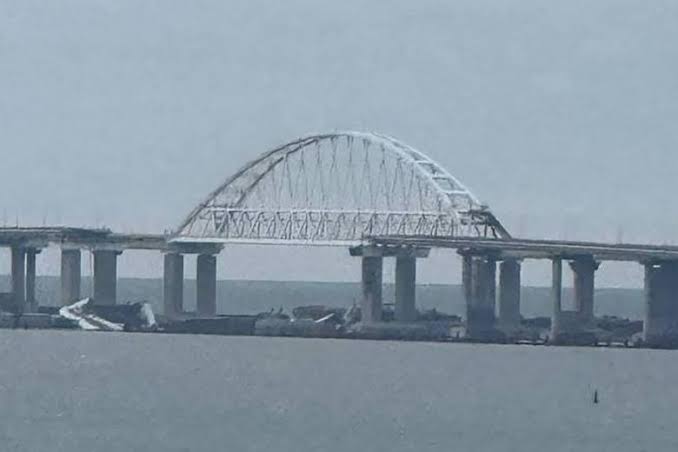
The Crimean Bridge has suffered one of its most serious attacks since Russia began its full-scale invasion of Ukraine in 2022. A Ukrainian drone and missile operation on November 17, 2026, destroyed a major section of the strategically important crossing connecting Russia with occupied Crimea.
The attack caused a road arch and a section of the bridge to collapse into the Kerch Strait. Images released by Ukrainian officials showed substantial structural damage, highlighting the scale of the operation. The railway section remained standing, although Ukrainian officials reported damage to its supporting structure.
The latest strike represents a significant development in the ongoing Russia-Ukraine war. The Crimean Bridge is more than a transportation route. It is a major military supply corridor, an economic connection and a powerful political symbol associated with Russian President Vladimir Putin.
Ukrainian President Volodymyr Zelenskyy described the operation as unprecedented. He also linked the attack to Russia’s continuing strikes against Ukrainian infrastructure.
The destruction of the road span could create serious logistical difficulties for Russian forces operating in southern Ukraine. However, the full extent of the damage, the time required for repairs and the long-term impact on military supplies remain important questions.
According to reports published on November 17 and 18, the operation involved Ukrainian-developed drones and missiles and followed a coordinated campaign against Russian air defence systems.
Reuters+2
Crimean Bridge Collapse: What Happened During The Ukrainian Attack?

The latest attack targeted the Kerch Strait Bridge during the night of November 16–17, 2026.
The crossing connects Russia’s Krasnodar region with the Crimean Peninsula. It includes road and railway sections and stretches approximately 19 kilometres across the Kerch Strait.
Ukrainian forces reportedly conducted a coordinated operation involving several stages. The objective was to weaken Russian defensive capabilities before striking the bridge itself.
Ukraine’s General Staff confirmed that the road arch and a road span collapsed following powerful explosions. The resulting damage left the road section unusable.
The railway crossing also sustained damage. However, it did not completely collapse, according to Ukrainian military statements.
The attack came after another round of strikes against the bridge. Ukrainian officials described the operation as part of a broader effort to weaken Russia’s military infrastructure.
Russia’s authorities confirmed that the bridge had been attacked and suspended traffic. The incident also prompted renewed security concerns across occupied Crimea.
The collapse of the road section is particularly significant because the bridge has served as a major connection for civilian transportation and Russian military logistics.
Although alternative routes exist, they cannot necessarily replace the bridge’s capacity and direct connection.
General Staff+2
Ukraine Claims Responsibility For The Major Strike
Ukraine’s Security Service and military leadership described the attack as a carefully planned operation.
President Volodymyr Zelenskyy said the operation involved multiple stages and was coordinated over several weeks.
According to Ukrainian accounts, the preparation included targeting Russian air defence installations, radar equipment and electronic warfare systems.
These systems are important because they help Russia detect incoming threats and interfere with hostile drones and missiles.
By weakening those defensive capabilities, Ukrainian forces sought to create an opportunity for a concentrated strike against the bridge.
The Ukrainian Security Service also released footage showing the aftermath of the attack.
Officials said the operation involved different components of Ukraine’s Defence Forces. These included specialised drone units and personnel responsible for long-range strikes.
Ukraine presented the attack as a response to Russian attacks against its own infrastructure.
Zelenskyy argued that Russia could not expect to attack Ukrainian bridges and other strategic facilities without facing consequences.
However, the military significance of the operation extends beyond the immediate physical damage.
The strike demonstrates Ukraine’s continuing efforts to target important Russian military logistics facilities far from the main battlefield.
Reuters+2
How Ukrainian Drones And Missiles Destroyed The Bridge Span
One of the most significant aspects of the Crimean Bridge collapse is the reported combination of domestically developed Ukrainian weapons.
According to statements from Ukrainian officials, the operation involved several types of unmanned systems and missile platforms.
The Ukrainian military described a coordinated approach in which drone operators helped conduct missions against designated targets and support the final strike.
The weapons mentioned in Ukrainian accounts included:
Palianytsia drone missiles: Reportedly used against the road section of the bridge.
Neptune cruise missiles: Part of the reported strike package targeting the railway section.
Ruta systems: Ukrainian-developed long-range weapons reportedly involved in the operation.
FP-5 Flamingo missiles: Also identified by Ukrainian officials as part of the wider operation.
The Ukrainian Security Service said its special operation lasted approximately one month and involved seven stages.
The preparation reportedly focused on reducing Russian air defence coverage before the final attack.
This approach highlights the growing importance of unmanned technology in modern warfare.
Drones can support surveillance, reconnaissance and targeting. Meanwhile, longer-range weapons can threaten infrastructure located far from active combat zones.
However, some details about the weapons and their individual contributions come from Ukrainian official statements. Independent verification of every operational claim remains limited.
The destruction of the road arch nevertheless provides visible evidence of serious damage to the crossing.
Reuters+2
Why The Crimean Bridge Is So Important To Russia
The Crimean Bridge has considerable strategic, economic and political importance for Moscow.
Russia constructed the crossing following its annexation of Crimea in 2014. The bridge opened to road traffic in 2018, while its railway connection became operational later.
President Vladimir Putin personally inaugurated the road section, making the structure an important symbol of Russian control over the peninsula.
However, its importance extends far beyond political symbolism.
The bridge provides a direct connection between mainland Russia and Crimea. It supports passenger transportation, commercial deliveries and military logistics.
Since Russia launched its full-scale invasion of Ukraine in February 2022, the crossing has become especially important for transporting supplies towards the southern battlefield.
Russian forces have relied on transportation networks connecting Crimea with occupied areas of southern Ukraine.
These networks support the movement of:
Military equipment and vehicles.
Fuel and ammunition.
Food and other essential supplies.
Personnel and reinforcements.
Civilian goods and commercial deliveries.
The bridge also supports tourism and regional economic activity.
Therefore, a major disruption can affect several sectors simultaneously.
For Russia, the latest Crimean Bridge collapse creates a difficult logistical challenge. Military planners may need to rely more heavily on alternative road routes through occupied southern Ukrainian territory.
Those alternatives can involve longer journeys and additional security concerns.
The extent of the disruption will depend on how long the road crossing remains unavailable and whether the railway section can continue operating safely.
Reuters+2
Putin Faces A Major Political And Military Setback
The Crimean Bridge is closely associated with Putin’s political legacy.
Its construction was presented as evidence of Russia’s ability to integrate Crimea into its transportation and economic network after the 2014 annexation.
The structure also became an important symbol of Moscow’s claims over the peninsula.
Consequently, the collapse of a major bridge span carries significance beyond the immediate transportation disruption.
The latest attack raises questions about Russia’s ability to protect critical infrastructure.
It also demonstrates that even heavily protected strategic facilities can remain vulnerable to coordinated attacks.
For Putin, the incident creates a difficult political situation.
Russia has repeatedly presented Crimea as a territory protected by strong military and security arrangements. However, repeated attacks against the bridge have challenged that image.
The crossing has previously suffered major incidents.
In October 2022, an explosion damaged the bridge and caused sections of the road to collapse. In July 2023, Ukrainian maritime drones attacked the structure again.
The November 2026 operation represents another major episode in this continuing pattern.
The latest damage could force Russian authorities to reassess infrastructure protection, transportation security and military logistics.
It may also increase pressure on officials to demonstrate that alternative routes can maintain supplies to Crimea.
The Guardian+2
Russia Suspends Traffic Following The Bridge Collapse
Russian authorities responded to the latest attack by suspending traffic across the crossing.
Sergey Aksyonov, the Russian-installed head of Crimea, confirmed that the bridge had been targeted.
Authorities also urged residents to postpone planned journeys across the structure.
The suspension affected transportation through one of the most important connections between Crimea and mainland Russia.
Reports also described serious security concerns around the Kerch Strait following the attack.
Russian investigators acknowledged structural damage, while Kremlin spokesman Dmitry Peskov said President Putin had been informed.
Russian authorities indicated that a repair plan would be prepared.
However, restoring a damaged bridge of this scale is a complicated engineering challenge.
The road arch and supporting structures must be inspected before reconstruction can begin.
Engineers will also need to assess the condition of the railway section and determine whether additional damage threatens its long-term stability.
The situation is particularly complicated because the bridge crosses a strategically sensitive waterway.
Repair work must consider structural safety, maritime transportation and military security.
Until authorities complete these assessments, uncertainty will remain over when normal road traffic can resume.
ABC News+2
How The Attack Could Affect Russian Military Supply Lines
The most important consequence of the Crimean Bridge collapse may be its impact on Russian military logistics.
The crossing has supported the movement of supplies from mainland Russia towards Crimea and southern Ukraine.
Its road section provided an important transportation option for military and civilian vehicles.
With that section out of service, Russian forces may need to depend more heavily on alternative routes.
One major alternative is the land corridor through Russian-controlled areas of southern Ukraine.
However, alternative transportation routes have their own limitations.
Longer journeys can increase fuel consumption, transportation costs and delivery times. They can also place additional pressure on roads, railways and supply facilities.
Military logistics depend on predictable transportation.
Fuel, ammunition and equipment must reach frontline units regularly. Delays can complicate planning and reduce the flexibility of military operations.
The bridge’s railway infrastructure is also important.
Rail transportation can move larger quantities of heavy equipment and supplies than ordinary road vehicles. Therefore, damage to the railway structure could create additional complications even if trains eventually resume operating.
At this stage, it would be premature to conclude that the collapse will completely interrupt Russian supplies to Crimea.
Russia has alternative transportation networks.
Nevertheless, the loss of a major road connection reduces the number of available options and could increase logistical pressure.
The longer repairs take, the greater the potential consequences for transportation and military planning.
Reuters+2
The Crimean Bridge Attack Comes Amid Escalating Strikes On Infrastructure
The latest attack occurred during an increasingly intense period of infrastructure strikes between Russia and Ukraine.
Both countries have targeted transportation networks, energy facilities and other strategically important infrastructure during the conflict.
Ukraine has repeatedly attempted to weaken Russia’s military supply systems.
Meanwhile, Russian forces have continued attacking Ukrainian cities and infrastructure using missiles and drones.
The timing of the Crimean Bridge operation is particularly significant because Russia also struck important bridges in Kyiv.
Ukrainian officials reported damage to the North and South bridges in the capital.
Kyiv Mayor Vitali Klitschko said the attacks affected transportation infrastructure and caused disruption.
These developments demonstrate how infrastructure has become an increasingly important part of the conflict.
Bridges are particularly valuable because they connect important geographical areas.
Destroying or disabling a major crossing can force military forces and civilians to use longer alternative routes.
However, infrastructure attacks also create risks for civilian transportation, economic activity and regional stability.
The latest developments therefore highlight the growing importance of protecting essential transportation networks during the war.
ABC News+2
Could Russia Repair The Crimean Bridge?
Repairing the Crimean Bridge could prove extremely difficult.
The structure is approximately 19 kilometres long and includes extensive road and railway infrastructure.
The latest attack reportedly destroyed a major road arch measuring approximately 227 metres, according to an analysis cited by UNITED24 Media.
The damaged structure was also reported to weigh more than 5,000 metric tonnes.
Replacing such a large component would require extensive engineering work.
Repair teams would first need to assess the foundations, supporting structures and remaining sections of the bridge.
They would then need to determine whether the damaged arch could be replaced without affecting neighbouring sections.
Several challenges could influence the reconstruction process.
1. Structural damage
The collapse may have affected more than the visibly destroyed section. Engineers must inspect surrounding supports and connected structures.
2. Construction materials
Replacing a large steel arch requires substantial quantities of specialised materials.
3. Maritime conditions
The bridge crosses the Kerch Strait, meaning repair operations must account for water depth, shipping activity and weather conditions.
4. Security concerns
The structure remains a strategic target during an active war. Security arrangements could complicate reconstruction.
5. Transportation restrictions
Repair work may require extended closures or restrictions affecting the remaining road and railway infrastructure.
The actual reconstruction timeline remains uncertain.
Some reports suggest the damage could require years of work. However, the final timeline will depend on engineering assessments and the extent of damage to the remaining structure.
united24media.com+2
What The Attack Means For Ukraine’s Military Strategy
The destruction of the Crimean Bridge span represents an important moment for Ukraine’s military strategy.
Kyiv has increasingly focused on targeting infrastructure that supports Russian military operations.
Rather than concentrating exclusively on frontline positions, Ukrainian forces have attempted to weaken supply routes, logistics facilities and military installations located deep behind Russian lines.
The latest operation reflects this broader approach.
It also demonstrates the growing role of domestically developed weapons in Ukraine’s defence strategy.
Ukraine has invested heavily in drone production and long-range strike capabilities. These technologies have become increasingly important as the country seeks to challenge Russia’s numerical and military advantages.
The bridge attack also sends a political message.
Ukraine wants to demonstrate that Russian-controlled territory and important infrastructure remain vulnerable.
However, the long-term effectiveness of this strategy will depend on whether such attacks create sustained military disadvantages for Russia.
A single destroyed bridge section does not automatically determine the outcome of a war.
Its significance depends on the availability of alternative routes, the speed of repairs and the wider military situation.
International Reaction And Growing Security Concerns
The destruction of the Crimean Bridge is likely to attract international attention because of its military and political significance.
The crossing is one of the most recognisable infrastructure projects associated with Russia’s control of Crimea.
Its destruction could become an important issue in diplomatic discussions about the war.
The timing is also notable.
The attack occurred ahead of a high-profile meeting involving Donald Trump, Vladimir Putin and Chinese President Xi Jinping at the APEC summit in Shenzhen.
According to reporting by The Guardian, the operation’s timing was viewed by Ukrainian sources as politically significant.
The incident could influence discussions about the future of the conflict, military escalation and potential diplomatic negotiations.
For Western governments, the attack also highlights the increasing importance of long-range weapons and infrastructure security.
For Russia, it creates additional pressure to protect important transportation networks.
China’s position will also attract attention because Beijing maintains important economic and diplomatic relations with Moscow while presenting itself as a potential participant in discussions about ending the war.
Nevertheless, the immediate consequences of the attack remain primarily military and logistical.
The Guardian+2
What Happens Next After The Crimean Bridge Collapse?
The coming days will be important in determining the full consequences of the attack.
Several developments will deserve close attention.
First, Russian authorities must complete structural assessments to determine whether the remaining sections can safely operate.
Second, military planners will need to evaluate alternative supply routes to Crimea and southern Ukraine.
Third, Ukraine may attempt to maintain pressure on Russian transportation infrastructure.
Finally, international observers will monitor whether the incident produces further escalation or influences diplomatic discussions.
The railway section deserves particular attention.
Although Ukrainian officials reported damage to its arch, the railway structure remained standing after the attack.
Its operational status and safety will be important factors in determining how much transportation capacity Russia retains.
There is also uncertainty surrounding reconstruction.
The destruction of a major steel arch is not comparable to repairing a minor road surface or replacing damaged equipment.
It requires specialised engineering, extensive materials and careful structural planning.
Therefore, the bridge’s future availability remains uncertain.
What is clear is that the November 17 attack has created a major challenge for Russian transportation infrastructure.
Conclusion: Crimean Bridge Collapse Marks A Major Escalation In The War
The Crimean Bridge collapse represents a significant development in the Russia-Ukraine conflict.
Ukraine’s November 17 operation destroyed a major road span of the Kerch Strait crossing, while the railway section remained standing but reportedly sustained damage.
The attack highlights Ukraine’s growing long-range strike capabilities and its determination to target infrastructure supporting Russian military operations.
For Moscow, the consequences extend beyond the physical destruction of a bridge section.
The crossing is an important transportation corridor, a military supply route and a political symbol associated with Putin’s leadership.
Its continued closure could create logistical difficulties and increase pressure on alternative transportation networks.
However, the overall impact will depend on the extent of the remaining structural damage, the availability of alternative routes and the time required for repairs.
The latest attack does not determine the outcome of the war. Nevertheless, it demonstrates how strategically important infrastructure has become in the ongoing conflict.
As Russia assesses the damage and Ukraine monitors the consequences, the Crimean Bridge will remain an important focal point in the wider military confrontation.
Frequently Asked Questions (FAQs)
1. Why did the Crimean Bridge collapse?
The Crimean Bridge suffered major damage following a Ukrainian military operation on November 17, 2026. Ukrainian officials said drones and missiles were used during a coordinated attack that caused a road arch and a road span to collapse into the Kerch Strait.
2. When was the Crimean Bridge attacked?
The latest major attack occurred overnight on November 16–17, 2026. Ukrainian officials described it as part of a coordinated, multi-stage operation.
3. Did Ukraine destroy the entire Crimean Bridge?
No. The road arch and a major section of the road crossing collapsed. The railway section remained standing, although Ukrainian officials reported damage to its arch.
4. What weapons did Ukraine reportedly use?
Ukrainian officials identified several domestically developed systems, including Palianytsia drone missiles, Neptune missiles, Ruta systems and FP-5 Flamingo missiles.
5. Why is the Crimean Bridge important to Russia?
The bridge connects mainland Russia with occupied Crimea. It supports civilian transportation, commercial deliveries and military logistics, including the movement of fuel, equipment and personnel.
6. Who confirmed the Crimean Bridge attack?
Ukraine’s General Staff and Security Service confirmed the operation. Russian-installed Crimean authorities also acknowledged the attack and announced the suspension of bridge traffic.
7. Will Russia rebuild the Crimean Bridge?
Russia has indicated that a repair plan will be prepared. However, rebuilding the destroyed road arch could require extensive engineering work. The final reconstruction timeline remains uncertain.
8. How will the bridge collapse affect Russian military supplies?
The closure of the road section could force Russia to rely more heavily on alternative routes through occupied southern Ukraine. This could increase transportation times and logistical pressure.
9. Was the railway section also destroyed?
No. The railway section remained standing following the attack. However, Ukrainian officials reported damage to its supporting arch, leaving questions about its operational safety.
10. Does the attack mean the Russia-Ukraine war is nearing an end?
No. Although the attack represents a significant military and symbolic development, it does not indicate that the conflict is close to ending. The broader war continues, and its outcome depends on numerous military and diplomatic factors.
About the Author