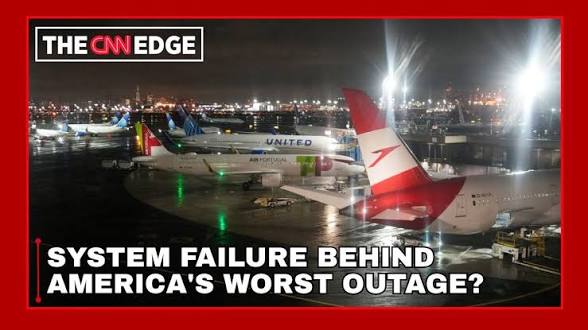
A growing wave of technology outages affecting airlines, banks and majo technology companies is raising serious questions about the reliability of America’s digital infrastructure. Within just a few days, disruptions have affected flight operations, online banking, payment services, cloud platforms and government communications.
The incidents have created confusion for travellers, businesses and ordinary customers. People have struggled to access financial services, complete digital transactions and obtain reliable travel information. Meanwhile, airlines have faced operational interruptions that have delayed flights and disrupted passenger journeys.
The timing of these incidents has also raised concerns about a possible connection between them. However, cybersecurity experts and government officials have cautioned against assuming that the disruptions are part of one coordinated cyberattack.
Instead, specialists point to several underlying problems. These include ageing technology, complicated software systems, infrastructure weaknesses, poor change management and growing dependence on a relatively small number of technology providers.
The latest incidents demonstrate how quickly a technical problem can affect essential services. They also highlight an uncomfortable reality: modern economies increasingly depend on digital systems that can become vulnerable when even one important component stops working.
Why Are Airlines And Banks Experiencing Major System Outages?
The recent disruptions have affected several major organisations across different industries.
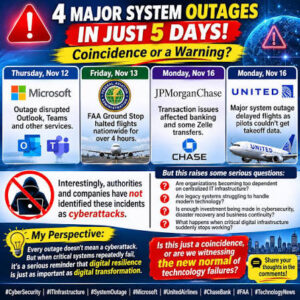
Microsoft, the Federal Aviation Administration (FAA), United Airlines, JPMorgan Chase and Apple have all experienced significant technology problems during the latest wave of incidents.
Although these organisations operate in different sectors, they depend on complex digital infrastructure. Their systems manage communications, customer accounts, payments, scheduling and other essential operations.
When these systems experience technical problems, the consequences can quickly extend beyond a single company.
For example, an airline technology failure can prevent employees from accessing operational information. It can also interrupt passenger check-in, flight scheduling and other services.
Similarly, a banking software problem can affect online account access, transfers and payment processing.
According to reporting published on November 18, the recent incidents involved different technical problems rather than one confirmed common cause.
Forbes+1
This distinction is important.
A series of outages occurring within a short period does not automatically mean that hackers have attacked multiple organisations. Independent technical failures can happen at the same time, especially when companies operate increasingly complicated systems.
However, the incidents have exposed weaknesses that deserve serious attention.
A Wave Of Technology Failures Raises National Concerns
The latest disruptions have affected several important parts of everyday life.
Each incident has demonstrated how dependent consumers and businesses have become on digital services.
1. Microsoft Outage Disrupts Business Operations
One of the major incidents involved Microsoft 365 services, including Outlook, Teams and Copilot.
The disruption began on November 12 and affected users across multiple countries. Businesses experienced difficulties accessing email, communication tools and other cloud-based services.
Microsoft attributed the incident to problems involving network capacity and a network configuration change.
The disruption demonstrated how a problem within a major cloud platform can affect organisations that depend on its services.
For many businesses, Microsoft applications are essential working tools. Employees use them to communicate, exchange documents, organise meetings and manage daily operations.
When these services become unavailable, even routine business activities can slow down.
The incident also highlighted the importance of testing software and network changes before introducing them into large production environments.
NDTV Profit+1
2. FAA Technology Failure Disrupts Air Travel
Air travel faced another major challenge when a technical problem affected the Federal Aviation Administration’s telecommunications network on November 13.
The disruption forced authorities to order a nationwide ground stop, temporarily interrupting flight operations across the United States.
The problem affected communication systems used to support aviation operations. Airlines subsequently faced cancellations and delays.
According to NDTV Profit’s November 18 report, the FAA attributed the incident to a data flood originating from two sites.
The disruption also renewed concerns about ageing infrastructure within America’s air traffic control system.
Although aviation technology has advanced considerably, important parts of the system still depend on older equipment and communications infrastructure.
This creates a difficult challenge for regulators.
They must modernise essential systems without interrupting the operations that millions of passengers depend on every year.
NDTV Profit+1
3. United Airlines Faces Operational Disruption
United Airlines also experienced a significant technology problem on November 16.
The incident disrupted flight operations and delayed approximately 150 flights, according to reporting on the recent outage.
Airline technology systems coordinate several essential activities. These include flight scheduling, passenger services, crew management and operational communications.
A failure in one part of this environment can create difficulties across the wider network.
Even when aircraft remain operational, airlines can struggle to maintain their schedules if employees cannot access important systems.
Passengers may experience delayed departures, missed connections and unexpected changes to their travel arrangements.
The incident highlights why airlines need reliable backup systems and effective recovery procedures.
Aviation companies cannot depend entirely on technology working perfectly at every moment. They must also prepare for situations in which important digital services become temporarily unavailable.
Forbes+1
4. JPMorgan Chase Banking Problems Affect Customers
The banking sector has also faced disruption.
JPMorgan Chase reported a software-related problem on November 16 that affected some banking services.
Customers experienced difficulties involving online banking, transfers and payment-related services.
The bank attributed the problem to a software bug involving an internal hardware system. It said the incident was not related to a cyberattack.
The disruption raised concerns because modern banking depends heavily on interconnected digital systems.
Customers expect to access their money, transfer funds and make payments at almost any time.
However, these services depend on multiple systems working together.
A problem involving one component can interrupt transactions even when customers’ accounts and financial records remain secure.
The incident also illustrates why financial institutions need reliable backup arrangements and strong software testing procedures.
NDTV Profit+1
What Is Causing These Widespread System Outages?
Cybersecurity specialists say there is no single explanation for every recent technology failure.
Instead, several long-term weaknesses may be contributing to the growing number of disruptions.
1. Ageing Digital Infrastructure
One major concern is the continued use of outdated technology.
Many organisations have upgraded their software without completely replacing the infrastructure supporting it.
As a result, modern applications sometimes operate on older servers, networks and hardware.
This creates compatibility and performance challenges.
Dr. David Utzke, a cybersecurity expert and CEO of MyKey Technologies, has highlighted the problem of introducing modern software into ageing infrastructure.
Older systems may struggle to handle new workloads, particularly when organisations introduce major upgrades.
The problem becomes more serious when essential services depend on technology that has not received sufficient investment.
Airlines and banks cannot simply switch off their systems for extended periods. They must maintain continuous operations while gradually replacing outdated equipment.
That makes infrastructure modernisation both expensive and technically complicated.
https://www.firstalert4.com+1
2. Software Bugs And Failed Updates
Software updates are necessary to improve security, performance and functionality.
However, updates can also introduce unexpected problems.
A small programming error can affect thousands or even millions of users when it reaches a widely used system.
The recent Microsoft and JPMorgan incidents demonstrate how software and configuration problems can interrupt important services.
Organisations often introduce updates to improve their systems. However, insufficient testing can create new vulnerabilities.
A change that works correctly in a limited testing environment may behave differently when exposed to millions of users.
This is particularly concerning for companies operating large digital platforms.
Experts believe organisations need stronger testing procedures, better monitoring and more careful approval processes before deploying major changes.
3. Too Much Dependence On A Small Number Of Technology Providers
Another important concern involves the concentration of digital infrastructure.
Although the internet appears decentralised, many organisations depend on a relatively small group of cloud providers, software companies and network operators.
This creates efficiency, but it also introduces shared risks.
If a major provider experiences an outage, several unrelated businesses may experience problems simultaneously.
For example, an airline, retailer and financial company may all depend on the same underlying cloud or network services.
They may have completely separate operations, but their digital infrastructure can share important components.
Lisa Forte, founder of Red Goat Cyber Security, has warned about this concentration of technology dependence.
The concern is not simply that one company might fail. It is that a failure within a widely used provider could affect many organisations at once.
This makes infrastructure diversification and independent backup arrangements increasingly important.
Forbes+1
4. Increasing Complexity Of Digital Systems
Modern businesses use thousands of connected applications and services.
A single banking transaction, for example, may involve identity verification, payment processing, fraud detection and communication with other financial institutions.
Airline operations are similarly complicated.
Flight management, passenger information, airport communications and scheduling systems must exchange information accurately.
These connections make services faster and more efficient.
However, they also make it harder to identify the source of a technical failure.
When one component stops working, the effects may spread through other connected systems.
This is sometimes described as a cascading failure.
The problem becomes particularly serious when companies do not fully understand all the dependencies within their technology environments.
Experts warn that organisations must understand how their systems behave during normal operations, unexpected failures and potential cyber incidents.
The Washington Post+1
5. Technology Debt And Lack Of Maintenance
Technology debt is another important factor.
It develops when organisations delay necessary infrastructure improvements or continue using outdated systems because replacing them is expensive.
Over time, these decisions can create complicated technology environments.
New applications are added, but older systems remain in operation.
Eventually, maintaining the entire environment becomes more difficult.
Cybersecurity expert Becky Pinkard has described the accumulation of technology debt as one reason why failures can occur across complex digital environments.
There is also a shortage of experienced professionals who understand some older systems.
When the original engineers leave, organisations may struggle to maintain infrastructure that was built many years earlier.
This makes regular maintenance, documentation and staff training essential.
Are These Outages Connected To A Major Cyberattack?
One of the biggest questions surrounding the recent incidents is whether a hostile country or cybercriminal group is responsible.
The timing has understandably attracted attention.
Several major organisations have experienced technology failures within days, including companies responsible for financial services, communications and transportation.
However, there is an important difference between a cyberattack and an ordinary technical failure.
A cyberattack involves malicious activity intended to compromise, disrupt or gain unauthorised access to a system.
A technical outage can happen without any malicious involvement.
It may result from a defective software update, hardware failure, network configuration problem or unexpected increase in traffic.
US Secretary of State Marco Rubio has rejected suggestions that the recent incidents represent one coordinated attack.
He said there was no evidence connecting the events to a common hostile actor.
Other officials and organisations have also indicated that the incidents were separate technical problems.
This does not mean cybersecurity threats should be ignored.
Cybercriminals can exploit weaknesses in digital systems, particularly during periods of disruption.
However, investigators need technical evidence before attributing an outage to a particular attacker.
Such evidence could include suspicious network activity, compromised credentials, malicious code or common attack infrastructure.
Without that evidence, describing the entire sequence as a coordinated cyberattack would be premature.
Forbes+2
Why Backup Systems Are Not Always Enough
Most major airlines and banks have backup arrangements designed to keep essential services running during technical problems.
However, recent incidents have raised questions about how effectively these arrangements work.
A backup system is only useful if it can operate independently of the failed system.
If two supposedly separate systems depend on the same network, software configuration or infrastructure provider, one problem may affect both.
This is known as a common point of failure.
For example, an organisation may have a backup server, but that server could still depend on the same network connection as its primary server.
If the network fails, both systems may become unavailable.
There is also the problem of unexpected demand.
When a primary service becomes unavailable, thousands of users may immediately move to alternative systems.
Those backup services may not have enough capacity to handle the additional traffic.
Experts therefore argue that companies should regularly test their recovery plans under realistic conditions.
They must also ensure that backup systems are genuinely independent.
A recovery plan that has never been tested may provide a false sense of security.
How System Outages Affect Ordinary People
The consequences of major technology failures extend far beyond company operations.
Ordinary consumers often experience the most immediate effects.
Here are some of the biggest risks.
Flight Delays And Cancellations
When airline or aviation systems experience disruptions, passengers may face unexpected delays.
They may also miss connecting flights or struggle to obtain updated travel information.
For international travellers, even a short disruption can affect hotel bookings, meetings and other arrangements.
Banking And Payment Difficulties
Banking outages can prevent customers from completing digital transactions.
They may struggle to transfer money, check account information or make online payments.
Businesses can also experience difficulties accepting payments from customers.
This is particularly challenging for small businesses that depend heavily on digital payment services.
Disrupted Business Operations
Companies increasingly depend on cloud platforms and online communication tools.
If these systems stop working, employees may lose access to important documents, emails and internal applications.
This can delay projects and affect customer services.
Increased Opportunities For Scams
An outage does not automatically mean that customer information has been stolen.
However, cybercriminals may exploit the confusion surrounding service disruptions.
They can send fraudulent emails and text messages claiming that customers must verify their accounts or install emergency software updates.
These messages may contain malicious links designed to steal passwords or financial information.
Consumers should be especially careful when receiving unexpected messages during major outages.
WRAL News+1
What Experts Say Companies Must Do Next
The recent outages have created pressure on businesses and government agencies to improve their digital infrastructure.
Experts believe organisations must move beyond simply restoring services after an incident.
They need to identify why the failure happened and determine how to prevent similar problems.
Several measures could make a meaningful difference.
First, companies must modernise ageing infrastructure. Older servers, communication equipment and network systems should be replaced through carefully planned upgrades.
Second, organisations need stronger software testing. Updates should be tested under realistic conditions before being introduced into critical environments.
Third, companies should improve backup systems. Alternative infrastructure must remain available even when the primary network or provider experiences problems.
Fourth, businesses need better monitoring. Early detection can help technical teams identify unusual activity before a small problem becomes a major outage.
Finally, organisations must improve transparency. Customers deserve clear explanations when essential services become unavailable.
The Washington Post’s November 17 reporting also highlighted the importance of understanding how complex systems behave under normal, abnormal and hostile conditions.
The Washington Post+1
Could More Airline And Banking Outages Happen?
Experts believe further disruptions remain possible.
The reason is straightforward: digital infrastructure continues to become more complicated.
Companies are introducing artificial intelligence, cloud computing and automated services into their daily operations.
These technologies can improve productivity, but they also increase the number of systems that organisations must manage.
More connections can mean more potential failure points.
There is also the challenge of maintaining older infrastructure while introducing new technology.
The transition can take years, particularly in industries where uninterrupted operations are essential.
However, this does not mean that a nationwide technology crisis is inevitable.
Companies can reduce risks through better planning, modernisation, independent backups and stronger cybersecurity procedures.
Government regulators also have an important role.
They can establish resilience standards, demand better reporting and encourage investment in critical infrastructure.
The goal should not simply be to prevent every possible failure. No complicated technology system can guarantee that.
Instead, the priority must be ensuring that failures remain limited and essential services recover quickly.
What Should Consumers Do During A Major System Outage?
While companies work to improve their infrastructure, consumers can take several practical steps to protect themselves.
Cybersecurity specialists recommend preparing for temporary disruptions rather than assuming digital services will always remain available.
Here are some important precautions:
Keep some cash available: Cash can help when card payments, ATMs or mobile payment services stop working.
Use strong passwords: Create unique passwords for banking, email and other important accounts.
Enable two-factor authentication: This adds another layer of protection against unauthorised access.
Avoid suspicious messages: Do not click links claiming that your bank or airline requires an urgent account update.
Download important travel information: Keep flight details, booking confirmations and essential contact information accessible offline.
Maintain alternative communication options: Save important phone numbers and keep your mobile phone charged.
Check official service announcements: Use verified company websites and applications to obtain accurate updates.
Experts also warn that scammers may use public concern about outages to create convincing phishing campaigns.
Customers should never share banking passwords, PINs or one-time passwords in response to unexpected messages.
WRAL News+1
The Bigger Warning: America’s Digital Infrastructure Needs Attention
The latest technology disruptions have exposed a serious challenge facing modern economies.
Airlines, banks, government agencies and technology companies increasingly depend on interconnected digital systems.
These systems make everyday activities faster and more convenient. However, they also create new risks when essential infrastructure becomes unavailable.
The recent incidents should therefore be viewed as an important warning.
A software bug can interrupt banking services. A telecommunications failure can disrupt aviation operations. A network configuration problem can affect businesses across multiple countries.
These incidents do not necessarily indicate a coordinated attack or a complete breakdown of America’s digital infrastructure.
However, they demonstrate that technological progress must be supported by investment in reliability and resilience.
Companies cannot focus exclusively on speed, convenience and efficiency. They must also prepare for unexpected failures.
The coming months will be important for determining whether major organisations can turn these disruptions into meaningful improvements.
For consumers, the message is equally clear: digital convenience should never replace basic preparation.
The biggest lesson from the latest system outages is that modern technology is only as reliable as the infrastructure supporting it.
Frequently Asked Questions (FAQs)
1. Why are airlines and banks experiencing system outages?
Airlines and banks are experiencing technology disruptions because of several possible factors, including software bugs, ageing infrastructure, network failures and complicated digital systems. Recent incidents have involved separate technical problems rather than one confirmed common cause.
2. Are the recent system outages caused by cyberattacks?
There is currently no confirmed evidence that the recent major outages are part of one coordinated cyberattack. US officials and affected organisations have attributed several incidents to technical problems, software bugs and network issues.
3. Which major companies have experienced recent technology outages?
Recent disruptions have affected Microsoft, United Airlines, JPMorgan Chase, Apple and the Federal Aviation Administration. Other technology and service providers have also reported or experienced technical issues.
4. How do system outages affect airline passengers?
Airline technology failures can interrupt flight scheduling, passenger check-in, operational communications and other services. Passengers may experience delayed departures, cancellations and missed connections.
5. Why do banking outages affect online payments?
Online payments depend on several interconnected systems. If a software bug or network failure affects an important component, customers may temporarily struggle to access accounts, transfer money or complete transactions.
6. What is technology debt?
Technology debt refers to the long-term problems created when organisations delay necessary technology improvements. It often develops when companies continue using outdated infrastructure while adding newer software and applications.
7. Can backup systems prevent major outages?
Backup systems can reduce disruption, but they cannot prevent every failure. If backup services depend on the same network, provider or infrastructure as the primary system, both may become unavailable.
8. Will more system outages happen in the future?
Further outages are possible as digital infrastructure becomes more complex and interconnected. However, modernisation, stronger testing, independent backups and improved monitoring can reduce the likelihood and impact of major disruptions.
9. How can customers protect themselves during banking outages?
Customers should use official banking applications and websites, avoid suspicious links, maintain strong passwords and never share PINs or one-time passwords. Keeping some emergency cash is also useful.
10. What is the biggest lesson from the recent technology failures?
The biggest lesson is that essential services need reliable and resilient infrastructure. Airlines, banks and technology companies must improve their systems, test software changes carefully and prepare for unexpected technical failures.
About the Author