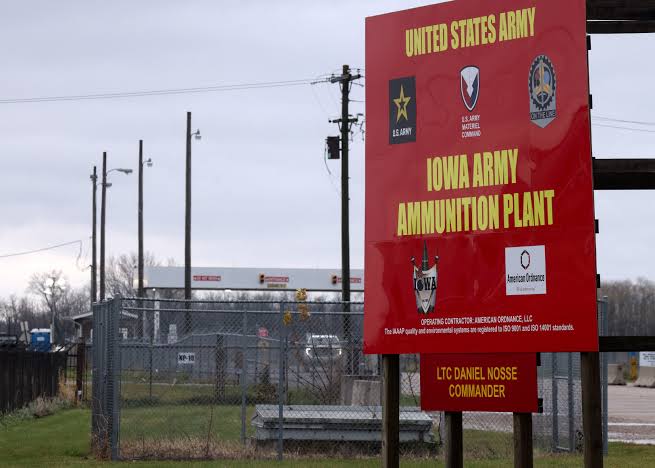
The US Army is preparing for a controversial controlled detonation of highly unstable lead azide at an ammunition facility in southeastern Iowa. The planned operation has raised significant concerns among residents, environmental organizations and public health officials because the explosion could release toxic lead particles into the surrounding environment.
The operation involves 68 barrels containing several tons of degraded lead azide stored at the Iowa Army Ammunition Plant near Middletown. Military officials say the explosive material has become increasingly unstable and could trigger an accidental explosion if left untreated or moved.
However, the planned destruction has generated widespread public concern. Residents fear that airborne lead particles could spread beyond the military installation, potentially affecting homes, agricultural land, waterways and nearby communities.
The Army initially scheduled the operation for November 20, 2026. However, repeated delays, legal challenges and changing weather conditions have complicated the timeline.
As of November 24, the Army plans to proceed with the controlled detonation on Wednesday, November 25, following a federal appeals court decision that cleared the way for the operation.
The situation has become a major public safety issue, highlighting the difficult balance between preventing an accidental explosion and protecting communities from environmental contamination.
1. Why Is the US Army Planning a Controlled Detonation in Iowa?

The Iowa lead azide detonation plan follows the discovery of severely degraded explosive material at the Iowa Army Ammunition Plant.
The problem was identified in March 2026 during inspections at the military installation.
According to Army officials, the facility contained dozens of barrels of lead azide that had deteriorated over time. Changes in the chemical mixture caused crystals to develop inside the containers.
This deterioration created a potentially dangerous situation.
Lead azide is an explosive chemical used in ammunition and detonators. Although it can be handled safely under controlled conditions, degraded material can become extremely sensitive to physical disturbances.
The Army believes moving the barrels could trigger an uncontrolled explosion.
Furthermore, leaving the material inside its current storage conditions could allow the situation to become even more dangerous.
Military specialists therefore recommended destroying the material through a carefully managed detonation.
The Army maintains that this approach presents the lowest overall risk to nearby residents.
However, environmental groups have questioned whether alternative disposal methods received sufficient consideration.
The disagreement has turned the planned operation into a major environmental and legal controversy.
According to the Associated Press, the federal appeals court considered several disposal alternatives before allowing the operation to proceed.
AP News+1
2. What Is Lead Azide and Why Is It Dangerous?
Lead azide is a chemical compound containing lead and nitrogen. Its chemical formula is Pb(N₃)₂.
The compound is primarily used as a primary explosive in military and industrial applications.
Its purpose is to initiate a larger explosive reaction. Because it reacts readily to certain physical disturbances, it requires careful storage and handling.
The Iowa situation is particularly concerning because the stored material has reportedly undergone chemical degradation.
Why Does Degraded Lead Azide Create a Risk?
Lead azide can become more dangerous when its storage conditions change.
In the Iowa case, officials identified a reduction in the liquid surrounding the explosive material. Some of the water in the storage mixture had evaporated.
As a result, crystals formed inside the containers.
These crystals can become highly sensitive to shock, friction and temperature changes.
According to military specialists, even relatively minor disturbances could potentially trigger an explosive reaction.
The approaching winter weather has added another complication.
Army officials warned that falling temperatures could increase the danger of an uncontrolled explosion.
This is one of the main reasons military authorities have pushed to complete the operation quickly.
However, destroying the explosive material also creates environmental challenges because lead is toxic and does not naturally break down into harmless substances.
3. Army Plans to Detonate 68 Barrels of Explosive Material
The planned operation involves 68 barrels containing degraded lead azide.
The total quantity has been described as nearly five tons of hazardous explosive material.
The Iowa Army Ammunition Plant, located near Middletown, will serve as the site of the controlled detonation.
The Army intends to conduct the operation with explosive ordnance disposal specialists and other technical personnel.
Officials say the process will include protective barriers, weather monitoring and environmental sampling.
These precautions are intended to reduce the possibility of an uncontrolled explosion and limit the spread of hazardous particles.
The Army also plans to monitor environmental conditions before and after the operation.
According to the Associated Press, the federal appeals court identified several safeguards in the emergency permit, including updated air modeling, advance public notification and environmental monitoring.
AP News+1
Why Is the Army Avoiding Transportation?
One of the biggest concerns involves moving the deteriorating barrels.
Military experts believe that handling, transferring or transporting the material could disturb the sensitive crystals.
Such disturbances could potentially trigger a chain reaction.
Therefore, the Army has selected an in-place destruction strategy rather than moving the barrels to another facility.
Military officials argue that this reduces the risk associated with transporting unstable explosives through populated areas.
Nevertheless, the environmental consequences of the explosion remain a major concern.
4. When Will the Iowa Lead Azide Detonation Happen?
The operation has experienced several scheduling changes.
Initially, the Army planned to conduct the controlled detonation on November 20, 2026.
However, concerns from residents, environmental organizations and public officials contributed to delays.
The Army subsequently moved the operation to November 23.
Additional legal and political developments complicated the schedule.
A federal court temporarily blocked the environmental permit while considering a legal challenge brought by environmental groups.
The Army also faced pressure to provide additional information about possible contamination and public safety measures.
On November 24, the situation changed following a federal appeals court decision.
The 8th US Circuit Court of Appeals lifted the hold on the plan, allowing the Army to move forward.
The Army subsequently confirmed its intention to conduct the controlled detonation on Wednesday, November 25.
Officials say weather conditions are an important factor in selecting the final timing.
Therefore, residents should continue monitoring official announcements for any changes.
The Washington Post+2
5. Toxic Lead Dust Raises Serious Health Concerns
One of the biggest concerns surrounding the Iowa lead azide detonation is the possibility of airborne lead contamination.
The explosion is expected to produce a dust plume containing lead particles.
Depending on weather conditions, these particles could travel beyond the ammunition plant.
Some Army projections have suggested that the potential impact area could extend as far as 100 miles.
However, this represents a modeled possibility rather than confirmed contamination.
The actual movement of airborne particles will depend on wind direction, atmospheric conditions and the characteristics of the explosion.
Lead exposure is a serious public health concern.
The US Environmental Protection Agency states that there is no known safe level of lead exposure.
Even relatively small amounts can create health risks, particularly for vulnerable populations.
Who Is Most Vulnerable to Lead Exposure?
Children are among the groups most vulnerable to lead exposure.
Their developing brains and nervous systems are particularly sensitive to toxic substances.
Lead exposure can contribute to:
Learning and developmental difficulties.
Problems with attention and behavior.
Damage to the nervous system.
Kidney-related health problems.
Increased cardiovascular risks.
Reproductive and pregnancy-related complications.
Pregnant women also face additional concerns because lead exposure can affect fetal development.
Furthermore, lead can remain in the environment for extended periods.
Unlike many organic pollutants, lead does not naturally disappear through ordinary environmental decomposition.
This means contaminated dust or soil could create longer-term problems if it is not properly managed.
These concerns explain why public health officials are urging residents to follow safety recommendations carefully.
Chicago Sun-Times+2
6. Could Toxic Lead Dust Spread Beyond Iowa?
The possibility of cross-state contamination has become another major concern.
The Iowa Army Ammunition Plant is located near the Mississippi River and the Illinois border.
This geographical location means that weather conditions could influence communities outside Iowa.
Illinois officials have already warned that some communities could potentially experience airborne lead exposure.
Mercer County, Illinois, has received particular attention in public safety discussions.
However, the exact impact area remains dependent on updated weather modeling.
The Army has developed maps showing two different potential exposure pathways.
The first map focuses on airborne lead particles that people could breathe.
The second identifies areas where lead-containing dust could settle on surfaces.
These maps are important because airborne exposure and surface contamination are different risks.
For example, a community might experience temporary airborne particles without receiving the same level of surface deposition as another location.
Officials have indicated that the modeled areas may change as weather forecasts are updated.
Therefore, residents should avoid treating early projections as final contamination maps.
Could Agricultural Land Be Affected?
Agriculture is an important part of Iowa’s economy.
Consequently, farmers and agricultural organizations are closely watching the situation.
If lead particles settle on farmland, soil and water contamination could become concerns.
Potential exposure pathways include:
Dust settling on agricultural soil.
Contamination of outdoor surfaces.
Exposure of livestock to contaminated environments.
Movement of particles through water systems.
Potential contamination of agricultural equipment.
However, the actual agricultural impact cannot be determined until environmental monitoring provides reliable measurements.
Officials will need to examine air, soil and water samples to understand the consequences.
epa.illinois.gov+2
7. Environmental Groups Challenge the Army’s Plan
The planned detonation has attracted opposition from environmental organizations.
These groups argue that the Army must provide stronger assurances about public safety and environmental protection.
Their concerns focus on the potential release of toxic lead particles and whether other disposal methods could reduce environmental damage.
One major issue involves chemical neutralization.
According to reporting by The Washington Post, the Army initially hired a Georgia-based environmental company to explore chemical treatment for the degraded lead azide.
The contract was later cancelled.
The company reportedly believed its approach could stabilize the material without producing the same environmental fallout associated with an explosion.
However, the Army said its evaluation found that the proposed treatment did not work at the required size, scope and scale.
This disagreement has become central to the public debate.
Environmental advocates argue that alternative methods deserved further investigation.
Meanwhile, military officials maintain that handling the unstable material could create a potentially fatal explosion risk.
The controversy demonstrates how difficult hazardous waste decisions can become when public safety and environmental protection appear to conflict.
The Washington Post+1
8. Federal Court Clears the Way for the Detonation
Legal challenges have played an important role in the Iowa situation.
Environmental groups filed a lawsuit seeking to stop the planned operation.
Their challenge focused on the environmental permit issued by the EPA.
A temporary court order placed the permit on hold, creating uncertainty about whether the Army could proceed.
However, the situation changed on November 23.
A three-judge panel of the 8th US Circuit Court of Appeals lifted the temporary hold.
The court concluded that the emergency permit included safeguards designed to address concerns about dust dispersal.
These measures included:
Protective barriers around the storage area.
Weather restrictions.
Advance public notification.
Updated air-quality modeling.
Environmental monitoring.
Post-operation sampling.
The ruling allowed the Army to move forward with its plan.
However, the legal dispute has not eliminated public concerns.
Environmental groups continue to question whether the Army has provided sufficient information about the potential consequences.
The case has also raised broader questions about federal responsibility when military operations involve hazardous chemicals near civilian communities.
AP News+1
9. Trump Administration and Iowa Officials Face Pressure
The planned detonation has also become a political issue.
Residents and elected officials have demanded clearer communication from federal authorities.
Iowa Governor Kim Reynolds activated the state’s emergency management office as preparations continued.
Incoming Governor Rob Sand has also commented on the situation.
Sand argued that the federal administration should make its decision using information gathered by the specialists involved in the operation.
President Donald Trump became directly involved when he called for the operation to be stopped until the legal challenge received further consideration.
He also suggested that Iowa’s governor-elect should approve the decision.
However, Sand maintained that the responsibility belongs to the federal government.
The situation highlights the complicated relationship between federal military authority and state-level emergency management.
Although local and state officials are responsible for supporting affected communities, the operation itself remains a federal military decision.
The debate has also increased pressure on the Army to explain why the hazardous material was allowed to deteriorate and what measures will prevent similar incidents.
The Washington Post+1
10. What Safety Precautions Should Residents Follow?
Public health officials have encouraged residents in potentially affected areas to follow official safety instructions.
The most important precaution is limiting contact with airborne lead particles.
People living or working in areas identified by updated exposure maps should consider taking the following steps.
Stay Indoors
Residents should remain inside during the airborne exposure period if their communities are included in the affected area.
Keeping windows and doors closed can help reduce the entry of outdoor particles.
Adjust Heating and Cooling Systems
Where possible, residents should set heating and cooling systems to recirculate indoor air.
Systems that bring in outdoor air may require temporary adjustments.
People should follow guidance from local health authorities.
Avoid Unnecessary Travel
Residents should avoid unnecessary outdoor activities and travel through affected areas during the operation.
This is particularly important for families with young children.
Clean Potentially Contaminated Surfaces
After authorities announce that the airborne exposure period has ended, residents may need to clean outdoor and indoor surfaces.
Wet cleaning with soap and water can help remove dust.
Surfaces requiring attention may include:
Windowsills.
Outdoor furniture.
Children’s playground equipment.
Vehicles.
Doorways and entry areas.
Frequently touched outdoor surfaces.
Avoid dry sweeping or other cleaning methods that could send settled dust back into the air.
Maintain Personal Hygiene
Wash hands before eating or drinking.
Remove outdoor shoes before entering living spaces where practical.
These measures can help reduce the possibility of tracking contaminated dust indoors.
Residents should also consult healthcare professionals if they have concerns about possible exposure.
The Illinois Department of Public Health has recommended staying indoors, keeping windows closed and cleaning potentially affected surfaces after the exposure period ends.
Chicago Sun-Times+2
11. What Happens After the Controlled Explosion?
The detonation will not necessarily mark the end of the environmental response.
Once the explosive hazard has been neutralized, environmental monitoring will become particularly important.
The Army has indicated that it will conduct sampling to determine whether hazardous material has spread beyond the immediate blast area.
The monitoring process is expected to examine environmental conditions and identify areas requiring additional attention.
Potential activities include:
Air monitoring: Testing airborne particles to determine whether lead concentrations have increased.
Surface sampling: Examining outdoor surfaces where dust could have settled.
Soil testing: Identifying possible contamination in nearby land.
Water monitoring: Assessing whether nearby water sources require additional investigation.
Cleanup operations: Removing contaminated soil or other materials where necessary.
The results will help determine whether additional protective measures are required.
However, independent verification and transparent reporting will be important for maintaining public confidence.
Residents will want clear answers about where particles traveled, what levels were detected and whether any cleanup is necessary.
The Army’s responsibility will therefore extend beyond completing the explosive disposal operation.
It will also need to address environmental concerns created by the process.
12. Why the Iowa Lead Azide Crisis Matters Beyond One Military Base
The Iowa incident has implications beyond the immediate area surrounding Middletown.
It raises important questions about how military facilities manage aging explosive materials.
Hazardous chemicals can become increasingly difficult to handle when storage conditions change or materials deteriorate.
Therefore, regular inspections and effective long-term storage systems are essential.
The situation also demonstrates the importance of communication between federal agencies and local communities.
Residents should receive clear information before potentially hazardous operations take place.
They need to understand the risks, expected timelines and available protective measures.
Furthermore, environmental emergencies require coordination between military specialists, public health departments and environmental regulators.
The Iowa situation has shown how disagreements over technical decisions can quickly become legal and political controversies.
It also highlights the importance of evaluating alternative disposal technologies before hazardous materials reach a critical stage.
Ultimately, preventing similar incidents will require better monitoring, responsible storage practices and transparent emergency planning.
Conclusion: Iowa Faces a Critical Test of Military Safety and Environmental Protection
The Iowa lead azide detonation has become a major public safety and environmental controversy.
The US Army says destroying the 68 barrels of degraded explosive material is necessary to prevent a potentially catastrophic uncontrolled explosion.
However, residents and environmental advocates remain concerned about toxic lead dust and its possible effects on nearby communities.
The federal appeals court’s November 23 decision has cleared the way for the operation, with the Army planning to proceed on November 25.
Still, important questions remain about the extent of potential contamination, the effectiveness of protective measures and the long-term environmental consequences.
For residents, the immediate priority is following official safety instructions and monitoring updated exposure information.
For the Army, the challenge extends beyond detonating the unstable material.
It must also demonstrate that public safety, environmental monitoring and post-operation cleanup receive the attention they require.
The coming days will be critical in determining whether the operation can eliminate the explosive threat while limiting environmental harm.
Frequently Asked Questions (FAQs)
1. Why is the US Army planning to detonate lead azide in Iowa?
The Army plans to destroy 68 barrels of degraded lead azide at the Iowa Army Ammunition Plant. Officials say the material has become unstable and could accidentally explode if it remains in storage or is transported.
2. When will the Iowa lead azide detonation happen?
As of November 24, 2026, the Army plans to conduct the controlled detonation on Wednesday, November 25. The final timing may depend on weather conditions and official operational updates.
3. What is lead azide?
Lead azide is an explosive chemical compound used in military ammunition and detonators. It is sensitive to shock and friction, particularly when its chemical condition deteriorates.
4. How many barrels of lead azide will the Army detonate?
The operation involves 68 barrels containing several tons of degraded lead azide at the Iowa Army Ammunition Plant near Middletown.
5. Is lead azide dangerous to humans?
Yes. Lead azide is an explosive substance, while lead itself is toxic to humans. Exposure to lead particles can damage the nervous system and create serious health problems, particularly for children and pregnant women.
6. Could the Iowa explosion spread toxic dust to Illinois?
Potentially. Army modeling indicates that airborne lead particles could travel beyond Iowa, depending on weather conditions. Illinois officials have warned that some communities could be affected.
7. Why did the Army delay the planned detonation?
The operation faced public opposition, environmental concerns, changing weather conditions and legal challenges. The Army also adjusted the schedule to address concerns about the instability of the stored material.
8. Did a federal court approve the Iowa detonation?
The 8th US Circuit Court of Appeals lifted a temporary hold on the EPA emergency permit on November 23, 2026. The decision cleared the way for the Army to proceed with the operation.
9. What should residents do during the lead azide detonation?
Residents in potentially affected areas should follow official instructions. Recommended precautions include staying indoors, closing windows and doors, avoiding unnecessary travel and cleaning potentially contaminated surfaces after authorities announce that the airborne exposure period has ended.
10. Will the Army test the environment after the explosion?
Yes. The Army has outlined environmental monitoring and sampling measures to assess potential lead contamination and identify areas that may require cleanup.
11. Can lead contamination disappear naturally?
No. Lead is an element that does not break down naturally. It can remain in soil, dust and other environmental materials for extended periods.
12. What is the biggest concern surrounding the Iowa toxic blast?
The biggest concern is balancing the danger of an accidental explosion against the environmental and public health risks of releasing lead-containing particles during the controlled detonation.
About the Author