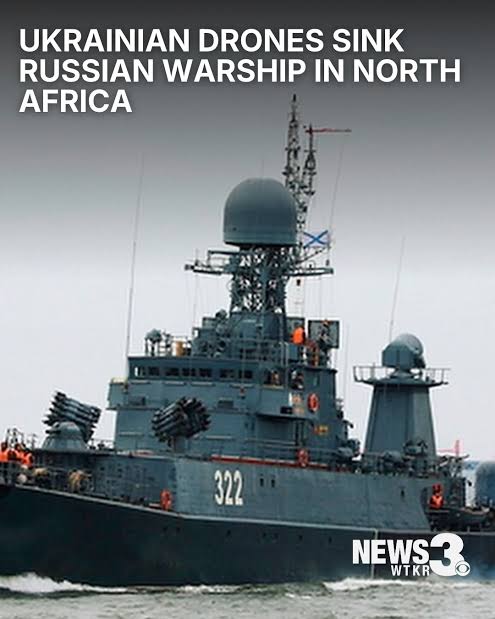
Ukraine has delivered another major blow to Russia’s naval capabilities after Ukrainian sea drones reportedly sank a Russian Navy warship at the Libyan port of Benghazi. The dramatic operation, which took place on November 22, 2026, demonstrates how far Ukraine’s maritime warfare capabilities have expanded since Russia launched its full-scale invasion in February 2022.
Ukrainian President Volodymyr Zelenskyy confirmed the operation on November 23, stating that Ukrainian forces deployed seven domestically manufactured naval drones to attack the Russian corvette Merkury. He described the mission as a successful operation against Russian military assets operating far beyond the Black Sea.
The attack reportedly destroyed the warship and a Ka-27 military helicopter. Ukrainian forces also struck a Russian cargo vessel, the MV Angara, which Kyiv claims was being used to transport military supplies.
The incident is particularly significant because the Russian warship was located in Benghazi, Libya, thousands of kilometres from Ukraine’s southern coastline. It highlights the growing geographical reach of Ukraine’s unmanned naval forces and raises questions about the security of Russian military logistics across the Mediterranean.
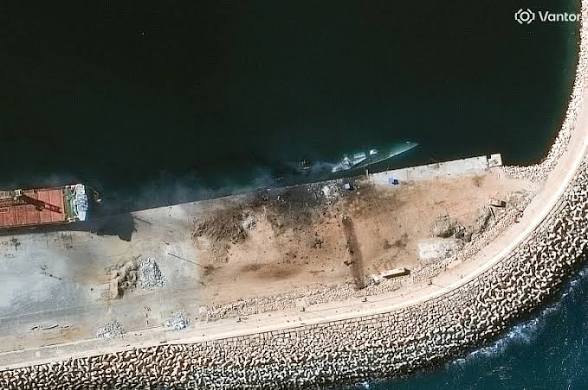
According to reporting by Reuters, footage released by Ukraine’s Security Service showed explosions, fires and smoke around the targeted vessels. Satellite imagery also showed the Russian corvette capsized at the naval base.
Reuters+2
What Happened During the Ukrainian Naval Strike?
The Ukrainian naval strike unfolded during the early hours of November 22 at Benghazi, a major port city in eastern Libya.
The Russian corvette Merkury was reportedly docked at a naval facility when Ukrainian unmanned surface vessels approached and attacked it.
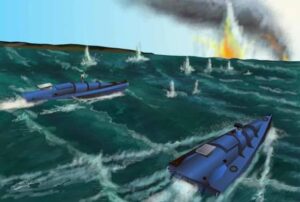
According to Zelenskyy, seven Ukrainian-made naval drones participated in the operation. These vessels were reportedly transported to the designated operational area aboard a larger support vessel, commonly described as a mother ship.
This approach allowed Ukrainian forces to conduct an operation far beyond the normal operating range of their coastal drone units.
Ukraine’s Security Service, known as the SBU, said the unmanned boats successfully reached their targets despite Russian attempts to intercept them.
The operation reportedly involved several coordinated strikes. The Russian warship suffered severe damage, caught fire and eventually sank.
Ukraine also announced that its forces struck the MV Angara, a Russian dry cargo vessel allegedly involved in transporting weapons.
However, the full extent of the cargo ship’s damage has not been independently established.
The operation represents a significant development in Ukraine’s efforts to challenge Russian military assets outside traditional battle zones.
Russian Corvette Merkury: Why the Warship Was an Important Target
The Russian vessel targeted in the operation was the Merkury, a Project 20380 Steregushchiy-class corvette.
It was among Russia’s newer naval vessels and was commissioned in 2023, according to Ukrainian officials. Its loss would represent a significant setback for the Russian Navy, particularly because the vessel was reportedly operating far from the main battlefield.
The Steregushchiy-class corvettes are designed for multiple naval missions. Their capabilities include:
Anti-ship warfare.
Air defence operations.
Anti-submarine warfare.
Maritime patrol missions.
Protection of important naval routes.
These vessels can carry modern missile systems, torpedoes and naval guns. They are designed to operate in coastal waters while maintaining the ability to engage different types of military threats.
The loss of a modern corvette therefore matters beyond the immediate financial cost of replacing the vessel.
It also reduces Russia’s available naval capacity and raises concerns about the vulnerability of its ships while operating from overseas ports.
According to reporting by Ars Technica, the Merkury belongs to the Project 20380 class and was originally intended for Russia’s Black Sea Fleet. However, restrictions connected to the Turkish Straits complicated its deployment to the Black Sea following the invasion of Ukraine.
Ars Technica+1
Seven Ukrainian Sea Drones: How the Operation Worked
One of the most important aspects of the Ukraine naval strike was the reported use of seven unmanned surface vessels.
Unlike conventional warships, sea drones are relatively small, remotely operated or autonomous vessels that can approach enemy targets without placing a large crew directly in danger.
They can be equipped with explosive payloads and used in coordinated attacks against ships, port facilities and other maritime targets.
Ukraine has invested heavily in these technologies because its conventional navy faces a considerable disadvantage against Russia’s larger fleet.
Instead of attempting to match Russia ship for ship, Kyiv has developed relatively inexpensive unmanned platforms capable of threatening much larger naval vessels.
The Benghazi operation demonstrated another important development: the ability to transport these drones over long distances before launching them near their targets.
The Mother Ship Strategy
According to Ukraine’s Security Service, the seven naval drones were transported to the operational area aboard a mother ship.
This approach offers several advantages.
First, it reduces the need for unmanned vessels to travel the entire distance from Ukrainian-controlled territory.
Second, it allows operators to select a launch position closer to the intended target.
Third, it provides greater flexibility when planning operations against ships located in distant ports or maritime areas.
The SBU stated that Russian attempts to stop the drones from the air, sea and land failed to prevent them from reaching their targets.
Nevertheless, important operational details remain undisclosed. Ukraine has not publicly provided a complete account of the launch location, the support vessel or the precise route taken by the drones.
Russian Cargo Ship MV Angara Also Targeted
The Russian warship was not the only reported target.
Ukraine also announced a strike against the Russian dry cargo vessel MV Angara.
President Zelenskyy claimed that the vessel had been used to transport weapons and other military supplies connected to Russia’s operations.
The SBU described both vessels as legitimate military targets because they allegedly contributed to Moscow’s military capabilities.
This distinction is important because Ukraine’s maritime campaign increasingly focuses on more than traditional naval vessels.
Cargo ships, logistics vessels and other commercial-looking ships can play an important role in maintaining military supply chains.
If a cargo vessel transports weapons, ammunition or military equipment, disrupting its operations can create logistical difficulties.
However, claims about the MV Angara’s precise cargo and military role should be treated carefully. Ukraine has made these allegations, but independent confirmation of the vessel’s complete cargo inventory has not been published.
The attack nevertheless illustrates Kyiv’s growing interest in targeting the maritime networks that support Russian military operations.
Why Was a Russian Warship in Libya?
The location of the attack has attracted considerable international attention.
Benghazi is located in eastern Libya, a region controlled by forces loyal to military commander Khalifa Haftar.
Russia has developed important military and political relationships with Haftar’s forces over several years.
These relationships have provided Moscow with opportunities to maintain influence in North Africa and support its broader activities across the African continent.
Russian military-linked vessels have also used Libyan ports for refuelling, resupply and logistical activities.
According to Reuters, the Merkury had reportedly stopped at the Benghazi naval base under a cooperation arrangement with the eastern Libyan authorities.
The vessel was also described as escorting Russian cargo ships that could carry military supplies.
Reuters+1
Libya’s Divided Political Situation
Libya remains politically divided between rival authorities.
The internationally recognised Government of National Unity operates from Tripoli in western Libya.
Meanwhile, the eastern part of the country is controlled by a rival administration supported by Haftar’s Libyan National Army.
This political division makes foreign military involvement particularly sensitive.
Russia’s relationship with the eastern authorities has allowed Moscow to maintain a presence in a strategically important Mediterranean location.
For Ukraine, striking Russian military assets in Benghazi could therefore weaken more than one warship. It could also disrupt an important part of Russia’s overseas logistics network.
However, the operation has created serious diplomatic concerns for Libya.
Both Libyan political authorities have expressed opposition to military operations that could turn the country’s territory or territorial waters into an extension of the Russia-Ukraine conflict.
Zelenskyy Confirms the Operation
Ukrainian President Volodymyr Zelenskyy publicly confirmed responsibility for the operation on November 23.
In his announcement, he praised the Ukrainian Security Service and other defence personnel involved in the mission.
He stated that seven Ukrainian-made naval drones were deployed and that the Russian corvette Merkury was successfully sunk.
Zelenskyy also announced the destruction of a Ka-27 combat helicopter associated with the vessel.
His announcement highlighted Ukraine’s expanding domestic defence industry and its ability to develop weapons capable of striking Russian military assets at considerable distances.
The Ukrainian government presented the attack as part of its wider response to Russian aggression.
The announcement also carried a strategic message: Russian military vessels cannot assume that they are protected simply because they operate outside the Black Sea.
Russia’s Defence Ministry had not immediately issued an official confirmation of the sinking when Reuters published its initial report.
Kremlin spokesman Dmitry Peskov also declined to provide an immediate assessment, saying that the Defence Ministry would release information if appropriate.
Reuters+2
Satellite Images Provide Evidence of the Sinking
Visual evidence has played an important role in confirming the extent of the damage.
Satellite images provided by Vantor showed the Merkury capsized at the Benghazi naval base.
The images indicated that much of the vessel had gone beneath the water, with only part of the ship remaining visible.
Footage released by Ukraine’s Security Service also showed explosions and fires involving the targeted vessels.
Reuters reported that it verified the Ukrainian footage showing the attacks.
The combination of satellite imagery and video evidence makes the reported sinking more credible than an unverified battlefield announcement.
However, visual evidence of a damaged or capsized vessel does not independently establish every detail of the operation.
The precise number of drones that successfully reached the warship, the complete damage assessment and the circumstances surrounding the helicopter’s destruction remain matters requiring further information.
Russia’s Naval Security Faces New Questions
The sinking of the Merkury could create significant concerns for Russian naval planners.
For years, Russia has relied on its conventional naval fleet to maintain military influence across important maritime regions.
However, Ukraine has demonstrated that relatively small unmanned vessels can threaten larger and more expensive warships.
The Black Sea has already become an important testing ground for this approach.
Ukraine’s attacks have forced Russia to reconsider how it protects naval bases, ships and supply routes.
The reported attack in Libya suggests that these challenges are no longer limited to the Black Sea.
Russian vessels operating in overseas ports may now need to consider additional threats from unmanned surface craft.
The Cost Advantage of Sea Drones
Traditional warships require substantial investment.
They also need large crews, maintenance facilities, fuel and extensive logistical support.
Sea drones operate differently.
Although individual systems can vary considerably in price and sophistication, they generally require fewer personnel and can be deployed in coordinated groups.
This creates an economic challenge for conventional naval forces.
A relatively inexpensive unmanned vessel can potentially damage a warship worth many times more.
That does not mean sea drones can replace conventional navies. However, they can change the balance of risk during naval operations.
Ukraine’s strategy demonstrates how smaller military forces can use technological innovation to challenge a larger opponent.
Ukraine Expands Its Naval Campaign Beyond the Black Sea
The Benghazi operation is part of a broader pattern of Ukrainian attacks against Russian maritime assets.
Since 2022, Ukraine has developed an increasingly sophisticated campaign against Russian warships, military vessels and logistics networks.
The strategy has helped Kyiv challenge Russia’s naval superiority despite having a much smaller conventional fleet.
Previous Attacks on Russian Naval Assets
Ukraine has previously used naval drones to attack Russian vessels operating in the Black Sea.
These operations have forced Moscow to reconsider the positioning of its naval forces and increase security around important bases.
The latest developments suggest that Kyiv is expanding its operational reach.
In November 2026, Ukrainian forces were also linked to attacks against Russian military-linked shipping in the Gulf of Finland.
One particularly notable incident involved the cargo vessel Sparta II, which caught fire after a drone strike in international waters. Finnish authorities said Ukraine was probably responsible, although Kyiv did not immediately confirm involvement.
The simultaneous pressure on Russian shipping in the Mediterranean and Baltic regions presents a complicated security challenge for Moscow.
According to Reuters, the incidents demonstrate how the maritime dimension of the conflict is spreading beyond its traditional geographical boundaries.
Reuters+1
Could the Attack Escalate the Conflict in the Mediterranean?
The attack on the Merkury raises important questions about the future of the Russia-Ukraine war.
Until recently, most international attention focused on fighting in Ukraine, the Black Sea and Russian territory.
However, the reported operation in Libya shows that military assets connected to the conflict can become targets much farther away.
This creates several potential risks.
First, Russia could increase security around its overseas naval facilities and logistics routes.
Second, Moscow could use the incident to strengthen diplomatic pressure against Ukraine and countries suspected of supporting its operations.
Third, Libya could face additional instability if foreign military activities continue using its ports and territory.
The attack also creates concerns for other countries operating in the Mediterranean.
Commercial shipping companies may become more cautious when transporting cargo connected to Russian military or government networks.
Insurance costs and maritime security requirements could also come under pressure if similar incidents become more frequent.
However, there is no automatic guarantee that the incident will lead to a wider international military confrontation.
Much will depend on Russia’s response and the diplomatic efforts of countries seeking to prevent Libya from becoming another battlefield.
Libya Condemns Military Operations on Its Territory
The attack has created an uncomfortable situation for Libya’s rival political authorities.
The eastern administration condemned the incident and indicated that it wanted an investigation into the suspected launch locations and the presence of Ukrainian military personnel.
Meanwhile, the Tripoli-based Government of National Unity also condemned military operations conducted on Libyan territory or within its territorial waters.
Its position was that neither Russia nor Ukraine should use Libya as a location for settling their conflict.
The United Nations mission in Libya also expressed serious concern about the attacks and called for an independent and transparent investigation.
This reaction highlights an important issue.
Although Ukraine views the operation as a strike against Russian military capabilities, Libya faces the consequences of foreign military activity within its territory.
The incident could therefore complicate relations between Libya’s political authorities, Russia and Ukraine.
It may also encourage international organisations to demand stronger protections for Libyan ports and civilian infrastructure.
RadioFreeEurope/RadioLiberty+1
What the Sinking Means for Russia’s Military Strategy
The loss of the Merkury could affect Russia in several ways.
Reduced naval strength: Losing a modern corvette reduces the number of available warships that Russia can deploy for maritime security and military operations.
Greater protection requirements: Russian vessels may require additional surveillance, patrols and defensive measures when operating in overseas ports.
Logistical disruption: Attacks against cargo ships could make it harder to move military supplies through maritime routes.
International concerns: Russia’s overseas military relationships could face additional pressure if partner countries become concerned about the security risks associated with hosting Russian vessels.
Strategic embarrassment: Losing a modern warship in a foreign port would create difficult questions about Russian naval security and operational preparedness.
Nevertheless, the sinking of one corvette does not mean that Russia has lost its overall naval capability.
Russia still possesses a substantial fleet, including submarines, frigates, destroyers, support vessels and other military platforms.
The more important development is that Ukraine has demonstrated an ability to threaten Russian naval assets in locations previously considered relatively distant from the main conflict.
What Happens Next?
The immediate question is how Russia will respond to the reported sinking.
Moscow could strengthen security around its overseas naval facilities, increase surveillance of maritime approaches and introduce additional protection for military-linked cargo ships.
Ukraine, meanwhile, may view the operation as evidence that its unmanned naval capabilities can be used against Russian military infrastructure across a much wider geographical area.
Further operations could target vessels involved in transporting military equipment, supporting overseas deployments or maintaining Russia’s maritime supply networks.
However, any expansion of the campaign carries risks.
Attacks near foreign ports could create diplomatic disputes, threaten civilian shipping and increase tensions with governments that do not want to become involved in the war.
For now, the sinking of the Merkury represents a significant development in the maritime conflict.
It demonstrates that the Ukraine naval strike campaign is evolving beyond the Black Sea and that Russia faces new challenges protecting its military assets overseas.
The coming days will be important in determining whether Moscow responds with additional military measures or diplomatic pressure.
Frequently Asked Questions (FAQs)
1. Did Ukraine sink a Russian Navy warship?
Yes. Ukrainian President Volodymyr Zelenskyy confirmed that Ukrainian forces sank the Russian corvette Merkury during an operation near Benghazi, Libya, on November 22, 2026.
2. Which Russian warship was destroyed?
The targeted vessel was the Merkury, a Project 20380 Steregushchiy-class corvette commissioned in 2023.
3. Where did the Ukrainian naval drone attack happen?
The attack took place at the naval base in Benghazi, eastern Libya, on the Mediterranean coast.
4. How many naval drones did Ukraine use?
According to President Zelenskyy and Ukraine’s Security Service, seven Ukrainian-made naval drones participated in the operation.
5. Was another Russian vessel attacked?
Yes. Ukraine also reported striking the Russian dry cargo vessel MV Angara, which Kyiv alleges was used to transport weapons.
6. Was a Russian military helicopter destroyed?
According to Zelenskyy, a Russian Ka-27 combat helicopter was also destroyed during the operation.
7. Why was the Russian warship in Libya?
The Merkury had reportedly stopped at Benghazi for refuelling and resupply under a cooperation arrangement with the eastern Libyan authorities.
8. Has Russia confirmed the sinking?
Russia had not immediately provided an official confirmation of the sinking when the initial reports appeared. The Kremlin referred questions to the Russian Defence Ministry.
9. Why are Ukrainian sea drones important?
Sea drones allow Ukraine to attack larger naval vessels without deploying conventional warships. They can also conduct coordinated operations while reducing the risks to Ukrainian personnel.
10. Could this attack expand the Russia-Ukraine war?
The operation increases the geographical reach of the conflict and creates diplomatic risks for Libya. However, it does not automatically mean that a wider international war will follow.
Conclusion: A Major Setback for Russia’s Naval Forces
The sinking of the Russian corvette Merkury marks an important moment in Ukraine’s evolving naval strategy.
By deploying seven unmanned sea drones against a Russian warship in Benghazi, Ukraine has demonstrated that its maritime operations can reach beyond the Black Sea.
The reported destruction of the warship, the strike against the MV Angara and the loss of a Ka-27 helicopter could create additional challenges for Russian military logistics and overseas operations.
More importantly, the incident highlights how modern naval warfare is changing.
Smaller unmanned systems are increasingly capable of threatening expensive conventional warships, forcing major military powers to rethink traditional maritime security.
For Russia, the attack represents another warning that its naval assets may face serious threats even when operating far from Ukrainian territory.
For Ukraine, it demonstrates the growing importance of technological innovation in its campaign against Russian military power.
The Mediterranean operation could become one of the most significant examples of how sea drones are reshaping the modern battlefield.
About the Author