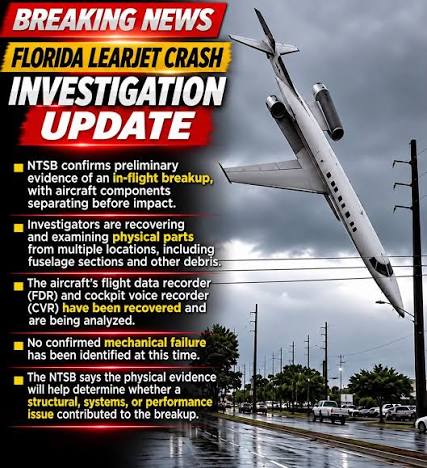
Evidence that a private jet may have started breaking apart in the air before crashing in South Florida. The aircraft plunged into a residential area near West Palm Beach on November 1, killing all nine people aboard.
The National Transportation Safety Board (NTSB) announced the preliminary findings on November 2. Investigators said pieces of the aircraft may have separated before impact, raising important questions about the events that caused the jet to lose control.
The crash involved a Learjet 60 that departed Austin, Texas, for the Bahamas. It carried two crew members and seven passengers.
The aircraft crashed in Greenacres, Florida, approximately seven miles southwest of West Palm Beach. The impact created a large crater near a roadway and mobile home community.
Although investigators have identified evidence of a possible in-flight breakup, they have not determined what caused the aircraft to descend so rapidly. They are examining weather conditions, aircraft systems, maintenance records and communications with air traffic control.
The investigation remains in its early stages, and officials have cautioned against drawing conclusions before examining the available evidence.
AP News+1
What investigators have revealed about the crash

NTSB board member Tom Chapman said investigators had found indications that the aircraft began breaking apart before striking the ground.
The discovery could help investigators reconstruct the final moments of the flight. Aircraft debris can provide important evidence about whether a plane remained intact during an emergency or suffered structural damage before impact.
Investigators expect to find pieces of the jet some distance from the main crash site. They are examining the wreckage to establish which components separated and when the separation occurred.
However, officials have not confirmed which parts of the aircraft may have come off. They have also not established whether the breakup resulted from structural failure, extreme aerodynamic forces, damage to a flight-control system or another problem.
Aviation investigators typically examine the condition of recovered components, including fractures, deformation and damage patterns. These details can help establish whether a component failed before impact or broke apart when the aircraft struck the ground.
The NTSB is also reviewing the aircraft’s flight path and recorded communications to understand how the emergency developed.
The findings could eventually help investigators determine whether the jet experienced a mechanical problem, encountered dangerous weather or suffered a combination of factors.
Courthouse News Service+1
Timeline: From routine flight to a deadly emergency
The Learjet 60 departed Austin-Bergstrom International Airport in Texas on the morning of November 1. Its destination was North Eleuthera Airport in the Bahamas.
The flight initially proceeded normally. However, the aircraft encountered problems while cruising at approximately 35,000 feet.
According to information presented by investigators, the crew first reported ice accumulation and moderate turbulence. The aircraft also experienced altitude changes of approximately 700 feet.
The pilots requested permission to climb to 37,000 feet. Air traffic control approved the request.
Less than 30 seconds later, the situation changed dramatically.
The crew reported that the aircraft was descending rapidly. The pilots then declared an emergency and communicated with air traffic controllers as they attempted to manage the situation.
The aircraft’s descent rate increased sharply. The crew reported an overspeed condition, indicating that the aircraft was descending at a speed that required immediate attention.
The jet ultimately crashed at approximately 12:51 p.m. local time.
The NTSB is reviewing the sequence of events to determine why the aircraft lost altitude so quickly and whether the reported weather conditions contributed to the emergency.
wplg+1
Severe weather and ice accumulation under investigation
One of the most important questions surrounding the Florida jet crash is whether weather conditions played a role in the aircraft’s loss of control.
The pilots reported ice accumulation and moderate turbulence while flying at high altitude.
Aircraft icing occurs when supercooled water droplets freeze on an aircraft’s surfaces. Depending on the location and amount of ice, accumulation can affect an aircraft’s aerodynamic performance.
Ice can alter airflow over wings and other surfaces. It can also add weight and interfere with certain aircraft systems.
However, the presence of icing does not automatically mean that icing caused an accident. Investigators must establish how much ice accumulated, where it formed and whether it affected the aircraft’s performance.
Turbulence is another factor under examination.
Strong turbulence can cause sudden changes in altitude and aircraft attitude. In severe conditions, it can create significant forces on an aircraft and make it more difficult for pilots to maintain stable flight.
The crew reported turbulence before the emergency developed. Investigators are therefore examining whether the aircraft encountered conditions more severe than those initially reported.
Heavy rain and thunderstorms were present in the region around the time of the crash.
The NTSB has not confirmed that the jet flew directly through a thunderstorm. Investigators must reconstruct the weather along the aircraft’s flight path and establish the conditions at its cruising altitude.
Weather specialists are expected to assist with this process.
The investigation will also consider whether the aircraft encountered changing weather conditions that affected its ability to remain under control.
Reuters+1
What does an in-flight breakup mean?
An in-flight breakup occurs when an aircraft separates into multiple pieces while it is still airborne.
This can happen for different reasons, including structural failure, damage to aircraft components or forces that exceed the aircraft’s structural limits.
In some accidents, a loss of control can produce an extremely rapid descent. The aircraft may then experience aerodynamic forces that place significant stress on its structure.
However, investigators must establish the actual sequence of events before determining whether this happened in Florida.
The evidence of a possible breakup is particularly important because it could help explain why the aircraft descended so rapidly.
If investigators recover components away from the main impact site, they can examine their condition and compare the damage with the aircraft’s known structure.
They can also study whether parts separated before the aircraft reached the ground.
This process is essential because a crash can destroy or damage components that would otherwise help explain what happened.
The NTSB has not confirmed that a particular structural component failed during the Florida accident. Officials have also not established whether any potential breakup occurred before or after the aircraft lost control.
For now, the reported evidence of an in-flight breakup remains an important investigative lead rather than a final explanation.
Courthouse News Service+1
The aircraft’s rapid descent raises new questions
The Learjet’s reported descent rate is another major focus of the investigation.
The aircraft was cruising at approximately 35,000 feet when the crew began reporting problems.
During the emergency, the pilots reported descent rates reaching approximately 20,000 feet per minute, according to recordings of communications with air traffic control.
For comparison, a normal passenger aircraft generally descends at a much slower rate during a routine approach to an airport.
A descent of 20,000 feet per minute represents an extremely rapid loss of altitude. At that rate, an aircraft would lose 10,000 feet in approximately 30 seconds if the descent rate remained constant.
The reported descent rate does not, by itself, establish what caused the accident.
Investigators must determine whether the aircraft entered an uncontrolled descent, experienced a structural failure or suffered another problem.
They will also examine the aircraft’s speed, altitude, attitude and flight-control responses during the emergency.
The crew’s communications with air traffic control provide important information about how quickly the situation deteriorated.
However, radio transmissions alone cannot reveal everything that happened inside the cockpit or within the aircraft’s systems.
That is why investigators are seeking additional evidence from the wreckage and any available flight-recording equipment.
Reuters+1
Cockpit voice recorder recovery remains important
The NTSB has said that maintenance records indicate the aircraft was equipped with a cockpit voice recorder.
Investigators are working to determine whether the recorder was aboard the aircraft at the time of the crash and whether it can be recovered.
A cockpit voice recorder can preserve conversations between pilots, radio communications and certain sounds inside the cockpit.
This information can help investigators understand what the crew observed, how they responded to the emergency and whether they discussed any aircraft problems.
A recorder could be particularly valuable in the Florida investigation because the aircraft’s final descent happened quickly.
The NTSB will also examine aircraft maintenance records, operational history and other available documentation.
Investigators may compare the aircraft’s condition with previous maintenance work to identify any issues that could be relevant to the accident.
The aircraft’s flight history can also help establish whether any previous problems were reported.
However, investigators have not announced that a specific maintenance issue contributed to the crash.
The recovery and analysis of physical evidence will be essential before officials can determine whether the aircraft suffered a mechanical or structural problem.
Reuters+1
Nine people killed in the Florida jet crash
All nine people aboard the Learjet died in the crash.
The aircraft was carrying two crew members and seven passengers.
Among those identified by family members was 20-year-old co-pilot Nathalia Gadelha Filgueiras.
Her father confirmed that she was serving as co-pilot on the flight. Reports also said that she had earned her pilot’s license while attending high school in Florida.
The passengers included Texas technology entrepreneur Adam Robinson, his wife, their two young children, family friends and a nanny, according to relatives.
The loss of the aircraft has left families and friends grieving as investigators work to establish what happened.
The NTSB has emphasized that the investigation is focused on understanding the circumstances of the accident.
Officials have not attributed responsibility to either pilot or established whether any particular decision contributed to the crash.
The crew’s final communications with air traffic control are being examined as part of the broader investigation.
AP News+1
Crash site creates challenges for investigators
The aircraft crashed in a residential area of Greenacres, near West Palm Beach.
The impact created a large crater near a roadway and a mobile home community.
The crash also caused a fire and scattered debris across the surrounding area.
A person in a vehicle near the crash site suffered a leg injury. No other injuries on the ground were reported in the initial investigation updates.
The crash site has created challenges for investigators because heavy rain and water in the impact crater have complicated the recovery of major wreckage.
Investigators need to recover aircraft components carefully so they can examine them without damaging important evidence.
The NTSB is also working with local authorities to search for debris that may have separated from the aircraft before impact.
Residents near the crash site were evacuated while investigators examined the area.
Officials have said that restoring access to affected homes depends on the progress of the investigation and the work needed to clear the scene.
The recovery operation is expected to take several days, although the full investigation will take considerably longer.
The agency is asking people who find possible aircraft debris to contact investigators rather than handle or move it.
Courthouse News Service+1
What happens next in the NTSB investigation?
The NTSB is responsible for determining the probable cause of the crash and identifying any safety issues that could help prevent similar accidents.
Investigators are expected to examine several areas:
Aircraft structure: Whether any components separated before impact and what caused the damage.
Weather conditions: The extent of icing, turbulence and possible thunderstorm activity along the flight path.
Aircraft systems: Whether any mechanical or flight-control problems developed during the emergency.
Flight crew actions: The pilots’ communications, decisions and responses to the rapidly developing situation.
Maintenance history: Whether previous inspections or repairs reveal information relevant to the accident.
The investigation will combine evidence from the crash site with flight records, weather information and communications with air traffic control.
Investigators may also compare the accident with other incidents involving similar aircraft.
The NTSB has not issued a final determination on the cause of the Florida jet crash. Officials have cautioned that the investigation is still in its early stages.
The preliminary findings may change as investigators recover additional evidence and analyze the aircraft’s components.
A final report will explain the agency’s conclusions and may include safety recommendations if investigators identify issues that require attention.
wplg+1
Conclusion: Florida jet crash investigation continues
The Florida jet crash has raised serious questions about the aircraft’s final moments, particularly after investigators reported evidence of a possible in-flight breakup.
The Learjet 60 lost altitude rapidly before crashing in Greenacres, killing all nine people aboard. The crew had reported icing and turbulence before the emergency developed.
Investigators are now examining whether weather conditions, aircraft systems or structural problems contributed to the accident.
The recovery of wreckage and any available flight-recording equipment will be important in establishing what happened.
Although the evidence of a possible in-flight breakup provides a significant investigative lead, it does not yet explain why the aircraft crashed.
The NTSB has not determined the probable cause, and further analysis will be necessary before officials can reach a final conclusion.
Frequently asked questions (FAQs)
1. What happened in the Florida jet crash?
A private Learjet 60 crashed in Greenacres, Florida, on November 1, 2026. The aircraft was traveling from Austin, Texas, to the Bahamas when it lost altitude rapidly and crashed in a residential area, killing all nine people aboard.
2. Did the Florida jet break apart in midair?
Investigators have found evidence that parts of the aircraft may have separated before impact. However, the NTSB has not confirmed which components separated or what caused the possible breakup.
3. What caused the Florida jet crash?
The cause remains under investigation. The NTSB is examining weather conditions, ice accumulation, turbulence, aircraft systems and the jet’s rapid descent.
4. Did bad weather contribute to the crash?
Weather is a major focus of the investigation. The pilots reported ice accumulation and moderate turbulence, while heavy rain and thunderstorms were present in the region. Investigators have not confirmed whether weather caused the crash.
5. How many people died in the Florida jet crash?
All nine people aboard the Learjet died. The aircraft was carrying two crew members and seven passengers.
6. Where did the Florida jet crash happen?
The aircraft crashed in Greenacres, Florida, approximately seven miles southwest of West Palm Beach. The impact occurred near a roadway and a residential mobile home community.
7. What is the NTSB investigating?
The NTSB is examining the aircraft’s structural condition, flight path, weather exposure, maintenance history and communications with air traffic control. Investigators are also seeking to recover the cockpit voice recorder.
8. Has the NTSB released its final report?
No. The investigation is ongoing, and officials have not determined the probable cause of the crash. A final report will be issued after investigators complete their analysis.
About the Author