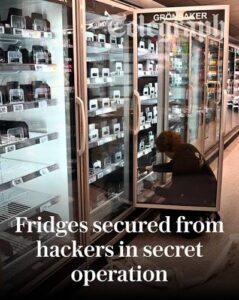
A major cybersecurity operation has taken place across the United Kingdom after officials discovered that thousands of supermarket refrigeration systems could be vulnerable to hackers. The operation involved government agencies, cybersecurity researchers and major retailers working together to prevent a potentially damaging attack on the country’s food supply.
According to a BBC investigation published on November 20, 2026, tens of thousands of supermarket fridges and freezers were secured during a largely confidential nationwide operation. The effort also covered warehouses, restaurants, petrol stations, stadiums and other businesses that depend on commercial refrigeration.
The discovery raised serious concerns about the security of internet-connected equipment. Although refrigeration systems are designed to keep food fresh, their digital controllers can become targets for cybercriminals when security protections are weak.
Officials moved quickly after researchers identified a potential vulnerability in widely used refrigeration controllers. Thousands of devices were taken offline, while businesses received instructions to improve security and monitor temperatures manually.
The operation followed several cyberattacks across Europe that reportedly caused extensive food spoilage. Those incidents demonstrated how hackers could disrupt essential services without directly targeting traditional computer networks.
UK Cyber Operation Targets Vulnerable Supermarket Refrigeration Systems
The UK cyber operation was launched after cybersecurity researchers identified a potential weakness in refrigeration control equipment used by businesses throughout the country.
The discovery was particularly concerning because commercial refrigeration systems often manage multiple units simultaneously. A single controller can regulate the temperatures of dozens of fridges and freezers.
This means that compromising one control system could potentially affect a large number of refrigeration units.
Researchers from refrigeration consultancy Omega Solutions first identified the security concern in late October. Cybersecurity specialists at Pen Test Partners subsequently examined the issue and helped alert the relevant authorities.
The National Cyber Security Centre (NCSC), the Department for Environment, Food and Rural Affairs (Defra) and the Food Standards Agency (FSA) became involved in coordinating the response.
Their priority was to identify potentially affected businesses and reduce the possibility of hackers exploiting the weakness.
Officials and industry representatives organised conference calls and contacted companies that operated potentially vulnerable equipment.
The response remained largely confidential because researchers feared that publicly revealing technical details could help malicious actors discover and exploit the vulnerability.
The BBC reported that major supermarket chains redirected IT teams to deal with the issue. Some companies reportedly removed hundreds of devices from internet access each day during the operation.
Why Were Thousands Of Supermarket Fridges Taken Offline?
The refrigeration systems involved in the operation rely on digital controllers that allow engineers to monitor temperatures and adjust settings remotely.
These controllers make commercial refrigeration more convenient. Engineers can identify problems, change operating conditions and monitor equipment without visiting every individual store.
However, internet connectivity also creates potential security risks.
If a controller is exposed to the public internet and protected by weak passwords or inadequate security measures, attackers may attempt to gain unauthorised access.
Once inside a vulnerable system, a criminal could potentially interfere with refrigeration settings.
For example, an attacker might attempt to change temperature controls or activate defrost functions. Such actions could cause food storage temperatures to rise beyond safe levels.
The UK operation therefore focused on reducing unnecessary internet exposure.
Thousands of control devices were disconnected from the public internet. Some were taken offline remotely, while others required physical intervention.
In certain locations, employees were instructed to remove internet cables and monitor refrigeration temperatures manually.
Although these steps created additional work for businesses, they reduced the opportunity for remote attackers to access vulnerable equipment.
The operation also highlighted the importance of identifying every internet-connected device within a company’s infrastructure.
Resource Data Management Controllers At The Centre Of Security Concerns
The investigation focused partly on refrigeration controllers manufactured by British company Resource Data Management (RDM).
These devices are widely used across commercial refrigeration environments in the United Kingdom.
They help businesses control and monitor refrigeration equipment across supermarkets, warehouses and other facilities.
According to reporting by the BBC, researchers identified security concerns involving the company’s controllers after examining the systems used throughout the UK market.
Cybersecurity specialists warned that some weaknesses appeared similar to problems associated with refrigeration systems targeted during earlier European attacks.
Weak passwords and inadequate protection can create opportunities for attackers, particularly when remote management systems are accessible.
Ken Munro of Pen Test Partners warned that the widespread use of these controllers increased the urgency of the response.
However, RDM disputed comparisons between its equipment and the refrigeration systems targeted in mainland Europe.
The company argued that exploiting the vulnerability identified by researchers would require access to a specific piece of hardware.
RDM’s chief executive, Ged Evans, said the vulnerability had been identified in a test environment. He also explained that the testing process went beyond what would normally be involved in a standard security assessment.
The company confirmed that it had already deployed initial software patches and contacted customers with recommendations.
RDM also said it had found no evidence of malicious activity involving the controllers.
This distinction is important. Identifying a potential vulnerability does not automatically mean that attackers have successfully exploited it.
Nevertheless, the investigation demonstrated why manufacturers and businesses must respond quickly when security weaknesses are discovered.
European Supermarket Cyberattacks Raised Alarm In The UK
The UK’s security operation came after several cyber incidents involving commercial refrigeration systems across Europe.
These incidents demonstrated how digital attacks could create physical consequences for businesses and consumers.
One major wave of attacks occurred in France on October 11 and 12, 2026.
Hundreds of supermarkets and food-processing locations reportedly experienced problems after attackers targeted refrigeration control systems.
Some refrigeration units were reportedly forced into continuous defrost cycles, causing temperatures to rise significantly.
Reports indicated that certain units reached temperatures of approximately 50 degrees Celsius.
Such conditions can make refrigerated and frozen food unsafe, potentially forcing businesses to dispose of large quantities of stock.
Another wave of incidents occurred on November 1 and 2, affecting businesses across several European countries.
Belgium and Luxembourg were among the countries particularly affected, while incidents were also reported elsewhere in Europe.
The BBC also reported that a small number of blood bank facilities in France experienced problems involving refrigeration equipment.
These incidents raised concerns about the vulnerability of systems that support essential services.
France publicly blamed Iran for one wave of attacks, but Tehran denied the allegation.
The identity and motivations of those responsible for the wider incidents have not been conclusively established in the available public reporting.
For British authorities, the incidents provided a clear warning.
Even if UK businesses used different refrigeration equipment, similar weaknesses could potentially create comparable risks.
How Could Hackers Disrupt Supermarket Refrigeration Systems?
Modern supermarkets depend heavily on automated technology.
Refrigeration systems are particularly important because they maintain the temperatures needed to preserve fresh food, dairy products, meat, seafood and frozen products.
Many commercial systems use connected controllers that allow engineers to monitor and adjust equipment remotely.
This technology improves efficiency, but it also creates opportunities for cyberattacks when security is inadequate.
There are several ways hackers might attempt to exploit vulnerable refrigeration systems.
1. Weak Passwords
Weak or default passwords are among the most common cybersecurity problems.
If businesses fail to change manufacturer-provided credentials, attackers may find it easier to access remote management systems.
2. Internet-Exposed Controllers
Some refrigeration controllers can be accessed through internet connections.
When businesses expose management interfaces directly to the public internet, they increase the number of potential entry points for attackers.
3. Outdated Software
Older software may contain security weaknesses that manufacturers have already identified and addressed.
Businesses that delay installing updates can leave their equipment vulnerable.
4. Poor Remote Access Management
Refrigeration contractors frequently need remote access to equipment.
However, poorly managed contractor connections can introduce security risks.
Businesses must ensure that remote access is properly protected and limited to authorised users.
5. Limited Monitoring
Supermarkets may operate refrigeration equipment throughout the night when fewer employees are present.
If temperature changes are not detected quickly, food could remain outside safe storage conditions for an extended period.
These risks explain why cybersecurity experts increasingly consider operational technology an important part of business security.
Government Agencies Coordinated The Nationwide Response
The UK operation involved cooperation between several organisations responsible for cybersecurity, food safety and business protection.
The National Cyber Security Centre played an important role in communicating security concerns and helping potentially affected organisations take protective action.
Defra and the Food Standards Agency also participated because refrigeration failures could affect food storage and supply chains.
The response required cooperation between government agencies, equipment manufacturers, cybersecurity specialists and supermarket operators.
Rather than relying on a single security measure, the operation focused on reducing exposure across thousands of devices.
Companies were encouraged to disconnect vulnerable equipment from the public internet and follow appropriate mitigation advice.
Some businesses also had to change their normal operating procedures temporarily.
For example, staff were instructed to monitor temperatures manually after certain controllers were disconnected.
This approach helped maintain oversight while companies addressed the underlying security concerns.
The operation demonstrates the importance of cooperation between public authorities and private businesses when cyber threats involve essential infrastructure.
Could A Supermarket Fridge Cyberattack Cause Food Shortages?
One of the biggest concerns surrounding refrigeration cyberattacks is their potential impact on food supplies.
Supermarkets store enormous quantities of perishable products. These include meat, fish, dairy products, fresh vegetables and frozen meals.
If refrigeration systems stop working properly, businesses may have to discard affected products.
The financial consequences could be substantial.
A successful attack on several warehouses or distribution centres could create problems beyond individual supermarkets.
Distribution centres store large amounts of food before it reaches shops. If refrigeration equipment fails at these facilities, businesses could lose valuable inventory.
Retailers might also experience delivery delays and temporary product shortages.
Customers could notice empty shelves, limited product choices or higher replacement costs.
However, it is important to distinguish between a potential risk and an actual food shortage.
The UK operation was designed to prevent exploitation of the identified vulnerability. There is no confirmed evidence in the BBC reporting that the newly identified RDM vulnerability caused widespread food losses in Britain.
The wider European incidents demonstrate the possible consequences, but they do not mean that UK consumers should expect immediate supermarket shortages.
What Does The Operation Mean For UK Supermarkets?
The operation has highlighted the need for retailers to strengthen cybersecurity across equipment that is not traditionally considered part of their IT infrastructure.
Supermarkets generally invest in protecting payment systems, customer information and corporate networks.
However, refrigeration controllers, heating systems, building management equipment and other operational technologies also require protection.
A weakness in one of these systems can interrupt business operations even when customer databases and payment networks remain secure.
Retailers may now need to review how refrigeration contractors access their equipment.
They should also maintain accurate records of connected devices and ensure that security updates are installed promptly.
Another important lesson involves network separation.
Critical equipment should not be unnecessarily exposed to public internet connections. Businesses should use properly secured remote-access systems and restrict access to authorised personnel.
Regular security assessments can also help identify weaknesses before criminals discover them.
These measures are particularly important for supermarket chains operating hundreds of locations.
A single security problem affecting widely used equipment could create risks across multiple sites.
Why Was The UK Operation Kept Secret?
The confidential nature of the operation was one of its most significant features.
Authorities and cybersecurity researchers had to balance public awareness with the need to prevent further attacks.
Releasing detailed information about an unresolved vulnerability could have helped criminals identify the affected equipment.
It could also have encouraged attackers to test similar systems before businesses had time to secure them.
The BBC explained that its reporting was delayed to reduce the risk of providing malicious actors with information that could cause harm.
This approach reflects a broader challenge in cybersecurity journalism.
The public has a legitimate interest in understanding threats to essential services. At the same time, revealing technical weaknesses too early can increase the danger.
Responsible disclosure generally involves informing manufacturers and relevant authorities first, allowing them to develop security fixes before publishing sensitive technical details.
In this case, researchers, manufacturers and government agencies worked together to reduce the exposure before the operation became public.
Are Household Refrigerators At Risk?
The news about supermarket refrigeration systems may cause concern among consumers who own smart refrigerators.
However, the reported operation primarily involved commercial refrigeration controllers used by businesses.
These systems are different from ordinary household refrigerators.
Commercial controllers can manage multiple refrigeration units and may be connected to remote engineering networks.
Household appliances generally have different software, access arrangements and security configurations.
That does not mean smart home appliances are completely free from cybersecurity risks.
Consumers should still install available software updates, use secure home Wi-Fi networks and change default passwords where applicable.
However, there is no reason to assume that ordinary household refrigerators are affected by the specific commercial vulnerability discussed in the UK operation.
The main concern involves large-scale refrigeration infrastructure rather than everyday domestic appliances.
Cybersecurity Is Becoming Essential For Food Supply Chains
The UK refrigeration operation highlights a growing connection between cybersecurity and everyday services.
For many years, cybersecurity discussions focused mainly on computers, banking systems, government databases and personal information.
However, modern businesses increasingly depend on connected physical equipment.
Supermarket refrigeration systems are one example of operational technology that can affect public safety and economic activity.
Other important systems include electricity networks, water treatment facilities, transport infrastructure and industrial equipment.
When these systems become vulnerable, cyberattacks can create real-world consequences.
A digital intrusion may lead to damaged equipment, interrupted services, financial losses or spoiled products.
This is why cybersecurity experts encourage businesses to treat operational technology as a critical security priority.
The UK operation also demonstrates the value of identifying weaknesses before attackers exploit them.
Researchers, manufacturers and government agencies can reduce risks by sharing information and responding quickly.
For supermarkets, maintaining secure refrigeration systems is not simply an IT responsibility. It is part of protecting food quality, business continuity and consumer confidence.
What Happens Next After The UK Fridge Security Operation?
The immediate priority is ensuring that potentially affected refrigeration controllers remain protected.
RDM has confirmed that initial software patches have been deployed and that customers have received mitigation advice.
The company is also continuing to work with relevant authorities.
Meanwhile, businesses must ensure that disconnected devices are not simply reconnected without appropriate security checks.
Retailers will need to review their equipment inventories, update vulnerable systems and establish secure remote-access arrangements.
Smaller businesses may face additional challenges because they often depend on external contractors for refrigeration maintenance.
These contractors must also follow appropriate cybersecurity practices.
Government agencies are expected to continue monitoring the situation and supporting affected organisations.
The wider incidents across Europe have also raised questions about whether stronger security standards should apply to connected industrial equipment.
The UK government has already indicated that it plans to consult on tackling insecure technology at source and considering where responsibility for cyber breaches should sit.
The challenge will be ensuring that security improvements reach businesses of every size.
Conclusion
The UK cyber operation to secure thousands of supermarket fridges demonstrates how cybersecurity threats can extend far beyond computers and traditional digital networks.
A potential weakness in commercial refrigeration controllers prompted researchers, government agencies and major retailers to coordinate a nationwide protective response.
Thousands of devices were disconnected from the public internet, while businesses introduced additional monitoring measures and manufacturers worked on security updates.
The operation followed damaging refrigeration-related cyber incidents across Europe, highlighting the potential consequences for food supplies and business operations.
Although the identified UK vulnerability has not been linked to confirmed widespread malicious activity, the incident offers an important warning.
Modern food supply chains depend on connected technology, and protecting that technology is essential.
As supermarkets continue to adopt automated systems, cybersecurity will become increasingly important for keeping food safe, businesses operational and consumers protected.
The UK operation may have remained secret for weeks, but its message is now clear: even a supermarket fridge can become part of a country’s critical cybersecurity challenge.
Frequently Asked Questions (FAQs)
1. Why did UK officials secretly secure thousands of supermarket fridges?
Officials coordinated a confidential cybersecurity operation after researchers identified potential vulnerabilities in commercial refrigeration controllers. The aim was to prevent hackers from accessing systems and disrupting food storage.
2. Which UK agencies were involved in the operation?
The National Cyber Security Centre (NCSC), Department for Environment, Food and Rural Affairs (Defra) and Food Standards Agency (FSA) were involved in coordinating the protective response.
3. Which company manufactured the refrigeration controllers involved?
The investigation focused partly on refrigeration controllers manufactured by British company Resource Data Management (RDM).
4. How many refrigeration systems were secured?
The BBC reported that tens of thousands of refrigeration units were protected through measures involving thousands of controllers and other devices.
5. How could hackers attack supermarket fridges?
Hackers could potentially exploit weak passwords, exposed internet connections or software vulnerabilities to access refrigeration controllers and interfere with temperature settings.
6. Were UK supermarkets actually hacked through the newly identified vulnerability?
There was no confirmed evidence of malicious activity involving the specific RDM controllers discussed in the BBC report. The operation was primarily a preventive security response.
7. Did European supermarket cyberattacks cause food losses?
Yes. Cyber incidents affecting refrigeration systems in France and other European countries reportedly caused food spoilage and financial losses after temperatures were changed.
8. Are household refrigerators affected by this cyber operation?
The reported vulnerability concerned commercial refrigeration systems. There is no confirmed indication that ordinary household refrigerators were affected by the specific issue.
9. Why were refrigeration controllers disconnected from the internet?
Disconnecting vulnerable controllers reduced the possibility of unauthorised remote access while businesses and manufacturers worked to improve security.
10. What is the National Cyber Security Centre’s role?
The NCSC supports organisations in identifying and managing cybersecurity threats. During this operation, it helped coordinate warnings and protective measures for potentially affected businesses.
11. Could supermarket fridge hacking cause food shortages?
A successful attack could spoil perishable products, disrupt warehouses and delay deliveries. However, the UK operation was intended to prevent such disruption, and widespread UK food shortages have not been confirmed as a result of this vulnerability.
12. What happens next?
Businesses are expected to continue installing security updates, reviewing remote-access arrangements and monitoring refrigeration equipment. Authorities and manufacturers will also continue working to reduce cybersecurity risks.
About the Author