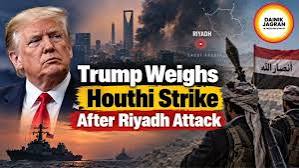
TRUMP STRIKES HALTED: Houthi targets spared, Saudi pressure ignored, sudden U-turn
The United States has reportedly stepped back from planned military strikes against Yemen’s Houthi movement, marking a significant development in the latest escalation across the Middle East. According to Reuters, President Donald Trump called off planned U.S. airstrikes after urgent appeals from Saudi Arabia and Yemen’s Saudi-backed leadership.
The reported decision comes as Houthi forces expand their position in Yemen and the conflict increasingly threatens important Red Sea shipping routes. At the same time, Saudi Arabia has faced attacks linked to the renewed fighting, increasing pressure on Riyadh to respond.
The reported Trump Houthi strikes halted decision therefore carries implications beyond Yemen. It touches on U.S.-Saudi relations, Red Sea security, oil markets, Iran-linked regional forces and Washington’s broader approach to military intervention.
Trump Houthi Strikes Halted After Plans Were Underway
The latest reports indicate that U.S. military preparations had advanced considerably before Trump decided against launching the strikes.
Reuters reported that Trump called off planned attacks against Houthi targets after appeals from Saudi Arabia and Yemen’s Saudi-backed president. The decision followed a rapid Houthi advance in parts of Yemen.
Other reports described the operation as having progressed to the point where targets had been selected and preparations were underway. Axios reported that Trump considered military action over the weekend after repeated requests from Saudi Crown Prince Mohammed bin Salman.
However, the reported decision was ultimately not to proceed.
That distinction is important. The United States has not announced a new large-scale campaign against the Houthis based solely on these reports. Instead, the immediate story concerns a contemplated military operation that was reportedly halted before execution.
Why Were Houthi Targets Being Considered?
The immediate background is the renewed fighting between Houthi forces and Saudi-backed forces in Yemen.
The Houthis have reportedly made territorial gains in strategically important areas. Reuters reported that Houthi forces were pushing into Yemen’s highlands in Taiz and Lahij provinces, with the objective of strengthening their position and cutting off Saudi-backed government forces from the Red Sea coast.
The developments are particularly significant because Yemen sits beside the Bab el-Mandeb Strait.
The narrow maritime passage connects the Red Sea with the Gulf of Aden. It is an important route for international shipping, energy transportation and trade between Europe and Asia.
Any prolonged conflict around the waterway could therefore affect shipping costs, insurance premiums and energy markets.
Saudi Arabia Wanted Stronger U.S. Support
Saudi Arabia has reportedly sought American military assistance as the Houthi threat has grown.
Axios reported that Crown Prince Mohammed bin Salman made multiple urgent requests for U.S. military assistance. The requests came as Houthi forces advanced toward strategically important territory near the Red Sea.
The situation creates a complicated choice for Washington.
Saudi Arabia is a major U.S. partner in the Middle East. At the same time, direct American military involvement against the Houthis could create new risks.
A U.S. strike could potentially trigger retaliation against American interests, shipping or regional partners. It could also widen an already complicated Middle Eastern conflict.
That appears to have been an important consideration in the reported decision to hold back.
Trump’s Reported Decision Changes the Immediate Calculus
The reported decision to halt the strikes does not mean the Houthi threat has disappeared.
Instead, it leaves the United States attempting to manage competing interests.
On one side, Washington has strategic relationships with Saudi Arabia and other Gulf states. On the other, the administration has reasons to avoid opening another major military front.
The Houthis have also reportedly communicated that they do not intend to attack U.S. vessels in the Red Sea.
The Associated Press reported that senior Houthi official Mohamed al-Bukhaiti said the group had assured the Trump administration that American ships would not be targeted. The report said the understanding was connected to Oman-mediated discussions and a reaffirmation of a previous U.S.-Houthi ceasefire arrangement.
Trump also said publicly that the Iran-backed Houthis had agreed not to fight the United States, according to reporting from Al Arabiya.
This could help explain why Washington has chosen not to immediately expand its military role.
Houthis Continue to Expand Their Position
While the United States has reportedly held back, Houthi forces have continued making gains.
Reuters reported that the group was advancing in Yemen’s highlands while seeking to strengthen its control and threaten Saudi-backed forces.
The Houthis already control substantial areas of western Yemen. Their ability to influence territory close to major shipping routes gives them strategic leverage.
The Bab el-Mandeb Strait is particularly important.
If fighting disrupts maritime traffic, shipping companies may have to reconsider routes. Longer routes around southern Africa can increase fuel consumption, transit times and operating costs.
That means the consequences of the Yemen conflict can extend well beyond the region.
Saudi Arabia Faces a Difficult Security Challenge
For Saudi Arabia, the renewed Houthi conflict presents a direct security concern.
Riyadh has already experienced attacks associated with the broader Yemen conflict in previous years. The latest escalation creates additional pressure because the Houthis are now operating in a regional environment already affected by wider confrontation.
Reuters reported that the fighting has threatened Saudi oil export routes and contributed to concerns about global energy supplies.
Saudi Arabia therefore has an interest in preventing Houthi forces from consolidating further territory.
At the same time, a major Saudi military campaign could increase the possibility of prolonged fighting.
The United States must consequently balance its commitment to regional partners with the risk that direct intervention could produce a wider conflict.
Why the Red Sea Matters to Global Markets
The Red Sea is not simply a regional security issue.
It is part of one of the world’s major commercial maritime corridors.
Ships traveling between Asian and European markets can use the Red Sea and Suez Canal route to avoid the longer journey around Africa.
The Bab el-Mandeb Strait is a critical gateway on this route.
Any sustained military confrontation around the strait could therefore have international consequences.
Markets can react to concerns about supply disruptions even before physical shortages develop. Oil prices, shipping costs and insurance rates can all be influenced by expectations of future risk.
Reuters reported that oil prices were approaching $100 per barrel amid the wider regional instability.
That makes the Trump administration’s decision particularly important for global energy observers.
A New U.S. Military Campaign Has Not Been Confirmed
Despite headlines about halted strikes, it is important to distinguish between reported plans and confirmed military operations.
The latest reporting indicates that Trump considered strikes and ultimately decided against proceeding. Reuters described the U.S. as having refrained from direct involvement in Yemen since a brief engagement in 2025.
Therefore, the immediate development should not automatically be interpreted as the beginning or end of a new U.S. war in Yemen.
Instead, it represents a decision point.
Washington can still change its position if American personnel, vessels or interests are attacked.
The Houthis can also alter their own calculations depending on developments in Yemen, Saudi Arabia and the wider region.
The Houthi-U.S. Understanding Could Be Important
One of the most notable elements of the latest development is the reported understanding between Washington and the Houthis.
The Associated Press reported that Houthi officials said they would not target U.S. vessels, while American strikes would remain halted.
If that arrangement holds, it could create a limited separation between the Houthi-Saudi conflict and direct U.S.-Houthi confrontation.
However, such arrangements can be fragile.
A single attack, miscalculation or change in regional strategy could alter the situation quickly.
The distinction between U.S. interests and Saudi interests may also become increasingly difficult to maintain if attacks against Saudi territory intensify.
Iran’s Role Adds Another Layer
The Houthis are widely described by international media as being backed by Iran.
The group has developed its own military and political structure in Yemen, while maintaining close ties with Tehran.
This means any U.S. military action against the Houthis could be viewed within the broader U.S.-Iran confrontation.
That is one reason the decision carries significance beyond Yemen.
A strike against Houthi targets could potentially be interpreted as another escalation involving Iran-aligned forces.
The Trump administration therefore faces a broader strategic problem: how to respond to regional attacks without creating additional fronts.
Humanitarian Consequences Remain Central
Yemen has experienced years of conflict and humanitarian suffering.
The latest escalation adds another layer to an already severe crisis.
Reuters reported that the intensified fighting has resulted in hundreds of deaths, thousands of injuries and significant displacement, citing United Nations reporting.
Military escalation could further affect civilians through displacement, infrastructure damage and restrictions on humanitarian access.
This is another reason why the consequences of the reported U.S. decision cannot be measured solely through military strategy.
The question is also whether the current situation creates an opportunity for negotiations or instead allows the conflict to intensify.
What the Trump U-Turn Could Mean for Saudi Arabia
The reported reversal could place greater responsibility on Saudi Arabia and its partners.
If Washington does not conduct airstrikes, Riyadh may have to rely more heavily on its own military capabilities and diplomatic channels.
The decision could also encourage Saudi policymakers to reassess how much military assistance they expect from Washington in future regional crises.
At the same time, the United States remains an important Saudi partner.
Therefore, the development does not necessarily indicate a fundamental breakdown in U.S.-Saudi relations.
Instead, it demonstrates that the two countries can have different immediate priorities.
Saudi Arabia may prioritize eliminating a direct security threat from the Houthis, while Washington may prioritize avoiding another military escalation.
What Happens Next?
Several developments will be important to watch.
First, observers will monitor whether the Houthis continue advancing in Yemen.
Second, attention will focus on attacks involving Saudi territory and infrastructure.
Third, shipping companies will closely watch conditions around the Bab el-Mandeb Strait.
Fourth, Washington’s response will depend partly on whether American vessels or personnel become targets.
Finally, diplomatic efforts could become increasingly important.
If the reported understanding between the United States and the Houthis remains intact, Washington could continue avoiding direct intervention while attempting to manage the wider crisis.
If that understanding breaks down, the military calculation could change quickly.
Trump Houthi Strikes Halted: Why the Story Matters
The reported decision to halt planned strikes is significant because it highlights the difficult choices facing the Trump administration in a rapidly changing Middle East.
The United States is balancing its relationship with Saudi Arabia against the risks of another military confrontation.
Saudi Arabia wants stronger action against a growing Houthi threat. The Houthis are expanding their position and have reportedly pledged not to attack U.S. ships. Meanwhile, the Red Sea remains vital to global commerce.
For now, the reported Trump Houthi strikes halted decision means that planned U.S. attacks have not moved forward.
But the underlying crisis remains unresolved.
The situation could change depending on Houthi military movements, Saudi responses, American security concerns and the wider confrontation involving Iran.
As a result, the reported U-turn is better understood as a pause in a developing crisis rather than a definitive resolution.
FAQs
1. Did Trump halt planned strikes against the Houthis?
Yes. Reuters reported on September 21, 2026, that President Donald Trump called off planned U.S. airstrikes against Houthi targets in Yemen following appeals from Saudi Arabia and Yemen’s Saudi-backed leadership.
2. Why was the United States considering strikes against the Houthis?
The reported plans followed renewed Houthi advances in Yemen and escalating attacks involving Saudi Arabia. The Houthis were also moving toward strategically important areas near the Red Sea.
3. Did Saudi Arabia ask Trump for military help?
Reports indicate that Saudi Crown Prince Mohammed bin Salman made repeated requests for U.S. military assistance against the Houthis. Axios reported that the requests were made as the Houthi advance increased regional security concerns.
4. Are the Houthis attacking U.S. ships?
Recent reporting indicates that Houthi officials said they had assured Washington that U.S. vessels would not be targeted. The Associated Press reported that this understanding was connected to Oman-mediated discussions.
5. Why is the Bab el-Mandeb Strait important?
The Bab el-Mandeb connects the Red Sea with the Gulf of Aden. It is a major maritime chokepoint for international trade and shipping between Europe and Asia.
6. Could the conflict affect oil prices?
Yes. Disruptions or fears of disruptions around important energy routes can affect oil markets. Reuters reported that regional instability had contributed to oil prices approaching $100 per barrel.
7. Does the decision mean the Yemen conflict is over?
No. The reported cancellation of U.S. strikes does not end the conflict between the Houthis and Saudi-backed forces. Fighting and territorial competition continue.
8. What could cause the United States to change its position?
A direct attack on American personnel, ships or other U.S. interests could change Washington’s calculations. Developments involving Saudi Arabia and the wider regional conflict could also influence future decisions.
9. Are the Houthis backed by Iran?
International reporting commonly describes the Houthis as Iran-backed or Iran-aligned. Their relationship with Tehran is an important part of the wider regional security picture.
10. What should readers watch next?
Key developments include Houthi territorial advances, attacks involving Saudi Arabia, Red Sea shipping conditions, the reported U.S.-Houthi understanding and any new American military decisions.
How useful was this post?
Click on a star to rate it!
Average rating 0 / 5. Vote count: 0
No votes so far! Be the first to rate this post.
About the Author

usa5911.com
Administrator
Hi, I’m Gurdeep Singh, a professional content writer from India with over 3 years of experience in the field. I specialize in covering U.S. politics, delivering timely and engaging content tailored specifically for an American audience. Along with my dedicated team, we track and report on all the latest political trends, news, and in-depth analysis shaping the United States today. Our goal is to provide clear, factual, and compelling content that keeps readers informed and engaged with the ever-changing political landscape.