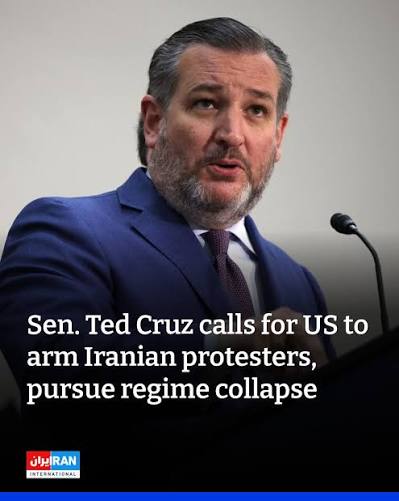
The debate over Iran’s future has intensified after U.S. Senator Ted Cruz called for American support for Iranian protesters seeking to challenge the Islamic Republic. Cruz’s remarks have renewed discussion about regime change, U.S. involvement in Iran and the risks of helping opposition groups inside a country with a powerful security apparatus.
In January 2026, Cruz publicly argued that the United States should be “arming the protesters in Iran” and linked that support to the possibility of Iranian citizens overthrowing the country’s leadership. The comments quickly became part of a wider debate about whether Washington should pursue pressure on Iran from outside or actively support forces seeking political change from within.
The controversy is significant because Cruz has supported the idea of weakening or collapsing Iran’s ruling system for years. In 2020, he argued that the United States should work toward the collapse of the Iranian regime while distinguishing that objective from the kind of prolonged nation-building associated with the Iraq War.
More recently, Cruz has gone further in describing regime removal as a strategic objective. In a March 2026 interview with Iran International, he said he believed the Iranian regime needed to be removed from power and argued that doing so would serve U.S. national security interests while supporting Iranians seeking greater freedom.
What Did Ted Cruz Say About Arming Iranians?

The most striking part of the debate came in January 2026, when Cruz called for U.S. assistance to Iranian protesters.
According to reporting on his remarks, Cruz wrote that the United States should be arming protesters in Iran immediately. He argued that if the Iranian people were able to overthrow the country’s leadership, the result could make the United States safer.
The statement represented a significant escalation in the rhetoric surrounding U.S. policy toward Tehran.
For years, American policy toward Iran has included sanctions, diplomatic pressure and efforts to restrict Iran’s nuclear capabilities. Cruz’s position goes beyond economic pressure by explicitly discussing support for people inside Iran who could challenge the government.
That distinction matters.
Supporting political opposition is different from launching a conventional military campaign. However, providing weapons to an organized opposition movement could potentially transform a political uprising into an armed conflict, with unpredictable consequences for civilians and regional stability.
Why Regime Change Is at the Center of the Debate
Ted Cruz has consistently argued that the Iranian government represents a major security challenge to the United States and its allies.
His position is not new. In a 2020 statement, Cruz said the United States should work toward collapsing the Iranian regime and compared the strategy to the pressure that ultimately contributed to the Soviet Union’s collapse. He also argued that regime collapse should not automatically mean a repeat of the large-scale nation-building approach used after the Iraq invasion.
That distinction has remained important in the current debate.
Supporters of regime change argue that the Islamic Republic has spent decades developing military capabilities, supporting regional armed groups and confronting the United States and Israel.
Critics, however, warn that removing a government is considerably easier to demand than to accomplish.
Iran has powerful security institutions, including the Islamic Revolutionary Guard Corps and other forces capable of suppressing internal opposition. An attempt to accelerate regime collapse could therefore produce civil conflict, political fragmentation or a prolonged struggle for power.
Could the Iranian Regime Actually Collapse?
Regime collapse is possible in theory, but it should not be confused with a political slogan or a short-term prediction.
Governments can survive serious protests, economic crises and military setbacks when security institutions remain loyal. Conversely, a government can collapse rapidly when military and political elites begin defecting or when institutions stop functioning.
The key question is therefore not simply whether Iranians oppose the government.
It is whether opposition forces can develop enough organization, political legitimacy and institutional support to replace the existing system.
That is one reason Cruz’s call for arming protesters is so controversial.
Weapons could potentially increase the ability of opposition groups to defend themselves. But weapons could also encourage fragmentation and violence between competing factions.
A future political transition would require more than weakening the existing government. It would require an alternative political structure capable of maintaining order and gaining legitimacy.
Cruz’s Iran Strategy Has Become More Explicit
Cruz’s position has evolved from supporting maximum pressure to openly discussing regime removal.
In March 2026, he told Iran International that the objective of the U.S.-Israeli military campaign was not merely to damage Iran’s weapons capabilities. He said the Iranian regime should be removed from power.
That statement placed Cruz firmly among American policymakers advocating a more aggressive approach toward Tehran.
It also raised a major strategic question: what happens after the existing government is weakened?
A military campaign can destroy infrastructure and weapons systems, but political transformation depends on people, institutions and leadership.
If the United States encourages regime change without having a realistic understanding of what follows, the aftermath could become more complicated than the original conflict.
Why the “Arm the Protesters” Proposal Is So Controversial
There are several reasons the proposal has generated intense debate.
First, supplying weapons to an opposition movement creates questions about who receives those weapons.
Iran has numerous political, ethnic and ideological factions. Not every group opposed to the Islamic Republic necessarily shares the same vision for Iran’s future.
Second, weapons can change the character of a protest movement.
A peaceful political movement may gain international sympathy, while an armed uprising can produce a much more dangerous confrontation involving government forces, militias and competing opposition groups.
Third, U.S. involvement could give Tehran an argument that foreign powers are attempting to destabilize the country.
Iranian authorities have historically accused Western governments of interference. Direct American assistance to armed opposition groups would likely become a central part of Tehran’s propaganda and security narrative.
Finally, there is the question of accountability.
If weapons supplied or supported by the United States are later used against civilians or by extremist factions, Washington could face serious political and diplomatic consequences.
Iran’s Nuclear Program Adds Another Layer
The debate over regime change cannot be separated from the long-running dispute over Iran’s nuclear program.
Cruz has repeatedly warned that Iran must not be allowed to obtain nuclear weapons. In 2018, he argued that the United States should prevent a nuclear-armed Islamic regime and continue supporting the Iranian people.
His concerns have continued into 2026.
In May 2026, Cruz criticized the possibility of an Iran agreement that he believed could allow Tehran to retain uranium-enrichment capabilities while receiving financial benefits. He described such an outcome as a serious mistake.
This illustrates the broader disagreement in Washington.
One side argues that negotiations, inspections and restrictions can reduce the nuclear threat without requiring regime change.
Another side argues that the Iranian leadership itself is the central problem and that long-term security requires political transformation.
The U.S. Faces a Difficult Choice
The United States has several possible approaches toward Iran.
The first is diplomacy.
Negotiations could attempt to address nuclear restrictions, sanctions, regional security and other disputed issues.
The second is economic pressure.
Sanctions can target Iranian institutions, individuals and revenue streams without directly entering a conventional war.
The third is military pressure.
This can involve strikes against military infrastructure, weapons facilities and other strategic targets.
The fourth is support for Iranian opposition forces.
This is where Cruz’s remarks become especially important.
Supporting protesters politically is one thing. Providing weapons is considerably more consequential because it can directly affect the balance of power inside Iran.
What Would Happen If the Regime Fell?
A collapse of Iran’s current political system would not automatically produce a stable democracy.
The country has a population of more than 80 million people, a complex political history and competing visions for its future.
Possible scenarios could include a transitional government, a military-backed authority, a new Islamic political structure, a secular democratic system or prolonged internal conflict.
The outcome would depend heavily on which institutions survive.
Iran’s military and security structures would also play a critical role.
If parts of the security establishment defected to opposition forces, regime collapse could happen more quickly. If those institutions remained unified, an uprising could face severe resistance.
This uncertainty explains why experts often distinguish between regime change and successful political transition.
The first means the existing leadership is removed.
The second means a functioning replacement government emerges.
The two outcomes are not necessarily the same.
Could U.S. Support Make Iran More Stable?
That remains one of the biggest unanswered questions.
Supporters of Cruz’s position could argue that helping Iranian opposition forces gives people inside Iran the resources needed to challenge a government they consider oppressive.
Critics could counter that external military support risks turning domestic political opposition into another regional conflict.
The historical record offers examples of both outcomes.
Foreign support has sometimes helped opposition movements survive. In other cases, outside intervention has contributed to prolonged instability.
Iran would present an especially difficult case because of its population size, military capabilities, geographic importance and position in the Middle East.
The Regional Impact Could Be Huge
Any major political transformation in Iran would affect countries across the Middle East.
Iran has relationships with armed groups and political organizations across the region. Changes in Tehran could therefore influence conflicts and security calculations involving Israel, Lebanon, Iraq, Syria and the Gulf states.
Energy markets would also be watching closely.
The Strait of Hormuz is one of the world’s most important energy routes. Any major disruption caused by conflict or political instability could affect oil prices and global trade.
The possibility of negotiations and reopening the Strait has already influenced international energy markets during the 2026 crisis.
This means the consequences of Iran’s political future would extend far beyond Washington and Tehran.
Is Regime Collapse Imminent?
There is not enough evidence to say that regime collapse is imminent.
Cruz’s comments demonstrate his preferred strategy, not proof that the Iranian government is about to fall.
Political systems can appear vulnerable while remaining resilient. Likewise, major changes can occur unexpectedly when elite divisions, economic pressure and public unrest combine.
For now, the most important indicators would include the cohesion of Iran’s security forces, the scale and organization of domestic opposition, elite defections, economic conditions and the ability of opposition groups to agree on a political alternative.
Why Ted Cruz’s Comments Matter
Ted Cruz’s call to arm Iranian protesters has intensified one of the most consequential foreign-policy debates facing Washington.
His argument is based on the belief that empowering Iranians against the Islamic Republic could ultimately advance both Iranian freedom and American security.
His critics see significant risks in turning an internal political struggle into an armed confrontation.
The difference between those positions is enormous.
At the heart of the dispute is a basic question: Can outside pressure help Iranians create a peaceful political transition, or could it make an already dangerous crisis even more violent?
There is no simple answer.
What is clear is that Cruz has moved beyond traditional calls for sanctions and pressure. His public statements in 2026 show continued support for removing Iran’s current regime and, at one point, explicitly called for arming protesters.
That makes his position one of the most aggressive proposals in the current U.S. debate over Iran.
Conclusion
The “regime collapse” debate surrounding Ted Cruz and Iran reflects a much larger struggle over American foreign policy.
Cruz argues that the Iranian government poses a fundamental security threat and that the United States should support Iranians challenging it. His January 2026 call to arm protesters brought that strategy into sharper focus.
But regime change carries enormous uncertainty.
Removing a government does not automatically create stability, democracy or peace. Any transition would depend on Iran’s opposition movements, security forces, political institutions and the international community.
For Washington, the challenge is balancing pressure on Tehran with the risk that intervention could produce consequences that are difficult to control.
The coming months could therefore be critical for understanding whether Cruz’s vision of supporting Iranian opposition becomes a larger part of U.S. policy—or remains one of the most controversial proposals in the debate over Iran’s future.
FAQs
1. What did Ted Cruz say about Iran?
Ted Cruz called for U.S. support for Iranian protesters and argued that helping Iranians overthrow the country’s leadership could make the United States safer. His comments were reported in January 2026.
2. Does Ted Cruz support regime change in Iran?
Yes. Cruz has publicly supported the removal or collapse of Iran’s current regime for years. In March 2026, he said he believed the regime needed to be removed from power.
3. Did Ted Cruz call for arming Iranian protesters?
Yes. In January 2026, Cruz publicly called for the United States to arm protesters in Iran.
4. Does Cruz believe regime change would benefit the United States?
Cruz has argued that removing Iran’s current leadership could improve U.S. national security and reduce threats posed by the Iranian government.
5. Is Iran’s regime close to collapsing?
There is no reliable basis to say that regime collapse is imminent. Political instability can weaken governments, but the survival of security institutions and the absence of a unified replacement leadership remain important factors.
6. Why is arming Iranian protesters controversial?
Providing weapons could increase protesters’ ability to resist government forces, but it could also turn political unrest into an armed conflict and create risks involving civilian casualties, fragmentation and regional instability.
7. What does regime change mean?
Regime change means replacing a country’s existing governing leadership or political system. It does not necessarily mean that the replacement government will be democratic or stable.
8. Why is Iran important to U.S. national security?
Iran is important because of its military capabilities, nuclear program, regional influence and strategic location near major energy routes. Its policies also affect security calculations throughout
the Middle East.
9. What is Ted Cruz’s position on Iran’s nuclear program?
Cruz has consistently opposed allowing Iran to develop nuclear weapons and has argued for strong pressure on Tehran over its nuclear activities.
10. Could regime change in Iran affect oil prices?
Yes. Major instability in Iran could affect energy markets, particularly if conflict threatens shipping through the Strait of Hormuz. Previous disruptions and uncertainty around the waterway have already affected global energy markets.
About the Author