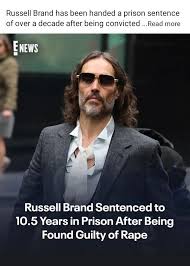
British comedian and actor Russell Brand has been sentenced to 10 years and six months in prison following his conviction for rape and sexual assault.
The sentence was handed down at Southwark Crown Court in London on November 9, 2026. The decision follows a high-profile criminal trial involving allegations from several women about incidents that took place between 2004 and 2009.
A jury found Brand guilty of one count of rape and three counts of sexual assault. However, he was acquitted of two additional rape charges and one charge of attempted indecent assault.
The case has attracted widespread attention because of Brand’s former celebrity status, his career in British entertainment and the serious nature of the convictions.
Judge Joel Bennathan imposed the combined prison sentence after hearing arguments from the prosecution and defence. The court also considered statements from the women who described the lasting effects of the offences.
The ruling marks a major development in a case that began attracting public attention after allegations against Brand became widely reported in 2023.
According to the Crown Prosecution Service (CPS), the convictions concern offences against four women. Prosecutors said the case demonstrates that fame and public influence do not place anyone above the law.
Gwasanaeth Erlyn y Goron+2
Why Was Russell Brand Sentenced to 10.5 Years?

The sentence follows four criminal convictions involving one rape offence and three sexual assaults.
The jury considered evidence relating to incidents that occurred during Brand’s entertainment career. At the time, he was becoming increasingly popular as a comedian, television presenter and radio personality.
The prosecution argued that Brand used his growing celebrity status and professional influence to gain access to women.
Brand denied the charges and maintained that his sexual encounters had been consensual. Nevertheless, the jury accepted the prosecution’s case on four counts.
The court treated the offences as serious criminal matters. It also considered the impact on the victims, including the emotional and psychological consequences they described.
The final sentence reflects the combined punishment for the four offences.
The rape conviction alone resulted in a nine-year prison term. The three sexual assault convictions attracted additional sentences of different lengths.
The judge imposed the overall term of 10 years and six months.
This distinction is important because the headline figure represents the combined sentence, rather than the punishment for the rape conviction alone.
The Guardian+1
Details of the Four Convictions
The trial examined allegations involving six women. Their accounts covered a period extending from 1999 to 2009.
However, the jury’s guilty verdicts related to four offences involving four women.
The convictions included the following incidents:
2004: Brand was found guilty of grabbing a woman’s breasts at a bar in London’s Soho district.
2005: He was convicted of sexually assaulting a woman at a radio station.
2009: He was convicted of sexually assaulting a woman who was working with him on a television project.
2009: He was convicted of raping a 21-year-old woman at his west London home.
The allegations were examined during a trial that lasted several weeks.
The jury considered witness testimony and other evidence before reaching its decisions. Brand denied the allegations throughout the proceedings.
Importantly, the jury did not find him guilty of every charge. He was acquitted of two counts of rape and one count of attempted indecent assault.
The distinction between the guilty and not-guilty verdicts remains central to understanding the case accurately.
The convictions establish Brand’s criminal responsibility for the four offences on which the jury found him guilty.
CBS News+2
Judge Delivers Strong Remarks During Sentencing
Judge Joel Bennathan delivered the sentence at Southwark Crown Court.
His remarks addressed Brand’s conduct, the victims’ experiences and the influence that celebrity status can create.
The judge criticised Brand’s apparent belief that fame allowed him to behave without respecting other people’s boundaries.
He also highlighted the importance of consent.
The court made clear that a person’s clothing, location or decision to socialise does not remove their right to refuse sexual activity.
This point was particularly important in the rape conviction.
The judge also considered the way Brand’s actions affected the woman involved in the 2009 incident.
The court heard that the woman continued to experience significant emotional difficulties long after the offence.
The sentencing remarks reflected the seriousness of the crimes and the lasting consequences described by the victims.
The judge also acknowledged the bravery of the women who came forward and participated in the criminal proceedings.
The case demonstrates how courts consider both the circumstances of an offence and its effects on those who experienced it.
The Guardian+2
The 2009 Rape Conviction Played a Major Role
One of the most serious parts of the case concerned an incident involving a 21-year-old woman in 2009.
The woman initially agreed to vaginal sex with Brand. However, the court heard that he subsequently removed a condom and engaged in anal sex without her consent.
She told the court that she repeatedly wanted the activity to stop.
The prosecution presented evidence about the circumstances of the encounter and the woman’s experience afterwards.
The judge identified several aggravating factors when determining the sentence.
These included the removal of the condom without consent and the humiliation the woman experienced afterwards.
The court also heard that she feared she might have contracted HIV.
According to the sentencing coverage, the judge imposed a nine-year sentence for the rape offence.
He explained that the circumstances increased the seriousness of the crime.
The victim described the lasting consequences in her personal statement. She said the experience affected her ability to sleep, eat and maintain relationships.
She also described the impact on her working life and emotional well-being.
Her account helped the court understand that the consequences of sexual violence can continue for many years.
The sentence therefore considered more than the immediate circumstances of the offence.
The Guardian+1
Victims Describe Lasting Emotional Trauma
The sentencing hearing included victim impact statements from women involved in the case.
These statements gave the victims an opportunity to explain how the offences affected their lives.
Some described years of emotional distress, anxiety and difficulties trusting other people.
Others spoke about humiliation and the challenges of discussing deeply personal experiences in a public criminal trial.
For many survivors, reporting sexual offences can be difficult.
Fear of public attention, embarrassment and concerns about not being believed can prevent people from approaching authorities.
The women in Brand’s case had to discuss events that had happened many years earlier.
They also faced the pressure of giving evidence in a highly publicised trial involving a well-known entertainer.
The prosecution recognised the courage required to participate in the proceedings.
Senior Crown Prosecutor David Roberts said the sentence could not undo the harm experienced by the victims. However, he expressed hope that the outcome would provide some measure of justice.
Their statements also highlighted an important issue: the passage of time does not automatically remove the consequences of sexual violence.
The court’s consideration of these experiences formed an important part of the sentencing process.
Gwasanaeth Erlyn y Goron+2
Russell Brand Denied the Allegations
Throughout the legal proceedings, Brand denied the allegations against him.
His defence maintained that his sexual encounters with the women had been consensual.
Brand also argued that the accusations presented an inaccurate picture of his behaviour.
During the trial, he acknowledged that his earlier lifestyle had involved promiscuity and an obsession with sex. However, he rejected the suggestion that he had forced anyone into sexual activity.
His legal team challenged aspects of the allegations and questioned the passage of time between the alleged incidents and the complaints.
The defence also highlighted changes in Brand’s personal life.
His lawyer, Ian Winter KC, described him as a fundamentally different person from the man he had been during the period covered by the charges.
The defence referred to his family, charitable work and efforts to overcome addiction.
However, these arguments did not prevent the jury from finding him guilty of four offences.
Following the verdict, Brand was refused bail and remained in custody ahead of sentencing.
The judge ultimately imposed a prison term of 10 years and six months.
CBS News+1
How Much Time Could Russell Brand Spend in Prison?
The 10.5-year sentence raises questions about how long Brand could remain behind bars.
Under the reported sentencing arrangements, Brand must serve two-thirds of his sentence before becoming eligible for parole.
Eligibility does not mean automatic release.
The relevant authorities must consider the applicable release rules and any conditions before a prisoner can be released.
The sentence includes nine years for rape and additional prison terms for the three sexual assault convictions.
The judge also considered mitigating circumstances.
These included Brand’s lack of significant previous convictions and evidence relating to his work helping people affected by addiction.
However, the court concluded that the seriousness of the offences required a substantial custodial sentence.
Brand was already being held at HMP Wandsworth after the jury returned its guilty verdicts.
His sentence represents a significant fall from the public life he once enjoyed as a comedian, actor and broadcaster.
The Guardian+1
Police Investigating Further Allegations Against Russell Brand
The legal developments may not be over.
British police have also been assessing additional allegations involving Brand.
Following the convictions, the Metropolitan Police confirmed that detectives were investigating two further rape allegations.
One of the allegations reportedly involves a girl who was 16 at the time.
On November 10, Reuters reported that detectives were assessing several new reports and potential criminal allegations concerning Brand.
Police said further individuals had contacted the investigation team following the convictions.
These reports are being reviewed as part of ongoing enquiries.
However, it is important to distinguish between an investigation and a criminal conviction.
The additional allegations have not been established as proven offences in court. Brand’s existing convictions relate to the four offences for which the jury found him guilty.
Police have encouraged anyone with relevant information to come forward.
The development suggests that investigators may continue examining information connected to Brand’s past conduct.
Whether further criminal proceedings follow will depend on the evidence and decisions made by prosecutors.
Reuters+2
From Comedy Stardom to a Major Criminal Conviction
Russell Brand was once one of Britain’s most recognisable entertainment personalities.
He developed a reputation through stand-up comedy before moving into television, radio and film.
His career included appearances in several popular Hollywood productions.
Some of his best-known films include Forgetting Sarah Marshall, Get Him to the Greek and Arthur.
He also became a familiar face on British television and radio.
His energetic personality, outspoken opinions and provocative humour helped him build a substantial audience.
Brand later moved away from mainstream entertainment and developed a significant online following.
His social media content increasingly focused on politics, religion, wellness and criticism of established institutions.
He also became known for discussing conspiracy theories and challenging mainstream media narratives.
His personal life attracted considerable public attention.
He married American singer Katy Perry in 2010. Their marriage ended after approximately 14 months.
He later married Laura Gallacher, with whom he has three children.
Despite his changing public image, the criminal proceedings brought renewed attention to his earlier entertainment career.
The convictions have fundamentally changed the public discussion surrounding Brand.
Instead of focusing primarily on his comedy and media appearances, attention has shifted towards the offences established in court and the experiences of the victims.
The sentencing represents one of the most significant developments in his public life.
Reuters+2
What the Russell Brand Case Means for Consent and Accountability
The case has also renewed discussion about consent, celebrity influence and accountability.
Consent is a fundamental part of any sexual encounter.
A person can agree to one activity while refusing another. Consent can also be withdrawn at any time.
The court proceedings highlighted the importance of respecting those boundaries.
The case also raised questions about the influence of fame and professional power.
Public figures often have access to professional networks, workplaces and social environments that can create unequal power relationships.
However, celebrity status does not provide legal protection from criminal responsibility.
The prosecution argued that Brand’s growing fame gave him access and influence that he exploited.
The judge’s sentencing remarks reinforced the principle that everyone must follow the same fundamental rules concerning consent.
Another important issue is the reporting of historical sexual offences.
The incidents in the case took place many years before the trial.
Nevertheless, investigators were able to examine the allegations and present evidence to a jury.
This demonstrates that the passage of time does not automatically prevent a criminal investigation.
Each case depends on its specific evidence, legal requirements and circumstances.
The outcome may also encourage other survivors to seek support or report offences.
The CPS has urged anyone who has experienced sexual violence to approach the authorities.
It has also emphasised that victims should receive support throughout the criminal justice process.
Gwasanaeth Erlyn y Goron+2
Public Reaction Following the Sentencing
The sentence has attracted widespread attention across Britain and internationally.
Brand’s former celebrity status has made the case particularly prominent.
News organisations have focused on the four convictions, the judge’s remarks and the statements from the victims.
The outcome has also generated discussion about the responsibilities of public figures.
For some observers, the sentence represents an important moment of accountability.
Others have focused on the broader questions raised by the investigation, including why allegations involving prominent individuals can take years to reach court.
The proceedings also demonstrate the importance of allowing criminal cases to be decided through evidence and established legal procedures.
Brand denied the charges, but the jury reached its verdict after considering the evidence presented during the trial.
The additional allegations being investigated by police remain separate matters.
They must be assessed through the appropriate legal process.
For now, the central development is clear: Brand has received a 10-year-and-six-month prison sentence following four criminal convictions.
The decision marks a major turning point in the former comedian’s life and career.
What Happens Next in the Russell Brand Case?
Brand’s immediate future will be shaped by his prison sentence and any further developments in the police investigations.
The 10-year-and-six-month term represents a substantial punishment for the offences established at trial.
He will remain subject to the relevant prison and release arrangements.
Meanwhile, detectives are assessing further reports involving the former television presenter.
If investigators identify sufficient evidence, additional legal proceedings could follow.
However, any new allegations must be examined independently. A person is not considered guilty of an additional offence simply because they are already serving a sentence for other crimes.
The victims’ experiences and the evidence presented during the trial will remain central to public discussion of the case.
The ruling also sends a wider message about accountability.
Fame, wealth and professional influence cannot replace the requirement to respect consent.
For Brand, the immediate consequence is a lengthy prison sentence that will significantly change his personal and professional future.
Frequently Asked Questions (FAQs)
1. Why was Russell Brand sentenced to 10.5 years in prison?
Russell Brand received a 10-year-and-six-month prison sentence after being convicted of one count of rape and three counts of sexual assault involving four women.
2. When was Russell Brand sentenced?
Brand was sentenced on November 9, 2026, at Southwark Crown Court in London.
3. How many charges was Russell Brand found guilty of?
A jury found Brand guilty of four offences: one count of rape and three counts of sexual assault.
4. Was Russell Brand acquitted of any charges?
Yes. He was acquitted of two additional rape charges and one charge of attempted indecent assault.
5. How old were the incidents involved in the case?
The four offences for which Brand was convicted occurred between 2004 and 2009.
6. How long must Russell Brand serve in prison?
Reports indicate that he must serve two-thirds of his 10-year-and-six-month sentence before becoming eligible for parole. Eligibility does not guarantee release.
7. Did Russell Brand deny the allegations?
Yes. Brand denied the charges and maintained that his sexual encounters were consensual. The jury nevertheless found him guilty of four offences.
8. Are British police investigating further allegations?
Yes. Reuters reported on November 10, 2026, that police were assessing several additional reports and potential criminal allegations involving Brand.
9. Who sentenced Russell Brand?
Judge Joel Bennathan delivered the sentence at Southwark Crown Court in London.
10. What is the significance of the Russell Brand sentencing?
The case highlights criminal accountability, consent and the importance of investigating sexual offences regardless of a person’s celebrity status.
Conclusion
The sentencing of Russell Brand to 10 years and six months in prison marks a major development in one of Britain’s most closely watched celebrity criminal cases.
His convictions for rape and three sexual assaults follow a trial involving evidence from several women and incidents dating back to the 2000s.
Although Brand denied the allegations, the jury found him guilty of four offences. The judge subsequently imposed a substantial prison sentence after considering the seriousness of the crimes and their lasting effects on the victims.
With police now assessing further allegations, the case could have additional developments.
For now, the 10.5-year sentence stands as the central outcome of the criminal proceedings and a significant moment in the wider discussion about consent and accountability.
About the Author