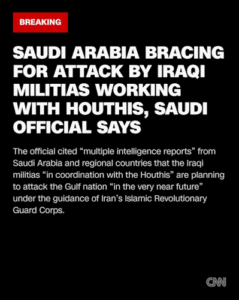
Saudi Arabia has moved into a heightened security posture after officials warned of possible coordinated attacks involving Iran-backed Iraqi militias and Yemen’s Houthis. The warning comes at a particularly sensitive moment for the Middle East, with tensions between Saudi Arabia and Iran-linked armed groups rising sharply.
According to recent reporting, Saudi officials believe attacks could potentially come from both the north and south, creating a two-front security challenge for the kingdom. Iraqi militias could threaten Saudi Arabia from the north, while the Houthis could pose a threat from Yemen in the south. Intelligence assessments reportedly indicate that energy infrastructure, ports and airports could be among the potential targets.
The developments have triggered fresh fears of a much wider regional conflict. Online discussions have increasingly used phrases such as “WW3” and “World War III,” but there is no confirmation that a global war has begun. Instead, the immediate concern is whether another round of attacks could expand the existing Middle East confrontation.
Saudi Arabia on High Alert
Saudi Arabia’s latest security concerns follow a series of attacks and retaliatory military operations involving Iran, the United States and Iran-aligned armed groups.
A senior Saudi official said the kingdom expects potentially imminent attacks involving Iranian-backed forces. The assessment reportedly includes Iraqi militias operating to Saudi Arabia’s north and the Houthi movement in Yemen to the south. Saudi, U.S. and regional intelligence agencies are said to have been examining the possibility of attacks against important civilian and economic infrastructure.
The warning is significant because Saudi Arabia is one of the world’s most important energy producers. Any successful attack against oil facilities, export infrastructure, airports or major ports could have consequences far beyond the kingdom.
Saudi Arabia has therefore faced a difficult strategic challenge: protect critical infrastructure while avoiding steps that could unintentionally accelerate a wider regional war.
Why Iraqi Militias Are at the Center of the Warning
Iraq has become one of the most sensitive arenas in the current regional confrontation.
Several Iran-aligned armed factions operate in Iraq and have historically described their military activities as resistance against Israel and U.S. interests. During the latest escalation, these groups have faced pressure following strikes against militia positions.
Recent reporting indicates that Iran-backed Iraqi factions threatened retaliation after U.S. and Saudi military action against targets in Iraq. However, the situation has not moved in a simple or predictable direction.
Reuters reported that the alliance commonly known as the Islamic Resistance in Iraq postponed its response following an appeal from influential Shiite political figure Hadi al-Amiri. The group did not publicly provide details of a planned operation or identify a specific target.
That postponement is important.
It means that while Saudi Arabia is preparing for a possible attack, there is not publicly confirmed evidence that a specific Iraqi militia attack on Saudi territory has already been launched.
Possible Targets Raise Major Concerns
The biggest concern for Saudi authorities is the possibility of attacks against strategic infrastructure.
Saudi Arabia’s economy depends heavily on energy exports, making oil facilities particularly sensitive. Ports and airports are also critical to the kingdom’s economy, tourism sector, trade and international connectivity.
According to the reported Saudi assessment, potential targets could include energy facilities, ports and airports.
An attack on such infrastructure would have consequences beyond physical damage.
Even a limited strike could cause:
- Temporary disruption to energy production
- Higher global oil prices
- Disruption to shipping
- Increased insurance costs
- Pressure on regional financial markets
- Greater military activity
- New diplomatic tensions
The possibility of attacks against energy infrastructure is therefore being treated as a strategic concern rather than simply another battlefield development.
Saudi Arabia Faces Pressure From Two Directions
One of the most worrying aspects of the current situation is geography.
Saudi Arabia shares a long border with Yemen, where the Houthi movement has previously demonstrated the ability to launch drones and missiles toward Saudi territory.
At the same time, Iraq lies directly to Saudi Arabia’s north, where Iran-backed armed groups operate.
That creates a potential north-south security challenge.
Saudi officials reportedly believe that Iraqi militias and the Houthis could coordinate or act within the same broader Iranian strategic framework.
Whether such coordination actually takes place remains an important question.
Nevertheless, the possibility forces Saudi planners to consider multiple threats simultaneously.
Houthi Attacks Add to the Alarm
The Houthi threat remains another major element of Saudi Arabia’s security calculations.
Recent reporting said Houthi drone and missile attacks reached Saudi territory, with civilians reportedly wounded in Najran Province. The broader Yemen conflict therefore remains directly connected to Saudi national security concerns.
The Houthi movement has developed extensive experience with drones and missiles during years of conflict in Yemen.
For Saudi Arabia, the challenge is particularly serious because drones can be relatively inexpensive compared with the high cost of sophisticated air-defense systems.
Even when incoming weapons are intercepted, the defensive operation can be expensive and can place pressure on military resources.
Iraq Tries to Prevent Further Escalation
The Iraqi government has an especially difficult role.
Baghdad wants to maintain sovereignty and avoid allowing Iraqi territory to become a launchpad for attacks against neighboring countries. At the same time, Iran-aligned political and armed factions possess significant influence inside Iraq.
Reuters reported that Iraqi Prime Minister Ali al-Zaidi met with Saudi intelligence chief Khalid al-Humaidan amid the rising tensions. Iraq reportedly reaffirmed that its territory should not be used to launch attacks against other countries.
That message could become increasingly important.
If an Iraqi militia attacks Saudi Arabia from Iraqi territory, Riyadh could face pressure to respond militarily. Such a response could then place the Iraqi government in an extremely difficult position.
The result could be a dangerous cycle:
Militia attack → Saudi retaliation → militia response → wider regional escalation.
Avoiding that cycle is one of the biggest diplomatic challenges facing the region.
Saudi Arabia Is Strengthening Regional Security Ties
The security situation has also encouraged Saudi Arabia to deepen cooperation with other regional powers.
On August 7, 2026, Saudi Arabia, Turkey and Pakistan signed the Mecca Joint Defense Agreement. The agreement establishes a framework under which an attack on one member is treated as an attack on all, while emphasizing defense and closer security cooperation.
The agreement is significant because it comes during an unusually tense period.
Saudi Arabia brings major financial and energy influence. Turkey has substantial military capabilities and NATO membership. Pakistan contributes extensive military experience and is a nuclear-armed state.
The agreement does not automatically mean that these countries will enter a war together. Its broader significance may instead lie in deterrence: demonstrating that an attack on Saudi Arabia could have consequences beyond the kingdom itself.
Why WW3 Fears Are Growing
The phrase “WW3” has become increasingly common whenever conflicts involving major powers and regional allies intensify.
However, describing the present situation as World War III would be premature.
A global war generally implies direct and sustained military confrontation among multiple major powers across several theaters. The current crisis is certainly dangerous, but it remains primarily a regional conflict involving interconnected actors.
The danger is escalation.
If an Iraqi militia attacks Saudi Arabia, Riyadh could retaliate. If Iran becomes directly involved, the United States could face additional pressure to respond. If the Houthis expand their attacks, shipping routes could become more dangerous. If other regional states enter the confrontation, the conflict could spread further.
That is why analysts and governments are watching developments so closely.
The concern is not necessarily that WW3 is inevitable. The concern is that a sequence of decisions could produce an escalation that becomes increasingly difficult to control.
Energy Markets Could Feel the Impact
Saudi Arabia’s importance to the global energy system means that any major security incident could affect international markets.
Oil traders closely monitor developments involving Saudi infrastructure because disruptions can influence global supply expectations.
Even rumors of attacks can produce market volatility.
A serious attack on an oil-processing facility, export terminal or pipeline could potentially reduce available supply. At the same time, concerns over shipping security could increase transportation and insurance costs.
This makes Saudi security a global economic issue.
Countries in Asia and Europe that depend heavily on imported energy would also be watching developments carefully.
The Strait of Hormuz Factor
Another major concern is the Strait of Hormuz, one of the world’s most important energy shipping routes.
The waterway connects the Persian Gulf with the Gulf of Oman and is critical for energy exports from several Gulf states.
Any major escalation between Iran and its regional opponents could create additional uncertainty around shipping through the region.
Recent reporting has also indicated that negotiations have been taking place around the possibility of reopening or stabilizing the Strait of Hormuz.
That makes the timing of any potential attack particularly significant.
A major military escalation could undermine diplomatic efforts aimed at reducing tensions.
Diplomacy Remains Possible
Despite the alarming security warnings, diplomacy has not completely disappeared.
Saudi Arabia has continued efforts aimed at reducing tensions, while discussions involving Iran have reportedly been taking place.
The postponement of a threatened response by Iraqi militias is another indication that political calculations remain important. Hadi al-Amiri’s intervention reportedly helped delay an immediate response from the Islamic Resistance in Iraq.
This creates a potential window for de-escalation.
The challenge is that diplomacy must compete with powerful armed groups, domestic political pressures and military calculations.
A single attack could rapidly change the situation.
What Happens Next?
The next stage will likely depend on whether the threats described by Saudi officials turn into actual attacks.
Three broad scenarios are possible.
Scenario One: Militias Hold Back
The most favorable scenario would be continued restraint.
If Iraqi militias delay or abandon retaliation and the Houthis reduce attacks, diplomatic channels could gain more space.
That would lower the immediate risk of a broader regional war.
Scenario Two: Limited Attacks Occur
A second possibility is a limited drone or missile attack.
Such an incident could be serious but potentially containable if casualties and infrastructure damage remain limited.
Saudi Arabia could respond through targeted military operations while international mediators attempt to prevent escalation.
Scenario Three: Regional Escalation
The most dangerous scenario would involve simultaneous attacks from multiple directions followed by major Saudi retaliation.
If Iran or other major powers became directly involved, the conflict could move beyond its current regional boundaries.
That is the scenario behind the strongest “WW3” fears.
Saudi Security Strategy Is Under Pressure
Saudi Arabia has spent years investing heavily in military modernization and air-defense capabilities.
The latest crisis tests whether those systems can protect critical infrastructure against multiple simultaneous threats.
Modern warfare has also changed.
Drones can be launched at relatively low cost, while defending against them can require expensive radar, interceptor missiles and fighter aircraft.
This creates an economic challenge as well as a military one.
Saudi Arabia must therefore balance defense spending, infrastructure protection, diplomacy and economic stability.
What This Means for the Middle East
The latest Saudi high-alert warning illustrates how interconnected the region’s conflicts have become.
An event in Iraq can affect Saudi Arabia.
An attack from Yemen can influence energy markets.
A confrontation involving Iran can affect shipping.
Military action by the United States can trigger responses from Iran-aligned groups.
This interconnected structure makes escalation particularly dangerous.
At the same time, it means that diplomacy in one area can have positive effects elsewhere.
The central question is whether regional governments and armed groups can maintain enough restraint to prevent another major cycle of retaliation.
Conclusion
Saudi Arabia’s high-alert posture reflects a serious security concern following warnings of possible attacks involving Iran-backed Iraqi militias and Yemen’s Houthis.
Recent reports indicate that Saudi authorities are preparing for potential threats against strategic infrastructure, while Iraqi political leaders are attempting to prevent their territory from being used to launch attacks against neighboring states.
The postponement of a threatened militia response provides a potential opening for diplomacy, but the underlying tensions remain extremely high.
The “WW3” label captures public anxiety about the possibility of a much larger conflict, but it should not be treated as a confirmed prediction. The more immediate issue is whether another attack could trigger a chain reaction involving Saudi Arabia, Iraq, Iran, Yemen and the United States.
For now, the region remains at a dangerous crossroads.
Saudi Arabia is on alert. Iraqi militias are under pressure to decide their next move. Yemen remains a major security concern. And diplomats are trying to prevent the next escalation from becoming something far larger.
The coming days could therefore prove critical for determining whether the latest crisis moves toward retaliation—or toward de-escalation.
FAQs
1. Why is Saudi Arabia on high alert?
Saudi Arabia is on heightened alert following warnings of possible coordinated attacks involving Iran-backed Iraqi militias and Yemen’s Houthis. Reported potential targets include energy infrastructure, ports and airports.
2. Are Iraqi militias preparing to attack Saudi Arabia?
Saudi officials have warned about the possibility of attacks by Iran-aligned Iraqi militias. However, publicly available reporting does not confirm that a specific attack on Saudi Arabia has been launched. An Iraqi militia alliance recently postponed its threatened response.
3. Could the Houthis attack Saudi Arabia?
The Houthis have previously launched drones and missiles toward Saudi Arabia, and recent reporting indicates renewed attacks have contributed to the kingdom’s heightened security concerns.
4. Is World War III starting?
There is no confirmation that World War III has started. The current situation represents a serious regional escalation, but the term “WW3” is largely being used to describe fears that the conflict could expand.
5. Why are Saudi oil facilities important?
Saudi Arabia is one of the world’s most important energy producers. Any major disruption to its oil infrastructure could affect global supply expectations and potentially push energy prices higher.
6. What is the Mecca Joint Defense Agreement?
Saudi Arabia, Turkey and Pakistan signed the Mecca Joint Defense Agreement on August 7, 2026. The pact strengthens defense cooperation and establishes that an attack on one member would be treated as an attack on all.
7. Is Iraq trying to prevent attacks from its territory?
Yes. Iraqi Prime Minister Ali al-Zaidi reportedly reaffirmed Iraq’s commitment to sovereignty and stated that Iraqi territory should not be used to launch attacks against other countries.
8. What could trigger a wider Middle East war?
A coordinated attack causing significant casualties or infrastructure damage, followed by major retaliation involving additional countries, could dramatically increase the risk of wider regional escalation.
9. Could the crisis affect oil prices?
Yes. Any significant disruption to Saudi energy infrastructure or regional shipping could affect global oil markets because Saudi Arabia is a major energy supplier.
10. What should readers watch next?
The most important developments are whether Iraqi militias proceed with retaliation, whether Houthi attacks continue, how Saudi Arabia responds to any incident, and whether diplomatic efforts involving Iran can reduce tensions.
About the Author