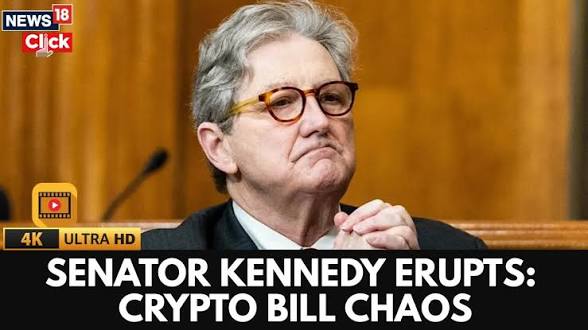
Washington is once again facing questions about political gridlock, budget uncertainty and the possibility of another government funding crisis. Sen. John Kennedy of Louisiana has emerged as one of the Republican voices warning that political divisions in Congress could create even more confusion in the nation’s capital.
Kennedy has repeatedly criticized what he sees as a failure by lawmakers to reach practical agreements on government spending. In recent Senate remarks, he argued that political calculations could make it harder for Congress to approve a new budget and avoid another shutdown.
The concerns come at a sensitive moment. With the 2026 midterm elections approaching, Washington is under pressure to resolve major spending and policy disputes while lawmakers from both parties prepare for a highly competitive election season.
For Kennedy, the problem is bigger than one disagreement. He has portrayed the situation as part of a broader pattern in which political confrontation is replacing cooperation.
Sen. Kennedy Warns of Washington Chaos
Sen. John Kennedy, a Republican from Louisiana, has become known for his blunt Senate speeches and sharp criticism of congressional dysfunction. His latest warnings focus heavily on government funding and the possibility that political disagreements could lead to another shutdown.
Kennedy said in June that he believed Congress could struggle to pass a new budget because of deep partisan disagreements. He specifically warned that Democrats could oppose funding legislation and that the resulting stalemate could create another government shutdown.
His argument reflects a larger concern in Washington: lawmakers have repeatedly relied on temporary funding measures and last-minute negotiations instead of completing the regular budget process.
That approach can leave federal agencies, workers and the public uncertain about what happens next.
Kennedy has argued that such uncertainty is particularly dangerous when the United States is dealing with major domestic and international challenges.
Why the Budget Fight Matters
Federal budgeting may sound technical, but it has consequences across the country.
Government funding affects federal employees, national security agencies, transportation operations, public programs and numerous other services. When Congress fails to approve funding, agencies can be forced to prepare for disruptions.
Kennedy has repeatedly focused on this problem.
In a May 2026 opinion piece, he argued that government shutdowns cause significant pain for ordinary Americans. He also criticized lawmakers for being able to continue receiving pay during shutdowns while federal workers can face financial uncertainty.
His response was to push for a Senate rule designed to withhold senators’ pay during a shutdown.
According to Kennedy, the Senate eventually approved his resolution through a voice vote. However, because of constitutional requirements surrounding congressional compensation, the change cannot take effect until after the November midterm elections.
That timing is important.
It means lawmakers could still face another funding confrontation before the new rule becomes effective.
Kennedy Says Political Incentives Are Driving the Crisis
One of Kennedy’s central arguments is that political incentives can make compromise more difficult.
The closer the country moves toward an election, the greater the temptation for politicians to use major legislative battles to energize their supporters.
Kennedy has suggested that a shutdown or funding confrontation could become part of that political strategy.
In a June Senate speech, he argued that creating government chaos to gain an electoral advantage would be irresponsible.
That accusation is politically controversial.
Democrats and Republicans have repeatedly blamed each other for Washington’s budget problems. Each side typically argues that the other party is refusing to compromise.
As a result, the public is often left watching two competing explanations for the same congressional stalemate.
This is one reason the phrase “Washington chaos” resonates with frustrated voters.
The Shutdown Threat Remains a Major Concern
Government shutdowns have become a recurring feature of American political battles.
A shutdown generally occurs when Congress fails to provide legal authority for federal agencies to continue spending. Some government functions continue, while other operations may be reduced or suspended.
The effects can vary depending on the agency and the circumstances.
Federal employees may be furloughed or required to work without immediately receiving pay. Contractors and businesses that depend on government activity can also experience disruption.
Airports, national parks, regulatory agencies and other public services can be affected depending on the length and scope of a shutdown.
Kennedy has used these consequences to argue that lawmakers should have stronger incentives to avoid shutdowns.
His proposal to temporarily withhold senators’ pay is intended to make lawmakers experience some of the financial consequences themselves.
Why Washington Feels Increasingly Divided
The budget dispute is only one part of the larger political divide in Washington.
Congress faces disagreements over immigration, national security, federal spending, energy policy, healthcare and foreign affairs.
These issues often divide lawmakers along party lines.
At the same time, both parties contain internal factions that do not always agree with their own leadership.
That makes negotiations even more complicated.
A congressional leader may reach a tentative agreement with members of the opposing party, only to face resistance from lawmakers within their own party.
The result can be a cycle of negotiation, rejection and renewed confrontation.
For voters, this can look like confusion.
For lawmakers, however, it reflects the difficulty of balancing party priorities, constituency demands and legislative realities.
Kennedy’s Criticism of Congressional Dysfunction
Kennedy has made congressional dysfunction a recurring subject of his public remarks.
His criticism is not limited to one party or one budget dispute. He has argued that shutdowns have become a default political weapon when lawmakers cannot resolve disagreements.
In his May opinion piece, Kennedy described shutdowns as harmful to Americans and said politicians could benefit politically while ordinary workers bear the consequences.
He has therefore attempted to change the incentives surrounding shutdown votes.
The underlying argument is simple: if lawmakers know they will personally face a financial consequence, they may have greater motivation to reach an agreement.
Whether that approach can prevent future shutdowns remains uncertain.
The Midterm Elections Add More Pressure
The 2026 midterm elections are an important part of the political backdrop.
Members of Congress are increasingly focused on their electoral prospects as November approaches. Control of Congress could have major consequences for the direction of federal policy.
That makes every major legislative battle more politically significant.
A spending dispute that might normally be resolved through negotiation can become part of a larger campaign narrative.
Republicans can accuse Democrats of blocking government funding, while Democrats can argue that Republicans are demanding policies they cannot accept.
Both sides can use the confrontation to motivate their voters.
Kennedy has warned that this dynamic could make a shutdown more likely.
He has argued that political leaders should not create government instability simply to gain an electoral advantage.
DHS Funding Shows the Broader Problem
Kennedy has also raised concerns about funding for the Department of Homeland Security.
In June, he warned that important DHS functions, including the Border Patrol and Immigration and Customs Enforcement, faced funding challenges. He criticized Democrats for opposing certain funding arrangements and argued that Republicans were being forced to pursue alternative legislative strategies.
The dispute demonstrates how individual agency funding can become tied to broader political battles.
Immigration remains one of the most divisive issues in American politics.
Republicans generally emphasize border security and immigration enforcement, while Democrats often place greater emphasis on legal protections, humanitarian concerns and limits on enforcement practices.
When those competing priorities become attached to funding legislation, compromise can become much harder.
What Kennedy Wants Congress to Do
Kennedy’s message has generally centered on accountability and cooperation.
He has argued that Congress should complete its budget responsibilities rather than repeatedly allowing funding deadlines to become crises.
His Senate resolution concerning lawmakers’ pay is one example of his attempt to change congressional incentives.
Kennedy has also argued that lawmakers should be willing to negotiate rather than treating shutdowns as a political strategy.
That position could appeal to voters who are tired of repeated government funding battles.
However, changing congressional behavior is much harder than criticizing it.
The Senate and House operate under different rules, and constitutional requirements can limit what lawmakers can do.
Is Washington Really in Chaos?
The word “chaos” is politically loaded.
Washington certainly faces serious disagreements, but disagreement itself is not necessarily evidence that government has stopped functioning.
Congress continues to pass legislation, conduct hearings and negotiate major policies.
Kennedy’s criticism is better understood as a warning about the consequences of prolonged political gridlock.
If lawmakers repeatedly wait until funding deadlines are close before negotiating, the possibility of disruption increases.
If partisan divisions become more intense during an election year, the political stakes can rise further.
And if both sides believe that confrontation helps their electoral position, compromise can become harder.
That is the environment Kennedy is warning about.
Why Voters Are Paying Attention
For ordinary Americans, congressional arguments matter most when they affect daily life.
Federal employees want certainty about their jobs and pay.
Travelers want functioning airports and transportation systems.
Businesses want predictable government operations.
Families want confidence that federal programs will continue.
Local governments often depend on federal funding for important projects.
That means Washington’s political disputes can eventually reach communities far beyond the capital.
Kennedy has repeatedly emphasized this connection.
His argument is that political leaders should remember that government shutdowns are not abstract events. They can affect real people.
Kennedy’s Message Ahead of the Next Budget Deadline
The next major test will be whether Congress can reach a funding agreement before the current budget arrangement expires.
Kennedy has warned that another confrontation could develop if lawmakers fail to compromise. His May statement noted that the existing budget agreement runs through September 30, 2026.
That deadline places pressure on Congress.
Lawmakers have several possible options.
They can negotiate and approve regular appropriations.
They can agree to another temporary funding measure.
Or they can fail to reach an agreement and risk a shutdown.
The political consequences of each option could be significant.
What Happens If Congress Cannot Agree?
If Congress fails to provide funding, affected federal agencies could begin shutdown procedures.
The exact impact would depend on which agencies lack funding and how long the disruption lasts.
A brief shutdown might cause limited interruptions, while a prolonged shutdown could create much wider consequences.
The economic impact could also increase as uncertainty continues.
Government workers, contractors and businesses may delay spending, hiring or investment decisions.
That is why both parties generally have an incentive to avoid a prolonged shutdown, even when negotiations become bitter.
The challenge is reaching an agreement that enough lawmakers from both parties can support.
A Bigger Debate About Government
The Washington conflict also reflects a deeper disagreement over the size and role of the federal government.
Republicans and Democrats often have different views about how much Washington should spend, which programs deserve priority and how federal agencies should operate.
Kennedy has frequently argued for stronger national security spending while criticizing waste and government inefficiency.
His June remarks also highlighted concerns about America’s defense requirements and international threats.
That creates another difficult balancing act.
Lawmakers must determine how much money should go toward defense, domestic programs, border security and other priorities while also considering the national debt.
There are no easy answers.
The Political Battle Is Far From Over
Sen. John Kennedy’s warnings have added another voice to an already heated Washington debate.
His criticism of congressional dysfunction reflects concerns shared by many Americans who are frustrated by repeated budget fights.
At the same time, the responsibility for avoiding a shutdown does not belong to one senator or one political party.
Both chambers of Congress must ultimately find enough votes to pass funding legislation.
The White House also has an important role in the broader negotiations.
That means the path forward will depend on multiple political actors.
Final Thoughts
The phrase “Washington chaos” captures the frustration surrounding Congress, but the underlying story is more complicated.
Sen. John Kennedy is warning that political divisions, budget uncertainty and election-year incentives could push Washington toward another confrontation.
His proposed solution—making senators feel a financial consequence during shutdowns—is designed to encourage lawmakers to avoid funding crises. The Senate has already approved his resolution, although its implementation is delayed by constitutional requirements.
Kennedy has also warned that Congress could struggle to approve a new budget if partisan divisions remain unresolved.
Whether his predictions prove correct will depend on what happens during the next round of budget negotiations.
For now, one thing is clear: Washington’s political calendar is getting more intense, and the approaching budget deadline could become one of the biggest tests of congressional cooperation before the 2026 midterm elections.
The coming months will reveal whether lawmakers can move beyond partisan confrontation and deliver a workable funding agreement—or whether another Washington showdown will dominate the national political conversation.
FAQs
1. Who is Sen. John Kennedy?
Sen. John Kennedy is a Republican senator from Louisiana. He is known for his outspoken Senate speeches and commentary on government spending, national security and congressional policy.
2. Why is Sen. Kennedy warning about Washington chaos?
Kennedy has warned that partisan disagreements over government funding could produce another shutdown and increase political instability in Washington.
3. What is Kennedy’s shutdown proposal?
Kennedy supported a Senate resolution designed to temporarily withhold senators’ pay during a government shutdown. The withheld pay would be provided after the government reopens.
4. When does the current budget agreement expire?
Kennedy’s May 2026 statement said the current budget agreement lasts until September 30, 2026.
5. Could there be another government shutdown?
A shutdown is possible if Congress and the administration fail to agree on government funding before a funding deadline. Whether that happens depends on negotiations and congressional votes.
6. Why are the 2026 midterms important?
The midterm elections will determine the balance of power in Congress. Because the elections are approaching, major legislative disputes can carry significant political consequences.
7. What issues are contributing to congressional divisions?
Budget spending, immigration, homeland security, defense, healthcare and the role of the federal government are among the issues producing major disagreements.
8. What does Kennedy say Congress should do?
Kennedy has called for lawmakers to negotiate and avoid using government shutdowns as a political strategy. He argues that government funding should be handled responsibly and that lawmakers should face stronger incentives to reach agreements.
9. Does “Washington chaos” mean the government has stopped functioning?
No. The phrase describes political dysfunction and uncertainty rather than a complete breakdown of government. Congress continues to conduct legislative business even during major political disputes.
10. What happens next?
The major question is whether Congress can reach a funding agreement before the September 30 deadline. The outcome could determine whether Washington avoids another shutdown confrontation ahead of the midterm elections.
About the Author