SPACEX LAUNCH SHOCK: Falcon 9 blasts off, Crew-13 rockets to ISS, NASA mission defies delays
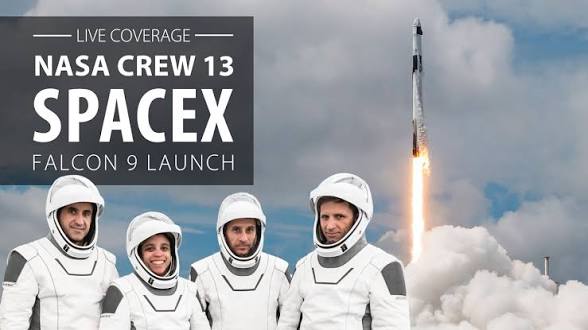
The SpaceX Crew-13 launch has successfully lifted four astronauts toward the International Space Station (ISS), ending weeks of anticipation and earlier delays.
A SpaceX Falcon 9 rocket carrying the Crew Dragon spacecraft launched from Space Launch Complex 40 at Cape Canaveral Space Force Station in Florida at 11:10 a.m. EDT on October 1, 2026. NASA confirmed the successful launch and identified the mission as a long-duration science expedition to the orbiting laboratory.
The mission carries NASA astronauts Jessica Watkins and Luke Delaney, Canadian Space Agency astronaut Joshua Kutryk, and Roscosmos cosmonaut Sergey Teteryatnikov.
The launch represents another major step in NASA’s Commercial Crew Program, which uses privately operated spacecraft to transport astronauts to and from low Earth orbit.
Falcon 9 Ignites as Crew-13 Begins Its Journey
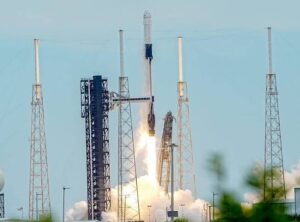
The Falcon 9 rocket rose from SLC-40 with the Crew Dragon spacecraft mounted on top.
NASA’s pre-launch coverage reported that the vehicle remained on schedule shortly before liftoff, with fuel-loading operations completed and liquid oxygen loading underway.
After launch, the Falcon 9’s first stage separated from the upper portion of the vehicle. SpaceX planned to return the booster to Landing Zone 40 at Cape Canaveral.
The booster supporting Crew-13 is flying its third mission. SpaceX says it previously launched Crew-12 and a Starlink mission, highlighting the company’s continued use of reusable hardware for human spaceflight.
That reusability is an important part of SpaceX’s launch strategy. Instead of treating every rocket as a single-use vehicle, the company routinely recovers Falcon 9 first stages and prepares them for future missions.
Crew-13 Launch Followed Earlier Delays
The successful launch came after the mission faced delays.
Crew-13 had originally been expected to fly earlier, but NASA and SpaceX postponed the mission because of an issue involving the Dragon spacecraft’s propulsion system. Reports described the problem as a leaking valve or propulsion-system leak that required corrective work before the spacecraft could carry astronauts.
The delay demonstrated the importance of resolving technical concerns before a crewed launch.
Human-spaceflight missions involve extensive checks because the spacecraft must support astronauts during launch, orbital operations, rendezvous and re-entry. NASA and SpaceX therefore used additional time to address the Dragon issue before returning to the launch schedule.
SpaceX eventually targeted October 1 for liftoff, with October 2 available as a backup opportunity.
The mission ultimately launched successfully on October 1.
Who Is Flying on SpaceX Crew-13?
Crew-13 features an international team of four astronauts.
Jessica Watkins
NASA astronaut Jessica Watkins is serving as commander.
Watkins is returning to the International Space Station for another long-duration mission. NASA lists her among the four Crew-13 astronauts and says the crew will join Expedition 75 aboard the station.
Her previous experience aboard the ISS gives the mission an experienced spaceflight commander.
Luke Delaney
NASA astronaut Luke Delaney is serving as the mission pilot.
Crew-13 is a major milestone for Delaney because it marks his first spaceflight. His responsibilities include supporting the spacecraft’s flight operations alongside the commander and the rest of the crew.
Joshua Kutryk
Canadian Space Agency astronaut Joshua Kutryk is another member of the international crew.
The mission marks Kutryk’s first journey into space. His participation also reflects Canada’s continuing role in international space-station operations.
Sergey Teteryatnikov
Roscosmos cosmonaut Sergey Teteryatnikov completes the four-person crew.
Like Delaney and Kutryk, this is his first spaceflight, according to reporting surrounding the mission.
The international makeup of Crew-13 reflects the collaborative nature of ISS operations, where astronauts and cosmonauts from different space agencies work together aboard the station.
Crew Dragon Heads for the International Space Station
After reaching orbit, the Crew Dragon spacecraft began its journey toward the ISS.
NASA said Dragon was expected to autonomously dock with the forward port of the station’s Harmony module at approximately 7 p.m. EDT. The planned flight from launch to docking was about 7 hours and 50 minutes.
That rapid journey is significant.
NASA described Crew-13’s trip as the fastest launch-to-docking by a U.S. spacecraft in ISS history.
The spacecraft’s ability to perform orbital maneuvers allows Dragon to adjust its trajectory and gradually catch up with the space station.
The ISS travels around Earth at extremely high speed. Therefore, a spacecraft cannot simply point toward the station and fly directly to it. Instead, mission controllers and spacecraft systems carefully manage altitude, speed and orbital position.
A Six-Month Science Mission Begins
Crew-13 is not simply a transportation flight.
The four astronauts are scheduled to spend an extended period aboard the International Space Station, conducting scientific research and supporting station operations.
NASA says the mission will investigate several areas involving human health, plant growth and medical research.
One important research area involves human stem-cell-derived tissues.
Scientists will use the microgravity environment to produce tissues that could help researchers study diseases, develop personalized medical approaches and test pharmaceuticals.
The crew will also conduct research into how the human body responds to spaceflight.
Why Microgravity Research Matters
The space station provides an unusual scientific laboratory.
On Earth, gravity affects almost every biological and physical process. In orbit, researchers can examine certain processes under microgravity conditions.
Crew-13 will contribute to studies involving blood-flow abnormalities and other changes associated with living in space. NASA also says the crew will test an inflight diagnostic device designed to help monitor astronaut health.
These studies are particularly important as space agencies prepare for longer missions.
Future missions could require astronauts to spend significantly more time away from Earth. Understanding how the human body responds to extended spaceflight can therefore help researchers develop better monitoring and medical-support strategies.
Crew-13 Will Also Study Plants in Space
Food production is another important part of long-duration spaceflight research.
NASA says Crew-13 will work with a new, mostly autonomous plant-growth system and investigate how crops develop outside traditional dedicated growth facilities.
Growing plants in space could eventually support future exploration.
For missions lasting months or years, crews may need more than packaged food. Researchers are investigating whether plants can contribute to food production and help create sustainable systems for future space habitats.
The ISS provides an ideal environment for testing these concepts before they are considered for missions farther from Earth.
SpaceX and NASA Continue Commercial Crew Operations
The Crew-13 launch also demonstrates the continuing partnership between NASA and SpaceX.
NASA’s Commercial Crew Program works with commercial aerospace companies to provide transportation to low Earth orbit.
SpaceX’s Crew Dragon has become a regular vehicle for NASA astronaut missions to the ISS.
NASA identifies Crew-13 as the 13th crew rotation mission of SpaceX’s human space transportation system and the company’s 14th flight carrying NASA astronauts to the station, counting the Demo-2 test flight.
The continuing cadence of crewed missions is important because the ISS requires regular crew rotations.
Astronauts must also transport supplies, conduct experiments, perform maintenance and prepare the station for future missions.
What Happened to the Previous ISS Crew?
Crew-13’s arrival also supports the transition between station crews.
NASA said the incoming astronauts would join Expedition 75, while the existing Crew-12 astronauts prepared to return to Earth.
This handover process helps maintain a continuous human presence aboard the ISS.
During the transition, astronauts can exchange information about station systems, experiments, maintenance tasks and ongoing operations.
The process is particularly important because the ISS is a complex laboratory with equipment that requires constant monitoring.
Falcon 9 Reusability Remains a Major Feature
Another notable part of the Crew-13 mission is the use of a previously flown Falcon 9 first stage.
SpaceX says the booster supporting the mission had already flown Crew-12 and a Starlink mission. After separation, it was scheduled to land at Landing Zone 40.
Reusable rockets have changed the economics and operational model of many orbital launches.
Rather than manufacturing an entirely new first-stage booster for every flight, SpaceX can recover, inspect and reuse compatible hardware.
For crewed missions, however, safety requirements remain especially demanding. Every component must meet NASA and SpaceX requirements before astronauts can fly.
The Bigger Picture for Human Spaceflight
Crew-13 is part of a broader shift in human spaceflight.
NASA’s Low Earth Orbit Program is designed to work with commercial companies while NASA focuses increasingly on exploration beyond low Earth orbit.
The agency says commercial crew missions help maintain access to the ISS while building experience and capabilities needed for future exploration.
That makes routine missions such as Crew-13 important beyond their immediate objectives.
Every successful crew rotation provides additional experience with spacecraft operations, docking procedures, life-support systems, scientific research and international cooperation.
What Comes Next for Crew-13?
After arriving at the ISS, Crew-13 will begin its long-duration mission.
The astronauts will participate in scientific experiments, station maintenance and other operational activities.
NASA says the crew will conduct research into personalized medicine, plant growth and astronaut health. The mission will also involve station operations and other activities required to support the orbital laboratory.
The astronauts are expected to remain aboard the station for several months before returning to Earth.
The exact schedule can change depending on station operations, spacecraft readiness and other mission requirements.
Why the SpaceX Crew-13 Launch Matters
The SpaceX Crew-13 launch combines several important elements of modern spaceflight.
First, it demonstrates the continued operational use of Falcon 9 and Crew Dragon for human missions.
Second, it shows how reusable launch hardware can support repeated flights.
Third, the mission strengthens the ongoing NASA-SpaceX commercial partnership.
Finally, Crew-13 will conduct research that could contribute to future human missions beyond low Earth orbit.
The mission also illustrates why launch delays do not necessarily mean a mission has failed. Technical problems can force schedule changes, but those delays can provide additional time to investigate and correct issues before astronauts fly.
In Crew-13’s case, NASA and SpaceX worked through the Dragon propulsion-system problem and ultimately proceeded with the October 1 launch.
Final Takeaway
The SpaceX Crew-13 launch successfully sent four international astronauts toward the International Space Station aboard a Falcon 9 and Crew Dragon spacecraft on October 1, 2026.
The mission followed earlier delays linked to a Dragon propulsion-system issue, but NASA and SpaceX eventually cleared the spacecraft and rocket for flight.
Crew-13 is more than another rocket launch. It is a long-duration science mission involving research into human health, medical applications and plant growth in microgravity.
The mission also highlights the growing role of reusable spacecraft and commercial companies in NASA’s human-spaceflight strategy.
With Crew-13 now aboard the ISS, attention turns to the research, maintenance and scientific work that will occupy the astronauts during their extended stay in orbit.
FAQs About SpaceX Crew-13
1. When did SpaceX Crew-13 launch?
SpaceX Crew-13 launched on October 1, 2026, at 11:10 a.m. EDT from Space Launch Complex 40 at Cape Canaveral Space Force Station in Florida.
2. What rocket launched Crew-13?
Crew-13 launched aboard a SpaceX Falcon 9 rocket carrying a Crew Dragon spacecraft.
3. Who are the Crew-13 astronauts?
The crew consists of Jessica Watkins, Luke Delaney, Joshua Kutryk and Sergey Teteryatnikov.
4. Where is Crew-13 going?
Crew-13 is traveling to the International Space Station for a long-duration mission.
5. Why was Crew-13 delayed?
The mission was delayed after an issue involving a leak in the Dragon spacecraft’s propulsion system required corrective work before launch.
6. How long did Crew-13 take to reach the ISS?
NASA planned an approximately 7-hour and 50-minute journey from launch to docking.
7. What will Crew-13 do on the ISS?
The astronauts will conduct scientific research, station maintenance and experiments involving human health, medical research and plant growth.
8. Is Falcon 9 reusable?
Yes. The first stage supporting Crew-13 had previously flown missions including Crew-12 and a Starlink flight, according to SpaceX.
9. How long will Crew-13 stay in space?
Crew-13 is planned as a long-duration ISS mission lasting several months, with the astronauts joining Expedition 75.
10. Why is Crew-13 important?
Crew-13 supports ongoing ISS research while demonstrating the continued operational partnership between NASA and SpaceX for human transportation to low Earth orbit.
How useful was this post?
Click on a star to rate it!
Average rating 0 / 5. Vote count: 0
No votes so far! Be the first to rate this post.
About the Author

usa5911.com
Administrator
Hi, I’m Gurdeep Singh, a professional content writer from India with over 3 years of experience in the field. I specialize in covering U.S. politics, delivering timely and engaging content tailored specifically for an American audience. Along with my dedicated team, we track and report on all the latest political trends, news, and in-depth analysis shaping the United States today. Our goal is to provide clear, factual, and compelling content that keeps readers informed and engaged with the ever-changing political landscape.