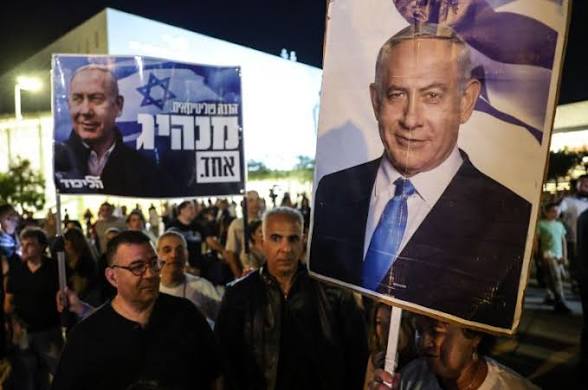
The results have created a difficult challenge for Netanyahu and his political rivals. Neither major bloc can independently command the 61 seats required in Israel’s 120-member Knesset.
Netanyahu’s coalition secured 53 seats, while the opposition grouping led by former military chief Gadi Eisenkot won 48. Arab-led parties gained a record 19 seats, giving them a potentially decisive role in determining the next government.
The outcome has created a political deadlock that could lead to lengthy coalition negotiations, a unity government, or another election.
However, the election results do not automatically remove Netanyahu from office. He remains caretaker prime minister while political leaders attempt to form a new government.
The situation is particularly important because Israel is dealing with major security challenges, including the continuing consequences of the wars in Gaza, Lebanon and Iran.
According to the final election results, Netanyahu’s political bloc has suffered a significant setback compared with the outgoing government.
The Times of Israel+1
1. Netanyahu’s Bloc Falls Short of a Majority
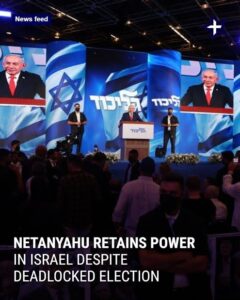
The central result of the election is that Netanyahu’s bloc has failed to reach the 61-seat threshold.
Although Likud remains the largest individual party, its 27 seats are not enough to guarantee Netanyahu another term as prime minister.
The right-wing coalition also includes ultra-Orthodox and nationalist parties. Together, these parties secured 53 seats, leaving them eight seats short of a parliamentary majority.
This shortfall matters because Israel’s proportional representation system makes coalition-building essential.
A party can win the most seats without having enough support to govern. The prime minister must secure the backing of a majority of lawmakers to establish a government.
Netanyahu has faced this challenge before. His political career has included several difficult coalition negotiations and repeated elections.
Yet the latest results present a particularly complicated situation. The opposition has gained ground, while Arab-led parties have increased their representation in parliament.
The right-wing bloc’s decline from 68 seats in the outgoing Knesset to 53 seats in the new parliament highlights the scale of the political shift.
Despite that setback, Netanyahu has not conceded defeat. His political experience and continued support among right-wing voters mean he remains an important figure in the negotiations.
The election has therefore produced neither a clear victory for Netanyahu nor an immediate transfer of power to his opponents.
2. Gadi Eisenkot Emerges as Netanyahu’s Main Rival
Former military chief Gadi Eisenkot has emerged as the principal challenger to Netanyahu.
His Yashar party won 21 seats, making it the largest party within the opposition grouping.
Eisenkot’s political message has focused on security, national unity and the need for a different approach to governing Israel.
His background in the military has helped him present himself as a leader with experience in national security.
However, his opposition bloc also faces significant difficulties.
The four Jewish-led opposition parties won a combined 48 seats. That total leaves them 13 seats short of the majority needed to form a government.
Eisenkot must therefore find additional parliamentary support if he wants to replace Netanyahu.
The Arab-led parties could provide that support. Their combined 19 seats would be sufficient to give the broader anti-Netanyahu camp a potential majority.
Yet political disagreements make such cooperation complicated.
Some opposition leaders have expressed reservations about working with Arab-led parties, while Netanyahu has rejected the idea of forming a government with them.
Eisenkot’s ability to bring together different political groups will be a major test of his leadership.
His challenge is not simply to defeat Netanyahu at the ballot box. He must also persuade enough lawmakers to support a workable governing coalition.
3. Arab-Led Parties Hold the Balance of Power
One of the most important developments in the election is the strong performance of Arab-led parties.
The Joint List and Ra’am won a combined 19 seats, giving them their largest parliamentary representation to date.
Their performance has changed the political calculations for both Netanyahu and Eisenkot.
The two main Jewish-led political blocs remain short of a majority. However, the combined opposition and Arab-led parties could theoretically command 67 seats.
That would be enough to support a government in the Knesset.
The difficulty is that parliamentary arithmetic does not automatically translate into a functioning coalition.
Several opposition parties have rejected the idea of formally cooperating with Arab-led factions. These disagreements reflect longstanding differences over security, national identity and the future direction of the country.
Netanyahu has also ruled out relying on Arab parties to secure a governing majority.
Consequently, Arab-led lawmakers have gained considerable influence without necessarily becoming part of the next government.
Their support could help Eisenkot receive a mandate to attempt forming a government. It could also affect negotiations over legislation, parliamentary procedures and future political alliances.
The election has therefore demonstrated the growing importance of Arab voters in Israel’s political system.
Their increased representation may influence the country’s political direction even if they remain outside the governing coalition.
4. Netanyahu Faces a Difficult Coalition Challenge
Netanyahu’s immediate challenge is to find additional support for his right-wing bloc.
The 53 seats secured by his allies leave him eight short of a majority.
His traditional partners include religious and nationalist parties that share several important policy objectives with Likud.
However, these parties also have their own priorities.
The ultra-Orthodox parties have long sought arrangements concerning military service, religious education and public funding.
Nationalist parties have focused on security policy, settlements and the future of the Palestinian territories.
These differences could complicate negotiations, particularly if Netanyahu needs support from lawmakers outside his traditional coalition.
Another important development concerns United Torah Judaism.
The party declined to recommend either Netanyahu or Eisenkot for prime minister during the initial consultations. Its decision has weakened Netanyahu’s position because he cannot assume that every previous coalition partner will support him automatically.
Political leaders must now decide whether their differences can be overcome through negotiations.
Netanyahu may attempt to attract additional lawmakers, negotiate a broader political agreement or explore the possibility of a national unity government.
However, each option carries risks.
A broader coalition could require Netanyahu to make concessions that frustrate his existing partners.
A unity government could also involve sharing power with political opponents who have campaigned against his leadership.
For now, the right-wing bloc’s failure to secure a majority remains the central obstacle to Netanyahu’s political ambitions.
5. Eisenkot Gains Support as Coalition Talks Begin
Eisenkot has received an important boost from the latest political developments.
Two Arab-led parties have recommended him as the candidate to form the next government.
That support has helped him demonstrate that he may have a broader parliamentary base than Netanyahu.
However, receiving recommendations does not guarantee that Eisenkot will become prime minister.
Israel’s president must consider which candidate has the best chance of forming a government.
President Isaac Herzog has been meeting political representatives as part of the formal process.
The recommendations provide an indication of parliamentary support, but the candidate must still negotiate a coalition agreement and secure approval from the Knesset.
Eisenkot’s potential coalition would face significant challenges.
He would need to reconcile the positions of centrist, left-wing and right-wing opposition parties.
He would also have to address disagreements over security, religious policy and relations with Arab-led factions.
Some opposition parties have already indicated that they will not join a government led by Netanyahu.
Nevertheless, that does not mean they will automatically agree on every policy proposed by Eisenkot.
The negotiations will test whether the opposition can maintain its unity after the election.
A successful agreement could end Netanyahu’s long period in office. A failed attempt, however, could leave the country facing another election.
6. Israel’s President Begins the Government Formation Process
Israel has a formal procedure for dealing with elections that produce no clear parliamentary majority.
President Isaac Herzog consults political parties before selecting a lawmaker to attempt forming a government.
The president generally chooses the candidate considered most likely to secure parliamentary support.
The candidate receives an initial period of 28 days to form a government. The president may grant an extension of up to 14 days.
If the first candidate fails, another lawmaker may receive an opportunity to form a coalition.
The process is designed to give political parties time to negotiate agreements and find a workable parliamentary majority.
However, it does not guarantee that negotiations will succeed.
If all attempts fail, lawmakers may have another opportunity to nominate a candidate. Otherwise, parliament could be dissolved, leading to another election.
The latest election has made this process especially important.
Both Netanyahu and Eisenkot have supporters who believe their candidate should lead the next government.
Yet the election results have not produced an obvious winner.
The president’s decision could therefore shape the next stage of the political crisis.
Herzog has urged party leaders to compromise and avoid another election.
His position reflects the wider concern that another round of voting could deepen political divisions without resolving the underlying disagreements.
7. Why Israel’s Election System Can Produce Deadlock
Israel uses proportional representation to elect members of the Knesset.
The country is divided into a single nationwide electoral district, and political parties receive parliamentary seats based on their share of the vote.
A party must cross the electoral threshold to win representation.
This system allows a wide range of political parties to enter parliament.
It also means that a single party rarely wins enough seats to govern alone.
As a result, coalition governments are a normal part of Israeli politics.
The system encourages smaller parties to negotiate with larger parties after elections.
These negotiations can produce broad coalitions, but they can also create instability.
A small party may gain considerable influence if its seats are necessary to form a majority.
The 2026 election illustrates this problem.
Netanyahu’s bloc has the largest number of seats, but it lacks a majority.
Eisenkot’s bloc has fewer seats and also needs additional support.
Arab-led parties have enough seats to change the parliamentary balance, but political disagreements complicate cooperation.
The election system has therefore produced a parliament in which several groups hold influence without any one group being able to govern independently.
This is the main reason Israel’s political deadlock could continue for weeks or months.
8. Security Concerns Add Pressure to Coalition Negotiations
The election has taken place during a period of significant security challenges for Israel.
The October 7, 2023, Hamas-led attack and the subsequent wars have shaped public debate and political campaigning.
Netanyahu has argued that his government has strengthened Israel’s security and taken action against regional threats.
His opponents have questioned his leadership and the government’s handling of the security failures that preceded the October 7 attack.
Eisenkot has used his military background to present himself as an experienced alternative.
The security situation also makes the government formation process more consequential.
A caretaker government remains in office while coalition negotiations continue.
It retains important powers, although caretaker governments face certain constraints.
This means that Israel’s government can continue handling national security matters even without a newly formed coalition.
However, prolonged political uncertainty could complicate decisions about budgets, appointments and long-term policy.
The next government will also need to address public concerns about military service, economic pressures and the future of Israel’s regional relationships.
These issues may influence coalition negotiations as much as the election results themselves.
9. Could Israel Hold Another Election?
Another election remains a possibility if political leaders cannot agree on a governing coalition.
Israel has experienced repeated elections in recent years.
Between 2019 and 2022, the country held five elections, with several producing inconclusive results.
The current deadlock has therefore raised concerns that the political system could return to a cycle of repeated voting.
Another election would give parties an opportunity to seek a clearer mandate.
However, it would also prolong uncertainty and require another national campaign.
Political leaders may prefer to reach a compromise rather than risk another inconclusive result.
The possibility of another election could also influence negotiations.
Parties may be more willing to compromise if they believe voters would punish them for prolonging the deadlock.
At the same time, leaders who believe their electoral support could improve may prefer to wait.
Netanyahu’s political experience means he cannot be ruled out as a future candidate, even if he fails to form a government in the current negotiations.
Eisenkot, meanwhile, must demonstrate that his opposition bloc can convert electoral support into a functioning coalition.
The next few weeks will be critical in determining whether Israel can avoid another election.
10. What the Election Means for Israel’s Political Future
The election has produced a significant change in Israel’s political landscape.
Netanyahu’s bloc has lost its parliamentary majority, while opposition parties have gained influence.
Arab-led parties have also secured a record number of seats, increasing their importance in government formation.
Yet the results have not produced an immediate political transition.
Netanyahu remains caretaker prime minister, and Eisenkot must still prove that he can assemble a governing coalition.
The outcome also highlights the limits of electoral victories in a parliamentary system.
Winning the most seats is not enough to guarantee power.
A candidate must also secure the support of a majority of lawmakers.
The political deadlock could eventually lead to a broader coalition, a new opposition-led government or another election.
Whatever the outcome, the negotiations will shape Israel’s domestic and foreign policy.
The next government will face difficult decisions about security, military service, economic policy and relations with neighboring countries.
The election has also demonstrated that Israeli voters remain divided over the country’s political direction.
For Netanyahu, the challenge is to retain power despite losing his majority.
For Eisenkot, the challenge is to turn a strong opposition performance into a governing agreement.
For Israel, the priority is to establish a stable government capable of addressing the country’s major challenges.
Frequently Asked Questions
1. Why did Netanyahu’s bloc fall short in Israel’s election?
Netanyahu’s right-wing bloc won 53 seats in the 120-member Knesset. It needs 61 seats to form a government, leaving it eight seats short of a majority.
2. Who won the 2026 Israeli election?
Netanyahu’s Likud-led bloc won the most seats, but neither major political bloc secured a governing majority. The election therefore produced no clear winner in terms of government formation.
3. How many seats did Gadi Eisenkot’s bloc win?
Eisenkot’s opposition bloc secured 48 seats. It needs additional parliamentary support to reach the 61-seat majority required to form a government.
4. What role do Arab-led parties play in the election results?
Arab-led parties won a combined 19 seats. Their support could help the opposition reach a parliamentary majority, although disagreements over cooperation make government formation difficult.
5. Is Benjamin Netanyahu still Israel’s prime minister?
Yes. Netanyahu remains caretaker prime minister while political leaders attempt to form a new government. He could remain in office until a new coalition is approved.
6. Can Gadi Eisenkot replace Netanyahu?
Eisenkot could replace Netanyahu if he secures enough parliamentary support to form a government. However, the opposition must overcome political disagreements and reach a coalition agreement.
7. What happens if no party can form a government?
If all attempts to form a government fail, Israel could hold another election. The process includes consultations and opportunities for lawmakers to negotiate a parliamentary majority before a new vote becomes necessary.
8. When will Israel have a new government?
There is no confirmed date for the formation of a new government. The timing depends on coalition negotiations, presidential consultations and whether a candidate can secure the support of a majority of lawmakers.
Conclusion
Israel’s election has left Benjamin Netanyahu facing a major political setback.
His right-wing bloc won the most seats but fell short of a parliamentary majority. Meanwhile, Gadi Eisenkot’s opposition grouping has gained an opportunity to challenge Netanyahu’s leadership.
The record performance of Arab-led parties has further complicated the negotiations.
Although the opposition may have a numerical path to power, political disagreements could prevent it from forming a government.
The coming weeks will determine whether Israel can establish a new coalition or faces another election.
For now, Netanyahu’s bloc remains short of the majority it needs, and Israel’s political future remains uncertain.
About the Author