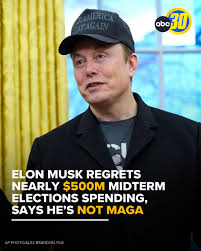
Billionaire entrepreneur Elon Musk is facing fresh questions about his political influence after admitting that he regrets spending hundreds of millions of dollars supporting Republican candidates during the 2026 US midterm elections.
The Tesla and SpaceX chief executive made the surprising remarks during an appearance at The New York Times DealBook Summit on November 18. Speaking with journalist Andrew Ross Sorkin, Musk acknowledged that his enormous financial investment had not delivered the political results he wanted.
His comments came after Democrats secured control of both chambers of Congress, dealing a major setback to Republicans and President Donald Trump’s political agenda.
Musk did not simply express disappointment with the election results. He also distanced himself from the Make America Great Again (MAGA) movement, saying that he did not consider himself MAGA.
The remarks represent a notable change in tone for a billionaire who previously positioned himself as one of Trump’s most prominent supporters.
The developing Elon Musk MAGA split raises important questions about the future of his relationship with the Republican Party, his political spending and the influence of wealthy individuals in American elections.
Elon Musk Admits He Regrets Spending Millions on Republicans
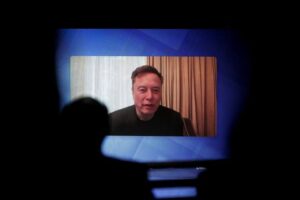
Musk’s comments attracted immediate attention because of the extraordinary amount of money he directed towards Republican political campaigns.
According to reporting by Reuters and The Washington Post, Musk spent approximately $445 million or more supporting Republican candidates and political groups during the 2026 election cycle, although reported totals vary depending on the accounting period and contributions included.
The billionaire hoped his financial support would help Republicans maintain their congressional majorities.
However, the election produced the opposite outcome.
Democrats made significant gains, taking control of both the House of Representatives and the Senate. Several Republican candidates who benefited from Musk-backed spending also suffered defeats.
During the DealBook Summit, Musk openly acknowledged that his investment had not produced the results he expected.
He described himself as feeling “pretty foolish” about spending so much money without seeing much return.
He also suggested that he would make a different decision if he could revisit the election cycle.
“If I could rewind the clock, I would have spent less money,” Musk said.
His admission was particularly striking because political spending has become an increasingly important part of his public involvement in American politics.
Rather than defending every financial decision, Musk acknowledged that his strategy had failed to deliver its main objective.
Reuters+2
Why Musk’s Massive Political Investment Failed
Musk’s political spending was designed to strengthen Republican control of Congress.
The billionaire supported numerous candidates through political action committees and other organisations aligned with Republican election efforts.
His financial involvement was especially significant in competitive races where control of Congress was at stake.
Nevertheless, campaign spending did not guarantee electoral success.
According to Reuters’ election analysis, only three of the 37 Republican House candidates backed by Musk won their races, while 33 lost. Another contest remained unresolved in the initial reporting.
The Senate results were similarly disappointing for the billionaire.
Six of the seven Republican Senate candidates he supported lost their races, with one contest still awaiting a final outcome in the reporting period.
These figures demonstrate the scale of the political setback.
Musk had invested enormous financial resources in helping Republicans maintain power. Yet voters ultimately delivered a different result.
Several factors may have contributed to the outcome.
Voters consider numerous issues when choosing candidates, including economic conditions, healthcare, immigration, inflation, employment and confidence in political leadership.
A wealthy donor can help candidates advertise their positions, organise campaigns and reach voters. However, financial resources cannot automatically overcome public dissatisfaction.
Musk himself appeared to acknowledge this reality during his interview.
He suggested that Republican candidates might have performed even worse without his support. However, he also recognised that the results demonstrated the limits of money in American elections.
Investing.com South Africa+2
Musk Says He Is No Longer Part of the MAGA Movement
Perhaps the most surprising part of Musk’s appearance was his decision to distance himself from MAGA.
For years, Musk had become closely associated with Trump’s political movement. He publicly supported the president, contributed substantial amounts to Republican campaigns and used his enormous social media following to amplify conservative political messages.
His earlier statements were particularly enthusiastic.
During a Trump campaign rally in 2024, Musk described himself as “Dark MAGA,” signalling his strong support for the movement.
However, his latest comments suggest a different political position.
When Sorkin questioned him about his political identity, Musk said he was not MAGA.
He explained that he did not necessarily understand what the movement represented. He added that if MAGA meant blindly following Republican Party policies, he did not identify with that approach.
Musk also described his political views as relatively moderate.
This distinction is important because it suggests that he wants to separate his personal political beliefs from automatic loyalty to a political movement.
His position does not necessarily mean that he has abandoned conservative causes or his relationship with Trump.
Instead, Musk appears to be arguing that political support should depend on individual policies rather than unconditional party loyalty.
Nevertheless, the change in language is significant.
A billionaire who once publicly embraced the MAGA identity is now questioning whether that label accurately represents his political beliefs.
The Washington Post+2
From Dark MAGA to Political Distance
Musk’s changing relationship with MAGA has attracted attention because his political involvement expanded considerably after Trump’s 2024 presidential victory.
The billionaire became one of the most influential financial supporters of the Republican movement.
He also took a prominent role in the Trump administration through the Department of Government Efficiency, commonly known as DOGE.
The initiative focused on reducing government spending, restructuring federal operations and cutting the federal workforce.
Musk’s involvement made him a controversial figure in Washington.
Supporters viewed his approach as an effort to reduce government waste. Critics questioned the methods used, the impact on federal employees and the influence of an unelected billionaire within the administration.
His political activities also generated protests and criticism directed at his companies.
The latest comments suggest that Musk may be reconsidering how closely he wants to associate himself with the MAGA label.
However, it would be premature to describe his remarks as a complete political break with Trump.
Musk has not announced that he is ending his support for the president or withdrawing from Republican politics.
His statements instead highlight a growing distinction between his personal political identity and the movement he previously championed.
The difference could become increasingly important as Republicans reconsider their strategy following the midterm defeats.
Texas Election Losses Create Another Problem for Musk
Texas was one of the most important political battlegrounds in Musk’s 2026 election strategy.
The state has considerable economic importance for his business empire.
Tesla maintains major operations in Texas, while SpaceX has significant facilities and activities in the state. Musk has also discussed ambitious technology and manufacturing investments connected to the region.
Consequently, political developments in Texas could have implications beyond ordinary election politics.
Musk reportedly directed substantial financial resources towards Republican candidates in the state.
His support included efforts to help Republican Senate candidate Ken Paxton and Governor Greg Abbott.
However, Democrats achieved major victories.
Democratic candidate James Talarico defeated Paxton in the Senate contest, while Democrat Gina Hinojosa defeated Abbott in the governor’s race.
The results represented a major political setback for Republicans in a state that has traditionally been an important part of their electoral coalition.
Musk’s substantial investment did not prevent the Democratic victories.
His financial involvement in Texas also attracted attention because of his companies’ economic interests in the state.
During the DealBook Summit, Musk appeared relatively relaxed about the incoming Democratic governor.
He described Hinojosa as someone he expected to be moderate and suggested that things would be fine in Texas under her leadership.
That response was notable.
Rather than launching an aggressive criticism of the incoming governor, Musk appeared willing to acknowledge the possibility of working with a Democratic administration.
His comments could indicate a more pragmatic approach to political relationships.
For business leaders, maintaining productive relationships with elected officials is often more important than maintaining strict party loyalty.
CBS News+2
Can Money Still Decide American Elections?
The Elon Musk MAGA split has revived a broader debate about the role of billionaire donors in American democracy.
Musk’s spending demonstrated how much financial power a single wealthy individual can bring into an election cycle.
His contributions supported political organisations, Republican candidates and campaign activities across several states.
However, the election results also demonstrated that financial support has limits.
Campaign money can provide candidates with important advantages.
It can help pay for television advertisements, digital campaigns, polling, political consultants, voter outreach and grassroots organisation.
Well-funded campaigns can also respond more quickly to attacks and communicate their messages to larger audiences.
Nevertheless, voters make their decisions based on a much wider range of considerations.
A candidate may receive substantial financial support and still struggle if voters dislike their policies or question their leadership.
Economic dissatisfaction can also become a powerful political force.
When households are concerned about living costs, employment opportunities and financial security, campaign advertisements may have limited influence over their final decisions.
Furthermore, strong opposition candidates can turn financial support for an unpopular politician into a campaign issue.
In Musk’s case, his enormous involvement became a prominent part of the political discussion surrounding several Republican candidates.
Democratic campaigns could portray their opponents as being closely connected to one extremely wealthy donor.
This created an opportunity to question whose interests those candidates would represent.
Musk’s experience therefore offers an important lesson for political donors.
Financial resources can influence the political environment, but they cannot guarantee public support.
His own comments acknowledged that reality.
Trump’s Relationship With Elon Musk Faces New Questions
Musk’s remarks also raise questions about his relationship with Donald Trump.
The two men developed a prominent political alliance during the 2024 presidential campaign.
Musk provided financial support, campaigned for Trump and used his social media platform to promote the Republican candidate.
Following Trump’s victory, Musk became involved in the administration’s efforts to reduce federal spending.
Their relationship attracted considerable attention because of Musk’s wealth, business interests and influence over online political discussions.
However, the alliance has not always been without tension.
The two men experienced a public disagreement in 2025, demonstrating that their relationship could become complicated despite their shared political interests.
They subsequently appeared to restore a degree of cooperation.
Now, Musk’s decision to distance himself from MAGA introduces another potential complication.
Trump’s political movement has been central to his administration’s identity. Therefore, Musk’s refusal to identify with the movement could create questions about how closely he intends to remain involved.
Still, the billionaire’s remarks should not automatically be interpreted as an attack on Trump.
Musk did not announce an intention to become a Democratic supporter.
Nor did he say that he regretted every political decision he had made.
His criticism focused primarily on the amount of money spent and the disappointing electoral outcome.
He also expressed support for the idea of political checks and balances.
This suggests that his current position may be more complicated than a simple Republican-to-Democrat shift.
The coming months could provide a clearer picture of whether Musk intends to maintain his political influence or reduce his involvement.
CBS News+2
Democrats Could Increase Scrutiny of Musk’s Business Interests
Another important consequence of the 2026 midterm results involves the possibility of increased congressional oversight.
With Democrats preparing to take control of both chambers of Congress, Musk could face greater scrutiny from lawmakers.
His business empire includes companies operating in strategically important industries.
Tesla is a major electric vehicle manufacturer, while SpaceX plays an important role in the commercial space industry and government-related space activities.
His artificial intelligence company, xAI, also operates in a sector receiving increasing attention from lawmakers and regulators.
These companies have different commercial interests, but their activities can intersect with federal policies, contracts and regulatory decisions.
Democratic lawmakers have already indicated that they want to examine aspects of the Trump administration’s activities.
Musk’s role in DOGE and the federal workforce changes could become subjects of congressional investigations and oversight hearings.
His political spending may also attract questions from lawmakers interested in campaign finance and the relationship between major donors and government decision-making.
However, political scrutiny does not automatically establish wrongdoing.
Any investigation would need to examine specific evidence, relevant laws and the conduct of the individuals or organisations involved.
For Musk, the challenge could involve balancing his business responsibilities with an increasingly complicated political environment.
His comments about being moderate and expecting a constructive relationship with Texas’s incoming governor may also reflect the importance of maintaining relationships across political lines.
The Washington Post+2
Will Elon Musk Stop Spending Money on Politics?
One of the biggest unanswered questions following Musk’s admission concerns his future political spending.
The billionaire has previously suggested that he wanted to reduce his involvement in election campaigns.
In May 2025, Musk said he intended to do considerably less political spending in the future.
He also suggested that he had already done enough.
However, his financial involvement in the 2026 midterms demonstrated that he remained willing to commit enormous resources to Republican political causes.
The disappointing results could now encourage another reassessment.
Musk has acknowledged that he would have spent less money if he could make the decision again.
That statement could indicate a more cautious approach to future election cycles.
However, it does not establish that he will completely withdraw from political activities.
There are several possible directions his strategy could take.
First, he could reduce the amount of money directed towards individual candidates.
Second, he could focus on specific policies rather than supporting a large number of Republican campaigns.
Third, he could concentrate more heavily on political issues connected to technology, artificial intelligence, government regulation and business development.
Finally, he could decide that direct political spending is less effective than using his public platform to influence political discussions.
His future decisions will likely depend on his business priorities, political relationships and assessment of the electoral environment.
For now, his latest remarks show that the results of the midterms have forced him to reconsider the effectiveness of his previous strategy.
Silicon Valley’s Political Relationship With Republicans Is Changing
Musk’s comments are also part of a wider discussion about the relationship between Silicon Valley and the Republican Party.
Several prominent technology executives have reconsidered how they publicly describe their political positions following the Democratic victories.
Some business leaders have adopted more moderate language, while others have expressed reservations about specific Trump administration policies.
This shift matters because technology companies depend on government decisions in several areas.
These include artificial intelligence regulation, international trade, immigration, defence contracts, taxation and competition policy.
A close relationship with the federal government can provide businesses with opportunities. However, political alignment can also create reputational risks when public opinion changes.
The return of Democratic congressional control could encourage technology executives to establish relationships with lawmakers from both parties.
For Musk, this environment creates an additional reason to clarify his political identity.
His statement that he is not MAGA may be an attempt to explain that his business interests and political views do not necessarily depend on unconditional support for Republicans.
However, whether his actions match this new position remains to be seen.
The wider question is whether other wealthy technology leaders will also reduce their association with Trump’s political movement.
The Guardian+1
What the Elon Musk MAGA Split Means for American Politics
The latest developments represent more than one billionaire expressing disappointment after an election.
They highlight the complicated relationship between money, political influence and public opinion in the United States.
Musk’s financial support made him one of the most influential individual political donors in the country.
His involvement helped shape Republican campaign strategies and attracted considerable attention from voters and political opponents.
Yet the 2026 midterm results demonstrated that even extraordinary financial resources cannot guarantee electoral victories.
His decision to distance himself from MAGA also raises questions about the future direction of his political involvement.
For Republicans, losing the support of an influential donor could create additional challenges as they attempt to rebuild their congressional position.
For Democrats, the results provide an opportunity to strengthen their influence and investigate issues involving the previous administration.
For Musk, the immediate challenge is deciding how much political influence he wants to exercise in the future.
He must also consider how his political activities affect his companies, public reputation and relationships with elected officials.
His latest comments suggest that he is reconsidering at least some of his previous decisions.
However, whether this represents a permanent change or a temporary reaction to disappointing election results remains unclear.
Conclusion
Elon Musk’s admission that he regrets spending hundreds of millions of dollars on Republican candidates marks a significant moment in his political journey.
After investing heavily in the 2026 midterms, the billionaire watched Democrats take control of both chambers of Congress and secure important victories in Texas.
His description of the spending as a mistake, combined with his declaration that he is not MAGA, signals a notable shift in his public political position.
Nevertheless, Musk has not announced a complete break with Donald Trump or the Republican Party.
The coming months will reveal whether he reduces his political spending, changes his strategy or continues influencing American politics through different channels.
One lesson from the election is already clear: even the world’s wealthiest individuals cannot simply purchase electoral victories.
Frequently Asked Questions (FAQs)
1. Why does Elon Musk regret spending money on the 2026 midterm elections?
Musk expressed regret because he spent hundreds of millions of dollars supporting Republican candidates, but Democrats won control of both chambers of Congress. He said he felt foolish about spending so much without achieving the expected results.
2. How much money did Elon Musk spend on Republican candidates?
Reports put Musk’s 2026 election spending at approximately $445 million or more. The exact figure varies depending on the reporting period and which political contributions are included.
3. Did Elon Musk say he is no longer MAGA?
Yes. At the November 18, 2026, DealBook Summit, Musk said he was not MAGA. He explained that he did not support blindly following Republican Party policies.
4. What did Elon Musk say about spending less money?
Musk said that if he could go back and make the decision again, he would have spent less money on the midterm elections.
5. Why did Republicans lose the 2026 midterm elections?
Several political and economic factors may have contributed to Republican losses. These include voter dissatisfaction, campaign issues and competition from Democratic candidates. Financial spending alone could not guarantee victories.
6. Did Elon Musk support Donald Trump?
Yes. Musk was a prominent financial and public supporter of Trump during the 2024 presidential campaign. He also became involved in the Trump administration through DOGE.
7. Did Democrats win both chambers of Congress in 2026?
According to the reported 2026 election results, Democrats secured control of both the House of Representatives and the Senate, creating a major setback for Republicans.
8. What happened to Republicans in Texas?
Democrats secured major victories in Texas. Gina Hinojosa defeated Republican Greg Abbott in the governor’s race, while James Talarico defeated Republican Ken Paxton in the Senate contest.
9. Will Elon Musk stop supporting Republicans?
Musk has expressed regret about his recent political spending, but he has not announced a complete withdrawal from Republican politics. His future financial involvement remains uncertain.
10. Could Democrats investigate Elon Musk?
Democratic lawmakers have indicated interest in investigating aspects of the Trump administration, including Musk’s involvement in DOGE and related government activities. Any investigation would depend on congressional priorities and specific evidence.
About the Author