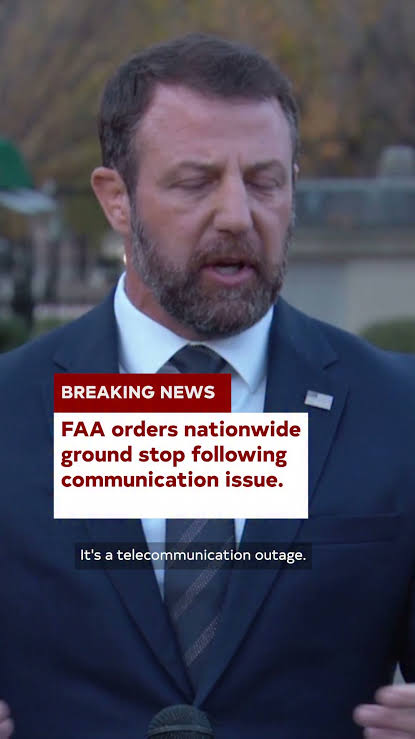
A nationwide aviation disruption across the United States has raised serious questions about the safety and reliabilityof the country’s air traffic control system. However, Homeland Security Secretary Markwayne Mullin has urged Americans not to confuse the latest Federal Aviation Administration (FAA) ground stop with the terrorist attacks of September 11, 2001.
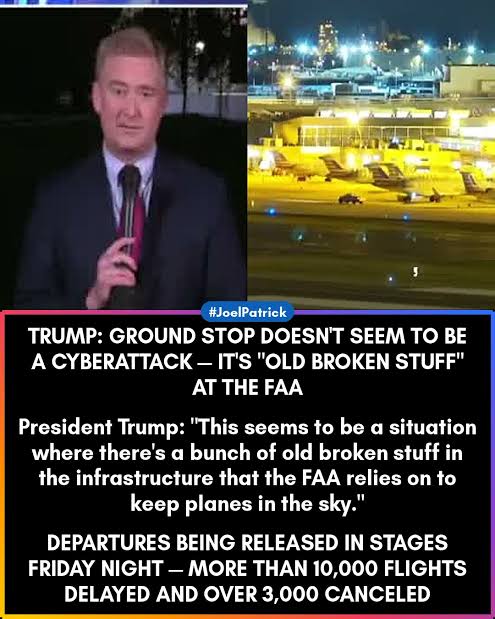
The FAA ordered a nationwide ground stop for departing flights on Friday, November 13, 2026, following communication problems affecting multiple Air Route Traffic Control Centers. The unusual decision brought departures to a temporary halt at airports across the country.
The disruption immediately attracted public attention because nationwide flight restrictions are extremely rare in the United States. The September 11 attacks remain the most significant historical example of a nationwide aviation shutdown.
Nevertheless, Mullin said there was no indication that the latest incident was a deliberate attack against the country.
Speaking to reporters at the White House, the DHS chief explained that officials were investigating the communication failure. He also reassured the public that there was no immediate evidence of a malicious operation targeting American aviation infrastructure.
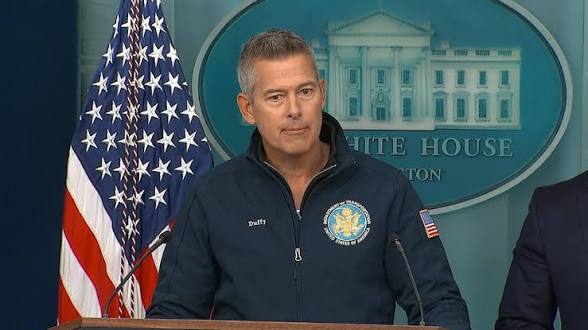
Transportation Secretary Sean Duffy also addressed the situation. He pointed toward aging telecommunications equipment and overloaded systems as the likely explanation for the disruption.
The FAA eventually lifted the nationwide ground stop after more than four hours. However, the decision did not immediately restore normal operations. Thousands of passengers experienced cancellations, delays and uncertainty about their travel plans.
The incident has now intensified the debate over America’s outdated aviation infrastructure and the urgent need for modernization.
What Happened During the Nationwide FAA Ground Stop?

The disruption began on Friday afternoon, November 13, when the FAA issued an order requiring airports across the United States to hold departing flights.
The agency cited extraordinary circumstances and safety concerns. Communication issues affecting multiple Air Route Traffic Control Centers were at the center of the problem.
These facilities play an essential role in managing aircraft moving through American airspace. They coordinate aircraft movements between airports and help maintain safe separation between planes.
When communication systems become unstable, air traffic controllers may face difficulties exchanging important information.
As a result, the FAA must consider whether normal flight operations can continue safely.
In this situation, officials chose to stop departures nationwide while technicians investigated the problem.
The decision affected airlines, airports and passengers across the country. Travelers encountered crowded terminals, changing departure times and limited information about when their flights would operate.
According to ABC News, the FAA lifted the nationwide ground stop after more than four hours. However, the disruption had already created significant operational problems for airlines.
The shutdown also demonstrated how dependent modern aviation is on reliable communication networks.
Even when aircraft remain physically safe, a failure in the systems connecting airports and air traffic controllers can affect thousands of flights.
ABC News+2
Markwayne Mullin Rejects Comparisons With the September 11 Attacks
The phrase “another 9/11” carries enormous historical significance in the United States.
On September 11, 2001, terrorists hijacked four commercial passenger aircraft. Two planes struck the World Trade Center in New York, another hit the Pentagon, and the fourth crashed in Pennsylvania.
Following the attacks, American authorities ordered an unprecedented nationwide shutdown of civilian air traffic.
The November 2026 ground stop also affected departures nationwide. This similarity explains why the latest incident attracted comparisons with the events of 2001.
However, the circumstances were fundamentally different.
Mullin emphasized that investigators had found no indication of a deliberate attack when he initially addressed reporters.
He described the situation as a telecommunications outage rather than evidence of a terrorist operation.
The DHS secretary also sought to reassure families whose relatives were traveling by air.
His message was clear: the disruption was serious, but the available information did not suggest that American aircraft were being targeted.
Importantly, the absence of evidence of an attack does not mean officials should stop investigating potential security threats.
Federal agencies must examine unusual disruptions carefully, particularly when critical national infrastructure is involved.
The distinction between a technical failure and a deliberate attack is therefore central to understanding the incident.
Mullin’s comments were intended to calm public concerns while authorities continued examining the cause.
People.com+2
Why Did the FAA Order a Nationwide Ground Stop?
The main issue involved instability in radar and telecommunications systems used by air traffic controllers.
According to Transportation Secretary Sean Duffy, the problems began at approximately 3:36 p.m. Eastern Time on Friday.
The system’s switches and routers became overloaded with data. This created inconsistencies in the information being transmitted through the network.
Officials decided to shut down the affected system rather than risk continuing normal operations under unstable conditions.
Duffy explained that the equipment had not completely lost radar or communications. Controllers were still able to manage aircraft already in the air.
This distinction is important.
The FAA did not order the ground stop because aircraft had suddenly become targets. Instead, the agency took precautionary action because communication instability could affect the safe management of departures.
At the time of the incident, approximately 3,500 aircraft were already flying, according to Duffy.
Officials said those aircraft were safely brought to the ground.
The episode highlighted the importance of reliable communication between pilots and air traffic controllers. Even a technical problem that does not immediately threaten aircraft can create serious operational risks.
Reuters+1
Mullin Says There Is No Evidence of a Cyberattack
One of the biggest questions surrounding the FAA ground stop was whether hackers had targeted America’s aviation infrastructure.
A cyberattack against air traffic control systems could have serious national security implications. Such an incident could potentially disrupt communications, create operational confusion and affect essential transportation networks.
Therefore, reporters questioned Mullin about the possibility of a deliberate attack.
His response was cautious.
The DHS chief said investigators had not found evidence of a cyberattack. However, he also made clear that authorities were not ruling out any possibilities while the investigation continued.
Later, Mullin said the incident appeared to be mechanically driven.
Reuters reported that the Department of Homeland Security and the National Security Agency were working together on the investigation.
Officials also examined whether a technical failure or an incompatibility between older equipment and newer technology contributed to the disruption.
This approach reflects the importance of investigating potential threats before reaching a final conclusion.
A lack of evidence of a cyberattack is not the same as proof that every possible security concern has been eliminated.
For now, the available information points toward a telecommunications and equipment problem rather than a confirmed hostile operation.
The distinction also explains why Mullin pushed back against comparisons with September 11.
The 2001 attacks involved a deliberate terrorist plot. The November 2026 incident, based on the information available so far, involved an aviation technology failure.
Reuters+2
Aging Air Traffic Control Technology Under Scrutiny
Although the FAA ground stop was lifted, the incident exposed a much larger problem.
America’s air traffic control infrastructure relies on equipment that has been in service for many years. Some of the systems still depend on older telecommunications technology.
Modern aircraft generate enormous amounts of operational information. Air traffic controllers must receive and process important details while maintaining safe distances between aircraft.
As aviation activity grows, outdated systems face increasing pressure.
Duffy argued that the United States needs a major modernization effort.
He described the existing infrastructure as extremely old and called on Congress to provide additional funding.
The transportation secretary also warned that similar problems could happen again if the government does not address the underlying weaknesses.
His comments placed the FAA ground stop at the center of a wider discussion about infrastructure investment.
The issue is not simply whether one technical failure can be repaired. It is whether the entire aviation network has enough capacity, reliability and backup systems to handle future demands.
Why Modernization Matters
A modern air traffic control system could improve several important areas:
Reliable communications: Updated equipment could reduce failures involving data transmission and controller communications.
Better system performance: Modern networks could process large amounts of information more efficiently.
Improved monitoring: Advanced diagnostic tools could help technicians identify technical problems earlier.
Stronger backup systems: Additional redundancy could help maintain operations when individual components fail.
Better coordination: Updated technology could improve information sharing between control centers and airports.
However, modernization requires more than purchasing new equipment.
The government must also manage installation, testing, cybersecurity and staff training. New systems must work reliably with existing aviation infrastructure during the transition.
That process requires careful planning and substantial investment.
Reuters+1
Sean Duffy Calls for Billions in Aviation Funding
Following the incident, Transportation Secretary Sean Duffy renewed his demand for additional federal funding.
He argued that the United States needs a comprehensive overhaul of its air traffic control infrastructure.
Duffy discussed a modernization requirement of approximately $50 billion.
Earlier on Friday, the White House and Department of Transportation had also urged Congress to approve $30.1 billion for upgrades to airports and air traffic control infrastructure.
The funding debate is particularly important because aviation technology supports millions of passenger journeys and commercial operations.
A nationwide disruption demonstrates how a problem in one part of the system can create consequences across the country.
However, the administration’s funding request is also likely to face questions from lawmakers.
Congressional representatives will want to understand what failed, how much modernization will cost and whether previous investments have delivered the expected improvements.
The government must also explain how it plans to prevent similar disruptions while new equipment is installed.
Duffy’s argument is that delaying modernization creates unnecessary risks for the aviation network.
The November incident has given that argument additional urgency.
Nevertheless, funding alone cannot guarantee that technical failures will never happen again. Effective maintenance, oversight, testing and emergency planning will remain essential.
Reuters+1
Thousands of Flights Affected as Airports Face Travel Chaos
The FAA’s decision had consequences far beyond the control centers experiencing technical problems.
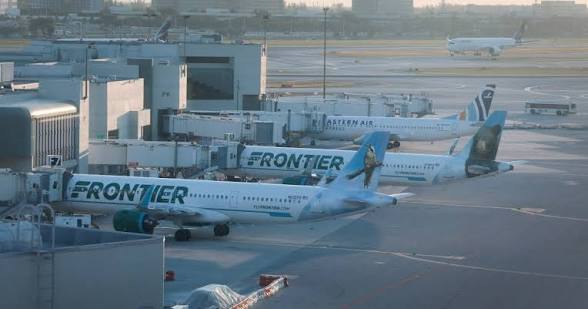
Airports across the United States faced widespread disruption as airlines were forced to hold departing aircraft.
Passengers encountered long queues, crowded terminals and changing departure information.
According to Reuters, nearly 10,000 flights had been canceled by 11:30 p.m. Eastern Time on Friday, based on figures from Flightradar24.
Major airlines experienced significant disruption.
Delta Air Lines and American Airlines each recorded more than 2,200 cancellations, while United Airlines reported approximately 1,800.
Tens of thousands of travelers faced uncertainty about their journeys.
Some passengers waited several hours for updates. Others had to find accommodation after their flights were canceled or rescheduled.
The disruption also affected aircraft and airline crews.
When planes cannot depart on schedule, they may end up in the wrong locations for their next scheduled journeys. Pilots and cabin crews can also become displaced from their planned assignments.
This creates a complicated recovery process.
Even after the FAA removes a ground stop, airlines cannot immediately restore every flight to its original schedule.
Reuters+1
Why Flight Delays Can Continue After a Ground Stop Ends
Many passengers may assume that lifting a ground stop means airports will immediately return to normal.
However, aviation operations are interconnected.
A single canceled flight can affect several later journeys involving the same aircraft.
For example, an aircraft scheduled to fly from New York to Chicago may be unable to depart. That same aircraft might then be scheduled for another journey from Chicago to Los Angeles.
When the first flight is canceled, the second journey may also face disruption.
The same problem applies to airline crews.
Airlines must ensure that the correct pilots and cabin crew members are available at the correct airports. They must also follow required working-hour and safety regulations.
As a result, delays can continue for hours or even days after the original technical problem is resolved.
Reuters reported that aviation analysts expected the nationwide shutdown to disrupt airline schedules for several days.
This explains why passengers were still experiencing problems after the FAA lifted the restriction.
Reuters+1
FAA Lifts the Ground Stop After More Than Four Hours
The nationwide restriction was eventually lifted at approximately 8:15 p.m. Eastern Time on Friday.
Duffy confirmed that American airspace was reopening and that airlines could gradually resume departures.
However, officials warned that restoring normal operations would take time.
The reopening was an important development because it allowed airports and airlines to begin working through the backlog.
Still, the immediate priority was to restore safe and stable operations rather than send every delayed flight into the air at once.
Airlines needed to review schedules, reposition aircraft and coordinate available crews.
The FAA’s decision to lift the ground stop also did not mean that the investigation had ended.
Authorities still needed to determine exactly why the communications systems became unstable and whether additional technical changes were necessary.
The government also faced questions about the resilience of its aviation network.
Reuters+1
Was the November 2026 Ground Stop the Second Since 9/11?
Yes. The November 13 incident was the second nationwide ground stop for departures since the September 11, 2001, terrorist attacks, according to Reuters and ABC News.
The previous incident occurred in January 2023.
During that event, the FAA temporarily halted domestic departures after its Notice to Air Missions (NOTAM) system experienced an outage.
The NOTAM system provides pilots and aviation personnel with important safety information before flights.
The January 2023 shutdown lasted approximately 90 minutes.
The November 2026 incident was significantly longer, lasting more than four hours.
Although both incidents resulted in nationwide restrictions, their causes were different.
The 2023 disruption involved the NOTAM system, while the latest incident involved instability in air traffic control communications and radar-related systems.
The comparison is useful because it demonstrates how unusual nationwide aviation shutdowns are.
However, it should not be interpreted as evidence that the November incident resembled the September 11 terrorist attacks.
The similarities relate to the scale of the flight restrictions, not the nature of the underlying events.
Reuters+1
Could Artificial Intelligence Have Played a Role?
Another question surrounding the FAA ground stop concerns the introduction of new artificial intelligence technology into America’s aviation network.
The FAA had recently rolled out its AI-supported Strategic Management of Airspace (SMART) system.
The technology is designed to help manage airspace congestion by combining information from multiple data sources.
Because the new system was introduced shortly before the nationwide disruption, some observers questioned whether the two events were connected.
The company behind the SMART system rejected that suggestion.
AirSpace Intelligence said the ground stop was not caused by its technology or its integration with the FAA.
Mullin said investigators were examining possible connections when questioned about the issue.
However, Duffy later stated that the failure involved older legacy equipment and that the SMART system could not have caused the incident.
At this stage, there is no established evidence connecting the AI rollout to the nationwide ground stop.
The investigation must establish the precise technical cause before officials can reach a definitive conclusion.
ABC News+1
Lawmakers Demand Answers After the FAA Disruption
The incident has also created political pressure on the Trump administration and federal aviation authorities.
Lawmakers from both parties have called for explanations about the communication failure and the condition of America’s air traffic control infrastructure.
House Democratic Leader Hakeem Jeffries described the incident as an unprecedented breakdown.
Senator Tammy Duckworth also called for a thorough investigation.
She emphasized the importance of redundancy in aviation safety systems.
Senator Maria Cantwell said the relevant congressional committee would review technical issues involving primary and backup communication frequencies.
These concerns reflect a broader question: how can the United States ensure that its aviation infrastructure remains reliable during unexpected technical failures?
Lawmakers are likely to examine several issues:
Why did the telecommunications equipment become overloaded?
Were warning signs identified before the shutdown?
Were backup systems operating as expected?
Could newer technology have contributed to compatibility problems?
What additional funding is required to prevent future disruptions?
The answers could influence future aviation spending and modernization plans.
They may also determine whether additional oversight or technical requirements are necessary.
For now, the investigation remains important because the public needs confidence in the systems responsible for managing American airspace.
ABC News+1
What Does the FAA Ground Stop Mean for American Travelers?
For passengers, the most immediate concern is whether future flights will operate normally.
Although the nationwide restriction has been lifted, travelers may continue experiencing delays because airlines need time to restore their schedules.
Passengers should take several practical steps when preparing for upcoming journeys.
Check flight status regularly: Airline websites and mobile applications provide updated departure information.
Confirm before leaving home: Travelers should check whether their flights have been delayed, canceled or rescheduled.
Keep airline notifications active: Text messages and app notifications can provide important updates.
Contact airlines about cancellations: Passengers should ask about alternative flights, rebooking and applicable refund policies.
Allow additional airport time: Disrupted schedules may create longer queues at check-in counters and customer service desks.
Travelers should also understand that compensation rules depend on the circumstances and applicable regulations.
Reuters reported that US airlines would not be required to provide compensation for passengers stranded by this particular FAA system failure because the airlines were not responsible for the disruption.
However, passengers should still check their individual airline policies and applicable consumer protections.
The most important point is that lifting the ground stop does not guarantee that every scheduled flight will operate on time.
What Happens Next in the FAA Investigation?
The next stage will involve identifying the exact cause of the communications failure.
Federal authorities must establish whether the problem resulted from equipment failure, data overload, compatibility issues or another technical factor.
The Department of Homeland Security and the National Security Agency are also involved in examining possible security concerns.
Meanwhile, the Department of Transportation faces pressure to explain how it plans to modernize the aviation network.
The incident could accelerate discussions about replacing outdated equipment and improving backup communications.
It may also encourage lawmakers to reconsider the funding needed for aviation infrastructure.
However, modernization will not happen overnight.
Installing new equipment across a nationwide network requires coordination between government agencies, contractors, airports and aviation professionals.
Testing is equally important because new systems must operate safely alongside existing technology.
The government must therefore balance the need for rapid improvements with the responsibility to protect aviation safety.
For Mullin, the immediate message remains that the November incident should not be mistaken for another September 11 attack.
For travelers and lawmakers, however, the disruption has raised an equally important question: how can the country prevent an aging technical system from causing another nationwide aviation shutdown?
Conclusion: Mullin Seeks to Calm Public Fears After Nationwide FAA Ground Stop
Homeland Security Secretary Markwayne Mullin has rejected comparisons between the November 2026 FAA ground stop and the September 11 terrorist attacks.
His comments came after a communications failure forced the FAA to halt departing flights across the United States.
Although the disruption created widespread travel chaos, officials said they had no evidence that a cyberattack or terrorist operation caused the incident.
Transportation Secretary Sean Duffy blamed overloaded, aging air traffic control equipment and called for substantial investment in modernization.
The FAA eventually lifted the restriction after more than four hours. Nevertheless, thousands of canceled flights and displaced aircraft created problems that continued beyond the shutdown.
The incident serves as a reminder that aviation safety depends on more than aircraft and airports. Reliable communications, modern equipment and effective emergency procedures are equally important.
While investigators continue examining the cause, Mullin’s central message is straightforward: the latest FAA ground stop was a serious technical disruption, not another 9/11 attack.
Frequently Asked Questions (FAQs)
1. What did DHS Chief Markwayne Mullin say about the FAA ground stop?
Homeland Security Secretary Markwayne Mullin said there was no indication that the nationwide FAA ground stop was caused by a deliberate attack. He reassured Americans that the incident was not another September 11 situation.
2. Was the November 2026 FAA ground stop caused by a cyberattack?
There was no confirmed evidence of a cyberattack when officials addressed the incident. Mullin said investigators were examining the possibilities but indicated that the failure appeared to be mechanically driven.
3. Why did the FAA ground all departing flights?
The FAA ordered the nationwide ground stop after communication problems affected multiple Air Route Traffic Control Centers. Officials took precautionary action because unstable communications could affect safe flight operations.
4. When did the FAA lift the nationwide ground stop?
The FAA lifted the nationwide ground stop at approximately 8:15 p.m. Eastern Time on November 13, 2026, after more than four hours of restrictions.
5. Was anyone in danger during the FAA ground stop?
Officials said aircraft already in the air were safely managed and landed. Mullin also reassured the public that the disruption did not mean passengers were facing another September 11-style attack.
6. How many flights were canceled during the FAA disruption?
Reuters reported that nearly 10,000 flights had been canceled by 11:30 p.m. Eastern Time on November 13, according to Flightradar24.
7. What caused the FAA communication failure?
Transportation Secretary Sean Duffy said aging switches and routers became overloaded with data, creating inconsistencies in radar and communications systems. The precise underlying cause remained under investigation.
8. Did artificial intelligence cause the FAA ground stop?
There is no established evidence that the FAA’s new SMART artificial intelligence system caused the disruption. Its developer rejected the connection, and Duffy blamed older legacy equipment.
9. Was this the first nationwide ground stop since 9/11?
No. It was the second nationwide ground stop since September 11, 2001. The previous incident occurred in January 2023, when an FAA NOTAM system outage temporarily halted domestic departures.
10. Will flight delays continue after the FAA ground stop?
Yes. Although the FAA lifted the restriction, airlines needed time to reposition aircraft, arrange crews and restore schedules. Consequently, delays and cancellations could continue for several days.
About the Author