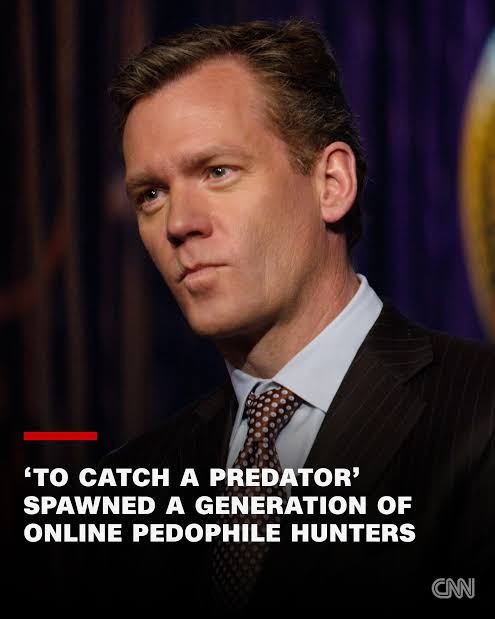
Chris Hansen is pushing back hard against Hollywood’s latest attempt to revisit the controversial world of To Catch a Predator.
The former Dateline NBC host has sharply criticized Primetime, the new film directed by Lance Oppenheim and starring Robert Pattinson as a fictionalized version of Hansen. After finally watching the movie, Hansen said its portrayal of him and his work was deeply disconnected from reality. He also criticized the filmmakers for turning a serious child-protection effort into something resembling a horror story.
That reaction has added another layer to a movie already designed to provoke debate.
Primetime does not present itself as a conventional Chris Hansen biography. Instead, it uses Hansen’s television career and the To Catch a Predator phenomenon as the foundation for a dark, stylized fictional story about television, fame, morality and exploitation.
However, Hansen’s objections raise an important question: Where does artistic interpretation end and exploitation begin?
Chris Hansen blasts Primetime after watching the movie

Hansen had already expressed reservations about Primetime before its release. His concerns became even stronger after he eventually watched the film.
According to Entertainment Weekly, Hansen described the movie as being “so detached from reality” and gave Pattinson’s performance a D. He argued that the fictionalized story did not accurately represent the people, investigations or motivations involved in the original To Catch a Predator operation.
Hansen also objected to the broader depiction of his work.
For years, To Catch a Predator has remained one of the most recognizable examples of sensational reality television. The program combined hidden cameras, undercover decoys and confrontations with men suspected of attempting to meet minors.
The format generated enormous public attention.
But it also created difficult ethical questions.
Was the program journalism?
Was it entertainment?
Was it a public-service investigation?
Or was it a combination of all three?
Those questions are central to Primetime.
Robert Pattinson plays a fictionalized Chris Hansen
Robert Pattinson’s involvement has made the controversy considerably bigger.
Rather than simply documenting Hansen’s career, Primetime turns him into a fictional character. Pattinson plays a version of Hansen during the height of the To Catch a Predator era.
The film also features Skyler Gisondo as an actor involved in the sting operation and Merritt Wever as producer Andie Bender. The story draws inspiration from the world surrounding the original television investigations but deliberately takes creative liberties.
The filmmakers have emphasized that the movie is not intended to be a straightforward biography.
That distinction matters.
A fictional film can take real people and real events and reshape them for dramatic purposes. However, when the central character is a living public figure, fictionalization can also create controversy if audiences assume that dramatic scenes represent actual events.
That appears to be one of Hansen’s central complaints.
Why Hansen says the movie misses the real story
Hansen’s criticism goes beyond a disagreement about acting.
His argument is essentially about context.
The original To Catch a Predator operation was presented as an effort to expose adults who allegedly attempted to meet minors for sexual purposes. Hansen became the public face of the investigation.
The show became famous because of its confrontational format.
Suspects would arrive at a sting location believing they were meeting someone underage. Instead, cameras recorded their interactions before Hansen confronted them.
The formula was simple, dramatic and highly effective television.
But Primetime approaches that history from a different direction.
Instead of celebrating Hansen as a crime-fighting television personality, the film examines the psychological and ethical consequences of turning real-world danger into entertainment.
The Washington Post described the movie as a morally complex dramatization that explores Hansen’s pursuit of justice while questioning how that pursuit became a public spectacle.
That is a very different interpretation from Hansen’s own view of his legacy.
Hollywood exploitation becomes the bigger debate
The dispute surrounding Primetime is ultimately larger than Chris Hansen.
It raises questions about Hollywood’s growing interest in turning controversial real-life personalities into fictional entertainment.
True crime has become one of the biggest genres in modern media. Documentaries, podcasts, television dramas and feature films frequently revisit real investigations and notorious personalities.
That popularity creates a difficult problem.
Real people lived these stories.
Hollywood turns them into products.
In Hansen’s case, the debate is particularly complicated because To Catch a Predator itself blurred the boundaries between journalism and entertainment.
The original show was already accused by critics of sensationalizing serious criminal investigations.
Now, years later, a movie is examining that sensationalism.
The result is almost circular.
A television program once criticized for turning crime into entertainment has become the subject of a movie about the consequences of turning crime into entertainment.
Primetime deliberately embraces controversy
The filmmakers do not appear to have accidentally created a provocative movie.
Director Lance Oppenheim has approached the story as a surreal and stylized examination of early-2000s media culture.
Screenwriter Ajon Singh has explained that the film was intended to reflect on sensationalism rather than provide a simple moral judgment about Hansen or the people involved in predator investigations. GQ reported that the project evolved into a surreal, fever-dream-style film designed to challenge audiences’ assumptions about media culture.
That approach explains why Hansen and the filmmakers see the same material so differently.
Hansen sees a distorted representation of work he believes protected children.
The filmmakers see an opportunity to question the machinery surrounding that work.
Neither perspective automatically settles the historical debate.
Instead, it demonstrates why Hansen’s legacy remains so controversial.
Is Primetime a Chris Hansen biopic?
No.
This is one of the most important points for viewers.
Primetime is a fictionalized film inspired by the world of Chris Hansen and To Catch a Predator. It is not a conventional documentary or authorized biography.
Robert Pattinson is portraying a dramatized version of Hansen rather than reproducing every detail of Hansen’s real life.
That means viewers should not treat every scene as a factual account.
This distinction is especially important because the film uses recognizable names, historical references and elements inspired by real television investigations.
The result can look authentic while still being dramatically constructed.
The Washington Post reported that the movie fictionalizes and condenses real events, including elements surrounding a Texas investigation.
Therefore, describing the movie as a “complete fraud” is better understood as a reflection of Hansen’s anger toward its portrayal rather than an objective finding about the film.
The movie’s critics see a different problem
Interestingly, Hansen is not the only person questioning the film.
Some critics have argued that Primetime raises major ethical questions but does not always provide satisfying answers.
The Indian Express described the film as an attempt to examine media ethics, reality-TV voyeurism and vigilantism while criticizing its reliance on cinematic style over deeper explanations.
The New Yorker similarly characterized the movie as a stylized examination of the blurred boundaries between justice and exploitation.
That means the film’s controversy is not simply a fight between Hansen and Hollywood.
There is a broader critical conversation happening around the movie.
Some viewers may see it as a powerful criticism of sensational television.
Others may see it as another example of Hollywood sensationalizing controversial people.
Hansen clearly falls into the second camp.
Why Chris Hansen’s reaction matters
Hansen remains closely associated with To Catch a Predator more than a decade after the show’s original run.
The program aired from 2004 to 2007 and became a major part of early internet and reality-TV culture. Its confrontational clips continued circulating online long after the original broadcasts ended.
A 2025 documentary titled Predators revisited the rise and fall of the show and examined its cultural legacy. That documentary included an interview with Hansen and explored questions surrounding public shaming, media sensationalism and modern online predator-hunting communities.
The arrival of Primetime therefore comes during a larger reassessment of the show’s legacy.
Hansen is no longer simply defending an old television program.
He is defending his interpretation of what that program represented.
The uncomfortable legacy of To Catch a Predator
There is no easy way to discuss To Catch a Predator without confronting its contradictions.
The show dealt with an extremely serious issue: adults seeking sexual encounters with minors.
At the same time, it presented those encounters through hidden cameras, dramatic confrontations and television editing.
That combination made the program compelling.
It also created ethical questions.
Supporters argued that the show exposed dangerous behavior and brought attention to child safety.
Critics questioned whether television should transform such investigations into entertainment.
That debate has never completely disappeared.
Instead, it has evolved with the internet.
Today, independent online predator catchers use livestreams, hidden identities and social-media platforms to conduct their own investigations.
Some see these groups as filling gaps in law enforcement.
Others warn that amateur investigations can create serious legal and ethical problems.
The legacy of Hansen’s television work is therefore still visible in today’s digital culture.
Hollywood’s fascination with controversial real people
The Primetime controversy also reflects a much bigger Hollywood trend.
Audiences are increasingly fascinated by real people who occupy morally complicated positions.
Hollywood has repeatedly transformed journalists, criminals, investigators, politicians and celebrities into fictional characters.
The appeal is obvious.
Real life provides built-in drama.
But the risks are equally obvious.
When filmmakers alter real events, audiences may not always know which elements are documented and which are invented.
That becomes particularly sensitive when a living person is involved.
In this case, Hansen has publicly rejected the film’s interpretation of his character.
That does not mean the filmmakers are prohibited from telling their fictional story.
It does mean audiences should understand the difference between a dramatized interpretation and historical fact.
Why the “fraud” claim needs context
Calling Primetime a “complete fraud” is a powerful headline, but it requires context.
Hansen has indeed condemned the movie and said it is detached from reality. However, available reporting describes Primetime as a fictionalized or dramatized work rather than a factual documentary about Hansen.
Therefore, the central controversy is not whether Hollywood accidentally made a factual documentary incorrectly.
The controversy is whether the fictional interpretation fairly represents a controversial real person and the complicated history behind his television career.
That distinction is crucial.
It also makes the story more interesting.
The question is no longer simply whether the movie is “true.”
The question is whether a fictional film has a responsibility to accurately represent the person who inspired its central character.
What Chris Hansen wants audiences to understand
Hansen’s reaction suggests that he wants audiences to separate the fictional movie from the actual work conducted during the To Catch a Predator era.
He has argued that the movie transforms something he viewed as a positive effort into a dark horror-like narrative.
That is a major disagreement over meaning.
For Hansen, the central story is about confronting people who attempted to exploit children.
For Primetime, the central story is about what happens when the pursuit of justice becomes intertwined with fame, ratings, ego and entertainment.
Both narratives emerge from the same historical phenomenon.
They simply point in different directions.
Will the controversy hurt or help Primetime?
Ironically, Hansen’s criticism could make the movie even more visible.
Controversy generates attention.
The film has already attracted significant discussion because Robert Pattinson plays one of the most recognizable figures from early reality-TV culture. It also premiered to positive critical attention, with the film receiving praise for its performances and distinctive visual style.
Hansen’s public rejection gives audiences another reason to investigate the movie.
Some viewers may watch it specifically because he dislikes it.
Others may watch it because they want to understand his criticism.
Either way, the controversy keeps the conversation alive.
The real scandal may be the media machine
The most interesting element of the Primetime debate may not be Hansen or Pattinson at all.
It may be the media machine surrounding them.
First, television transformed predator investigations into mass entertainment.
Then the internet transformed Hansen into a cultural icon.
Now Hollywood has transformed that cultural icon into a fictional character.
Each stage changes the original story.
That raises a difficult question:
Who owns the narrative once real events become part of popular culture?
Hansen believes the new film gets that narrative badly wrong.
The filmmakers appear to believe that questioning Hansen’s public image is precisely the point.
Audiences will ultimately decide which interpretation they find more convincing.
Final thoughts
The Chris Hansen controversy surrounding Primetime is unlikely to disappear soon.
Hansen has made his position clear: he believes the movie is deeply disconnected from reality and unfairly portrays his work.
The filmmakers, meanwhile, have created a fictionalized story designed to examine the uncomfortable relationship between justice, television, fame and exploitation.
That difference is at the heart of the controversy.
Calling the movie a “complete fraud” captures Hansen’s anger, but it should not be presented as an independently established fact. The film is a dramatization, and its purpose is not simply to reproduce Hansen’s biography.
What Primetime ultimately exposes may be bigger than one television host.
It exposes the uneasy relationship between real crime and entertainment.
It shows how quickly investigations can become spectacle, how public figures can become fictional characters and how Hollywood can revisit controversial history through an entirely different lens.
For viewers, the best approach is to watch the film with that distinction in mind.
It is a fictional interpretation of the Chris Hansen era—not a definitive record of what happened.
And that may be the most important fact in the entire controversy.
FAQs
Is Primetime about Chris Hansen?
Yes. Primetime is a fictionalized film inspired by Chris Hansen, his To Catch a Predator era and the broader culture of early-2000s reality television. Robert Pattinson plays a dramatized version of Hansen.
Did Chris Hansen approve the movie?
Hansen has publicly criticized the movie and said its portrayal of him and his work is detached from reality. Reports indicate that he was not involved in the production and did not approve the fictional portrayal.
What did Chris Hansen say about Primetime?
After watching the film, Hansen strongly criticized its portrayal and reportedly described it as “so detached from reality.” He also gave Pattinson’s performance a D.
Is Primetime a true story?
Primetime is a fictionalized dramatization inspired by real people, events and the To Catch a Predator era. It should not be treated as a documentary or exact historical account.
Who plays Chris Hansen in Primetime?
Robert Pattinson portrays a fictionalized version of Chris Hansen. The cast also includes Skyler Gisondo and Merritt Wever.
Why is Chris Hansen angry about the movie?
Hansen objects to what he sees as an inaccurate and highly fictionalized portrayal of his work. He believes the film turns a serious effort to expose people targeting children into something much darker and more sensationalized.
Is To Catch a Predator still controversial?
Yes. The show’s legacy continues to generate debate about journalism, entertainment, public shaming, investigative tactics and the ethics of televised sting operations. A recent documentary also revisited those questions.
Is Primetime a documentary about Chris Hansen?
No. It is a fictionalized feature film. While it draws from Hansen’s real career and the To Catch a Predator phenomenon, its characters and events are dramatized.
Why is Hollywood interested in Chris Hansen now?
Hansen’s work remains culturally recognizable, while renewed interest in true crime, reality television and media ethics has created an opportunity to revisit the To Catch a Predator era from a modern perspective.
What is the main controversy surrounding Primetime?
The central controversy is whether the film’s fictionalized portrayal fairly examines Hansen and his television legacy or unfairly exploits and distorts real people and events. Hansen strongly favors the latter interpretation, while the film’s creators have approached the subject as a critique of media culture.
About the Author