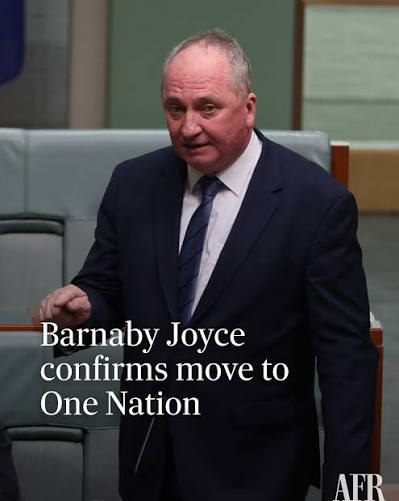
Australian politics is facing another major shake-up as One Nation continues to attract attention from conservative voters and politicians dissatisfied with the established political parties. Barnaby Joyce, the party’s deputy leader, has defended the movement of voters and politicians towards One Nation, arguing that Australians have the right to change their political loyalties.
His comments have gained fresh attention following the dramatic defection of South Australian Liberal Senator Leah Blyth to Pauline Hanson’s One Nation. The announcement has created further pressure on the Liberal Party and raised questions about its ability to retain conservative voters.
Joyce rejected criticism that politicians leaving their original parties should automatically be considered disloyal. He questioned whether millions of Australians who were considering changing their political preferences should also face the same criticism.
The development comes at a challenging time for Australia’s opposition, with One Nation attempting to strengthen its national presence and position itself as an alternative for voters dissatisfied with traditional political leadership.
The latest developments also highlight a broader question: could more Liberal politicians follow the same path as Joyce and Blyth?
Barnaby Joyce Defends Political Defections to One Nation

Barnaby Joyce has strongly defended the decision of politicians and ordinary Australians to move towards One Nation.
Speaking after Leah Blyth announced her departure from the Liberal Party, Joyce argued that political choices should be understood in the context of changing voter preferences.
His central argument was that Australians are entitled to reconsider their political loyalties when they believe an established party no longer represents their interests.
Joyce challenged criticism directed at politicians who leave their original parties. He questioned whether voters who move away from the major parties should also be labelled disloyal.
He pointed to the growing support for One Nation and argued that many Australians are looking for stronger conservative representation.
According to Joyce, these voters are following their political beliefs rather than simply supporting a particular political personality.
His comments are significant because they frame One Nation’s growth as part of a wider political shift rather than an isolated series of parliamentary defections.
The party is attempting to attract people who feel disconnected from established political organisations.
For Joyce, the movement represents an opportunity to give these voters another political home.
Leah Blyth’s Defection Creates Fresh Pressure on the Liberals
Blyth announced her decision on November 26, 2026, becoming the latest prominent political figure to move towards Hanson’s party.
Before her defection, she had served as a shadow assistant minister on Opposition Leader Angus Taylor’s frontbench. She had also previously served as president of the South Australian Liberal Party.
In announcing her departure, Blyth expressed serious doubts about the Liberal Party’s ability to provide effective opposition to Prime Minister Anthony Albanese’s government.
She argued that the Coalition was no longer capable of delivering the political changes she believed Australia needed.
Blyth also praised One Nation for addressing issues that she felt established political parties were reluctant to confront.
Her decision immediately attracted attention because she was not simply an ordinary party member. She had held important positions within the Liberal organisation and had been involved in its internal political structure.
Pauline Hanson welcomed Blyth’s arrival, describing the move as positive for Australians who wanted stronger conservative representation.
However, the defection also generated criticism from former Liberal colleagues.
Some accused Blyth of abandoning the party and the voters who had supported her political career.
The disagreement demonstrates the growing tension between established conservative parties and politicians who believe One Nation offers a more attractive political platform.
The development was reported by The Guardian and the Australian Associated Press on November 26, 2026.
The Guardian+1
Why Barnaby Joyce Rejects the Turncoat Argument
One of the most interesting aspects of Joyce’s response was his rejection of the suggestion that politicians who change parties are automatically betraying their supporters.
Criticism of political defections is common in parliamentary democracies. Voters often choose candidates partly because of their political party, its policies and its leadership.
Therefore, when an elected representative changes political affiliation, questions about trust and accountability naturally emerge.
However, Joyce believes the same argument must also consider ordinary voters.
People regularly change their political preferences because their priorities, expectations and opinions evolve.
Some voters may support the Liberal Party in one election but choose One Nation in the next.
Others may move towards Labor, the Greens or independent candidates.
Joyce questioned why politicians should face a completely different standard when they make a similar political decision.
His argument is particularly relevant because One Nation has been seeking support from Australians who previously identified with conservative parties.
Rather than viewing every defection as an act of political disloyalty, Joyce presented the movement as evidence that voters are reconsidering their options.
Nevertheless, there is an important distinction between an individual voter changing their preference and an elected senator changing parties during a parliamentary term.
That distinction is likely to remain central to the political debate surrounding Blyth’s decision.
Barnaby Joyce’s Own Move to One Nation
Joyce’s comments also carry additional significance because he has experienced a major political transition himself.
He previously served as a senior Nationals politician and was one of the most recognisable figures in Australia’s conservative political landscape.
His career included serving as Deputy Prime Minister and leading the Nationals.
However, in November 2025, Joyce left the Nationals and joined One Nation.
His move was an important development for Pauline Hanson’s party because Joyce brought considerable political experience, national recognition and an established profile among conservative voters.
His arrival also demonstrated that One Nation was interested in attracting experienced politicians rather than relying exclusively on new candidates.
Since joining the party, Joyce has become an important public figure in its efforts to expand its national influence.
His position also allows him to speak directly to voters who may feel politically homeless after disagreements with the Liberal-National Coalition.
The arrival of Leah Blyth provides another example of this broader movement.
For Joyce, her decision reinforces the argument that One Nation can attract politicians who previously worked within Australia’s established conservative parties.
However, the long-term significance of these moves will depend on whether the party can translate political attention into lasting electoral support.
Why Liberal Voters May Turn Towards One Nation
One Nation’s growing visibility reflects several political and social concerns.
Although individual voters have different motivations, several issues help explain why some conservative Australians are reconsidering their traditional political choices.
1. Dissatisfaction with Major Political Parties
Some voters believe Australia’s established political parties have become disconnected from ordinary citizens.
They may feel that political leaders spend too much time managing internal disagreements and not enough time addressing everyday concerns.
This dissatisfaction can create opportunities for smaller parties that present themselves as alternatives to the political establishment.
One Nation has attempted to position itself within this space.
2. Demand for Stronger Conservative Representation
Conservative voters do not necessarily agree on every political issue.
However, some believe their preferred positions are not adequately represented within the Liberal-National Coalition.
Issues such as national identity, immigration, economic policy and government accountability can influence their political decisions.
Joyce has argued that One Nation offers these voters a stronger voice.
3. Frustration with Political Compromises
Political parties often make compromises to maintain parliamentary support and develop workable policies.
However, these decisions can disappoint voters who expect politicians to maintain clear ideological positions.
Some conservatives may therefore prefer a party that presents itself as more consistent with their expectations.
4. Leadership and Party Direction
Leadership changes can also influence political loyalty.
The Liberal Party has faced questions about its direction, internal disagreements and its approach to competing political pressures.
When voters become uncertain about a party’s future, alternative political organisations can benefit.
One Nation is attempting to attract voters who believe the Coalition needs a stronger conservative direction.
5. The Appeal of Political Alternatives
Another factor is the growing willingness of voters to consider parties outside the traditional two-party structure.
Political loyalty is not necessarily permanent.
Voters may experiment with different candidates and parties when they believe their previous choices have failed to deliver satisfactory results.
This creates an opportunity for One Nation to expand beyond its established supporter base.
Liberal Party Faces Questions Over Its Future
The Blyth defection has created another challenge for Liberal leader Angus Taylor.
The Liberal Party is already dealing with difficult questions about its political identity, electoral strategy and relationship with conservative voters.
The departure of a senator who previously held a senior party position could intensify those discussions.
It also raises concerns about whether other members might consider similar moves.
For the Liberals, the challenge is not limited to losing individual politicians.
The larger concern is whether the party is losing voters who once viewed it as their natural political home.
If conservative voters increasingly support One Nation, the Liberals could face additional competition in electorates where conservative preferences are particularly important.
However, it would be premature to assume that every dissatisfied Liberal voter will automatically support Hanson.
Some may remain loyal to the Coalition, while others could support independent candidates or different political parties.
The Liberal leadership will therefore need to understand why some members and voters are becoming dissatisfied.
It may also need to explain how the party intends to differentiate itself from One Nation.
The coming months could be important in determining whether the defection represents an isolated political disagreement or part of a longer-term shift.
One Nation’s Growing Political Influence
One Nation’s expanding political presence has become an important issue for Australia’s major parties.
Pauline Hanson established the party as a political alternative for Australians dissatisfied with established political leadership. Over the years, the organisation has experienced periods of strong support as well as electoral setbacks.
However, its recent developments suggest that it is once again attracting significant national attention.
The recruitment of experienced politicians such as Joyce and the arrival of Blyth have strengthened its public profile.
The party is also benefiting from increased discussion about the future of conservative politics.
According to reporting by the ABC, One Nation has used prominent political recruits to create momentum and challenge the established opposition.
ABC News+1
One Nation Wants to Become a Stronger Alternative
One Nation’s strategy appears focused on attracting voters who believe the existing political system does not adequately represent their concerns.
The party has highlighted issues including immigration, national identity, government spending and political accountability.
These issues have helped it maintain a recognisable political identity.
The addition of experienced politicians could also help the party develop a stronger parliamentary presence.
However, attracting popular politicians does not automatically guarantee electoral success.
One Nation must demonstrate that it can develop workable policies, build a reliable candidate network and maintain public confidence.
It must also convince voters that its political platform offers practical solutions rather than simply expressing dissatisfaction with established parties.
Latest Polling Shows One Nation’s Growing Challenge to the Coalition
The latest political developments have arrived alongside encouraging polling figures for One Nation.
A Newspoll survey published earlier in the week showed Labor and One Nation tied at 27 per cent of the primary vote, while the Coalition recorded 22 per cent.
The figures suggest that One Nation has become a significant competitor for conservative political support.
They also demonstrate the pressure facing the Liberal-National Coalition as it attempts to rebuild its electoral position.
However, primary vote figures should be interpreted carefully.
They do not directly determine the final distribution of parliamentary seats. Australia’s preferential voting system means that preferences, electorate-level results and candidate performance can significantly influence election outcomes.
Nevertheless, the polling figures provide an important indication of the changing political environment.
For One Nation, stronger polling can help create momentum and attract potential supporters.
For the Coalition, the figures raise questions about how it can win back voters who may be considering alternative political options.
The reported figures were highlighted in coverage of Blyth’s defection by AAP.
AAP News+1
Victoria Election Could Test One Nation’s Popularity
The upcoming Victorian state election is another important test for One Nation.
The party is seeking to increase its representation and demonstrate that its growing national visibility can translate into electoral results.
Barnaby Joyce has been involved in the campaign and has discussed the challenges facing the party.
Interestingly, he has avoided suggesting that One Nation is guaranteed major victories in the lower house.
In comments reported by the ABC, Joyce explained that preference flows could benefit the Liberal Party in some lower-house contests.
He also expressed greater confidence about One Nation’s prospects in the upper house, where proportional representation creates different electoral opportunities.
ABC News+1
This distinction is important.
A strong primary vote does not necessarily translate into winning individual lower-house seats.
In preferential voting, candidates must also benefit from the distribution of preferences.
The upper house operates differently, allowing parties with sufficient support across the state to compete for representation.
For One Nation, the Victorian election could provide valuable information about the strength of its support.
A strong result would reinforce the party’s argument that it is becoming an important force in Australian politics.
A disappointing result, however, would raise questions about whether national polling support can translate into actual parliamentary representation.
Joyce has also pushed back against the suggestion that One Nation’s future depends entirely on winning a large number of seats in Victoria.
His argument is that political growth should be assessed over a longer period rather than through one election.
Why Leah Blyth’s Move Matters Beyond South Australia
Blyth’s decision is particularly important because of her previous position within the Liberal Party.
She was not an unknown politician joining a smaller organisation.
She had served as the South Australian Liberal Party president and entered federal parliament in February 2025 through a Senate casual vacancy, replacing Simon Birmingham.
Her departure therefore creates questions about the Liberal Party’s internal relationships and its ability to maintain unity.
Reports also indicate that internal political disagreements in South Australia formed part of the background to her departure.
The political situation became more complicated after conservative senator Alex Antic gained control of the South Australian Liberal Party branch.
Blyth’s position within the party had consequently become increasingly difficult.
Her departure gives One Nation its first federal senator from South Australia.
It also provides the party with an opportunity to strengthen its organisation in a state where conservative political competition is becoming more significant.
However, the circumstances surrounding her decision have attracted criticism.
Some former colleagues argue that elected politicians should remain accountable to the party and voters who helped them enter parliament.
Blyth, on the other hand, has maintained that she no longer believes the Liberal Party can deliver the political direction she wants for Australia.
This disagreement reflects a broader conflict over political loyalty, ideology and representation.
The Guardian+1
Pauline Hanson Benefits From High-Profile Defections
Pauline Hanson has emerged as one of the main beneficiaries of the recent political developments.
As One Nation’s leader, she has spent years building the party’s public identity and attracting supporters who feel dissatisfied with mainstream politics.
The arrival of Joyce in 2025 gave the organisation an experienced political figure with considerable national recognition.
Blyth’s defection adds another dimension to that strategy.
Her background within the Liberal Party could help One Nation connect with conservative voters who previously supported the Coalition.
Hanson welcomed Blyth’s decision and described her as a true conservative.
She also argued that Australians were becoming frustrated with major political parties that had failed to meet their expectations.
However, Hanson has denied approaching Blyth to encourage her defection.
According to AAP reporting, Hanson said Blyth made the decision independently.
This is politically important because it allows One Nation to present itself as an organisation attracting people voluntarily rather than actively recruiting dissatisfied politicians through direct approaches.
AAP News+1
Can More Liberal Politicians Follow Barnaby Joyce and Leah Blyth?
The possibility of further defections is likely to remain an important question for Australian politics.
Joyce’s departure from the Nationals and Blyth’s move from the Liberals demonstrate that established political affiliations are not necessarily permanent.
However, predicting additional defections would be premature.
Politicians must consider several factors before changing parties.
These include their political beliefs, relationships within their existing organisations, electoral prospects and the expectations of their supporters.
Some conservative politicians may feel that One Nation provides a better platform for their political positions.
Others may believe they can achieve more by remaining within the Liberal Party.
There are also practical considerations.
Joining a smaller party can offer new opportunities, but it can also create challenges involving parliamentary influence, electoral support and policy development.
For One Nation, attracting additional experienced politicians could strengthen its parliamentary influence.
For the Coalition, preventing further departures will require addressing internal disagreements and rebuilding confidence among its members.
The coming months will provide a clearer picture of whether the recent changes represent the beginning of a larger political realignment.
What This Means for Australia’s Conservative Politics
The developments surrounding Joyce and Blyth could have consequences beyond the immediate political debate.
Australia’s conservative political landscape has traditionally been dominated by the Liberal-National Coalition.
However, One Nation’s growing profile is creating additional competition for voters who previously supported conservative candidates.
This competition could influence future election campaigns, policy debates and political alliances.
The Liberal Party Must Rebuild Voter Confidence
The Liberal Party faces an important challenge.
It must convince voters that it remains capable of representing conservative interests while offering credible policies for Australia’s future.
Simply criticising One Nation may not be enough to win back dissatisfied supporters.
The party will need to explain its positions on important national issues and demonstrate that its leadership can maintain a consistent direction.
One Nation Must Prove It Can Govern
One Nation also faces challenges.
Growing public attention and attracting experienced politicians are important achievements, but they do not automatically establish a party’s ability to govern.
The organisation must demonstrate that it has strong candidates, detailed policies and the parliamentary experience needed to influence national decisions.
Its performance in upcoming elections will help determine whether its growing support represents a lasting political change.
Conclusion
Barnaby Joyce’s defence of voters and politicians defecting to One Nation highlights an important shift in Australian conservative politics.
His response to criticism surrounding Leah Blyth’s departure challenges the idea that changing political affiliations should automatically be considered an act of disloyalty.
The latest developments also place additional pressure on the Liberal Party, which must address concerns about its leadership, political direction and relationship with conservative voters.
For Pauline Hanson, the arrival of experienced politicians provides an opportunity to strengthen One Nation’s national influence.
However, the party still needs to convert growing attention and polling support into consistent electoral success.
The upcoming Victorian election and future federal contests will provide important tests.
Ultimately, the biggest question is whether One Nation can become a lasting alternative for Australians who no longer feel represented by traditional conservative parties.
Frequently Asked Questions (FAQs)
1. What did Barnaby Joyce say about One Nation defections?
Barnaby Joyce defended politicians and voters who choose to leave their existing political parties. He questioned whether Australians changing their political preferences should also be considered disloyal.
2. Why did Leah Blyth join One Nation?
Leah Blyth said she had lost confidence in the Liberal Party’s ability to deliver meaningful political change. She described One Nation as a party willing to confront difficult national issues.
3. Who is Barnaby Joyce?
Barnaby Joyce is an Australian politician and former Deputy Prime Minister. He previously led the Nationals before leaving the party and joining One Nation in November 2025.
4. Who is the leader of One Nation?
Pauline Hanson is the founder and leader of One Nation, an Australian political party known for its conservative political positions.
5. Why is Leah Blyth’s defection important?
Her departure is significant because she previously served as South Australian Liberal Party president and held a position on the Liberal opposition frontbench. Her move gives One Nation its first federal senator from South Australia.
6. Are Liberal voters moving towards One Nation?
Recent polling indicates growing support for One Nation. However, not all dissatisfied Liberal voters are necessarily moving towards the party. Some may continue supporting the Coalition or consider other political alternatives.
7. Could more Liberal politicians join One Nation?
Further defections are possible, but there is no certainty that additional Liberal politicians will leave. Future decisions will depend on political disagreements, party leadership and electoral considerations.
8. What is One Nation’s position in Australian politics?
One Nation is seeking to strengthen its national political influence by attracting conservative voters and experienced politicians. Its electoral performance will determine how much influence it can gain.
9. What is the significance of the Victorian election for One Nation?
The Victorian election provides an opportunity to test the party’s growing support. Its performance in both houses of parliament will offer insight into its electoral strength.
10. Can One Nation replace the Liberal Party as Australia’s main conservative alternative?
It is too early to make that prediction. One Nation is gaining attention and competing for conservative voters, but replacing the Liberal Party would require sustained electoral success and a much stronger national organisation.
About the Author