President Donald Trump has launched a fierce attack on California Governor Gavin Newsom over his decision to commute the death sentences of 548 inmates, escalating an increasingly bitter political confrontation over capital punishment, criminal justice and executive power.
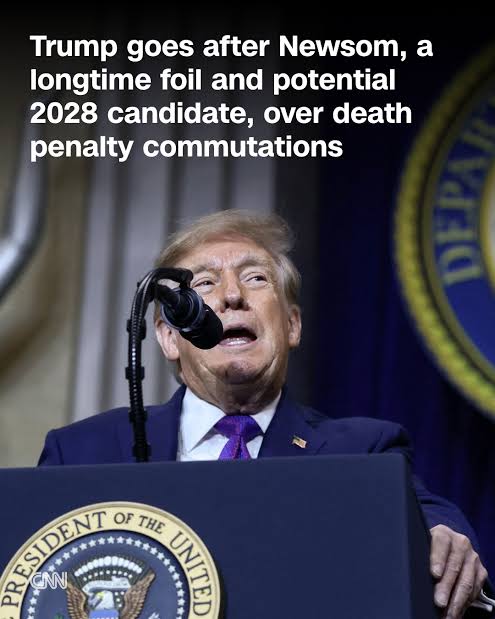
Trump delivered his criticism during an appearance at the US Department of Justice on Monday, November 23. He described Newsom’s decision as one of the most shocking acts of injustice in American history. He also accused the California governor and other Democrats of showing sympathy toward convicted murderers rather than victims and their families.
The president’s remarks came as several relatives of murder victims publicly expressed their opposition to Newsom’s plan. Their emotional accounts gave the White House an opportunity to highlight the consequences of violent crime and portray the Democratic governor as weak on public safety.
However, Newsom quickly fired back. He defended his decision and accused Trump of hypocrisy over his own use of presidential pardons. The governor argued that wealthy and politically connected individuals have benefited from Trump’s clemency decisions while ordinary Americans face a different standard of justice.
The confrontation has now developed into a major national political dispute. It also raises questions about the limits of presidential authority, the future of capital punishment and the possibility of a wider Trump-Newsom rivalry ahead of the 2028 presidential election.
Trump Condemns Newsom’s Death Row Decision

Trump used his Justice Department appearance to deliver a direct message to Newsom.
The president strongly criticized the California governor for announcing plans to commute every death sentence in the state’s prison system. He argued that the decision undermined justice and ignored the suffering of families whose loved ones were murdered.
During his remarks, Trump accused Newsom and the political left of prioritizing convicted criminals over innocent victims.
The president described the decision as a betrayal of families who have spent years seeking justice through the criminal courts.
Trump also questioned the political judgment behind Newsom’s announcement. He suggested that the governor’s position could damage public confidence in Democratic leadership, particularly among voters concerned about violent crime.
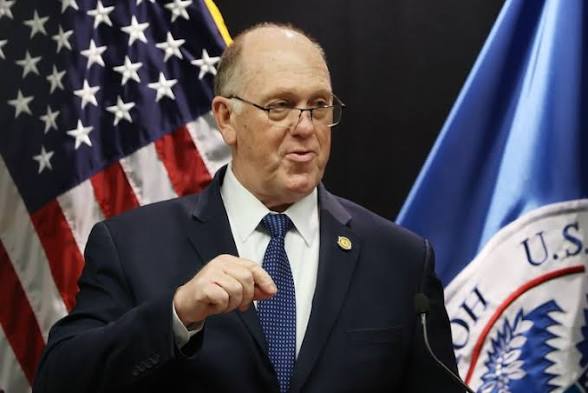
The event included Attorney General Todd Blanche and FBI Director Kash Patel. Families affected by violent crimes also attended and shared their experiences.
Their presence reinforced Trump’s central argument: decisions involving capital punishment should consider the interests and suffering of victims’ families.
The president’s criticism was not limited to California’s criminal justice system. He also used the occasion to attack Democrats more broadly, portraying the party as unwilling to support tough penalties for serious crimes.
Why Gavin Newsom Wants to Commute 548 Death Sentences
The controversy began on November 5, when Newsom announced his intention to commute all 548 death sentences in California.
Under his proposal, the affected inmates would have their sentences changed from death to life imprisonment without the possibility of parole.
This distinction is important.
Newsom’s announcement does not mean that convicted murderers will be released from prison. Instead, the proposed commutations would remove the death penalty while keeping the affected prisoners incarcerated for the rest of their lives.
The governor has repeatedly opposed capital punishment throughout his political career.
In 2019, shortly after taking office, Newsom established a moratorium on executions in California. His administration also dismantled the state’s execution chamber and repealed its lethal injection protocol.
In his November 5 open letter to Californians, Newsom explained that he believes government cannot carry out executions while remaining faithful to justice and human dignity.
He argued that state-sanctioned killing is incompatible with California’s values.
For Newsom, the decision represents the continuation of a position he has maintained for decades.
However, his latest announcement has created a much larger political controversy because it involves every person currently facing a death sentence in California.
The commutations also require further legal review. The California Supreme Court must approve the majority of the proposed changes before they can take effect.
Victims’ Families Challenge Newsom’s Decision
One of the most emotional parts of Trump’s Justice Department appearance involved relatives of murder victims.
Several family members expressed anger and disappointment over Newsom’s announcement. They argued that changing death sentences could undermine the justice they believed had been delivered through years of legal proceedings.
Among those present was Sandy Friend, whose eight-year-old son, Michael Lyons, was kidnapped, tortured and murdered in 1996.
Friend spoke about the devastating loss and questioned why the governor had made such an important decision without adequately considering the feelings of victims’ families.
She expressed the belief that the commutation decision had taken away an important part of the justice her family had sought.
Gloria Vega also spoke about her father, Gil Vega, a Palm Springs police officer who was killed alongside another officer in 2016.
Her father was a father of eight and was reportedly close to retirement when he was murdered.
These accounts gave the debate a deeply personal dimension.
For many victims’ families, capital punishment represents accountability for crimes that permanently changed their lives.
They argue that the state should not remove a sentence without giving sufficient consideration to those who suffered the consequences of the original crimes.
However, not every victims’ family shares the same position. Some relatives support alternatives to execution, including life imprisonment without parole.
This disagreement demonstrates why the death penalty remains such a difficult issue in American society.
Newsom Fires Back at Trump Over Presidential Pardons
Newsom did not remain silent after Trump’s criticism.
The California governor responded by turning the discussion toward the president’s own record of granting pardons.
He argued that Trump was using the Justice Department to attack a political opponent while overlooking controversial clemency decisions involving wealthy individuals and political allies.
Newsom also highlighted the difference between his proposed commutations and presidential pardons.
His central argument was that California’s death row inmates would remain behind bars, while some individuals who received presidential pardons could regain their freedom.
In his response, Newsom said that every person affected by his decision would die in prison.
He also accused Trump of treating mercy as a privilege available to wealthy and politically connected people.
The governor’s criticism included references to Trump’s pardons involving individuals convicted of serious crimes.
He questioned whether the president’s approach to clemency was consistent with the principles of equal justice.
Newsom also argued that the Justice Department should serve the American public rather than function as a political instrument for the president.
His response transformed the dispute from a disagreement over capital punishment into a broader argument about executive clemency and political accountability.
The Legal Battle: Can Trump Reverse Newsom’s Decision?
One of the biggest questions surrounding the controversy concerns presidential authority.
Trump said his administration would attempt to overturn Newsom’s commutation decision.
However, the president did not provide a clear legal explanation for how the federal government could reverse a state governor’s clemency action.
The distinction between federal and state powers is important.
Under the US Constitution, the president has the authority to grant reprieves and pardons for federal offenses, except in cases of impeachment.
Governors, meanwhile, exercise clemency powers under their respective state constitutions and laws.
California’s governor has constitutional authority over state criminal sentences, subject to applicable legal requirements.
Therefore, Trump’s federal clemency authority does not automatically give him the power to reverse a California governor’s decisions involving state convictions.
The California Supreme Court also has an important role in reviewing the proposed commutations.
As a result, the process involves state constitutional authority and judicial review rather than a simple presidential decision.
Trump’s promise to challenge Newsom’s action could lead to further political and legal arguments.
However, any attempt to reverse the governor’s decision would need a valid legal foundation.
The controversy highlights a broader constitutional question: how far can federal officials go when they disagree with a state government’s exercise of executive authority?
Republican Attorneys General Join the Attack
Trump is not the only Republican criticizing Newsom.
Fourteen Republican state attorneys general also condemned the California governor’s decision.
Their criticism focused on the seriousness of the crimes committed by people currently on California’s death row.
The Republican officials argued that some crimes are so severe that execution remains an appropriate punishment.
They also pointed to California voters’ previous decisions to retain capital punishment.
California voters rejected efforts to abolish the death penalty in ballot measures during the past two decades.
For Republican officials, these votes demonstrate that the governor should not ignore the public’s position on capital punishment.
However, the debate is more complicated than a simple disagreement between elected officials.
A governor’s clemency authority exists within the state’s constitutional framework. The question of how that authority should be exercised remains a matter of political and legal debate.
The Republican opposition nevertheless increases pressure on Newsom.
It also gives Trump an opportunity to present the dispute as part of a national disagreement between Republicans and Democrats over crime and public safety.
Death Penalty Debate Divides American Voters
The confrontation comes at a time when public attitudes toward capital punishment are changing.
According to a Gallup poll conducted in October 2026, support for the death penalty among Americans convicted of murder has fallen to 49%.
This marks the first time since 1971 that support has dropped below 50%.
The figures suggest that Americans are increasingly divided over whether the government should retain the power to execute convicted murderers.
Republican support for capital punishment remains significantly higher than Democratic support.
Meanwhile, many opponents argue that executions are irreversible and that the criminal justice system can make mistakes.
They also point to concerns about unequal sentencing, racial disparities and the financial costs of lengthy death penalty proceedings.
Supporters of capital punishment counter that certain crimes deserve the most severe possible punishment.
They argue that execution can provide accountability for victims and their families while demonstrating society’s rejection of extreme violence.
Both positions have influenced the national discussion for decades.
Newsom’s decision has brought these arguments back into the political spotlight.
Trump Uses the Dispute to Promote Tougher Crime Policies
Trump’s criticism of Newsom was also part of a broader message about his administration’s criminal justice priorities.
During his Justice Department appearance, the president promoted a tougher approach to violent crime and capital punishment.
He announced plans to expand the federal government’s use of the death penalty for certain serious offenses, including murders involving children, rape and human trafficking.
He also discussed efforts to accelerate federal executions.
The president’s comments reflected his long-standing support for capital punishment.
During his first administration, the federal government carried out 13 executions in the final months of his presidency.
Former President Joe Biden later commuted the sentences of 37 of the 40 people on federal death row in December 2024.
Trump has repeatedly criticized that decision.
The latest confrontation with Newsom therefore reflects a much wider disagreement over how the federal government should approach the death penalty.
Trump wants stronger use of capital punishment in qualifying federal cases, while Newsom wants to remove executions from California’s state sentencing system.
These opposing positions illustrate the growing political divide over criminal justice policy.
Justice Department Independence Raises Questions
Another important aspect of the controversy concerns the location and political setting of Trump’s remarks.
The president delivered his attack at the headquarters of the Department of Justice.
He appeared alongside senior federal law enforcement officials, including Attorney General Todd Blanche and FBI Director Kash Patel.
The appearance attracted attention because the Justice Department traditionally operates with a degree of independence from direct presidential political activity.
Presidents appoint senior department officials, but the department is also expected to apply federal law fairly and independently.
Critics argue that using an official Justice Department event to attack a political opponent creates concerns about the relationship between law enforcement and presidential politics.
The issue is particularly sensitive because Newsom has previously accused the Trump administration of politically motivated scrutiny involving him and his family.
No criminal charges have been announced against Newsom in connection with those reported investigations.
The governor has denied wrongdoing.
Trump’s latest remarks have therefore added another layer to an already complicated relationship between the White House and California’s Democratic leadership.
The Trump-Newsom Rivalry Could Shape the 2028 Election
The political consequences of this dispute could extend well beyond California.
Newsom is widely viewed as a potential Democratic presidential candidate in 2028.
He has become one of the most prominent critics of Trump and frequently challenges the president’s policies.
Trump, meanwhile, has repeatedly targeted Democratic leaders who oppose his administration.
The death penalty dispute provides both politicians with an opportunity to communicate their positions to voters.
Trump can use the issue to reinforce his tough-on-crime image and appeal to voters who support capital punishment.
Newsom can present himself as a defender of constitutional authority, criminal justice reform and limits on executive power.
The governor has said he will decide in January whether to run for president.
That decision could make the current confrontation even more politically significant.
However, the issue also presents challenges for Newsom.
Some voters may support his opposition to executions while disagreeing with the decision to commute every death sentence.
Others may believe that victims’ families deserve greater consideration before such a major policy change.
For Trump, the dispute offers a chance to criticize a potential political rival, but it also raises questions about the use of federal institutions for partisan messaging.
What Happens Next in California’s Death Row Controversy?
The next major development will likely involve the legal process surrounding Newsom’s proposed commutations.
The California Supreme Court must review and approve the majority of the affected sentences.
Until the necessary legal steps are completed, the announcement should not be confused with an immediate change to every inmate’s sentence.
The political pressure is also likely to continue.
Republican officials may pursue additional criticism, while Democratic leaders are expected to defend the governor’s position.
Victims’ families will remain central to the debate, particularly those who believe the death penalty represents the only appropriate punishment for the crimes committed against their loved ones.
At the same time, supporters of Newsom’s decision will continue arguing that life imprisonment without parole provides permanent punishment without requiring state executions.
Trump’s promise to challenge the decision could also produce further legal questions.
However, the president’s ability to directly reverse state-level clemency decisions remains limited by the constitutional division between federal and state authority.
The coming weeks could therefore determine whether the controversy remains primarily political or develops into a more significant legal confrontation.
Conclusion: Trump and Newsom Face Off Over Capital Punishment
Donald Trump’s attack on Gavin Newsom has turned California’s death row commutations into a major national political controversy.
Trump argues that the governor’s decision betrays victims’ families and weakens accountability for violent crimes.
Newsom counters that the affected prisoners will remain behind bars for life and accuses the president of hypocrisy over his own use of presidential pardons.
The dispute also raises important questions about executive authority, Justice Department independence and the future of capital punishment in America.
With 548 death sentences involved and the California Supreme Court’s review still ahead, the controversy is far from over.
As the 2028 presidential election approaches, the confrontation could become an important part of the wider political battle between Trump and Newsom.
For now, the central question remains whether America should continue using the death penalty or move toward a system based on permanent imprisonment without execution.
Frequently Asked Questions (FAQs)
1. Why did Donald Trump attack Gavin Newsom?
Trump attacked Newsom because the California governor announced plans to commute all 548 death sentences in the state to life imprisonment without the possibility of parole. Trump described the decision as a major injustice against victims and their families.
2. How many death row inmates are affected by Newsom’s decision?
Newsom announced plans to commute the sentences of 548 people on California’s death row. Their sentences would change from death to life imprisonment without parole.
3. Will California death row inmates be released from prison?
No. The proposed commutations would not release the inmates. They would remain in prison for life without the possibility of parole.
4. What did Gavin Newsom say in response to Trump?
Newsom accused Trump of hypocrisy over his presidential pardons. He argued that wealthy and politically connected individuals have benefited from Trump’s clemency decisions while California’s death row inmates would remain imprisoned for life.
5. Can Donald Trump reverse Newsom’s commutations?
The president does not have general constitutional authority to reverse a governor’s clemency decisions involving state convictions. California’s legal and judicial processes govern the proposed commutations.
6. Does Newsom support the death penalty?
No. Newsom has opposed capital punishment for decades. In 2019, he established a moratorium on executions in California.
7. Does the California Supreme Court have a role in the decision?
Yes. The California Supreme Court must review and approve the majority of the proposed commutations before they can take effect.
8. Why are victims’ families opposing the commutations?
Some families believe that commuting death sentences undermines justice and accountability for the murders of their loved ones. They also argue that victims’ families should receive greater consideration in major sentencing decisions.
9. What is Donald Trump’s position on capital punishment?
Trump strongly supports the death penalty for certain serious crimes. During his Justice Department appearance, he promoted expanding federal use of capital punishment and accelerating executions.
10. Could the Trump-Newsom dispute affect the 2028 presidential election?
Yes. Newsom is considered a potential Democratic presidential candidate. His confrontation with Trump could influence the national debate over criminal justice, public safety and executive power.
About the Author