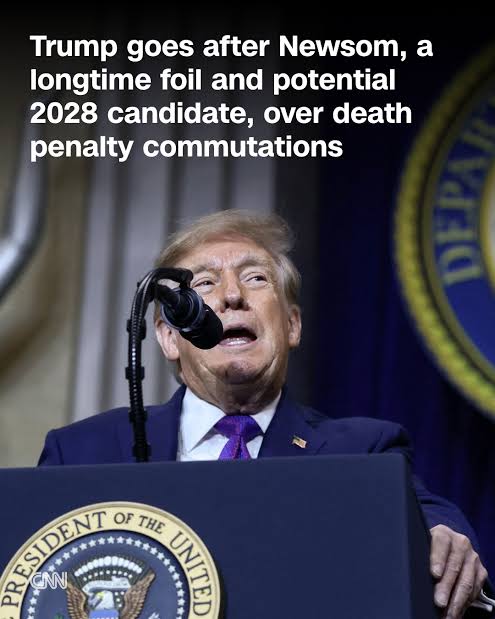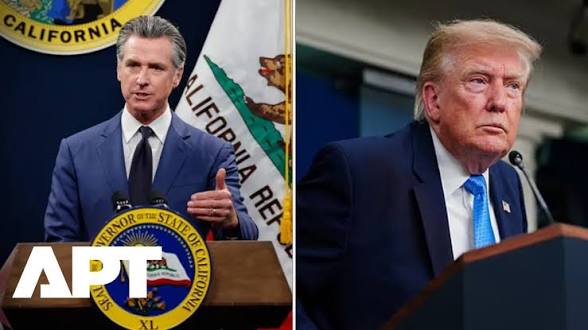
The political battle between California Governor Gavin Newsom and President Donald Trump has intensified following a major dispute over the future of capital punishment in the United States. Newsom has fired back at Trump after the president publicly condemned his decision to commute California’s death sentences.
The confrontation has placed the death penalty, presidential pardons and victims’ rights at the centre of a growing political controversy.
On November 23, 2026, Trump used an appearance at the Department of Justice to attack Newsom’s decision to commute the sentences of all 548 people currently on California’s death row. The president described the move as a shocking injustice and invited relatives of murder victims to share their objections.
Newsom responded with a sharp criticism of Trump’s own record of granting presidential clemency. He accused the president of helping wealthy political allies and convicted individuals escape financial accountability through pardons.
The exchange has created another major confrontation between two politicians who have repeatedly clashed over public safety, criminal justice and national politics.
Newsom-Trump Death Penalty Clash Intensifies

The latest Newsom-Trump death penalty clash began after the California governor announced his intention to commute every death sentence in the state to life imprisonment without the possibility of parole.
Newsom made the announcement on November 5, 2026. His decision reflects his long-standing opposition to capital punishment and his belief that the government should not carry out executions.
However, the announcement immediately attracted criticism from supporters of the death penalty.
Trump joined that criticism on November 23, when he addressed the issue at the Department of Justice in Washington.
The president argued that Newsom’s decision showed insufficient concern for victims and their families. He also highlighted several notorious murder cases involving people on California’s death row.
Trump’s remarks were particularly focused on the suffering experienced by families whose relatives were murdered.
He argued that changing the sentences would undermine the justice they had spent years seeking.
Newsom, however, rejected the president’s criticism and defended his decision.
The governor maintained that commuting a death sentence does not mean releasing a convicted criminal. Every person affected by the proposed action would remain behind bars for life.
This distinction became central to Newsom’s response.
Why Gavin Newsom Wants to Commute California Death Sentences
Newsom’s decision is part of a broader effort to move California away from capital punishment.
The governor has opposed executions for years. Shortly after taking office in 2019, he established a moratorium on executions in the state.
California has not carried out an execution since January 17, 2006.
According to the governor’s office, 548 people currently remain under death sentences in California.
Many have spent decades waiting for their appeals and other legal proceedings to move forward.
Newsom argues that the state’s death penalty system is expensive, unequal and vulnerable to serious mistakes.
He also believes that government institutions should not impose irreversible punishment when the justice system can make errors.
In his November 5 open letter to Californians, Newsom explained that state-sanctioned executions conflict with his understanding of justice and human dignity.
His proposed action would replace death sentences with life imprisonment without the possibility of parole.
Importantly, the change would not erase convictions or release prisoners.
The individuals affected would continue serving their sentences in prison.
Newsom’s position is that society can hold people accountable for serious crimes without carrying out executions.
However, critics argue that this approach removes an important form of punishment for the most serious offences.
Trump Attacks Newsom Over 548 Death Row Prisoners
Trump’s criticism brought national attention to California’s decision.
During his November 23 appearance, the president described Newsom’s move as one of the most shocking acts of injustice in American history.
He also criticised the governor’s leadership and accused him of showing sympathy towards convicted murderers rather than victims.
The president referred to several high-profile criminal cases to demonstrate why he believed the death sentences should remain in place.
Among the cases discussed were those involving Charles Ng, Randy Kraft and Robert Boyd Rhoades.
Trump also invited victims’ relatives to speak about their experiences.
Their statements highlighted the emotional consequences of violent crime and the frustration some families feel about the proposed commutations.
For these families, a death sentence represents a form of accountability after years of suffering.
They argue that changing the punishment without meaningful consultation disregards the promises made by the justice system.
Trump used their concerns to strengthen his criticism of Newsom.
The president also suggested that California’s decision reflected a broader problem with Democratic criminal justice policies.
Newsom rejected that political argument and insisted that his administration was not excusing criminal behaviour.
Newsom Fires Back Over Trump’s Presidential Pardons
Newsom’s response quickly shifted the debate towards Trump’s use of presidential clemency.
In a statement released on November 23, the California governor said he would not accept lectures about accountability from a president who had used the pardon power to benefit wealthy friends and business associates.
Newsom argued that Trump’s clemency decisions had allowed certain convicted individuals to avoid financial obligations owed to victims.
He also highlighted the difference between changing a prisoner’s death sentence and eliminating financial penalties.
The governor’s office cited a report by Democrats on the House Judiciary Committee. According to the report, Trump’s clemency actions had eliminated approximately $1.7 billion in restitution and other financial obligations.
These obligations included money intended for crime victims and financial penalties that could support public programmes.
Newsom argued that victims deserve more than political speeches. They also need financial assistance, support services and meaningful accountability.
In a video response, he delivered another pointed criticism of the president.
He argued that wealthy people with political connections could receive mercy while poorer defendants faced harsher consequences.
The governor also recalled Trump’s 1989 involvement in the controversy surrounding the Central Park Five.
Five Black and Latino teenagers were wrongfully convicted in connection with the assault of a woman in New York’s Central Park. Their convictions were later vacated after evidence established their innocence.
Newsom used the case to question Trump’s historical support for capital punishment.
His argument was that an irreversible punishment carries serious risks when the justice system can make mistakes.
Understanding the Difference Between Pardons and Commutations
One important part of the Newsom-Trump death penalty clash is the difference between presidential pardons and sentence commutations.
Although both involve executive clemency, they do not have identical legal consequences.
A pardon generally provides forgiveness for a federal offence. Depending on its terms, it can restore certain legal rights and remove some consequences of a conviction.
However, a pardon does not necessarily erase the historical fact of a conviction.
A commutation, meanwhile, reduces or changes a person’s punishment.
It does not normally eliminate the underlying conviction.
This distinction matters because Newsom’s proposed action would not free California’s death row prisoners.
Instead, their death sentences would become life sentences without the possibility of parole.
They would remain incarcerated for the rest of their lives.
Trump’s presidential pardon authority applies to federal offences. It does not give him general authority to overturn state criminal convictions or directly control California’s sentencing decisions.
Similarly, Newsom’s clemency authority applies within California’s legal system.
This means the dispute involves two different levels of government and two separate exercises of executive power.
The political arguments may overlap, but their legal authority is not interchangeable.
Victims’ Families Remain Divided Over Newsom’s Decision
The reaction from victims’ families has become one of the most sensitive aspects of the controversy.
Some relatives strongly oppose Newsom’s decision.
They believe death sentences represent justice for victims of particularly brutal crimes. They also argue that families deserve to be consulted before major changes affect the punishment imposed on those responsible.
During Trump’s November 23 appearance, several relatives expressed their anger and disappointment.
Their statements demonstrated that the debate is not simply about political disagreements.
For families who have lost loved ones, the issue involves grief, justice and the long-term consequences of violent crime.
One of the cases highlighted involved Michael Lyons, who was kidnapped, tortured and murdered in 1996. His mother, Sandy Friend, spoke about the emotional impact of the proposed commutation.
Other relatives also described the lasting pain caused by the loss of family members.
However, not every victim’s family shares the same position.
Some survivors and relatives support Newsom’s approach. They believe the government should focus more resources on helping victims rather than maintaining an expensive execution system.
Newsom has acknowledged that families have different opinions.
His administration has argued that the decision does not minimise their suffering and that every affected prisoner will remain incarcerated for life.
The disagreement highlights a difficult question: how should the justice system balance victims’ expectations, public safety and the limits of government punishment?
Trump Moves to Expand Federal Use of the Death Penalty
Trump did not limit his criticism to Newsom.
During the Department of Justice appearance, the president also announced plans to strengthen the federal government’s use of capital punishment.
He said he would direct the Justice Department to seek the death penalty for certain cases involving the killing of children, as well as killings connected to rape and human trafficking.
He also announced plans to expedite federal death sentences.
The proposals reflect Trump’s long-standing support for capital punishment.
On his first day back in office in January 2025, he signed an executive order aimed at restoring and strengthening the federal death penalty.
That position contrasts sharply with Newsom’s effort to move California away from executions.
The two leaders therefore represent opposing approaches to criminal justice.
Trump argues that the death penalty provides an important punishment for the most serious crimes.
Newsom believes executions are incompatible with a fair and humane justice system.
The federal proposals could generate further legal and political debate, particularly over constitutional protections and the administration of capital punishment.
However, Trump’s federal policy announcements do not automatically reverse California’s state-level commutations.
Can Trump Legally Reverse Newsom’s Death Penalty Decision?
The legal authority behind the controversy is another important issue.
The United States has separate federal and state criminal justice systems.
The president has constitutional clemency powers relating to federal offences.
Governors, meanwhile, exercise clemency powers under their respective state constitutions.
Trump therefore does not possess a general presidential power to overturn a California governor’s state-level commutation decisions.
Newsom is relying on Article V, Section 8 of the California Constitution.
However, the process involves important legal requirements.
For prisoners convicted of multiple felonies, the California Constitution requires a recommendation from the California Supreme Court before the governor can grant clemency.
Newsom’s explanatory statement says that the court’s recommendation is required for 382 of the condemned individuals covered by the proposed action.
This means the process is not simply a matter of announcing a decision and immediately changing every sentence.
The relevant legal procedures must be followed.
Victims’ advocates have also raised objections and sought legal intervention.
Consequently, the final legal status of the proposed commutations remains an important part of the developing controversy.
The Political Consequences for Newsom and Trump
The Newsom-Trump death penalty clash could have consequences beyond California.
Newsom is widely viewed as a potential Democratic presidential contender for the 2028 election.
His decision may strengthen his reputation among voters who oppose capital punishment.
It could also appeal to progressive Democrats who want stronger criminal justice reforms.
However, the decision carries political risks.
Death penalty support remains significant among American voters, particularly among Republicans.
A July 2026 Pew Research Center survey cited by the San Francisco Chronicle found that approximately two-thirds of American adults supported capital punishment for people convicted of murder.
This suggests that Newsom’s position could face criticism from voters who prioritise tougher criminal penalties.
Trump, meanwhile, can use the controversy to strengthen his law-and-order message.
By appearing alongside victims’ families, he presented himself as an advocate for those demanding the strongest punishment.
The dispute also allows Trump to attack a prominent Democratic politician who may become a major opponent in the next presidential election.
Both leaders have an incentive to present their positions as a matter of justice and public safety.
Nevertheless, the political debate should not overshadow the legal questions or the concerns of victims’ families.
What Happens Next in the California Death Penalty Dispute?
The next stage will depend heavily on California’s legal process.
The California Supreme Court’s role will be particularly important for prisoners whose cases require a judicial recommendation.
Legal challenges could also influence the timing and implementation of the proposed action.
Meanwhile, victims’ families and advocacy organisations are likely to continue expressing their positions.
Some will demand that the death sentences remain unchanged.
Others will support Newsom’s effort to replace executions with life imprisonment.
Trump’s administration may continue promoting federal capital punishment policies, but those measures operate separately from California’s constitutional clemency process.
The dispute could therefore continue through legal proceedings, public statements and political campaigns.
For now, the central disagreement remains clear.
Trump believes Newsom has weakened justice by commuting the sentences of condemned prisoners.
Newsom argues that keeping those individuals imprisoned for life is accountability, while executing them is neither necessary nor consistent with his understanding of justice.
Conclusion: A Growing Battle Over Justice and Presidential Power
The Newsom-Trump death penalty clash has developed into a wider debate about punishment, executive authority and the meaning of justice in America.
Trump has condemned the California governor for seeking to commute 548 death sentences. Newsom has responded by questioning the president’s own record of granting pardons and eliminating financial obligations owed by convicted individuals.
Both leaders have attempted to frame the controversy around accountability and victims’ rights.
However, the disagreement also exposes deep divisions over capital punishment.
For supporters of the death penalty, executions remain an essential form of justice for the most serious crimes. For opponents, the possibility of wrongful convictions and the irreversible nature of executions make capital punishment unacceptable.
The legal process in California will determine how Newsom’s proposed action proceeds.
At the same time, the political confrontation is likely to remain part of the national debate as the country approaches the 2028 presidential election.
Ultimately, the question is bigger than the rivalry between two politicians: should the government have the power to take a convicted person’s life, or should permanent imprisonment be the ultimate punishment?
The answer continues to divide America.
About the Author