The political landscape in the United States is facing another major test following the November 2026 midterm elections. New polling figures reveal widespread dissatisfaction with the country’s political leadership, raising questions about President Donald Trump’s standing and the future direction of both major parties.
A particularly striking figure is Trump’s 38% approval rating in an October NPR/PBS News/Marist poll of registered voters. The survey found that 61% disapproved of his performance, leaving the president with a substantial approval gap.
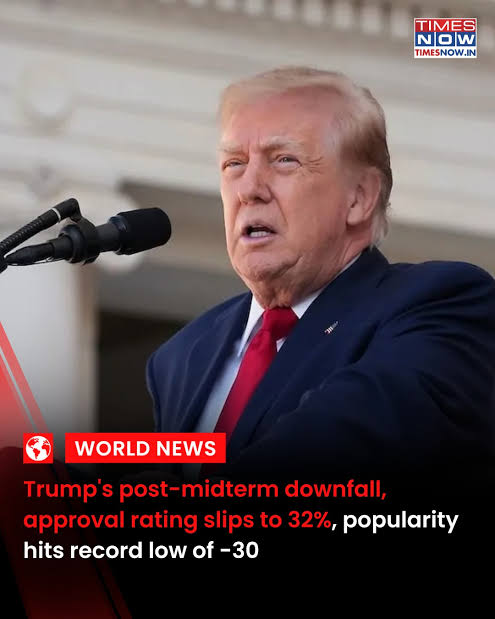
However, other surveys conducted around the midterm elections have reported different figures. A Reuters/Ipsos poll published on November 16 placed Trump’s approval at just 32%. Meanwhile, a polling average showed approximately 39% approval.
These differences highlight an important reality: presidential approval can vary depending on the polling organization, survey dates and respondents.
The broader political message is equally significant. Voters are expressing frustration with economic conditions, political leadership and the ability of either party to address everyday problems.
The latest polling therefore presents challenges not only for Trump and Republicans but also for Democrats as they prepare to take control of Congress.
The central question is whether the post-midterm political environment represents a temporary backlash or a deeper loss of confidence in America’s political institutions.
1. Trump’s 38% Approval Rating Raises Political Questions
President Donald Trump is facing growing scrutiny as polling continues to show significant dissatisfaction among American voters.
The NPR/PBS News/Marist survey conducted on October 19–20, 2026, found that 38% of registered voters approved of Trump’s performance. Meanwhile, 61% disapproved.
The results also revealed a substantial divide between political groups.
82% of Republican voters approved of Trump.
17% of Republicans disapproved.
30% of independent voters approved.
67% of independent voters disapproved.
Only 4% of Democratic voters approved.
96% of Democratic voters disapproved.
These figures demonstrate how strongly political identity continues to influence presidential approval.
However, the independent voter numbers deserve particular attention. Independents often play an important role in determining election outcomes, especially in competitive congressional districts and closely contested states.
When nearly two-thirds of independent voters express disapproval, it creates a difficult political environment for the president.
The findings also suggest that strong support within the Republican Party does not necessarily translate into broader national approval.
Source: NPR/PBS News/Marist polling tables.
2. November Polling Shows Trump’s Approval Under Further Pressure
The October 38% figure is not the only important measure of Trump’s political standing.
A Reuters/Ipsos poll published on November 16 found that only 32% of Americans approved of Trump’s performance. The figure remained close to the lowest level recorded during his second presidency.
The survey also found that approval had remained around this level across four consecutive Reuters/Ipsos polls.
The poll surveyed 1,521 American adults and reported a margin of error of approximately three percentage points.
Several issues appear to be contributing to the president’s declining numbers.
These include:
Rising household expenses.
Higher fuel prices.
Concerns about foreign policy.
Disagreement over military involvement in Iran.
Frustration with political leadership.
The Reuters/Ipsos survey also found that only 31% of respondents supported the US war with Iran.
This suggests that foreign policy decisions may be creating additional difficulties for the administration.
The November figures are particularly important because they arrived shortly after the November 3 midterm elections. They provide an early indication of the political atmosphere following the election results.
Reuters+1
3. Voter Disapproval Is Not Limited to Republicans
One of the most interesting aspects of the current political environment is that dissatisfaction extends beyond the Republican Party.
Although Trump faces criticism from voters, Democrats are also dealing with questions about their leadership, public image and ability to deliver meaningful political change.
The midterm results gave Democrats control of both chambers of Congress, creating an opportunity to challenge the president’s agenda.
However, winning elections does not automatically guarantee public confidence.
Voters increasingly expect political leaders to deliver practical solutions rather than simply criticize their opponents.
Economic security, healthcare costs, employment opportunities, immigration and national security remain important concerns.
Democrats therefore face a difficult challenge.
They must demonstrate that their congressional victories can produce meaningful improvements in people’s lives.
At the same time, Republicans must understand why voters who previously supported their agenda have become increasingly dissatisfied.
This creates a political environment in which neither party can assume that public support will remain stable.
4. Democrats Face Their Own Leadership Challenges
Although Democrats benefited from the November midterm results, their leadership is not immune to criticism.
Recent polling has highlighted concerns about the popularity of prominent Democratic figures.
A November 16 Reuters/Ipsos survey found that Senate Democratic leader Chuck Schumer had a more negative than positive image among Democratic respondents.
According to the survey:
34% of Democrats viewed Schumer favorably.
43% viewed him unfavorably.
22% said they had never heard of him.
These findings indicate that dissatisfaction exists within the Democratic Party itself.
Meanwhile, House Democratic leader Hakeem Jeffries received relatively stronger numbers among Democratic respondents.
Approximately 40% viewed Jeffries favorably, compared with 29% who viewed him unfavorably.
The contrast suggests that Democratic voters may be more comfortable with some leaders than others.
It also highlights a potential challenge for the party as it prepares to exercise greater congressional power.
Democrats will need to maintain unity while responding to different expectations among progressives, moderates and independent voters.
If disagreements become more visible, the party could struggle to maintain the political momentum created by its midterm victories.
Reuters+1
5. The Economy Remains a Major Concern for American Voters
Economic dissatisfaction is one of the most important factors shaping the latest polling environment.
For many households, political decisions are closely connected to everyday financial pressures.
Families are concerned about grocery bills, housing expenses, electricity costs, healthcare and transportation.
When these expenses increase, voters often become more critical of the government.
This creates a challenge for any administration, regardless of its political affiliation.
The Trump administration has faced particular scrutiny over its economic performance and the cost of living.
Earlier Washington Post-ABC News-Ipsos polling in October found that 33% of Americans approved of Trump’s performance, while 66% disapproved.
Among likely voters, approval stood at 38%, compared with 62% disapproval.
The same survey highlighted substantial dissatisfaction with Trump’s handling of inflation and the cost of living.
Economic concerns also influenced voters’ preferences regarding congressional control.
The survey found that 58% of registered voters preferred a Democratic-led Congress acting as a check on Trump, while 39% preferred a Republican-led Congress supporting his agenda.
These findings demonstrate how economic frustration can influence broader political preferences.
For Democrats, the challenge is to turn economic criticism into credible policy proposals.
For Republicans, restoring confidence will require convincing voters that their policies can improve household finances.
The Washington Post+1
6. Independent Voters Could Become the Biggest Political Battleground
Independent voters may become one of the most important groups in the next phase of American politics.
Unlike strongly committed Democrats and Republicans, independent voters are often more willing to change their political preferences.
Their decisions can influence close elections, particularly in competitive states and congressional districts.
The October NPR/PBS News/Marist survey found that 67% of independent voters disapproved of Trump’s performance, while 30% approved.
This result suggests that the president faces a significant challenge outside his traditional political base.
However, independent voters are not automatically Democratic supporters.
Many independents are dissatisfied with both parties and may reject candidates who focus primarily on political conflict.
Their priorities often include:
Affordable housing and everyday living costs.
Reliable employment opportunities.
Lower healthcare expenses.
Government accountability.
Immigration and border security.
National security and foreign policy.
Both parties will need to address these concerns if they want to attract independent voters.
The party that offers practical solutions rather than simply attacking its opponents could gain an important advantage in future elections.
7. The November 2026 Midterms Changed Washington’s Political Balance
The November 3 midterm elections marked an important moment for American politics.
Democrats secured control of both chambers of Congress, creating a new political reality for the Trump administration.
The election results also demonstrated that presidential popularity can influence congressional contests.
Historically, midterm elections often serve as a public assessment of the president’s performance.
Voters who are unhappy with the administration may use congressional elections to create a political check on the White House.
That dynamic appears particularly relevant in 2026.
According to Change Research’s November 5 analysis, Trump’s net approval rating had fallen substantially during the period leading up to the election.
Its October 12–18 Compass Poll found that 37% of registered voters approved of his performance, while 62% disapproved.
The same analysis reported that Democrats had developed an 11-point advantage on the generic congressional ballot in the final polling period.
These figures provide important context for understanding the election outcome.
However, the results do not necessarily mean that all voters have permanently abandoned Republicans.
Political preferences can change quickly, particularly when economic conditions, foreign policy developments or congressional performance shift.
The midterm results have nevertheless created new pressure on the administration.
Change Research+1
8. Republicans Must Rebuild Confidence Beyond Their Core Supporters
For Republicans, the latest polling presents a serious political warning.
The October Marist survey showed that 82% of Republican voters approved of Trump.
That is a strong figure within the party.
However, support among Republicans alone cannot determine national political success.
The president must also consider the concerns of independents and voters who supported him previously but are now questioning his performance.
Republicans face several important challenges.
First, economic confidence must improve.
Voters want to see tangible progress on inflation, energy prices and household expenses.
Second, the administration must address foreign policy concerns.
Military decisions and international tensions can influence public confidence, particularly when they affect fuel prices and national security.
Third, Republicans must respond to their midterm losses.
The party will need to evaluate its campaign strategy, voter outreach and legislative priorities.
Finally, Republican lawmakers must maintain party unity.
Differences between congressional Republicans and the White House could complicate efforts to present a consistent political message.
The coming months will show whether Republicans can respond effectively to these challenges.
9. Democrats Also Face Pressure to Deliver Results
Democrats enter the post-midterm period with a significant advantage in Congress.
However, their victory also creates greater expectations.
Voters who supported Democratic candidates may expect action on the issues that influenced their decisions.
These include the economy, healthcare, government accountability and the cost of living.
Democratic leaders will also have to manage disagreements within their party.
Progressive lawmakers may demand more ambitious policy changes, while moderate Democrats could prioritize bipartisan agreements.
This balancing act will be particularly important in a politically divided country.
If Democrats focus entirely on opposing Trump, they risk disappointing voters who expect concrete results.
The party must demonstrate that it can govern effectively and communicate its priorities clearly.
Its performance in Congress could influence public opinion well before the next presidential election.
10. Why the 38% Approval Figure Matters
A presidential approval rating is more than a simple popularity measurement.
It provides an indication of how Americans evaluate the president’s performance at a particular moment.
A 38% approval rating, accompanied by 61% disapproval in the October Marist survey, suggests that negative opinions substantially outweighed positive ones.
However, polling figures should always be interpreted carefully.
Different surveys use different methodologies, sample populations and question wording.
For example, an approval rating measures how respondents assess a president’s job performance. A favorable rating measures their overall opinion of that person.
These measurements are related but are not interchangeable.
Similarly, registered voters and all American adults represent different survey populations.
This explains why Trump’s numbers can vary between 30%, 32%, 38% and 39% across different polls and averages.
The important finding is not that every survey produces exactly the same result.
Rather, several major surveys have identified substantial dissatisfaction with the president.
That pattern deserves attention from both political parties.
11. What the Latest Polling Means for Trump’s Political Future
The latest polling could have important implications for Trump’s remaining time in office.
Although the next presidential election is still ahead, declining approval can affect the administration’s ability to influence Congress, negotiate with lawmakers and build public support for major policies.
A president with strong approval ratings generally has greater political flexibility.
However, a president facing widespread disapproval may encounter resistance from lawmakers, including members of his own party.
Republicans who represent competitive districts may become more cautious about supporting controversial administration proposals.
Democrats, meanwhile, may use their congressional majority to investigate administration decisions, challenge legislation and promote alternative policies.
Trump’s relationship with congressional Republicans will therefore become increasingly important.
His ability to maintain party unity could determine how effectively the administration responds to the new political balance.
The president also has an opportunity to change public perceptions.
Improvements in the economy, progress on foreign policy and greater attention to household concerns could help rebuild confidence.
Nevertheless, the latest polling suggests that restoring public support will require more than political messaging.
Voters will want to see measurable results.
12. Will Voter Dissatisfaction Continue Into 2027?
The political consequences of the November midterms will become clearer during 2027.
Several developments could influence public opinion over the coming months.
Economic performance: Changes in inflation, fuel prices, wages and employment could influence how voters assess the administration.
Congressional performance: Democrats will face pressure to demonstrate that their newly gained power can produce meaningful results.
Foreign policy: International conflicts and military decisions could continue to shape presidential approval.
Political investigations: Disputes between Congress and the White House could create additional political tensions.
Party leadership: Both Republicans and Democrats may face internal debates over their future political strategies.
These factors will help determine whether current dissatisfaction becomes a lasting political trend.
There is also a possibility that voter attitudes could shift if economic conditions improve or political leaders reach agreements on important national issues.
For now, the polling provides an important warning to both parties.
Americans are evaluating political leaders based on their performance, not simply their party affiliation.
Conclusion: Trump’s 38% Polling Figure Highlights a Wider Political Challenge
The latest post-midterm polling presents a challenging picture for President Donald Trump and the broader American political establishment.
The October NPR/PBS News/Marist survey placed Trump’s approval rating at 38%, with 61% disapproving. Subsequent November polling, including the Reuters/Ipsos survey, showed that his approval had fallen further in some measurements.
At the same time, Democrats face their own leadership challenges despite gaining control of Congress.
Negative opinions about prominent political figures, economic frustration and concerns about government performance suggest that voter dissatisfaction extends across party lines.
For Republicans, the priority will be rebuilding confidence among independent voters and addressing concerns about the economy and foreign policy.
For Democrats, the challenge will be turning their midterm victory into effective governance.
Ultimately, the latest numbers highlight a larger problem in American politics: voters want results, accountability and leadership that addresses their everyday concerns.
The months ahead will reveal whether either party can meet those expectations.
Frequently Asked Questions (FAQs)
1. What is Trump’s approval rating after the 2026 midterm elections?
An October 19–20 NPR/PBS News/Marist poll found that 38% of registered voters approved of Trump’s performance, while 61% disapproved. A November 16 Reuters/Ipsos poll subsequently reported 32% approval.
2. Why is Trump’s approval rating declining?
Several factors may be contributing to his declining approval, including economic concerns, rising fuel prices, foreign policy disagreements and dissatisfaction with government performance.
3. How many Americans disapprove of Trump?
The NPR/PBS News/Marist October survey found that 61% of registered voters disapproved of Trump’s performance. Other November surveys reported different disapproval figures.
4. Are independent voters turning against Trump?
The October Marist survey found that 67% of independent voters disapproved of Trump, compared with 30% who approved. This suggests significant dissatisfaction among independent voters.
5. Are Democrats also facing declining public confidence?
Yes. Democratic leaders have faced criticism over their leadership and political direction. A November Reuters/Ipsos survey found that 43% of Democratic respondents viewed Chuck Schumer unfavorably, compared with 34% who viewed him favorably.
6. Did Democrats win the 2026 midterm elections?
Yes. According to Change Research’s November 5 analysis, Democrats won control of both the House and Senate in the November 3 elections.
7. Why are voters unhappy with both political parties?
Voter dissatisfaction reflects several concerns, including living costs, economic uncertainty, political divisions, leadership disputes and concerns about government accountability.
8. How could Trump’s approval rating affect Republicans?
Low presidential approval can make congressional campaigns more difficult, particularly in competitive districts. Republican lawmakers may also face pressure to distance themselves from unpopular policies.
9. What challenges do Democrats face after the midterms?
Democrats must maintain party unity, address economic concerns, manage leadership disagreements and demonstrate that their congressional majority can deliver meaningful results.
10. Could Trump’s approval rating improve in 2027?
Yes. Presidential approval can change as economic conditions, public policies and international developments evolve. Improvements in household finances and foreign policy could help restore public confidence.
About the Author