The Ilhan Omar probe is attracting renewed national attention as federal investigators continue examining the Minnesota congresswoman’s immigration history and financial background. The investigation has become a major political talking point in Washington, particularly after federal agents searched Omar’s Washington, D.C., residence in October.
Legal commentator Jonathan Turley has also weighed in on the controversy, discussing the growing scrutiny surrounding the Democratic representative. His comments have added another dimension to an investigation that is generating questions about federal law enforcement, political accountability and the limits of government authority.
The investigation has attracted attention from both Republicans and Democrats. Supporters of the inquiry argue that allegations involving immigration documents deserve proper examination. Meanwhile, Omar and her political allies have questioned the timing and motivation behind the federal action.
However, an important distinction remains: an investigation does not establish criminal wrongdoing. Omar has denied the allegations, and no criminal charges against her had been publicly announced as of November 19, 2026.
Ilhan Omar Probe Draws Renewed National Attention

The federal investigation involving Ilhan Omar has developed into one of the most closely watched political and legal stories in Washington.
Federal agents searched Omar’s Washington residence on October 12, 2026. The operation was conducted by Homeland Security Investigations under a judicially authorised search warrant connected to an ongoing federal criminal investigation.
According to reporting by the Associated Press, investigators are examining potential fraud involving immigration paperwork connected to Omar’s family.
The search reportedly resulted in the seizure of electronic devices, notebooks and other personal items. Omar said that agents took 17 items from the property.
The operation immediately attracted political attention because Omar is a sitting member of Congress and a prominent critic of President Donald Trump.
The timing also raised questions. The search happened less than a month before the November 3 midterm elections, in which Omar was seeking another term in the House of Representatives.
Despite the controversy, Omar won reelection and secured her fifth congressional term.
The investigation, however, did not end with the election. Federal authorities have continued examining evidence, while legal proceedings surrounding the search warrant have created another public dispute.
Jonathan Turley Weighs In on the Growing Investigation
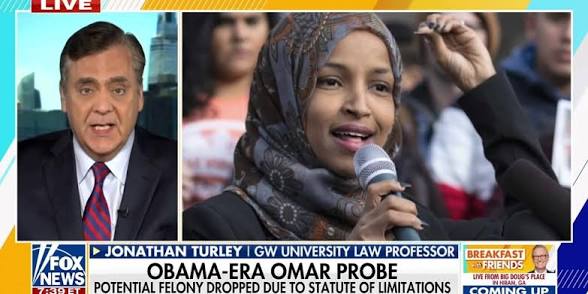
Jonathan Turley, a legal commentator and law professor, has discussed the investigation into Omar during appearances on Fox News.
In an October 30 segment, Turley examined the renewed federal scrutiny surrounding the congresswoman and the allegations involving her immigration history.
His appearance came as the investigation was receiving increasing national coverage.
The discussion highlighted several important questions: What evidence are investigators examining? Could the inquiry lead to criminal charges? And how might the investigation affect the political environment surrounding Omar?
Turley’s commentary has helped bring legal analysis into a debate that is frequently dominated by partisan arguments.
The suggestion that the investigation is snowballing reflects the growing number of developments surrounding the case. These include the October search, reported grand jury activity, subpoenas involving family members and disputes over access to court records.
However, Turley’s commentary should be distinguished from official investigative findings. His television analysis does not establish that Omar committed a crime or that prosecutors have reached a charging decision.
What Are Federal Investigators Examining?
The central focus of the reported investigation involves questions about immigration records and information submitted by Omar or members of her family during their immigration process.
According to reporting by The Washington Post, investigators have examined allegations concerning historical birth-date information, citizenship documents and possible inaccuracies in immigration paperwork.
The allegations have circulated publicly for years. Omar has repeatedly rejected claims of immigration fraud and disputed accusations concerning her previous marriage.
The investigation reportedly includes questions about whether information provided decades ago was accurate.
These questions are particularly complicated because the underlying events date back many years.
Investigators may need to establish several things before prosecutors could consider criminal charges:
- Whether specific information in immigration documents was inaccurate.
- Whether any inaccuracies were intentional.
- Whether the relevant individuals knew the information was false.
- Whether the alleged conduct violated federal law.
- Whether sufficient admissible evidence exists to support prosecution.
Simply identifying an inconsistency in an old document would not automatically establish criminal fraud.
Prosecutors would need evidence addressing the relevant legal requirements, including intent where required.
The investigation’s precise scope also remains partly confidential because important court documents are still sealed.
October Search of Omar’s Washington Home
The October 12 search marked a significant development in the federal inquiry.
Homeland Security Investigations agents executed a judicially authorised warrant at Omar’s Washington residence.
The Department of Justice described the operation as part of an ongoing federal criminal investigation.
According to the Associated Press, investigators seized several items, including phones, notebooks and other personal belongings.
Omar publicly criticised the operation and accused the Trump administration of using federal law enforcement against a political opponent.
Her office has argued that the investigation is politically motivated.
The administration, meanwhile, has maintained that the search was authorised by a judge and connected to a legitimate criminal investigation.
Homeland Security Secretary Markwayne Mullin previously described the investigation as a strong case during an October interview. He also indicated that agents had executed multiple search warrants.
These developments suggest that investigators are examining more than a single document or isolated allegation.
Nevertheless, the government has not publicly disclosed all the evidence supporting its investigation.
That lack of information has made it difficult for outside observers to assess the strength of the case independently.
Federal Grand Jury Activity Adds Another Dimension
Another important development involves reported grand jury activity in Washington, D.C.
The Minnesota Star Tribune reported on November 16 that a federal grand jury in Washington has been hearing evidence connected to the investigation.
Some individuals familiar with the inquiry have indicated that investigators are examining Omar’s immigration history and financial matters involving her and her husband, Tim Mynett.
The report also highlighted an important distinction between earlier investigations and the current federal inquiry.
According to the Star Tribune, Minnesota federal prosecutors previously investigated allegations involving Omar during Trump’s first administration. That earlier inquiry ended without charges after prosecutors determined that the applicable legal deadline had expired.
The current investigation is being handled in Washington, without the participation of Minnesota federal prosecutors.
This development has raised questions about why the Justice Department is pursuing the matter through a different office and whether investigators have uncovered new evidence.
However, the existence of grand jury proceedings does not mean that prosecutors have decided to bring charges.
Grand juries examine evidence and can determine whether an indictment is justified. Their proceedings are generally confidential.
For now, the investigation remains ongoing.
Judge Considers Public Access to Investigation Records
The legal battle over access to court records has become another major part of the Ilhan Omar controversy.
More than a dozen news organisations, including The Associated Press, have asked a federal court to release records connected to the October search.
The media organisations argue that the public has a First Amendment interest in understanding why federal agents searched the home of a sitting member of Congress.
The Justice Department has opposed releasing the complete search-warrant affidavit while the investigation remains active.
On November 17, Chief Judge James Boasberg heard arguments concerning the request.
According to the Associated Press, the judge agreed that releasing the 67-page search-warrant affidavit at this stage could expose sensitive investigative information.
The document contains details concerning witnesses and other aspects of the investigation.
However, Boasberg indicated that other sealed court filings could potentially be released in redacted form.
The government was given until November 20 to propose redactions to certain records. The judge said some documents could become available as early as November 23.
This decision could provide the public with additional information without revealing everything investigators are currently examining.
The dispute highlights the tension between transparency and protecting an active criminal investigation.
For journalists and members of Congress, access to these records is important because the case involves a high-profile elected official.
For prosecutors, protecting witnesses and investigative methods may be necessary to preserve the integrity of the inquiry.
Previous Investigations Complicate the Current Case
The current investigation is not the first time Omar has faced scrutiny over allegations involving her immigration history.
The Minnesota Star Tribune reported that federal inquiries into Omar date back to at least 2016.
One earlier investigation examined allegations concerning her marriage history and immigration records.
The newspaper reported that prosecutors in Minnesota eventually closed a Trump-era inquiry without filing charges after determining that the relevant statute of limitations had expired.
Other previous reviews also reportedly examined similar allegations.
The history of these investigations raises an important legal question: Can federal authorities successfully pursue allegations involving events that happened decades ago?
The answer depends on the specific conduct under investigation, the applicable federal statutes and the relevant limitation periods.
Different offences can have different deadlines. Certain legal circumstances may also affect how those deadlines apply.
Therefore, the existence of an earlier investigation does not automatically prevent a new investigation.
At the same time, investigators must establish a legally viable case. Reopening an allegation does not remove the government’s responsibility to prove every required element.
This is one reason the current investigation is receiving close attention from legal experts.
Ilhan Omar Rejects Allegations of Wrongdoing
Omar has strongly rejected allegations involving her immigration history and previous marriage.
She has described the investigation as politically motivated and accused the administration of weaponising federal law enforcement.
Her criticism is connected to a longer political conflict with Trump and his allies.
Omar has frequently criticised the president’s immigration policies, foreign policy positions and political rhetoric.
Trump and Republican officials have also repeatedly targeted the congresswoman in public statements.
This political background has contributed to concerns about whether the investigation is being conducted independently.
Omar’s supporters argue that elected officials should not face unusual investigative pressure because of their political positions.
Republican supporters of the inquiry counter that public officials should not receive special treatment when credible allegations require examination.
Both arguments raise important questions about accountability and equal treatment under federal law.
Ultimately, the evidence and legal process must determine whether any criminal offence occurred.
Political disagreements cannot substitute for proof in a criminal case.
Political Consequences Could Extend Beyond Minnesota
The investigation could have political consequences beyond Omar’s congressional district.
Omar is an influential progressive Democrat and a prominent member of the House of Representatives.
Her reelection victory on November 3 demonstrated that the investigation did not prevent her from securing another term.
However, continued federal scrutiny could create challenges for her political position.
Republicans may use the investigation to question Democratic leadership and highlight concerns about immigration enforcement.
Democrats, meanwhile, may point to the case as an example of the dangers of politicising federal institutions.
The controversy could also become part of wider congressional debates about the independence of the Justice Department.
Lawmakers may seek additional information about how the investigation began, what evidence supports the search warrant and whether established investigative procedures were followed.
The issue could become particularly important if prosecutors eventually announce charges or if additional court records become public.
For now, neither political side has a complete picture of the government’s evidence.
Could the Investigation Lead to Criminal Charges?
One of the biggest questions surrounding the Ilhan Omar probe is whether federal prosecutors will eventually bring criminal charges.
At this stage, there is no publicly confirmed charging decision.
Investigators reportedly continue reviewing materials seized during the October search and examining information obtained through other investigative steps.
Before filing charges, prosecutors generally need to establish that sufficient evidence supports each element of a specific criminal offence.
That process may involve:
- Reviewing immigration records and historical documents.
- Examining electronic evidence obtained through authorised searches.
- Interviewing witnesses and evaluating their statements.
- Reviewing evidence presented to a grand jury.
- Assessing applicable statutes of limitations.
- Determining whether prosecution is legally justified.
Even when investigators believe they have identified suspicious conduct, prosecutors must consider whether the evidence can support a case in court.
Omar would also retain the right to challenge the government’s allegations through the judicial process.
An investigation can end without charges. It can also continue for months while investigators gather and examine evidence.
Consequently, predictions about the final outcome should be treated cautiously.
Why the Ilhan Omar Probe Matters Nationally
The investigation has implications beyond one congressional representative.
First, it raises questions about how federal authorities investigate allegations involving prominent political figures.
Second, it highlights the challenges of examining immigration records that may be several decades old.
Third, it raises questions about transparency when search warrants involve elected officials.
Finally, it places renewed attention on the relationship between federal law enforcement and political independence.
The Justice Department must be able to investigate credible allegations regardless of an individual’s political position.
At the same time, the government must protect constitutional rights and avoid using criminal investigations as political instruments.
Maintaining public confidence requires both accountability and fairness.
The case also demonstrates why public reporting must distinguish between allegations, investigative actions and proven criminal conduct.
A search warrant is not a conviction. A grand jury investigation is not proof of guilt. And political commentary cannot replace evidence tested through the legal system.
What Happens Next in the Ilhan Omar Investigation?
The coming weeks could provide important developments.
The first major issue is the potential release of redacted court filings. These documents may offer additional information about the legal basis for the October search.
The second is the continuing examination of evidence collected by federal investigators.
The third is the possibility of further grand jury proceedings or additional investigative steps.
The Justice Department has not publicly provided a complete explanation of the investigation’s scope.
Omar’s legal and political responses are also likely to remain central to the story.
Jonathan Turley’s commentary has helped highlight the growing attention surrounding the investigation, but the ultimate outcome will depend on the evidence and decisions made by federal prosecutors and the courts.
For now, the case remains unresolved.
Conclusion: Ilhan Omar Probe Faces Critical Legal Questions
The Ilhan Omar probe has become a significant political and legal controversy following the October search of her Washington home and reports of continuing federal investigative activity.
Jonathan Turley’s commentary has brought additional attention to the case as questions surrounding Omar’s immigration history, financial background and previous investigations continue to generate debate.
The reported grand jury activity and upcoming court-record decisions could provide further insight into the investigation.
However, the most important question remains unanswered: whether federal prosecutors have enough legally admissible evidence to pursue criminal charges.
Omar denies wrongdoing, and an investigation alone does not establish guilt.
As the legal process continues, the public will be watching for new court filings, official statements and any decision from federal prosecutors.
About the Author