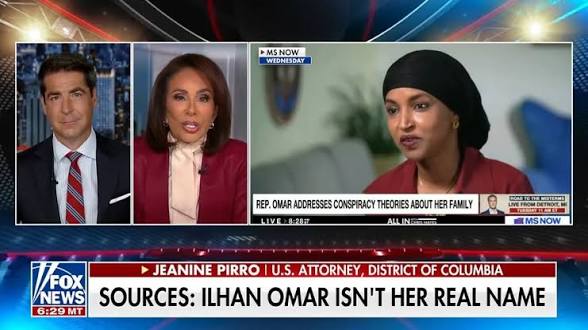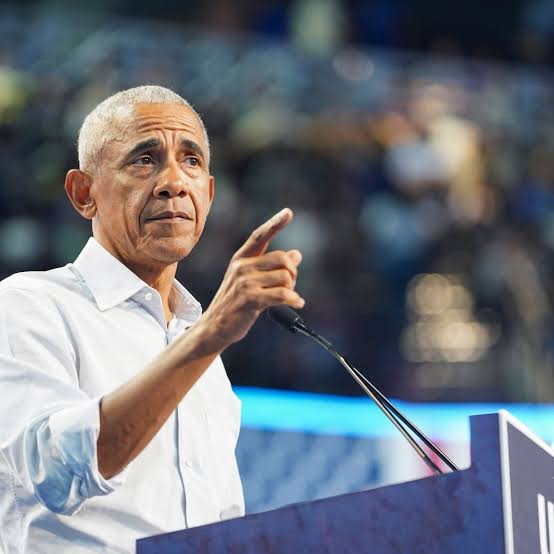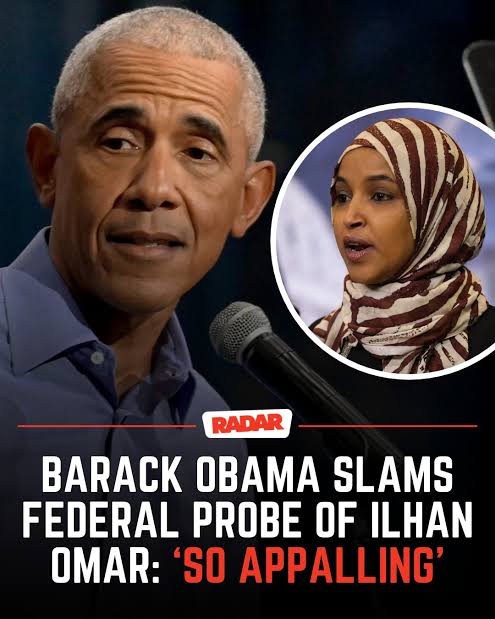
Former President Barack Obama has strongly condemned the federal investigation into Democratic Congresswoman Ilhan Omar, describing the probe as “appalling” and warning that the government must not use its authority to intimidate elected officials.
Obama’s criticism comes after federal agents searched Omar’s Washington, D.C., residence on October 12, 2026. The investigation reportedly concerns allegations involving her immigration paperwork and citizenship status. Omar has denied wrongdoing and accused the Trump administration of targeting her because of her political views.
The controversy has quickly become a major political dispute, raising questions about the independence of federal law enforcement, the treatment of political opponents, and the rights of elected representatives.
Obama’s intervention has added a powerful voice to the debate. His remarks also highlight a broader concern: whether government investigations can be conducted fairly when the subject is a prominent critic of the president.
As the investigation continues, the public is waiting for clear answers about the allegations, the evidence, and the legal basis for the federal government’s actions.
Obama condemns the investigation into Ilhan Omar
On October 18, Obama publicly criticized the investigation into Omar, arguing that the federal government was using its authority against an elected official who had challenged President Donald Trump.
In a statement shared on social media, Obama said the government was bringing its full weight against a law-abiding representative because she had dared to criticize the president.
He described the investigation as appalling and warned that such conduct should concern Americans regardless of their political beliefs.
Obama’s central argument was that government institutions must remain independent of political disputes. He suggested that allowing federal agencies to target political opponents could establish a dangerous precedent for future administrations.
The former president also questioned the justification for the investigation, arguing that the allegations did not establish a legitimate basis for the government’s actions.
His criticism was directed at the administration’s conduct, rather than a general rejection of criminal investigations involving elected officials.
The distinction is important. Obama did not argue that members of Congress should be exempt from the law. Instead, he questioned whether the investigation was being pursued fairly and without political interference.
His remarks were reported by several major news organizations, including the BBC and The Washington Post.
BBC+1
What triggered the federal investigation?
The controversy intensified after federal agents searched Omar’s Washington residence in the early hours of October 12.
The search was conducted by Homeland Security Investigations under a judicially authorized warrant obtained through the Justice Department.
Authorities have not publicly disclosed the full scope of the investigation. However, reports indicate that investigators are examining whether Omar or members of her family provided false information on immigration documents.
The inquiry reportedly focuses on events dating back several decades, when Omar and her family arrived in the United States as refugees from Somalia.
Omar has repeatedly rejected allegations concerning her immigration history. She has said she arrived in the United States in 1995 and became a naturalized citizen in 2000.
According to Reuters, investigators are examining possible false statements and immigration fraud connected to her family’s immigration records. The report also said authorities seized Omar’s phone and issued subpoenas as part of the inquiry.
Reuters+1
The Justice Department has not announced criminal charges against Omar.
That distinction remains essential. An investigation, a search warrant, or the collection of evidence does not establish that a person has committed a crime.
The allegations remain unproven, and Omar retains the right to challenge the investigation through the legal system.
Why the timing of the search has raised concerns
The timing of the search has become a major part of the political controversy.
Federal agents searched Omar’s home less than a month before the November 3 midterm elections. Omar is seeking reelection to represent Minnesota’s Fifth Congressional District.
The Justice Department has historically sought to avoid conspicuous investigative actions that could influence an election. Its longstanding practice is particularly relevant when an investigation involves a political candidate close to voting day.
However, the policy does not automatically prohibit every investigative action during an election period.
The central question is whether the search was necessary, properly authorized, and conducted without political considerations.
Omar’s supporters argue that the timing raises serious questions about the administration’s intentions.
Republican critics, meanwhile, argue that public officials should not receive special treatment simply because they are running for office.
The legal distinction is that an investigation must be justified by evidence and lawful procedures, not by the political identity of the person under investigation.
Reuters reported that the search appeared to depart from the Justice Department’s historical practice of avoiding investigative steps likely to become public close to an election.
Investing.com+1
The timing has therefore become a central issue in the debate over whether the investigation represents legitimate law enforcement or political intimidation.
Obama’s warning about political intimidation
Obama’s criticism goes beyond the allegations against Omar.
His statement raises a broader question about the relationship between political power and federal law enforcement.
In a democracy, government institutions are expected to apply the law consistently. They should not punish people for criticizing the president or supporting an opposing political party.
Obama warned that allowing an administration to use its authority against a political opponent could have consequences beyond one investigation.
He argued that such actions could establish a precedent that future presidents might use against their own critics.
This concern is especially significant because the Justice Department has substantial investigative powers.
Federal investigators can obtain search warrants, issue subpoenas, collect evidence, and pursue criminal charges when the legal requirements are met.
Those powers are necessary to enforce the law. However, they also require strong safeguards against political interference.
Obama’s argument is that the public must be able to trust those safeguards.
If an investigation is perceived as politically motivated, confidence in federal institutions can weaken even before a court reaches a decision.
The former president’s remarks also reflect a broader democratic principle: political disagreement should not become a reason for government retaliation.
The Trump administration’s response
The Trump administration has rejected claims that the investigation is politically motivated.
The White House defended the inquiry by saying the Justice Department was focused on restoring law and order.
Officials have also argued that the law must apply equally to elected representatives and ordinary citizens.
President Trump has publicly criticized Omar and her political positions. However, he said the search of her residence had nothing to do with him and that the matter was for the Justice Department to handle.
That response has not ended the political dispute.
Critics argue that Trump’s repeated attacks on Omar create an appearance of political pressure surrounding the investigation.
Supporters of the administration maintain that the existence of political disagreement does not prevent federal investigators from examining possible criminal conduct.
Both arguments point to the same underlying issue: whether the investigation can be shown to rest on evidence rather than political considerations.
The Justice Department’s handling of the case will therefore remain under close scrutiny.
Its decisions about evidence, charging standards, and public disclosures could shape how the public evaluates the investigation.
The administration’s position is that the inquiry should proceed through established legal procedures.
BBC+1
What is known about Ilhan Omar’s citizenship?
Omar was born in Somalia and came to the United States with her family as a child.
She became a naturalized U.S. citizen in 2000 and has represented Minnesota in Congress since 2019.
The current investigation reportedly examines whether information supplied during her family’s immigration process was accurate.
One issue concerns her age when her father became a U.S. citizen.
Obama argued that Omar’s father became a naturalized citizen when she was 17, which would have allowed her to obtain citizenship under the applicable rules.
However, investigators are reportedly examining allegations that she may have been older than the age reflected in immigration records.
The legal question is whether the available evidence supports those allegations and whether any conduct violated federal law.
U.S. citizenship law contains specific requirements for children who acquire citizenship through a parent. The circumstances of each case matter, including the child’s age, immigration status, and relationship with the naturalized parent.
A person’s citizenship cannot simply be revoked because political opponents question their background.
Federal authorities must follow the legal process and establish the grounds for any action.
Omar has maintained that she became a U.S. citizen lawfully. The government has not publicly established that she obtained citizenship through fraud.
The investigation must therefore be distinguished from a final legal finding about her citizenship.
BBC+1
Could the investigation lead to deportation?
The possibility of deportation has become another major source of controversy.
Federal authorities have reportedly examined whether the allegations could support proceedings to revoke Omar’s citizenship.
However, denaturalization is a serious legal process that requires the government to establish specific grounds for removing citizenship.
It is not an automatic consequence of an investigation.
A person who has become a U.S. citizen through naturalization has legal protections. The government must demonstrate that the citizenship was unlawfully obtained or that another legally recognized ground for denaturalization exists.
The government must also follow the applicable court procedures.
Obama’s criticism focused partly on the possibility that the administration could seek to remove Omar from the United States based on an unsubstantiated theory about her age and citizenship.
He argued that such an effort would raise serious concerns about the use of federal authority.
At the same time, the investigation has not resulted in a public determination that Omar’s citizenship is invalid.
Any future legal action would need to be evaluated on its evidence and legal merits.
For now, the public record does not establish that Omar has lost her citizenship or that a court has ordered her deportation.
BBC+1
The political reaction to Obama’s statement
Obama’s criticism has intensified an already heated political debate.
Democratic lawmakers have largely defended Omar and questioned the timing of the search.
House Democratic leaders described the search as deeply disturbing and raised concerns about the potential misuse of federal law enforcement.
They argued that an investigation involving a sitting member of Congress should be handled with particular care.
Omar has also received support from political allies who argue that the investigation represents an attempt to intimidate a prominent critic of the administration.
Republicans have responded by emphasizing the principle that no elected official should be above the law.
Some conservative commentators have also criticized Obama for defending Omar, pointing to controversies involving government investigations during his own presidency.
That response has shifted part of the debate toward the history of political investigations in Washington.
However, the central legal question remains whether the current investigation is supported by evidence and whether investigators have followed the law.
Political criticism from either party cannot establish guilt or innocence.
The public will need to evaluate the investigation based on its documented facts, rather than partisan claims.
The Washington Post+1
Why the investigation matters for American democracy
The controversy surrounding Omar has become part of a larger discussion about the independence of federal law enforcement.
In a functioning democracy, investigations should be based on evidence and legal standards.
They should not be influenced by whether a suspect supports or opposes the president.
This principle is especially important when investigations involve elected officials.
Members of Congress must remain accountable to the law, but they must also be able to perform their duties without fear of retaliation for their political positions.
The Constitution protects political speech and provides important safeguards for the legislative branch.
Those protections do not create immunity from criminal investigations. However, they help ensure that elected representatives can debate public policy and criticize government decisions.
The Omar investigation has raised questions about how these principles should operate when federal authorities investigate a prominent political opponent.
The timing of the search has also increased public concern.
When a high-profile investigation occurs close to an election, authorities face additional scrutiny over whether their actions could influence the political process.
That does not mean every investigation conducted near an election is improper.
It means that transparency, careful legal procedures, and independent oversight become especially important.
Obama’s warning reflects concern that public trust could suffer if federal power is perceived as a political weapon.
The outcome of the investigation may therefore have implications beyond Omar herself.
What happens next in the Ilhan Omar investigation?
The investigation remains ongoing, and several important questions have not been answered publicly.
The Justice Department has not announced criminal charges against Omar.
Investigators are reportedly reviewing evidence collected during the search and examining immigration records connected to the case.
The government has also sought to keep the search warrant materials sealed while the investigation continues.
That decision has limited the information available to the public.
The Justice Department has argued that releasing the warrant materials could jeopardize the investigation. Media organizations have sought greater disclosure, citing the public interest in understanding the basis for the search.
The dispute over the warrant could provide additional information about the investigation’s scope and the evidence presented to the court.
However, the release of investigative documents would not necessarily establish that the allegations are true.
The next major developments could include additional court filings, public statements from investigators, or a decision about whether to pursue criminal charges.
Omar may also continue to challenge the search and the government’s handling of evidence.
Until those developments occur, important aspects of the case will remain unresolved.
The public should distinguish confirmed investigative actions from allegations and political interpretations.
The Washington Post+1
Conclusion
Obama’s condemnation of the Ilhan Omar investigation has intensified the debate over political accountability and the independence of federal law enforcement.
The former president has argued that the government must not use its authority to intimidate elected officials who criticize the administration.
The Trump administration, meanwhile, maintains that the investigation is a legitimate law enforcement matter.
The case involves serious allegations, but no criminal charges against Omar have been publicly announced.
The investigation’s timing, its connection to her immigration history, and the possibility of citizenship proceedings have all raised important questions.
Ultimately, the investigation must be judged by the evidence and the law.
If wrongdoing is established, the legal system must address it fairly. If the investigation is being influenced by political considerations, that too requires accountability.
The outcome will matter not only for Omar but also for public confidence in American democratic institutions.
Frequently asked questions
1. Why did Obama call the Ilhan Omar investigation appalling?
Obama described the investigation as appalling because he believes the Trump administration is using federal authority to intimidate a law-abiding elected official who has criticized the president.
2. What is the investigation into Ilhan Omar about?
The investigation reportedly concerns allegations involving Omar’s immigration paperwork and citizenship status. Authorities are examining whether she or members of her family provided false information on immigration documents.
3. Has Ilhan Omar been charged with a crime?
No criminal charges against Omar have been publicly announced in connection with the investigation as of October 31, 2026.
4. Why did federal agents search Ilhan Omar’s home?
Federal agents searched Omar’s Washington, D.C., residence on October 12 under a judicially authorized warrant. The search was part of an ongoing federal investigation.
5. Could Ilhan Omar lose her U.S. citizenship?
The investigation reportedly examines allegations that could potentially lead to citizenship proceedings. However, Omar has not publicly been stripped of her citizenship, and no court has ordered her deportation.
6. What has the Trump administration said about the investigation?
The administration has rejected claims that the investigation is politically motivated. Officials have defended the inquiry as a legitimate law enforcement matter.
7. Why is the timing of the investigation controversial?
The search occurred less than a month before the November 2026 midterm elections. Critics argue that the timing raises concerns about political interference, while supporters of the investigation say the law must apply equally to elected officials.
8. What happens next in the investigation?
Investigators are expected to continue reviewing evidence and immigration records. The Justice Department has not publicly announced whether it will pursue criminal charges or other legal action against Omar.
About the Author