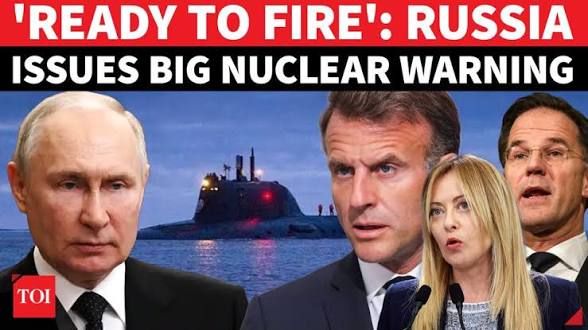
Russia has issued a fresh and unusually direct nuclear warning to NATO as tensions surrounding the Baltic region and the Russian exclave of Kaliningrad intensify.
President Vladimir Putin said on October 1, 2026, that Russia would defend its territory with all available weapons if it faced an attack. His remarks specifically highlighted Kaliningrad, the strategically important Russian territory located between NATO members Poland and Lithuania. Reuters reported that Putin reiterated Russia could use nuclear weapons if the exclave were threatened.
The warning has renewed international attention on the risk of escalation between Russia and NATO. However, the available evidence does not show that Russia has announced an imminent nuclear attack on NATO.
Instead, Moscow’s latest statements form part of a broader deterrence strategy in which Russian officials repeatedly warn that direct military confrontation with NATO could carry nuclear consequences.
Putin Nuclear Warning Puts Kaliningrad at the Center of the Crisis
Kaliningrad has become the central focus of the latest nuclear dispute.
The Russian exclave sits on the Baltic Sea between Poland and Lithuania. Because it is geographically separated from the rest of Russia, Moscow regards maintaining access to the territory as an important security issue.
On September 30, Reuters reported that Russia had sent NATO a diplomatic document warning that Moscow could use nuclear weapons if NATO attempted to isolate Kaliningrad from the rest of Russia. The document reportedly warned of a potentially direct armed confrontation and said Russia was prepared to use its available military capabilities, including nuclear weapons, to defend the territory.
The document was described as a diplomatic “non-paper,” meaning an informal document used to communicate a government’s position without taking the form of a formal treaty or diplomatic note.
That distinction matters because the warning represents a serious political and military signal, but it does not itself mean that nuclear weapons have been placed on an immediate launch order.
Putin Says Russia Does Not Plan to Attack Europe
At the same time, Putin’s latest remarks included an important qualification.
According to Reuters, Putin said Russia had no plans to attack European countries and said Moscow wanted peaceful coexistence. He nevertheless warned that Russia would use all weapons in its arsenal if Russian territory, including Kaliningrad, were threatened.
This creates two simultaneous messages.
First, Moscow is presenting itself as seeking to avoid a direct war with NATO.
Second, Russia is warning that any attack on territory it considers Russian could trigger an extremely severe military response.
That combination is central to nuclear deterrence. Governments possessing nuclear weapons frequently seek to convince potential adversaries that certain military actions would carry unacceptable risks.
Why Kaliningrad Matters So Much
Kaliningrad is strategically significant because of its location.
The territory is surrounded by NATO members except for its Baltic Sea coastline. Poland and Lithuania are both members of the alliance, while Belarus, Russia’s ally, lies to the east.
The geography means that any major military crisis involving the Baltic states could potentially raise questions about Russian access to Kaliningrad.
This is why the region has repeatedly appeared in Russian security warnings.
Russia has significant military infrastructure in the area, making Kaliningrad an important part of Moscow’s broader military posture in the Baltic region.
For NATO, meanwhile, the Baltic Sea and eastern European flank have become increasingly important security areas following Russia’s full-scale invasion of Ukraine in 2022.
Russia’s Nuclear Doctrine Has Already Changed
The latest warning cannot be separated from changes Russia made to its nuclear doctrine in 2024.
In November 2024, Putin approved an updated nuclear doctrine that expanded the circumstances under which Russia says it could consider nuclear weapons.
Reuters reported at the time that the revised doctrine allowed for nuclear use in response to certain conventional attacks that create a “critical threat” to Russian sovereignty or territorial integrity. The doctrine also addressed situations involving attacks by non-nuclear states supported by nuclear powers.
The change attracted international attention because analysts interpreted it as lowering the perceived threshold for possible nuclear use.
The UK House of Commons Library similarly reported that the 2024 update represented another development in Russia’s nuclear rhetoric surrounding the Ukraine war. It noted that experts had argued the revised doctrine lowered the threshold for possible nuclear use.
However, a nuclear doctrine is not an automatic launch mechanism.
It establishes conditions and policy principles under which Russian leadership says nuclear weapons could potentially be considered. Actual use would remain a political and military decision.
What Does “Total Atomic Retaliation” Actually Mean?
The phrase “total atomic retaliation” is dramatic language and should not be treated as an exact quotation describing a confirmed Russian operational order.
Russia’s actual recent language has focused on using its available weapons, including nuclear weapons, to defend its territory if it comes under attack.
That distinction is important.
There is no evidence in the latest reports that Moscow has ordered a general nuclear strike against NATO.
Instead, Russian warnings are intended to communicate the potential consequences of direct military confrontation.
Nuclear deterrence works partly through uncertainty. A nuclear-armed state wants an adversary to believe that certain attacks could lead to an unacceptable response.
At the same time, the existence of nuclear weapons creates a serious risk of miscalculation if military forces operate in close proximity during a crisis.
NATO Rejects Russia’s Nuclear Pressure
NATO has rejected the idea that the alliance is preparing to attack or isolate Kaliningrad.
NATO Secretary General Mark Rutte said there was no immediate threat to NATO territory from Russia, according to Reuters reporting on September 30. He also described NATO’s posture as defensive and said the alliance did not threaten Kaliningrad.
The alliance has nevertheless continued strengthening its defense capabilities in eastern Europe.
NATO’s own nuclear policy emphasizes deterrence rather than offensive nuclear warfare. The alliance says the fundamental purpose of its nuclear capability is to preserve peace, prevent coercion and deter aggression.
NATO’s nuclear posture involves the United States, United Kingdom and France, the alliance’s three nuclear-armed members under the Nuclear Non-Proliferation Treaty framework.
NATO Is Also Strengthening Nuclear Deterrence
NATO’s nuclear posture has itself received renewed attention.
In June 2026, the alliance’s Nuclear Planning Group said NATO would continue strengthening its nuclear deterrence mission. The group said this included modernizing nuclear capabilities, improving nuclear planning and adapting the alliance’s posture to the changing security environment.
NATO says nuclear weapons remain part of its broader deterrence strategy alongside conventional forces, missile defenses, space capabilities and cyber capabilities.
The alliance also states that decisions concerning nuclear deterrence remain under political control.
This creates a classic strategic balance: Russia emphasizes the potential consequences of attacking Russian territory, while NATO emphasizes that its nuclear capabilities exist to deter aggression and protect the alliance.
The Danger of Miscalculation
The biggest concern surrounding the latest Putin nuclear warning is not necessarily that a nuclear attack is about to happen.
The greater concern is escalation.
A confrontation could theoretically begin with a conventional incident, such as an attack, blockade, missile strike or military accident. If both sides interpreted the incident as preparation for a larger attack, each could respond by increasing military readiness.
That process can create a dangerous escalation cycle.
Russia could interpret NATO military movements as preparation for an attack. NATO could interpret Russian military deployments as preparation for aggression. Each side could then take defensive measures that the other side sees as offensive.
Nuclear weapons make such misunderstandings especially dangerous.
This is why communication channels, military-to-military contacts and clear signaling remain important during periods of heightened tension.
Putin’s Warning Comes Amid Wider Military Tensions
The nuclear dispute comes at a time of broader military activity in the region.
On October 2, Putin observed the final stage of Russia’s Center-2026 military exercises in the Ural region. The exercises involved tens of thousands of troops from Russia and several partner countries, according to Associated Press reporting.
The drills occurred against the backdrop of continuing tensions over Ukraine and the Baltic region.
Russia has repeatedly accused NATO of expanding military pressure around its borders.
NATO, meanwhile, says its defensive posture is necessary because of Russian military aggression against Ukraine and the changing security environment in Europe.
These competing interpretations are part of the larger strategic confrontation.
Russia’s Nuclear Messaging Has a Long History
Russia’s nuclear warnings did not begin in 2026.
Since the beginning of the full-scale war in Ukraine, Russian officials have repeatedly referred to the country’s nuclear arsenal when discussing possible Western involvement.
The UK House of Commons Library documented several aspects of Russia’s nuclear signaling since 2022, including heightened readiness, nuclear weapons deployments to Belarus and changes to nuclear doctrine.
Experts have debated whether these statements are primarily intended as deterrence, coercion or signaling.
The key point is that rhetoric alone does not necessarily indicate that nuclear use is imminent.
Nevertheless, repeated nuclear threats can increase uncertainty and make crisis management more difficult.
What Happens If NATO and Russia Clash Directly?
A direct NATO-Russia confrontation would represent a major escalation beyond the current indirect confrontation surrounding Ukraine.
NATO operates under the principle of collective defense. An armed attack against one member can trigger alliance consultations and potentially collective action under Article 5.
Russia, meanwhile, maintains one of the world’s largest nuclear arsenals and has repeatedly emphasized that its nuclear weapons are intended to deter major threats to Russian security.
This means both sides possess powerful incentives to avoid an uncontrolled direct war.
However, deterrence is not a guarantee against accidents or miscalculations.
Military aircraft can encounter one another. Missiles can be misidentified. Cyberattacks can create uncertainty about who carried out an operation. Political leaders can also misinterpret an opponent’s intentions.
For that reason, the latest nuclear rhetoric is being watched closely by governments and security analysts.
Is Russia Preparing to Launch Nuclear Weapons?
There is no evidence in the latest reporting that Russia has announced an imminent nuclear launch against NATO.
The recent statements are warnings about possible nuclear use under specific circumstances, particularly an attack or attempted isolation of Kaliningrad.
Reuters reported that Putin’s October 1 comments were framed around defending Russian territory and warned that Russia could use all available weapons if necessary.
That is different from announcing an imminent nuclear operation.
The distinction is essential when interpreting dramatic headlines about nuclear war.
What Is the Risk for Europe?
Europe remains directly affected by the confrontation because several NATO members border Russia or are located close to areas of strategic competition.
Poland and the Baltic states are particularly sensitive to developments around Kaliningrad.
At the same time, NATO says its assessment does not indicate an immediate Russian attack on NATO territory. Rutte said there was no imminent threat while reiterating the alliance’s defensive commitments.
The current situation therefore involves a high level of military and political tension without evidence of an imminent general nuclear conflict.
That distinction is important for understanding the situation accurately.
Why the Latest Warning Matters
Putin’s latest nuclear warning matters because it demonstrates that nuclear weapons remain central to Russia’s strategic messaging.
The warning also highlights how quickly a regional dispute involving Kaliningrad could acquire broader strategic significance.
Russia wants NATO to understand that Moscow considers the security of Kaliningrad a matter serious enough to invoke its nuclear deterrent.
NATO, meanwhile, wants to prevent Russia from using nuclear threats to constrain the alliance’s defensive decisions.
The resulting confrontation is a difficult balance between deterrence and escalation.
Nuclear Brinkmanship Raises Global Concerns
The latest Russia-NATO dispute also has implications beyond Europe.
Russia and the United States possess the world’s largest nuclear arsenals. The United Kingdom and France also maintain independent nuclear forces.
Any direct confrontation between Russia and NATO would therefore have consequences for global security.
Other nuclear-armed states are also watching how nuclear deterrence is being used during the Ukraine conflict.
If nuclear threats become a routine part of conventional military disputes, other governments could reconsider their own security strategies.
That is one reason international arms-control experts continue to emphasize communication, risk reduction and nuclear restraint.
What to Watch Next
Several developments could determine whether tensions rise or fall.
First, governments will watch NATO’s military posture around the Baltic region.
Second, Moscow’s future statements concerning Kaliningrad will be closely monitored.
Third, any new changes to Russian nuclear doctrine or nuclear readiness could attract significant international attention.
Fourth, developments in the Ukraine war could either increase or reduce the possibility of direct confrontation.
Finally, diplomatic contacts between Russia, the United States and European governments could influence the broader security environment.
For now, the available evidence points to an intensified war of words and deterrence signaling rather than an announced nuclear attack.
Conclusion
Putin’s latest nuclear warning has placed Kaliningrad at the center of renewed Russia-NATO tensions.
Russia has made clear that it considers any attempt to isolate or attack the exclave a serious security threat and has warned that its response could include nuclear weapons.
NATO, however, says it does not threaten Kaliningrad and maintains that its posture is defensive. The alliance continues to regard nuclear deterrence as a means of preventing conflict rather than seeking one.
The latest developments therefore represent a serious escalation in rhetoric, but they should not be confused with evidence of an imminent nuclear strike.
The central issue remains deterrence: Russia is signaling the consequences it says would follow an attack on its territory, while NATO is reinforcing its own defense and deterrence posture.
With nuclear weapons involved, even limited military confrontations carry potentially global consequences. That makes clear communication, restraint and crisis management especially important as tensions continue to develop.
FAQs
1. What did Putin say about nuclear weapons in October 2026?
Putin said Russia would defend its territory using all available weapons if it came under attack. He specifically warned that nuclear weapons could be used if Kaliningrad were threatened.
2. Is Russia planning a nuclear attack on NATO?
There is no evidence in the latest reporting of an announced imminent Russian nuclear attack against NATO. The statements concern potential nuclear use if Russia’s territory were attacked or threatened.
3. Why is Kaliningrad important?
Kaliningrad is a Russian exclave on the Baltic Sea located between NATO members Poland and Lithuania. Its geographic position gives it major strategic importance in the Baltic region.
4. Has Russia changed its nuclear doctrine?
Yes. Putin approved an updated Russian nuclear doctrine in November 2024. The changes expanded the circumstances under which Moscow says nuclear weapons could potentially be considered.
5. What is NATO’s position on nuclear weapons?
NATO says its nuclear forces are primarily intended to deter aggression, prevent coercion and preserve peace. The alliance maintains that nuclear weapons remain part of its broader defense strategy.
6. Does NATO want to attack Kaliningrad?
NATO says it does not threaten Kaliningrad. NATO Secretary General Mark Rutte has described the alliance’s posture as defensive.
7. Could a Russia-NATO conflict become nuclear?
A direct conflict between Russia and NATO would carry serious escalation risks because both sides possess powerful military capabilities and nuclear deterrents. However, the possibility of escalation should not be presented as evidence that nuclear war is imminent.
8. Why are Russia’s nuclear warnings significant?
Russia’s warnings are significant because they communicate that Moscow considers certain territorial threats serious enough to potentially invoke its nuclear deterrent. They also demonstrate the continuing role of nuclear signaling in the Russia-NATO confrontation.
9. Is Kaliningrad part of Russia?
Yes. Kaliningrad is a Russian territory separated geographically from mainland Russia.
10. What should happen next?
The situation will depend on developments around Ukraine, NATO’s eastern flank, Kaliningrad and diplomatic contacts between Russia and Western governments. Military and diplomatic signals will remain important indicators of whether tensions increase or decrease.
About the Author