House Vote Update: Seven GOP Reps Break With Party on Iran War Powers Resolution, Bipartisan Defection
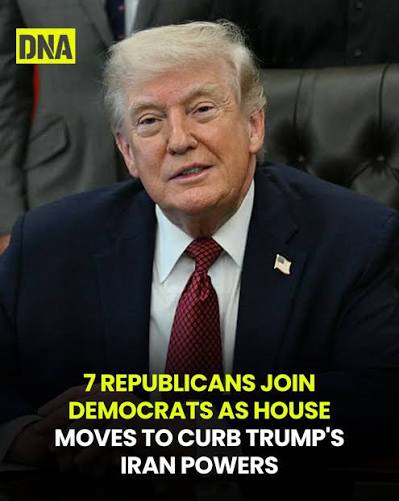
The U.S. House of Representatives has passed a new Iran war powers resolution, with seven Republicans joining Democrats in an effort to restrict President Donald Trump’s authority to continue military operations against Iran without congressional approval.
The resolution passed 220-204 on September 15, 2026, according to the official House roll call. All 213 voting Democrats supported the measure, while seven Republicans also voted yes. The Republican conference recorded 203 votes against it, with eight Republicans not voting.
The vote marks the third time the House has approved a war powers measure seeking to end or restrict U.S. military involvement in the Iran conflict.
The latest vote is notable because the number of Republicans supporting the resolution increased from four in the previous House votes to seven.
The seven Republicans who voted for the resolution were:
- Tom Barrett of Michigan
- Warren Davidson of Ohio
- Brian Fitzpatrick of Pennsylvania
- Thomas Massie of Kentucky
- Nancy Mace of South Carolina
- Mariannette Miller-Meeks of Iowa
- Zach Nunn of Iowa
Three of those lawmakers—Mace, Miller-Meeks and Nunn—were voting for a House war powers resolution of this type for the first time.
The vote adds another layer to the congressional debate over presidential war powers, congressional authorization and the continuing U.S. military campaign against Iran.
What the House Resolution Does

The measure was introduced as a war powers resolution under Section 5(c) of the War Powers Resolution.
Its stated purpose is to direct the president to remove U.S. armed forces from hostilities with Iran. The House Clerk’s official record identifies the vote as H. Con. Res. 93 and confirms that the resolution passed 220-204.
The measure does not simply constitute a general statement about foreign policy. It invokes the War Powers Resolution, a federal law designed to establish congressional involvement when U.S. forces are engaged in hostilities.
The current dispute therefore involves a broader constitutional question: how much authority does the president have to conduct sustained military operations without a new authorization from Congress?
That question has become increasingly important as the Iran conflict has continued.
Seven Republicans Join Democrats
The most closely watched feature of the September vote was the Republican split.
Four Republicans had already supported previous House war powers efforts:
- Tom Barrett
- Warren Davidson
- Brian Fitzpatrick
- Thomas Massie
Three additional Republicans joined them in the latest vote:
- Nancy Mace
- Mariannette Miller-Meeks
- Zach Nunn
That brought the Republican total supporting the measure to seven.
The House Clerk’s official roll call confirms seven Republican yes votes.
This represents a change from the June and July votes, when four Republicans supported similar resolutions.
For comparison, the House’s July 23 vote on H. Con. Res. 89 passed 214-208, with four Republicans voting yes and 207 voting no.
An earlier June 3 vote passed 215-208, also with four Republicans supporting the resolution.
The voting pattern therefore shows an increase in Republican support for congressional restrictions on the administration’s Iran policy.
Why the Vote Matters
The House vote is important for several reasons.
First, it demonstrates that opposition to continuing military action is not confined entirely to one party.
Second, it puts the constitutional role of Congress in authorizing military action back at the center of the debate.
Third, it comes as lawmakers prepare to leave Washington for the campaign period before the November midterm elections.
The Associated Press reported that this is likely to be the final House vote on the Iran war before the midterms.
That timing gives the vote additional political significance, although the seven Republican lawmakers have different districts, constituencies and stated positions.
The Three New Republican Votes
Nancy Mace
South Carolina Republican Nancy Mace was one of the three Republicans who supported the latest resolution after not voting for the earlier House measures.
Mace is retiring from Congress after losing the Republican primary for governor of South Carolina, according to reporting from the Associated Press and other outlets.
Her vote adds another Republican voice to the House effort to invoke congressional war powers over Iran.
Mariannette Miller-Meeks
Iowa Republican Mariannette Miller-Meeks also supported the resolution for the first time.
Her vote is particularly significant because Iowa is expected to be an important battleground during the 2026 congressional elections.
Miller-Meeks has also served in the U.S. military, and reporting on the vote has highlighted her concerns about the direction and objectives of the conflict.
Zach Nunn
Iowa Republican Zach Nunn was the third new Republican supporter.
Nunn is a former Air Force officer. In a statement reported after the vote, he argued that continued combat operations should have clear objectives and congressional authorization.
His position is notable because he has generally been viewed as more hawkish on Iran than some other Republicans, making his vote part of the wider debate over how long U.S. military involvement should continue.
Four Republicans Had Already Supported War Powers Measures
The other four Republicans—Tom Barrett, Warren Davidson, Brian Fitzpatrick and Thomas Massie—had previously voted for similar House resolutions.
Their continued support means that the latest vote was not simply a one-time break by seven Republicans.
Instead, it builds on a smaller group of Republican lawmakers who had already supported congressional efforts to restrict the administration’s military authority in Iran.
Thomas Massie has been particularly outspoken on the issue. On September 15, he separately introduced articles of impeachment against Defense Secretary Pete Hegseth, alleging that the administration had conducted military action without proper congressional authorization. Reuters reported that the impeachment effort was unlikely to advance but would create another vote requiring House Republicans to take a position.
The War Powers Debate in Congress
The latest House action is rooted in a longstanding constitutional debate.
The U.S. Constitution gives Congress the power to declare war, while the president serves as commander in chief.
The War Powers Resolution of 1973 was enacted after the Vietnam War as Congress sought to strengthen its role in decisions involving U.S. military forces.
Under the law, presidents are required to notify Congress when U.S. forces are introduced into hostilities or situations where hostilities appear imminent. The law also establishes limits on continued military action without congressional authorization.
However, presidents and Congress have repeatedly disagreed over how the law should be interpreted and applied.
The Iran conflict has revived that dispute.
Supporters of the House resolution argue that prolonged military operations require congressional authorization. The Trump administration has maintained a different position regarding the scope and application of the War Powers Resolution.
That disagreement means the House vote is both a legislative action and part of a broader constitutional dispute.
This Is the Third House Attempt
The September vote did not occur in isolation.
Congress has repeatedly considered resolutions addressing the Iran war.
The House passed a similar measure in June. It then approved another in July. The latest resolution became the third House attempt.
The June 3 measure, H. Con. Res. 86, passed 215-208. Four Republicans supported it.
On July 23, the House approved H. Con. Res. 89 by 214-208, again with four Republican votes.
The September 15 vote increased the Republican support to seven and passed 220-204.
The progression shows that the House coalition supporting war powers restrictions has grown over the course of the year.
Why Previous Efforts Did Not End the Conflict
Passing a House war powers resolution does not automatically end a military campaign.
For legislation to become law, it generally must move through both chambers and survive the presidential process.
Previous congressional attempts concerning the Iran conflict have not resulted in the president receiving a measure that ends the military campaign.
The Associated Press reported that previous resolutions did not reach Trump’s desk and that the latest measure was also expected to face significant obstacles.
That makes the practical effect of the House vote different from its political and constitutional significance.
The vote expresses the position of the House majority that continued military action should be restricted under the War Powers Resolution.
However, the administration can dispute the measure’s legal effect.
Senate Action Adds Another Complication
The Senate has also considered war powers legislation related to Iran.
According to Associated Press reporting, the Senate previously approved a similar resolution, but Republican senators reversed course the following day after Trump challenged them during a private lunch.
That history illustrates the difficulty of moving war powers legislation through both chambers.
Even if the House continues to pass similar measures, the Senate’s position remains important.
The Senate and House must both act before a congressional measure can become federal law through the normal legislative process.
The Cost of the Iran War
The House vote comes amid growing discussion about the financial cost of the conflict.
The Congressional Budget Office estimated that the war had cost approximately $38 billion through August 1, 2026, according to Associated Press reporting. The CBO also estimated ongoing costs of roughly $2 billion to $3 billion per month, depending on the intensity of military operations.
The CBO also projected that the war could increase inflation by approximately 0.5 percentage points compared with earlier expectations heading into 2027.
These figures have become part of the congressional debate because the conflict affects not only military policy but also federal spending and economic conditions.
Energy prices have also become an important issue.
The fighting has disrupted energy flows through the Strait of Hormuz, a strategically important route for global oil shipments. That disruption has contributed to higher fuel prices and increased economic pressure.
Iran War Becomes a Midterm Election Issue
The latest House vote arrives less than two months before the November 2026 midterm elections.
Lawmakers are preparing to return to their districts and campaign.
The Iran war has therefore become part of the political debate surrounding control of Congress.
Republicans who support the administration’s military strategy have emphasized the continuing threat from Iran and the need to protect U.S. forces and interests.
Republicans supporting the war powers resolution have focused instead on congressional authorization and limits on prolonged military action.
Democrats have generally used the votes to argue that Congress should exercise greater control over the use of military force.
These competing arguments will continue to shape congressional debate as the conflict continues.
What the White House Says
The Trump administration has defended its approach to Iran.
The administration has disputed the interpretation that Congress can use the War Powers Resolution in the way proposed by Democrats and Republican supporters of the House measure.
Republican leaders have also argued that Iran remains a security threat and that military action can be necessary to protect U.S. forces and interests.
House Foreign Affairs Committee Chairman Brian Mast questioned what military resources Democrats would want removed from the region, according to AP reporting.
At the same time, Speaker Mike Johnson has acknowledged concerns over energy prices and said the conflict could be entering a new phase.
This creates an important distinction: the House vote concerns congressional authority and military operations, while administration officials continue to defend the broader national-security rationale for the campaign.
What the Seven Republican Votes Mean
The seven Republican votes provide a clear indication that there is not complete agreement within the House Republican conference over the Iran war powers question.
However, the vote alone does not establish that all seven lawmakers share identical views about Iran, military policy or President Trump.
Their individual statements and political circumstances differ.
For example, Nunn has emphasized congressional authorization while also saying Iran should be held accountable for threats and attacks against Americans.
Miller-Meeks has also called for a clearer strategy for ending the conflict, according to AP reporting.
Therefore, the seven votes are best understood as a common vote on one specific congressional resolution rather than evidence of identical foreign-policy positions.
What Happens Next?
The immediate future of the resolution depends on what happens in the Senate and how the administration responds.
The House has completed its vote, but the resolution still faces major procedural and political hurdles.
If the Senate does not act, the House measure cannot become law through the ordinary legislative process.
If Congress were ultimately to pass a measure restricting military operations, the president could also challenge it.
The constitutional dispute could therefore continue even after the congressional vote.
Meanwhile, military operations, negotiations and developments involving Iran could change the political environment before Congress returns after the election.
House Iran War Powers Resolution: Key Facts
| Detail | Information |
|---|---|
| Vote date | September 15, 2026 |
| House vote | 220-204 |
| Democrats voting yes | 213 |
| Republicans voting yes | 7 |
| Resolution | H. Con. Res. 93 |
| Main issue | Removing U.S. forces from hostilities with Iran |
| Previous House efforts | June and July 2026 |
| New Republican supporters | Nancy Mace, Mariannette Miller-Meeks, Zach Nunn |
| Previous Republican supporters | Tom Barrett, Warren Davidson, Brian Fitzpatrick, Thomas Massie |
| Current status | Passed House |
The official House Clerk’s roll call confirms the 220-204 result and the seven Republican yes votes.
Why Bipartisan Support Is Significant
The bipartisan nature of the vote is one of the clearest features of the latest House action.
Every voting Democrat supported the resolution, along with seven Republicans.
That does not mean Congress has reached bipartisan agreement on the overall Iran conflict. Instead, it shows bipartisan support for this particular effort to invoke congressional war powers.
That distinction is important.
Lawmakers can agree that Congress should have a role in military authorization while disagreeing sharply about Iran’s threat, U.S. strategy and the use of military force.
The September vote therefore provides evidence of bipartisan disagreement with continued military operations without congressional authorization, but it does not establish a unified bipartisan foreign-policy position.
Bottom Line
The House Iran war powers resolution passed 220-204 on September 15, 2026, with seven Republicans joining all voting Democrats.
The seven Republican supporters were Tom Barrett, Warren Davidson, Brian Fitzpatrick, Thomas Massie, Nancy Mace, Mariannette Miller-Meeks and Zach Nunn. Three of them—Mace, Miller-Meeks and Nunn—supported the House effort for the first time.
The vote represents the third House attempt this year to restrict U.S. military action against Iran through the War Powers Resolution.
Its immediate legal effect remains contested, and the measure faces further congressional and executive hurdles. Nevertheless, the increased Republican support makes the latest vote an important development in the continuing debate over presidential war powers, congressional authorization and the future of U.S. military involvement in Iran.
As lawmakers prepare for the November midterm elections, the Iran conflict is likely to remain an important congressional and economic issue.
FAQs
1. What happened in the latest House Iran war powers vote?
The House passed a war powers resolution on September 15, 2026, by 220-204. The measure seeks to direct the president to remove U.S. forces from hostilities with Iran without congressional authorization.
2. How many Republicans voted for the Iran war powers resolution?
Seven Republicans voted for the resolution: Tom Barrett, Warren Davidson, Brian Fitzpatrick, Thomas Massie, Nancy Mace, Mariannette Miller-Meeks and Zach Nunn.
3. Which Republicans supported the resolution for the first time?
Nancy Mace, Mariannette Miller-Meeks and Zach Nunn were the three new Republican supporters in the September vote.
4. What is the War Powers Resolution?
The War Powers Resolution is a 1973 federal law intended to establish congressional involvement and limits concerning U.S. military forces engaged in hostilities.
5. Is this the first House vote on the Iran war powers issue?
No. The House previously passed similar resolutions in June and July 2026. The September vote was the third House effort.
6. Did all Democrats support the latest resolution?
All 213 Democrats who voted supported the resolution, according to the official House roll call.
7. Will the House vote automatically end the Iran war?
No. Passing the House resolution does not by itself guarantee an immediate end to military operations. The measure faces additional congressional and executive hurdles.
8. How much has the Iran war cost?
The Congressional Budget Office estimated the conflict had cost approximately $38 billion through August 1, 2026, with additional monthly costs estimated at roughly $2 billion to $3 billion depending on the intensity of fighting.
9. Why is the vote important before the midterm elections?
The vote comes as lawmakers prepare to campaign ahead of the November midterms. The conflict has also become connected to debates over military spending, fuel prices, inflation and congressional authority.
10. What happens next with the resolution?
The Senate would need to consider the measure for it to advance through Congress. The administration has also disputed congressional efforts to use war powers legislation to restrict its military actions, leaving the broader constitutional dispute unresolved.
How useful was this post?
Click on a star to rate it!
Average rating 0 / 5. Vote count: 0
No votes so far! Be the first to rate this post.
About the Author

usa5911.com
Administrator
Hi, I’m Gurdeep Singh, a professional content writer from India with over 3 years of experience in the field. I specialize in covering U.S. politics, delivering timely and engaging content tailored specifically for an American audience. Along with my dedicated team, we track and report on all the latest political trends, news, and in-depth analysis shaping the United States today. Our goal is to provide clear, factual, and compelling content that keeps readers informed and engaged with the ever-changing political landscape.