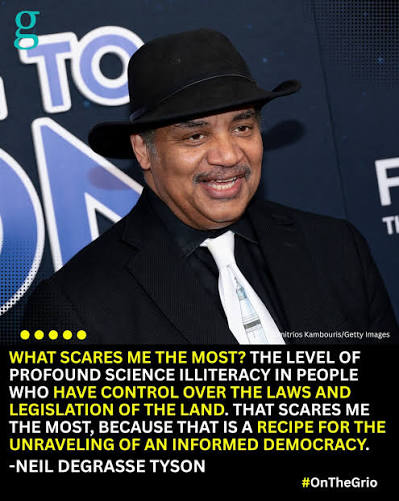
Modern technology is advancing faster than almost any previous generation could have imagined. Artificial intelligence is becoming more powerful, automation is changing workplaces, deepfakes are challenging trust, and scientific tools are opening entirely new frontiers of discovery. However, technological progress also creates serious questions about responsibility.
That is where the Neil deGrasse Tyson warning about scientific limits, ethics and modern technology becomes especially important.
Neil deGrasse Tyson has spent decades explaining science to the public. As an astrophysicist and science communicator, he has consistently emphasized the importance of evidence, skepticism and intellectual humility. His broader message is not that humanity should fear science or abandon technology. Instead, it is that powerful tools must be understood before society places unlimited trust in them.
The modern world increasingly faces a difficult challenge: Just because humans can build a technology, does that mean they should use it without limits?
This question applies to artificial intelligence, autonomous weapons, biotechnology, surveillance systems and other rapidly developing technologies. Scientific progress can improve human life dramatically. At the same time, progress without accountability can create consequences that society may struggle to control.
The Neil deGrasse Tyson warning therefore represents a larger debate about the relationship between scientific capability, ethical responsibility and human judgment.
Science Is Powerful, but Science Has Limits
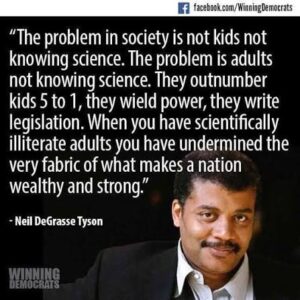
One of the most important lessons from science is that knowledge is always expanding. Scientists do not simply collect facts and declare that everything has been solved. Instead, scientific research constantly identifies new questions.
Tyson has frequently emphasized the importance of being comfortable with uncertainty. Science operates at the boundary between what humanity knows and what humanity has yet to discover.
This is important because modern society often expects science to provide immediate and absolute answers.
However, scientific research does not always work that way.
Scientific understanding develops through:
- Observation
- Evidence
- Experimentation
- Testing
- Replication
- Debate
- Revision
At the frontier of research, uncertainty is unavoidable. New hypotheses can fail. Experimental results can be questioned. Earlier explanations can be replaced by better ones.
That does not mean science is unreliable.
In fact, the ability to correct mistakes is one of science’s greatest strengths.
Tyson has argued that science depends on avoiding self-deception and testing ideas against reality. Scientific conclusions become stronger when evidence can be independently examined and verified.
Therefore, one major part of the Neil deGrasse Tyson warning is about intellectual humility.
Human beings should recognize that having powerful technology does not mean having complete knowledge.
Modern Technology Is Moving Faster Than Public Understanding
The speed of technological development has created another major challenge.
In previous generations, new technologies often took decades to spread throughout society. Today, digital technologies can reach millions or even billions of people within a very short period.
Artificial intelligence is a clear example.
AI can write text, analyze data, generate images, assist scientific research and automate complex tasks. At the same time, AI can also create misinformation, impersonate individuals and make decisions that humans may not fully understand.
This creates a gap between technological capability and public understanding.
People may use advanced systems without knowing:
- How the systems were trained
- What data they rely on
- Where bias may exist
- How mistakes occur
- Who is responsible when something goes wrong
The problem becomes even more serious when people assume that a machine must be correct simply because it is technologically advanced.
A computer can process enormous amounts of information. However, processing information is not the same as possessing human wisdom, moral judgment or social responsibility.
That distinction is becoming increasingly important in the age of AI.
The Neil deGrasse Tyson Warning on Artificial Intelligence
Artificial intelligence has become one of the biggest scientific and technological debates of the modern era.
The technology offers extraordinary possibilities.
AI could potentially help scientists discover new medicines, analyze complex data and accelerate research. It can assist with education, accessibility and scientific exploration.
However, Tyson’s participation in recent public discussions about AI has also highlighted serious ethical questions.
During the 2026 Isaac Asimov Memorial Debate at the American Museum of Natural History, Tyson discussed concerns involving AI’s social costs, environmental impact, bias, deepfakes and the use of AI in decisions involving human life.
One of the most important questions raised is simple but profound:
When should humans trust an AI system over a human being?
This question becomes especially serious in situations involving:
- Healthcare
- Criminal justice
- Military operations
- Autonomous weapons
- Transportation
- Financial decisions
A mistake made by an entertainment algorithm may be inconvenient.
A mistake made by an autonomous weapons system could be catastrophic.
That is why the Neil deGrasse Tyson warning about modern technology is fundamentally connected to human responsibility.
AI Can Make Mistakes—and So Can Humans
The debate about AI is complicated because humans also make mistakes.
Doctors can make incorrect diagnoses. Drivers can cause accidents. Military commanders can make terrible decisions.
Therefore, the question is not whether AI must be absolutely perfect before humans use it.
Instead, society must determine the acceptable limits of automation.
Tyson has discussed the ethical problem of allowing machines to participate in decisions involving lethal force. The central concern is that an imperfect system should not make a decision that results in a person’s death without meaningful human responsibility and oversight.
This creates several difficult questions.
Who is responsible when an AI system makes a mistake?
Is it the programmer?
The technology company?
The government?
The military commander?
Or the person who approved the system?
Technology can make decisions appear automatic. However, responsibility should never disappear simply because a computer was involved.
That principle may become one of the defining ethical challenges of the twenty-first century.
Ethics Must Keep Pace With Innovation
Scientific innovation often moves faster than laws and regulations.
A new technology may be developed first. Society then begins using it. Problems appear later. Only after serious damage occurs do governments attempt to create rules.
This reactive approach can be dangerous.
Tyson’s discussions about technology reflect a broader concern: society should think about consequences before technology becomes impossible to control.
Ethical questions should not be treated as obstacles to scientific progress.
Instead, ethics should be part of responsible innovation.
Before deploying powerful technology, institutions should ask:
- What could go wrong?
- Who could be harmed?
- Who benefits?
- Who controls the system?
- Can decisions be audited?
- Can humans intervene?
- Who is accountable for failure?
These questions are especially important when technologies affect millions of people.
Research on AI ethics continues to focus on issues including privacy, manipulation, opacity, bias, autonomy and responsibility.
The Danger of Trusting Technology Too Much
Modern technology often creates an illusion of certainty.
When people see a sophisticated machine, they may assume it is objective.
However, technology is created by humans.
Humans design systems.
Humans select data.
Humans define objectives.
Humans decide how technology will be used.
Therefore, technology can reflect human limitations.
AI systems can inherit biases from training data. Algorithms can produce inaccurate results. Automated systems can be manipulated.
The danger is not simply that machines make mistakes.
The greater danger may be that humans stop questioning machines.
Scientific thinking requires skepticism.
A scientific approach asks:
How do we know this is true?
What is the evidence?
Can the result be tested?
Can the conclusion be independently verified?
These questions should remain important even when the answer comes from an advanced computer.
Scientific Limits Should Encourage Humility
The universe itself demonstrates the limits of human knowledge.
Astronomers have learned an extraordinary amount about stars, galaxies and planets. Yet enormous mysteries remain.
Scientists continue to investigate:
- Dark matter
- Dark energy
- Black holes
- The origin of the universe
- The possibility of extraterrestrial life
- The nature of consciousness
Tyson has often presented astrophysics as a field that reminds humanity of its small place in the universe.
This perspective encourages humility.
Human civilization has developed remarkable technology. Yet humanity still does not fully understand the universe in which it exists.
That does not mean progress should stop.
Instead, it means progress should be accompanied by caution.
The most dangerous attitude is not ignorance itself.
The most dangerous attitude may be believing that we know more than we actually do.
Technology Can Also Harm Scientific Discovery
Modern technology is not always automatically beneficial to science.
For example, Tyson has warned about the growth of artificial light and its impact on astronomy.
Light pollution can interfere with humanity’s ability to observe the night sky. As cities expand and artificial illumination increases, astronomers may lose access to increasingly dark skies needed for scientific observation.
This creates an interesting contradiction.
Technology can help humanity explore the universe.
Yet technology can also make the universe harder to see.
The lesson applies to many areas of modern life.
A technology designed to solve one problem may create another.
Therefore, innovation must be evaluated according to its full consequences.
Deepfakes and the Crisis of Trust
Another major challenge involves deepfake technology.
AI can now generate realistic images, audio and video.
This technology can be entertaining and useful. However, it can also be used to create false evidence and impersonate real people.
Tyson himself has discussed being deepfaked and the broader implications of convincing synthetic media.
The danger is not only that people can be deceived.
Eventually, the existence of deepfakes could create a world where people doubt authentic evidence as well.
If everything can be fabricated, proving the truth becomes more difficult.
This could affect:
- Elections
- Journalism
- Court cases
- Personal reputations
- National security
Society may therefore need stronger systems for verifying authentic information.
Human Judgment Still Matters
One of the strongest lessons from the debate about modern technology is that machines should not automatically replace human judgment.
AI can analyze enormous amounts of data.
Robots can perform repetitive tasks.
Computers can identify patterns humans might miss.
However, human beings remain responsible for determining what should be done.
Tyson has previously discussed the difference between robots and humans in scientific exploration. Machines can be programmed to search for expected results, while humans can sometimes make unexpected discoveries through broader experience and creativity.
This distinction remains important.
Technology should ideally enhance human capability rather than eliminate human responsibility.
The Need for Ethical Rules Before a Crisis
History shows that powerful technologies can produce consequences that were not fully understood during their development.
The challenge with AI is that its applications are spreading across society at enormous speed.
Waiting until serious damage occurs may be too late.
That is why discussions about:
- AI regulation
- Safety standards
- Human oversight
- Transparency
- Accountability
- International cooperation
are becoming increasingly important.
The goal should not necessarily be to stop innovation.
The goal should be to ensure that innovation serves humanity.
Scientific progress should improve life rather than reduce human freedom, dignity or safety.
A Warning Against Scientific Arrogance
The Neil deGrasse Tyson warning can ultimately be understood as a warning against arrogance.
Science is powerful.
Technology is powerful.
But neither should create the illusion that humans have become all-knowing.
The scientific method itself teaches humility.
A scientist must be willing to say:
I do not know yet.
That sentence is not a weakness.
It is the beginning of discovery.
When governments, corporations and technology companies act as though every problem can be solved simply by building a more powerful machine, they may ignore important ethical questions.
Technology can increase human power.
It cannot automatically increase human wisdom.
The Future of Science and Modern Technology
The future will likely bring technologies that seem almost unimaginable today.
Artificial intelligence may transform medicine and scientific research.
Robotics may change industry.
Space exploration may reveal new discoveries.
Biotechnology may create revolutionary treatments.
However, every major advance will raise new questions.
The future must therefore combine three important principles:
1. Scientific Curiosity
Humanity should continue exploring the unknown.
2. Ethical Responsibility
Innovation must consider the consequences for people and society.
3. Intellectual Humility
Humans must recognize the limits of current knowledge.
These principles can help society benefit from technology without becoming blindly dependent on it.
Conclusion: Progress Requires Responsibility
The Neil deGrasse Tyson warning about scientific limits, ethics and modern technology is ultimately not a rejection of progress.
It is a call for responsible progress.
Science has given humanity extraordinary power. Technology has transformed communication, medicine, transportation and exploration.
However, power without responsibility can create serious risks.
Artificial intelligence, autonomous systems and other emerging technologies should therefore be developed with careful attention to human consequences.
The greatest scientific achievement may not simply be building increasingly powerful machines.
It may be learning how to use powerful tools wisely.
Science teaches humanity how the universe works.
Ethics helps humanity decide what it should do with that knowledge.
As modern technology continues to advance, society will need both.
The future should not belong only to the fastest innovators.
It should belong to those capable of combining innovation with responsibility, evidence with humility and technological progress with human values.
That may be the most important message behind the growing discussion surrounding the Neil deGrasse Tyson warning on scientific limits, ethics and modern technology.
FAQs
What is the Neil deGrasse Tyson warning about modern technology?
The Neil deGrasse Tyson warning broadly focuses on the need for responsible use of powerful scientific and technological tools. His discussions emphasize uncertainty, evidence, ethics, human responsibility and the risks of placing excessive trust in technology.
What has Neil deGrasse Tyson said about AI?
Tyson has participated in discussions about AI’s social costs, bias, deepfakes, environmental impact and ethical concerns. He has also raised questions about human oversight when AI is involved in decisions that could affect human life.
Does Neil deGrasse Tyson oppose scientific progress?
No. His broader scientific work promotes curiosity and discovery. The concern is not progress itself but the responsible use of powerful technologies.
Why are scientific limits important?
Scientific limits remind humanity that knowledge is incomplete. Recognizing uncertainty encourages further research and prevents overconfidence.
Why is ethics important in AI development?
Ethics helps society address issues such as bias, privacy, accountability, manipulation and human safety before technological systems cause serious harm.
Can AI replace human judgment?
AI can assist human decision-making and analyze large amounts of information. However, ethical judgment, accountability and responsibility remain major reasons for maintaining meaningful human oversight.
What are the dangers of deepfakes?
Deepfakes can be used to spread misinformation, impersonate individuals and create false evidence. They may also make it harder for people to distinguish authentic information from fabricated media.
What is the main lesson from the Neil deGrasse Tyson warning?
The central lesson is that technological capability should be balanced with responsibility. Just because humanity can develop a powerful technology does not mean it should be used without ethical limits or human oversight.
About the Author