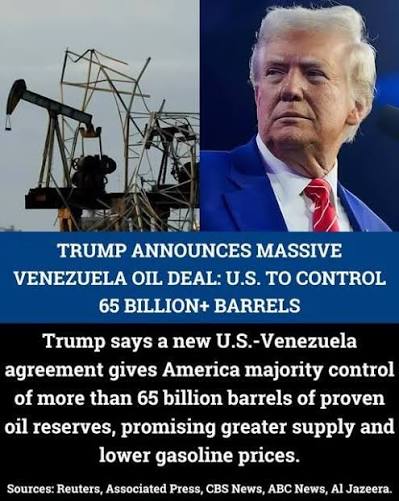
The US-Venezuela oil deal has emerged as one of the most significant energy and geopolitical developments of 2026. The agreement involves more than 65 billion barrels of proven Venezuelan oil reserves and gives the United States majority control through a new partnership structure.
President Donald Trump described the arrangement as the “biggest oil deal in world history,” while Venezuela’s interim President Delcy Rodríguez said the broader energy agreement would run for 25 years and could help revive Venezuela’s struggling oil industry.
The deal has immediately attracted global attention because of its enormous scale, its potential impact on oil markets and its implications for the political relationship between Washington and Caracas.
However, important questions remain. Reports indicate that some elements of the commercial structure involve much longer operating concessions, while Venezuelan officials have described the energy pact itself as lasting 25 years. The complete legal and financial details have not yet been publicly released.
What Is the US-Venezuela Oil Deal?

The US-Venezuela oil deal is a major energy agreement designed to bring American participation and private investment into Venezuela’s oil sector.
According to reports, the agreement focuses on approximately 65 billion barrels of proven oil reserves. The reserves are expected to be developed through a public-private partnership involving the United States, Venezuelan interests and private energy operators.
The arrangement reportedly covers the development of 17 strategic oilfields, with plans to expand activity into additional oil blocks. Venezuelan officials have presented the agreement as a major economic opportunity that could modernize infrastructure, increase production and generate significant government revenue.
The United States, meanwhile, sees the agreement as a strategic opportunity to strengthen long-term energy security and increase access to one of the world’s largest concentrations of petroleum resources.
65 Billion Barrels: Why the Number Is So Important
The headline figure of 65 billion barrels explains why the agreement has generated so much international attention.
Venezuela possesses the world’s largest proven oil reserves. Yet despite its enormous natural resources, the country has struggled for years to translate those reserves into high levels of oil production.
Years of underinvestment, infrastructure problems, economic instability, sanctions and management challenges have damaged Venezuela’s petroleum industry.
As a result, possessing oil underground has not automatically meant producing large volumes of oil.
The US-Venezuela oil deal is therefore not simply about owning or accessing reserves. The real challenge is developing those resources.
Oilfields require:
- Modern drilling equipment
- Pipelines and transportation networks
- Processing facilities
- Refineries
- Electricity infrastructure
- Skilled workers
- Billions of dollars in investment
Without these elements, even enormous oil reserves can remain largely undeveloped.
That is why the agreement’s supporters argue that American participation and private investment could help restore Venezuela’s oil production capacity.
How Does Majority US Control Work?
One of the most controversial elements of the agreement is the reported majority US control.
President Trump announced that the United States had secured majority control over the 65 billion barrels through a partnership with private business.
Reports citing US officials said the American side could effectively receive 55% of the output or economic control structure of the new venture through a combination of equity and rights to obtain oil under agreed terms.
However, Venezuelan officials have emphasized an important distinction.
They argue that Venezuela retains sovereignty over its natural resources.
This creates a difference between:
- Sovereign ownership of the natural resource, and
- Commercial control or participation in its development and output.
This distinction is central to the political debate surrounding the deal.
Supporters argue that Venezuela can retain sovereignty while allowing foreign partners to provide capital and expertise.
Critics, however, question whether granting majority economic control to a US-backed partnership could weaken Venezuela’s practical control over a major portion of its energy resources.
The 25-Year Pact Explained
Venezuela’s interim President Delcy Rodríguez said the energy agreement with the United States would last 25 years.
The announcement created some confusion because separate reports described longer operating rights associated with the new commercial structure.
In other words, the reported 25-year political or energy framework and the longer-term operating concessions discussed in some reports may refer to different parts of the overall arrangement.
This distinction is important because early reports have not provided the complete text of the agreement.
Until official documents are released, several questions remain about:
- The exact ownership structure
- The role of private companies
- How revenue will be divided
- Which fields are included
- How investment will be financed
- How long individual operating rights will last
The lack of complete public documentation has become one of the biggest sources of controversy surrounding the US-Venezuela oil deal.
Venezuela Wants to Increase Oil Production
A major goal of the agreement is increasing Venezuela’s oil production.
Reports indicate that the new framework aims for production capacity of approximately 1.5 million barrels per day from the targeted development program.
For Venezuela, increasing production could transform government finances.
The country depends heavily on petroleum revenue. A stronger oil industry could potentially provide money for:
- Public services
- Infrastructure
- Employment
- Government revenue
- Foreign currency reserves
- Economic reconstruction
Venezuelan officials have also suggested that the agreement could attract nearly $100 billion in investment and generate substantial future tax revenue.
However, these figures depend heavily on whether investors actually commit the money and whether Venezuela can successfully rebuild its damaged oil infrastructure.
Can the Deal Lower US Gas Prices?
President Trump has argued that the agreement could increase oil supplies and eventually help lower gasoline prices in the United States.
The argument is straightforward.
More oil production can increase global supply. If supply rises significantly while demand remains stable, oil prices could face downward pressure.
However, energy analysts have warned that the impact will not be immediate.
Venezuela’s oil industry requires major investment before production can increase substantially.
Analysts point to several challenges:
1. Aging Infrastructure
Much of Venezuela’s oil infrastructure requires modernization and repair.
2. Heavy Crude
A significant amount of Venezuelan crude is heavy oil, which requires specialized equipment and processing.
3. Political Risk
Energy companies need confidence that contracts and investments will remain protected over many years.
4. Financing Challenges
Large-scale oil projects require enormous amounts of capital.
5. Production Takes Time
Developing major oilfields cannot happen overnight.
For this reason, the deal could have important long-term consequences without producing an immediate drop in gasoline prices.
Several analysts have said any major production increase could take years rather than months.
What Does the Deal Mean for Venezuela?
For Venezuela, the agreement represents both an opportunity and a major political risk.
The Economic Opportunity
Venezuela could potentially receive:
- Foreign investment
- New technology
- Infrastructure improvements
- Higher oil production
- More tax revenue
- Job creation
After years of economic difficulties, supporters believe foreign investment could help rebuild the petroleum industry.
The Political Risk
The country’s oil resources are deeply connected to national identity and political sovereignty.
Many Venezuelans and critics are concerned about the scale of American involvement.
Public protests and political criticism have already emerged, with opponents questioning whether the agreement gives the United States too much influence over Venezuelan resources.
The debate is therefore likely to continue long after the initial announcement.
Why the US Is Interested in Venezuelan Oil
The US-Venezuela oil deal is about more than petroleum.
It also has major geopolitical implications.
Energy Security
Access to large oil reserves could provide the United States with another long-term source of crude.
Western Hemisphere Strategy
Venezuela is located relatively close to the United States compared with many major oil-producing regions.
Competition With China and Russia
Venezuela has historically developed strong relationships with countries including China and Russia.
Greater US involvement in Venezuela’s energy industry could reduce the influence of rival powers in the country.
Private Investment Opportunities
The agreement could create opportunities for energy companies and investors willing to operate in Venezuela.
However, major international companies will likely evaluate political, legal and financial risks before committing large amounts of money.
Chevron and Other Energy Companies
Chevron is already one of the best-known American energy companies with experience operating in Venezuela.
Reports indicate that US companies could play a significant role in future joint ventures under the new energy framework.
Other international companies with existing or previous connections to Venezuela’s energy sector may also examine opportunities.
Still, participation is not guaranteed.
Energy companies will want answers to important questions, including:
- Who provides legal protection?
- Who controls operations?
- How are profits divided?
- What happens if political leadership changes?
- Will contracts remain enforceable?
- What infrastructure investments are required?
The answers could determine whether the projected investment actually arrives.
The Biggest Challenges Facing the Agreement
The announcement of a massive oil deal is only the beginning.
Implementation could prove far more difficult.
Infrastructure Problems
Venezuela’s petroleum industry needs major investment.
Legal Questions
The complete legal framework has not been publicly released.
Political Opposition
Critics in Venezuela and abroad question the legitimacy and fairness of the arrangement.
Investor Confidence
Companies may hesitate to invest billions of dollars without strong guarantees.
Long-Term Political Stability
A 25-year energy relationship requires confidence that future governments will honor agreements.
Oil Market Conditions
The profitability of large projects depends partly on future oil prices.
If global prices fall significantly, expensive Venezuelan projects may become less attractive.
Is This Really the Biggest Oil Deal in History?
President Trump described the agreement as the “biggest oil deal in world history.”
There is no universally accepted formula for determining which oil transaction is the largest in history.
The scale of the reserves involved is certainly enormous.
However, the deal should not be understood as a simple purchase of 65 billion barrels of oil.
Instead, it appears to involve a complex combination of:
- Government agreements
- Private investment
- Joint ventures
- Operating rights
- Production access
- Equity interests
That makes direct comparisons with traditional oil purchases or corporate acquisitions difficult.
The agreement is unquestionably one of the most unusual and strategically significant energy arrangements announced in recent years.
What Happens Next?
The next stage of the US-Venezuela oil deal will be crucial.
Investors, governments and energy markets will watch for several developments.
Release of Official Details
The full legal and financial terms will be closely examined.
Identification of Private Partners
The identity and role of private operators could determine how quickly projects move forward.
Investment Commitments
Announcements of actual investment will be more important than projected figures alone.
Production Growth
Markets will watch whether Venezuelan output begins to rise.
Political Reaction
Public opposition or future government changes could affect the agreement.
Global Oil Market Impact
A successful expansion of Venezuelan production could eventually influence global crude supplies.
Final Thoughts on the US-Venezuela Oil Deal
The US-Venezuela oil deal involving 65 billion barrels, a reported 25-year energy pact and majority US control represents a major shift in the relationship between Washington and Caracas.
For the United States, the agreement could strengthen long-term energy security and expand American influence in a strategically important region.
For Venezuela, it could bring desperately needed investment and help revive an oil industry that has struggled despite possessing enormous reserves.
At the same time, the deal faces serious challenges.
Questions about sovereignty, legality, transparency, infrastructure and political stability remain unresolved.
The agreement’s true significance will therefore depend on what happens next.
If billions of dollars in investment arrive and oil production increases, the US-Venezuela oil deal could reshape the Western Hemisphere’s energy landscape.
If political disputes, legal challenges or infrastructure problems prevent implementation, the announcement may prove far more ambitious than the final results.
For now, the world is watching closely as the United States and Venezuela attempt to turn one of the largest oil reserve agreements in modern history into a functioning long-term energy partnership.
Frequently Asked Questions
What is the US-Venezuela oil deal?
The US-Venezuela oil deal is a major energy agreement involving American participation and majority control in a development structure connected to more than 65 billion barrels of Venezuelan proven oil reserves.
How much Venezuelan oil is involved?
The agreement involves approximately 65 billion barrels of proven oil reserves, according to reports and statements from US officials.
How long will the US-Venezuela oil deal last?
Venezuela’s interim President Delcy Rodríguez said the energy agreement would last 25 years. However, reports have also described longer operating concessions connected to parts of the commercial structure.
Does the United States own Venezuela’s oil?
Venezuelan officials say Venezuela retains sovereignty over its natural resources. The agreement concerns commercial control, development rights, investment and access to production rather than a simple transfer of national ownership.
Will the deal lower US gas prices?
It could potentially increase oil supplies over the long term, but analysts warn that significant production growth will take time because Venezuela’s oil infrastructure requires major investment and modernization.
Why is Venezuela important to the global oil market?
Venezuela has the world’s largest proven oil reserves. If its production increases significantly, it could become a much more important supplier to global markets.
Which companies could benefit from the agreement?
Chevron and other energy companies with experience in Venezuela could potentially benefit, although the final list of private participants and investment commitments remains unclear.
What are the biggest risks to the deal?
Major risks include political instability, infrastructure problems, legal uncertainty, investor hesitation and disagreements over sovereignty and revenue sharing.
About the Author