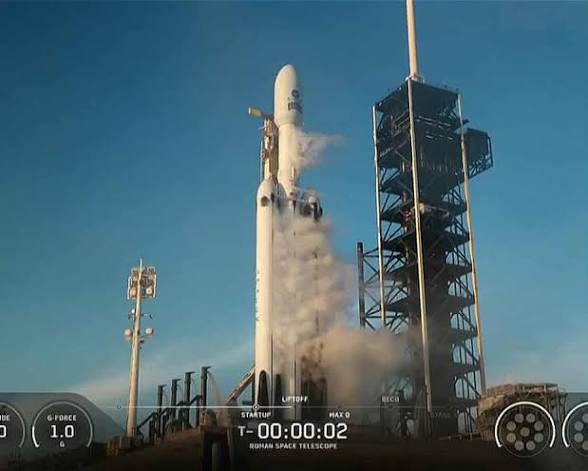
NASA has reached another major milestone in space exploration with the successful launch of its powerful next-generation observatory, the Nancy Grace Roman Space Telescope. The historic NASA space launch marks the beginning of a mission designed to investigate some of the universe’s biggest mysteries, including dark energy, dark matter and planets beyond our solar system.
The Roman Space Telescope lifted off aboard a SpaceX Falcon Heavy rocket from Launch Complex 39A at NASA’s Kennedy Space Center in Florida on August 30, 2026. NASA confirmed that the observatory is now beginning its journey toward deep space, where it will eventually operate around one million miles from Earth.
This NASA space launch is especially important because Roman is expected to survey the universe on a scale that previous telescopes could not easily achieve. Its powerful infrared technology and extremely wide field of view will allow scientists to observe enormous sections of the sky while maintaining remarkable image quality.
NASA hopes the mission will help answer fundamental questions about how the universe evolved and why its expansion is accelerating.
NASA Space Launch Marks a New Era for Astronomy
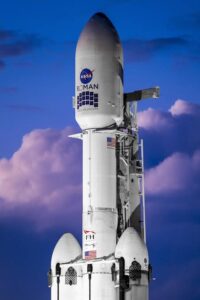
The launch of the Nancy Grace Roman Space Telescope represents one of NASA’s most significant astronomy missions in years.
For decades, scientists have relied on observatories such as the Hubble Space Telescope and the James Webb Space Telescope to study the cosmos. Each telescope has provided a different view of space. Hubble transformed modern astronomy with its observations of distant galaxies, while Webb opened new opportunities for studying the infrared universe.
Roman is designed to add another major capability.
Its greatest strength is its ability to combine powerful infrared observations with an extraordinarily wide view of the sky. NASA says the telescope can examine huge cosmic regions much faster than earlier observatories.
This means scientists will be able to collect enormous amounts of information about galaxies, stars, planets and other objects across the universe.
NASA describes Roman as a next-generation observatory capable of conducting deep and panoramic surveys of the cosmos. Its mission could significantly improve humanity’s understanding of the structure and history of the universe.
The NASA space launch therefore represents more than the deployment of another telescope. It begins a major scientific campaign focused on some of the most difficult unanswered questions in modern astrophysics.
Roman Telescope Begins Its Journey Into Deep Space
Following launch, the Roman Space Telescope began traveling toward its operational destination near the Sun-Earth Lagrange Point 2, commonly known as L2.
This region of space is located roughly one million miles from Earth.
L2 is an important location for major space observatories because it provides a relatively stable environment for scientific operations. The James Webb Space Telescope also operates near this distant region of space.
Roman will spend months traveling, deploying systems and completing commissioning activities before beginning full scientific operations.
NASA expects the observatory to undergo an extensive period of testing and calibration. Engineers must verify that its instruments, communication systems and spacecraft components are functioning properly before scientists begin major surveys.
The journey itself is only the first stage of the mission.
Once Roman reaches its destination and completes commissioning, astronomers will begin using the telescope to examine vast portions of the universe.
NASA’s latest mission update describes Roman as beginning a deep-space journey that will eventually place one of the world’s most advanced astronomical survey observatories in position for years of scientific discoveries.
What Makes the Roman Space Telescope Different?
The Roman Space Telescope has several capabilities that distinguish it from previous NASA observatories.
One of its most important features is its Wide Field Instrument.
This advanced infrared camera allows Roman to observe a much larger section of the sky at one time than the Hubble Space Telescope.
NASA has said Roman’s field of view is at least 100 times larger than Hubble’s.
That difference could dramatically increase the speed at which scientists survey the universe.
For example, a project that would require Hubble to observe small areas of the sky repeatedly can potentially be completed much more efficiently using Roman’s wide-field capabilities.
However, Roman is not intended to replace Hubble or James Webb.
Instead, the telescopes are expected to complement one another.
Roman can locate and survey enormous numbers of interesting objects across wide areas of space. Scientists can then use other observatories for more detailed investigations of specific targets.
This combination could create a powerful new approach to astronomical research.
Roman’s ability to rapidly survey the sky may help scientists discover objects and cosmic patterns that would otherwise be difficult to detect.
The Mission to Investigate Dark Energy
One of the primary goals of the NASA space launch is to improve scientific understanding of dark energy.
Dark energy is the name scientists use to describe the mysterious phenomenon believed to be connected with the accelerating expansion of the universe.
Astronomers have observed that the universe is expanding. More surprisingly, scientific observations indicate that this expansion is accelerating.
Scientists still do not fully understand why.
Dark energy is one possible explanation, but its true nature remains one of the biggest mysteries in physics.
Roman will study enormous numbers of galaxies and distant cosmic events to help scientists measure how the universe has changed over time.
By observing the distribution of galaxies and studying how cosmic structures evolved, researchers hope to gain new information about the forces affecting the universe.
Roman could also help scientists test whether current theories of gravity accurately explain cosmic expansion across enormous distances.
The telescope’s large surveys will provide scientists with a massive amount of observational data.
That information could help answer questions that have challenged astronomers for decades.
Searching for the Hidden Influence of Dark Matter
The Roman mission will also investigate dark matter.
Unlike ordinary matter, dark matter does not appear to emit or reflect light in a way that scientists can directly observe.
However, astronomers believe its gravitational influence affects galaxies and other large cosmic structures.
Scientists estimate that dark matter plays a major role in shaping the universe.
Roman will study how light from distant galaxies is affected as it travels through regions containing large amounts of matter.
This technique can help astronomers map the distribution of matter across vast distances.
Because Roman can observe huge areas of the sky, it may provide some of the most extensive surveys ever conducted for this type of research.
Understanding dark matter is important because it could help explain how galaxies formed and evolved.
The telescope’s observations could therefore provide valuable clues about the hidden structure of the universe.
NASA Space Launch Could Transform Exoplanet Research
The Roman Space Telescope will also search for planets beyond our solar system.
These distant worlds are known as exoplanets.
Thousands of exoplanets have already been discovered, but scientists believe the Milky Way contains an enormous number of planetary systems that have not yet been detected.
Roman is expected to significantly expand the search.
Its wide surveys may allow astronomers to discover planets through several different observation techniques.
NASA expects Roman’s mission to identify large numbers of new planetary candidates and provide important information about how planetary systems form.
The telescope also carries a technology demonstration known as a coronagraph.
A coronagraph is designed to block the intense light from a star, making it easier to observe objects located near it.
This technology could help scientists improve methods for directly studying distant planets.
Future space missions may benefit from the lessons learned through Roman’s coronagraph technology.
The long-term goal is to develop increasingly advanced systems capable of examining planets around other stars in greater detail.
Why the Falcon Heavy Launch Was Important
The telescope was launched aboard a SpaceX Falcon Heavy rocket.
Falcon Heavy is one of the most powerful rockets currently used for major space missions.
The rocket provided the capability needed to send the large observatory on its journey away from Earth and toward deep space.
The launch from Kennedy Space Center represented the culmination of years of construction, testing and mission preparation.
Roman had previously completed major assembly and testing activities before being transported to Florida for final launch preparations.
NASA teams then performed additional inspections, fueling operations and spacecraft integration procedures.
Before launch, the telescope was connected with the hardware needed for its journey aboard the Falcon Heavy rocket.
These operations required careful coordination between NASA, SpaceX and mission teams.
A successful launch does not end the work.
After separation from the rocket, the spacecraft must operate independently and complete a complicated series of deployments and system checks.
The next major stage is ensuring that Roman safely reaches its deep-space destination and begins its scientific mission.
A Telescope Built for Massive Cosmic Surveys
The Roman Space Telescope could produce an extraordinary amount of scientific information.
NASA expects its surveys to observe enormous numbers of galaxies and stars.
The mission could help astronomers create increasingly detailed maps of the universe.
One major advantage is speed.
Roman’s wide field of view means that astronomers can collect information across much larger areas than traditional narrow-field observations.
This could allow scientists to identify rare events and unusual objects that might otherwise be missed.
The telescope may observe:
- Billions of galaxies and stars
- Large numbers of distant supernovae
- Thousands of potential exoplanets
- Massive cosmic structures
- Regions influenced by dark matter
- Objects from relatively nearby areas of space to the distant universe
These observations could create a major scientific database for researchers around the world.
The information may also support discoveries that scientists cannot yet predict.
Throughout the history of astronomy, new instruments have often revealed unexpected phenomena.
Roman could continue that tradition.
Roman Will Work Alongside Hubble and James Webb
NASA’s newest observatory will become part of a larger network of major scientific missions.
Hubble, James Webb and Roman each have different strengths.
Hubble remains important for observations across multiple wavelengths and has produced decades of historic discoveries.
James Webb specializes in extremely sensitive infrared observations and can examine distant galaxies, stars and planetary systems in remarkable detail.
Roman will provide a much wider perspective.
Its ability to rapidly survey large portions of the sky can help identify important objects for follow-up observations.
Scientists could use Roman to find an interesting galaxy or planetary system and then request more detailed observations from Webb or other telescopes.
This scientific cooperation could make future discoveries more efficient.
Rather than competing with existing observatories, Roman expands the range of tools available to astronomers.
Together, these missions may provide a more complete understanding of the universe.
The Legacy of Nancy Grace Roman
The telescope is named after Nancy Grace Roman, a pioneering astronomer often remembered as a major figure in the development of NASA’s space-based astronomy programs.
Roman served as NASA’s first chief astronomer and played an important role in supporting the development of space observatories.
Naming the mission after her recognizes her contribution to the history of astronomy and NASA.
The Roman Space Telescope also represents the continuation of a vision that scientific discoveries could be transformed by placing observatories above Earth’s atmosphere.
Space telescopes avoid many limitations caused by atmospheric conditions.
This allows them to collect types of information that are difficult or impossible to obtain from the ground.
The successful NASA space launch ensures that the latest chapter of this space-based astronomy legacy has now begun.
What Happens Next for the NASA Mission?
The launch is only the beginning of Roman’s mission.
During the coming months, NASA engineers will closely monitor the spacecraft as it travels toward its operational destination.
The telescope will undergo several important steps.
First, it must safely complete its journey through deep space.
Next, mission teams will conduct deployments and system checks.
Scientists and engineers will then begin calibrating the telescope’s instruments.
Only after extensive testing will Roman begin major scientific observations.
NASA expects the mission to operate for at least several years.
The observatory may potentially continue operating longer if its systems remain healthy and sufficient resources are available.
The first scientific observations could eventually provide entirely new views of the universe.
Astronomers will be watching closely for the discoveries that emerge from Roman’s enormous surveys.
Why This NASA Space Launch Matters for the Future
The successful launch of the Roman Space Telescope is important because it demonstrates how space exploration continues to move toward larger and more ambitious scientific missions.
Humanity has already learned an extraordinary amount about the universe.
Yet some of the most important questions remain unanswered.
What exactly is dark matter?
What is dark energy?
Why is the expansion of the universe accelerating?
How many planetary systems exist in our galaxy?
Could there be planets with conditions suitable for life?
Roman will not necessarily answer every question immediately.
However, its observations could provide critical evidence that moves science closer to finding answers.
The telescope’s wide-field approach may reveal patterns across the universe that smaller surveys could not easily detect.
The mission could also inspire future generations of astronomers, engineers and scientists.
Every major space telescope has changed how humanity sees the universe.
NASA hopes Roman will become another mission that transforms scientific understanding.
Conclusion
The successful NASA space launch of the Nancy Grace Roman Space Telescope marks the beginning of an ambitious new deep-space mission.
The next-generation observatory is now beginning its journey toward the Sun-Earth L2 region, where it will conduct massive surveys of the universe.
Roman’s advanced infrared capabilities and wide field of view could allow scientists to study billions of cosmic objects and investigate some of the universe’s greatest mysteries.
From dark energy and dark matter to exoplanets and distant galaxies, the mission has an enormous scientific agenda.
The telescope will also complement the work of Hubble and James Webb, creating new opportunities for astronomers to combine wide surveys with highly detailed observations.
As Roman continues its journey through deep space, NASA and scientists around the world will prepare for the next phase of the mission.
The launch is complete, but the real scientific adventure is only beginning.
FAQs
1. What is the latest NASA space launch?
The latest major NASA space launch is the successful August 30, 2026 launch of the Nancy Grace Roman Space Telescope aboard a SpaceX Falcon Heavy rocket from Kennedy Space Center in Florida.
2. What is the Roman Space Telescope?
The Nancy Grace Roman Space Telescope is NASA’s next-generation space observatory designed to study dark energy, dark matter, distant galaxies and exoplanets.
3. Where is the Roman Space Telescope going?
Roman is traveling toward the Sun-Earth Lagrange Point 2, a deep-space region located roughly one million miles from Earth.
4. Why is the Roman Space Telescope important?
The telescope has a very wide field of view and powerful infrared capabilities, allowing it to survey enormous portions of the universe much faster than earlier observatories.
5. Will Roman replace the Hubble Space Telescope?
No. Roman is designed to complement Hubble and the James Webb Space Telescope. Its main strength is conducting wide and rapid surveys of the sky.
6. What will Roman study?
Roman will study dark energy, dark matter, galaxies, cosmic evolution and planets outside our solar system.
7. How long will the Roman mission last?
NASA’s baseline mission is expected to last several years, with the possibility of an extended mission depending on spacecraft health and available resources.
8. What rocket launched the Roman Space Telescope?
The Roman Space Telescope was launched aboard a SpaceX Falcon Heavy rocket.
About the Author