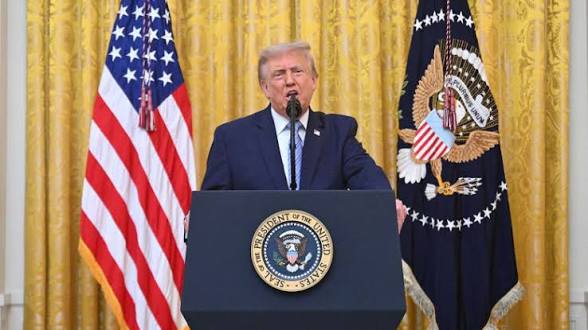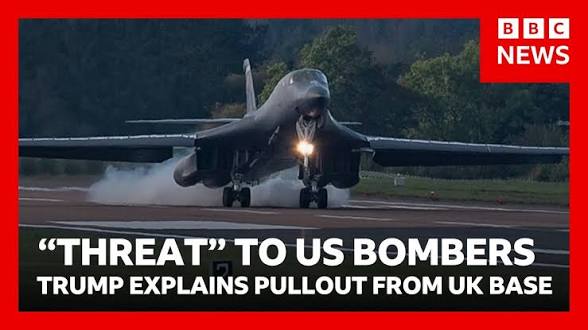
U.S. President Donald Trump has confirmed that threats prompted the United States to move its B-1 bombers out of RAF Fairford in the United Kingdom, adding a new and serious dimension to an ongoing security investigation surrounding the military base.
The sudden withdrawal of the American aircraft from the Gloucestershire airbase came after British authorities investigated a suspected terrorist plot near the facility. Several people have been arrested in connection with the investigation, while officials continue to examine whether Iran or an Iran-linked network played a role.
Trump said the bombers did not leave Britain by accident. According to Reuters, he told reporters that the United States had received information about a threat and decided to move the aircraft rather than expose them to unnecessary danger.
The Pentagon subsequently confirmed that all U.S. bombers deployed at RAF Fairford had returned to their home stations in the United States.
The development is significant because RAF Fairford is one of the most important European operating locations for U.S. heavy bombers. The base has supported American military operations for decades and recently played a role in U.S. operations against Iran.
Trump Confirms Threat Behind B-1 Bomber Withdrawal
The removal of the B-1 bombers initially generated considerable speculation because the Pentagon did not immediately provide a detailed explanation.
Trump has now confirmed that a specific security concern was involved.
The president said there were threats and argued that there was little reason to leave valuable aircraft exposed if the United States believed they could become targets. He also indicated that American authorities knew who they believed was responsible for the threat.
Trump’s comments have strengthened reports that the withdrawal was connected to intelligence concerning a possible attack on the base.
However, important questions remain unanswered. U.S. officials have not publicly released the intelligence behind the decision, and the exact nature of the threat has not been officially disclosed.
That distinction is important because several different explanations have circulated in recent days.
Reports have pointed to concerns about a potential Iranian drone attack, while other officials have emphasized that the U.S. military routinely moves aircraft and other assets between locations.
About 12 B-1 Bombers Were Moved From RAF Fairford
The U.S. military’s withdrawal involved approximately a dozen B-1B Lancer bombers deployed at RAF Fairford.
Air & Space Forces Magazine reported that all 12 B-1 bombers stationed at the base departed for the United States on October 4. The publication said the aircraft left rapidly amid security concerns involving a potential Iranian threat.
The Pentagon confirmed that the bombers had been redeployed to their home stations.
Importantly, the United States has stressed that the move does not mean the bombers are unavailable for combat operations.
The Pentagon said America’s bomber force remains capable of delivering precision global strike capabilities from the continental United States.
That means the withdrawal changes the bombers’ location rather than eliminating the U.S. ability to use them.
Still, geography matters.
Aircraft positioned in Europe can reach targets in the Middle East faster than aircraft launching from the continental United States. Forward deployment can also reduce the amount of aerial refueling required for certain missions.
As a result, moving the B-1s back to America may reduce the speed with which the United States can generate additional sorties from Europe, even if the overall bomber force remains operational.
RAF Fairford Is a Key U.S. Bomber Base in Europe
RAF Fairford is located in Gloucestershire, roughly 90 miles west of London.
Although the base is owned by the United Kingdom, it has long served as an important operating location for the U.S. Air Force.
The facility does not permanently host America’s bomber fleet. Instead, U.S. bombers are deployed there when required for exercises, deterrence missions or military operations.
The base is particularly valuable because it can accommodate large U.S. aircraft such as the B-1, B-2 and B-52.
It has therefore become a major part of America’s ability to project airpower into Europe and the Middle East.
The recent deployment was especially significant because U.S. bombers had been involved in operations connected to the conflict with Iran.
The sudden withdrawal consequently raised questions about whether Washington had identified a new security vulnerability at one of its most important overseas operating locations.
Suspected Terror Plot Triggered Major Security Investigation
The security concerns surrounding RAF Fairford intensified after a September 27 incident.
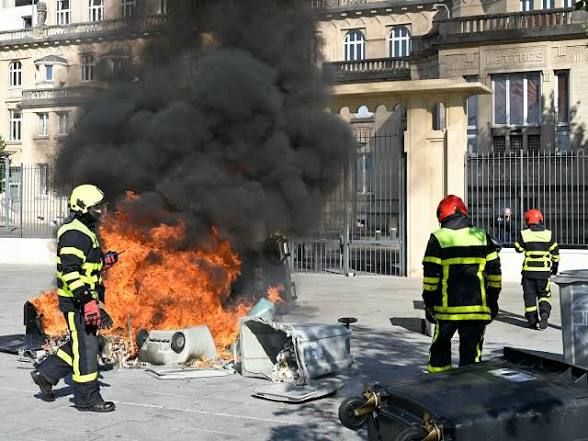
British police were called after suspicious activity involving several vans was reported near the base. Five men in their 20s were arrested during the initial operation.
Authorities later said that no explosives were found. However, police recovered a quantity of petrol from the vehicles.
The incident resulted in a major security response, including the evacuation of residents from nearby homes.
A sixth person, a dual British-Iranian national, was subsequently arrested in London on suspicion of preparing terrorist acts.
All six people arrested earlier in the investigation have since been released on bail while the investigation continues.
On October 6, British counterterrorism police announced another arrest.
A 22-year-old British man was detained in Westminster, London, on suspicion of preparation of terrorist acts under Section 5 of the Terrorism Act 2006. That brought the total number of people arrested in connection with the investigation to seven.
British authorities have emphasized that the investigation remains active.
The latest arrest demonstrates that investigators have not closed the case and are continuing to examine multiple possible explanations for what happened near the base.
Is Iran Behind the RAF Fairford Threat?
Iran’s alleged involvement is one of the biggest questions surrounding the investigation.
Trump has said the threats were linked to Iran.
U.S. Vice President JD Vance also described the decision to move the bombers as a precaution based on concerns about Iranian activity.
British Prime Minister Andy Burnham has separately said there were strong indications that Iran played a role in the incident.
However, Iran has denied involvement and rejected the allegations.
That means there is currently an important distinction between what Western officials suspect and what has been publicly proven.
The investigation is ongoing, and no public evidence has established that the Iranian government directly ordered an attack against RAF Fairford.
Reuters reported that U.S. Secretary of State Marco Rubio also cautioned against directly connecting the bomber withdrawal to the arrests near the base. He said the Pentagon regularly reallocates military resources.
This difference in official messaging is significant.
Trump has directly linked the threat to Iran, while Rubio has avoided confirming a direct connection between the arrests and the aircraft movement.
Reports Point to Possible Iranian Drone Threat
Additional reporting has provided more detail about what may have prompted the withdrawal.
The Washington Post reported that U.S. and British officials believed intelligence pointed to a potential Iranian drone attack against RAF Fairford. The report said about a dozen B-1 bombers were moved after multiple streams of intelligence raised concerns about possible attacks.
Sky News also reported that the withdrawal was connected to a reported threat involving a possible Iranian drone attack, although officials could not establish publicly whether an attack was imminent.
The reported concern highlights a growing challenge for modern military bases.
Small drones can be relatively inexpensive compared with fighter aircraft or strategic bombers. Yet they can potentially threaten aircraft parked on the ground, personnel and critical infrastructure.
Recent conflicts have demonstrated how relatively small unmanned systems can cause disproportionate damage when they reach high-value military targets.
For the United States, protecting expensive aircraft on foreign bases is therefore becoming increasingly complicated.
Why Move the Bombers Instead of Increasing Security?
The decision to remove the B-1s may appear surprising because the United States and Britain have extensive security capabilities around major military installations.
However, removing high-value aircraft can be one of the simplest ways to reduce the consequences of a potential attack.
A bomber parked on the ground is considerably more vulnerable than an aircraft already operating in the air.
If intelligence suggests that an adversary could target aircraft at a particular location, commanders can reduce the potential damage by moving those aircraft elsewhere.
Trump’s comments suggest this was the logic behind the decision.
Rather than leave the B-1 bombers at a location where officials believed there was a threat, the United States chose to relocate them.
The decision also demonstrates the importance of intelligence in modern military operations.
A credible warning does not necessarily mean an attack will occur. But when the potential target is a high-value strategic bomber, commanders may choose to act before the threat becomes more concrete.
The B-1 Remains an Important U.S. Strike Aircraft
The B-1B Lancer is one of America’s major long-range bomber platforms.
It was designed for long-range missions and can carry a large conventional weapons load.
The aircraft has been used extensively in U.S. military operations and remains an important part of America’s conventional strike capability.
Its ability to travel long distances and carry substantial weapons makes it particularly useful for missions where the United States needs to project power over large geographic areas.
The B-1’s presence at RAF Fairford therefore had strategic value.
Keeping the aircraft in Britain placed them closer to the Middle East than they would have been at their permanent U.S. locations.
Moving them back to the United States creates additional logistical demands, although the Pentagon has emphasized that the aircraft remain capable of conducting global missions.
What the Withdrawal Means for U.S. Operations Against Iran
The immediate military effect of the withdrawal is difficult to quantify.
RAF Fairford provided the United States with a forward operating location from which bombers could support missions involving Iran.
Moving the aircraft to American bases increases the distance between the bombers and the Middle East.
However, the United States has extensive aerial refueling capabilities and other overseas military facilities.
The Pentagon has therefore emphasized that America’s bomber force remains ready.
The U.S. can also use alternative locations depending on operational requirements, available infrastructure and agreements with partner countries.
Consequently, the withdrawal should not automatically be interpreted as a reduction in America’s overall military capability.
Instead, it represents a shift in how and where that capability is positioned.
Britain Says RAF Fairford Remains Safe
The United Kingdom has sought to reassure the public following the U.S. withdrawal.
British officials have maintained that RAF Fairford remains secure.
A spokesperson for Prime Minister Andy Burnham said the British government would not comment on another country’s military decisions but maintained that there had been no change in the British position regarding the base. Sky News reported that the government is also investing hundreds of millions of pounds in securing defense bases across the country.
This creates an interesting contrast.
The United States has moved high-value bombers because of reported threats, while British officials continue to say the base itself is safe.
Those statements are not necessarily contradictory.
A military commander can decide that an aircraft is safer elsewhere even when a base remains adequately protected.
The decision can also reflect the value of the aircraft rather than an assessment that the entire facility is about to be attacked.
New Arrest Keeps Pressure on the Investigation
The October 6 arrest adds another layer to the growing security story.
British counterterrorism officials have stressed that detectives are pursuing multiple lines of inquiry.
The seventh arrest does not establish guilt, and all suspects are entitled to due process.
Police have not publicly confirmed a final motive for the alleged plot.
They are still examining the circumstances surrounding the suspicious vehicles, the individuals involved and possible connections to foreign actors.
The investigation therefore remains fluid.
Any definitive claim about who ordered the alleged operation would be premature until British authorities publish stronger evidence or announce charges.
U.S.-UK Security Cooperation Faces a New Test
The RAF Fairford incident also matters for the broader U.S.-UK security relationship.
Britain and the United States are among the closest military allies in the world.
RAF Fairford is one example of how closely their defense infrastructure is connected.
The United States depends on British bases for projecting military power into Europe and beyond, while Britain benefits from the presence and capabilities of American forces.
The bomber withdrawal demonstrates how security concerns at a British facility can immediately affect U.S. military planning.
At the same time, the incident could encourage both governments to reassess protection for high-value aircraft and other military assets.
The threat environment has changed dramatically.
Military bases that were once protected mainly against conventional attacks now have to consider drones, sabotage, cyber operations and covert operations.
What Happens Next?
The next major development will likely come from the British counterterrorism investigation.
Authorities will need to determine whether the suspects were acting independently, as part of an organized network, or on behalf of a foreign state.
They will also have to establish whether the activity near RAF Fairford was directly connected to the intelligence that caused the United States to move its bombers.
For now, that connection remains an important but unresolved question.
The United States will also have to decide when and whether B-1 bombers return to RAF Fairford.
Their eventual return could provide an indication of how officials assess the threat level.
If the aircraft remain away for an extended period, it could suggest that American commanders believe the security concerns require a longer-term response.
If they return quickly, it could indicate that the immediate threat has been reduced.
Bottom Line
President Donald Trump’s confirmation that threats prompted the removal of U.S. B-1 bombers from RAF Fairford has transformed what initially appeared to be a routine military redeployment into a major international security story.
The Pentagon has confirmed that the bombers returned to their U.S. home stations, while reports indicate that intelligence about a possible Iranian drone threat may have influenced the decision.
At the same time, British authorities are investigating a suspected terrorist plot near RAF Fairford. Seven people have now been arrested in connection with the investigation, although six of those previously detained have been released on bail. No explosives were found in the vans involved in the initial incident, although police recovered petrol.
Iran has denied involvement.
The most important facts remain unsettled: whether Iran directly supported the alleged plot, whether the September incident was connected to the intelligence that prompted the bomber withdrawal, and how long the B-1s will remain away from Britain.
For now, Washington is choosing caution over exposure.
The decision underscores a wider reality of modern warfare: even the world’s most powerful military aircraft can become vulnerable when parked on a forward base, and intelligence about a potential attack can be enough to trigger a major strategic redeployment.
As the UK investigation continues, RAF Fairford remains a key symbol of the increasingly complicated security environment surrounding U.S. military operations in Europe and the Middle East.
FAQs
Why did the US pull B-1 bombers from the UK?
President Donald Trump said the United States moved the B-1 bombers because of threats that he believed were linked to Iran. The Pentagon confirmed that U.S. bombers at RAF Fairford had returned to their home stations in America.
Where were the B-1 bombers stationed?
The B-1 bombers were stationed at RAF Fairford in Gloucestershire, England. The base is an important U.S. forward operating location for heavy bombers in Europe.
How many B-1 bombers left RAF Fairford?
Reports indicate that about 12 B-1B Lancer bombers were rapidly withdrawn from RAF Fairford on October 4, 2026.
Was Iran responsible for the alleged threat?
Iran has denied involvement. U.S. and British officials have expressed concerns about possible Iranian involvement, but the investigation is ongoing and publicly available evidence has not established direct Iranian responsibility.
What happened near RAF Fairford?
British authorities launched a counterterrorism investigation after suspicious activity involving several vans was reported near the base on September 27. Five men were initially arrested, followed by another suspect and, on October 6, a seventh person. Police said no explosives were found, although petrol was recovered.
Are the B-1 bombers still operational?
Yes. The Pentagon has emphasized that the bomber force remains ready to conduct precision global strike missions, including operations launched from bases in the continental United States.
Is RAF Fairford still considered safe?
British officials have said the base remains safe. However, the U.S. decision to remove its bombers indicates that American commanders considered the aircraft’s exposure to potential threats significant enough to warrant relocation.
Will the B-1 bombers return to the UK?
There is currently no confirmed timetable for their return. Future decisions will likely depend on the security situation, intelligence assessments and U.S.-UK military planning.
Why is RAF Fairford important to the United States?
RAF Fairford is a major European operating location for U.S. heavy bombers. Its geographic position gives American aircraft a forward base closer to potential operating areas in Europe and the Middle East.
What happens next in the RAF Fairford investigation?
British counterterrorism investigators are continuing to examine the incident and possible motives. Authorities have said the investigation remains active and that multiple lines of inquiry are being pursued.
About the Author