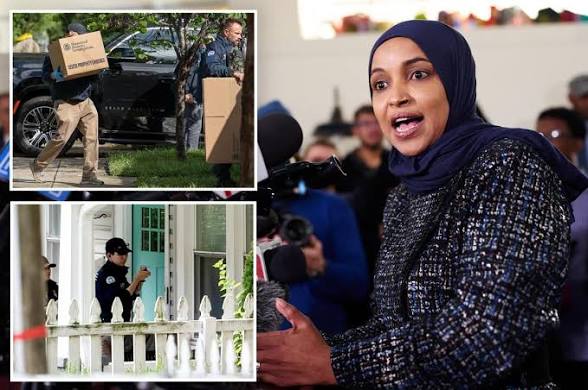
ILHAN OMAR JAIL TIME WARNING: Legal Attorney Warns Representative Faces Denaturalization And Deportation Risk

Representative Ilhan Omar is facing renewed scrutiny over her immigration history as federal investigators examine questions surrounding the documents connected to her arrival in the United States and her acquisition of citizenship. The investigation has intensified political debate about whether she could face criminal charges, lose her citizenship or eventually face deportation.
The controversy has drawn national attention because Omar is an elected member of the U.S. House of Representatives and a prominent critic of President Donald Trump’s immigration policies. Reports published in October 2026 describe an investigation involving her immigration paperwork, with officials reportedly examining allegations of possible fraud and false statements. Omar has denied wrongdoing and characterized the investigation as politically motivated.
The headline surrounding this controversy raises an important question: Could Ilhan Omar actually face jail time, denaturalization or deportation if investigators establish wrongdoing?
The answer depends on the evidence, the specific allegations and the outcome of any legal proceedings. A warning from an attorney or government official does not establish guilt. Likewise, a federal investigation does not mean that prosecutors have proved a crime.
Understanding the distinction between allegations and legal findings is essential to evaluating the case.
Why Is Ilhan Omar Facing Renewed Federal Scrutiny?

The current controversy centers on questions about Omar’s immigration history and the process through which she became a U.S. citizen.
Omar was born in Somalia and came to the United States as a refugee during the 1990s. Her official congressional biography describes her family’s flight from Somalia’s civil war, their time in a refugee camp in Kenya and their eventual arrival in the United States.
According to reporting published in October 2026, federal investigators are examining whether information supplied by Omar or members of her family during immigration proceedings was accurate. Reports have also raised questions about her age at the time her father became a U.S. citizen in 2000.
These questions matter because citizenship eligibility for children can depend on several factors, including age, the citizenship and legal status of a parent, and the law applicable at the time.
However, the existence of questions about historical paperwork does not establish that any information was deliberately falsified.
The investigation’s precise scope also remains unclear. The Associated Press reported that Omar’s lawyers challenged the search of her Washington, D.C., residence and demanded the return of property seized by federal agents. Her legal team described the investigation as unlawful and politically motivated, while the Justice Department maintained that agents complied with their legal obligations.
These competing positions underline why the evidence and any eventual court findings matter more than political rhetoric.
Legal Attorney Warns of Potential Jail Time: What Are the Possible Charges?
The possibility of jail time has become a major focus of the political debate surrounding Omar. However, it is important to distinguish between public warnings about potential penalties and criminal charges that prosecutors have actually filed.
In September 2026, immigration attorney Michael Wildes discussed the legal challenges investigators would face if they pursued allegations of marriage fraud against Omar. He emphasized that the government would need to establish the required intent and satisfy demanding legal standards.
The October investigation has also raised separate questions about immigration paperwork and statements made during the process of obtaining citizenship.
Depending on the evidence, prosecutors could examine several potential offenses.
1. Immigration fraud allegations
Immigration fraud generally involves knowingly providing false information or using fraudulent documents to obtain an immigration benefit.
In Omar’s case, reports indicate that investigators are examining historical immigration records and whether information about her age or family circumstances was misrepresented.
However, an inaccurate record does not automatically establish fraud. Prosecutors would need to demonstrate the elements of the specific offense, including any required knowledge or intent.
2. False statements on government documents
Federal law criminalizes certain knowingly false, material statements made in matters within the jurisdiction of the federal government.
If investigators identify evidence of such statements, prosecutors would need to establish that the conduct satisfies the applicable statute. A discrepancy in a decades-old document alone does not prove that Omar knowingly made a false statement.
3. Possible marriage fraud
Previous allegations have also concerned Omar’s marriage to Ahmed Elmi. Omar has repeatedly denied allegations that she married her brother to obtain an immigration benefit.
Attorney Michael Wildes explained that a successful marriage-fraud prosecution would require proof of the necessary intent to evade immigration laws. The existence of a marriage, questions about family relationships or online speculation would not independently establish the offense.
These allegations must be treated separately from the questions surrounding Omar’s citizenship through her father.
Has Omar been sentenced to jail? No. The reporting reviewed for this article does not establish that she has been convicted or sentenced in connection with these allegations. Possible penalties should not be presented as an actual sentence.
Could Ilhan Omar Lose Her U.S. Citizenship?
Denaturalization is the legal process through which the government seeks to revoke citizenship obtained through naturalization. It is permitted under federal law, but only when the applicable legal requirements are satisfied.
According to legal analysis published by Axios on October 15, 2026, the government can pursue denaturalization in limited circumstances, including when citizenship was illegally obtained or procured through qualifying concealment or willful misrepresentation.
The crucial question in Omar’s case is whether the evidence establishes a lawful basis for challenging the citizenship she acquired in 2000.
Why her age at the time matters
Reports indicate that Omar acquired U.S. citizenship through her father’s naturalization when she was reportedly 17 years old.
Investigators are examining whether information about her birth date was accurate and whether it affected her eligibility for citizenship through her father. Under the law applicable at the time, age and other statutory requirements were relevant to citizenship acquired through a parent’s naturalization.
If the government alleges that the citizenship was obtained unlawfully, it must prove the relevant legal grounds with evidence.
Omar’s citizenship history also raises questions about the earlier law governing certain children whose parents naturalized when the other parent was deceased. The applicability of that provision would depend on the precise facts and legal requirements.
Consequently, the age question is not, by itself, a final determination of whether Omar’s citizenship was lawful.
Can President Trump revoke her citizenship directly?
No. A presidential statement or executive announcement cannot, by itself, revoke a person’s citizenship.
The Justice Department must use the applicable legal process. In a civil denaturalization case, that generally means bringing proceedings in federal court and establishing the statutory grounds for revocation.
The government must meet a demanding evidentiary standard. An investigation, political accusation or public statement is not a substitute for proof.
For Omar, that means investigators would have to build a case supported by admissible evidence rather than rely solely on allegations circulating in political debate.
Could Ilhan Omar Face Deportation?
Deportation is a separate legal issue from denaturalization.
As a U.S. citizen, Omar cannot ordinarily be deported under immigration law. If a court were to revoke her citizenship, however, immigration authorities could examine whether she has another lawful basis to remain in the country.
That would not necessarily result in immediate removal.
According to legal experts quoted in October reporting, the government would need to address her immigration status and follow the applicable removal procedures. Any available defenses or forms of relief would depend on her circumstances and the law.
The process could involve several stages:
Citizenship challenge: The government would need to establish grounds to revoke citizenship.
Court proceedings: Omar would have an opportunity to contest the allegations and present her legal arguments.
Immigration status review: If citizenship were revoked, authorities would need to determine her resulting legal status.
Removal proceedings: Any deportation effort would have to satisfy the applicable immigration requirements and provide the required procedural protections.
These stages could involve substantial litigation and appeals.
Therefore, claims that Omar is about to be deported would go beyond what the reported investigation alone establishes.
What Happened During the Federal Search of Omar’s Home?
The investigation received renewed attention after federal agents searched Omar’s Washington, D.C., residence on October 12, 2026.
According to reporting by Reuters and the Associated Press, agents seized her cellphone and other property, while investigators issued more than a dozen grand jury subpoenas involving the wider inquiry. Reports identified possible immigration fraud, conspiracy and false-statement offenses among the matters being examined.
The search represented a significant development because investigators were examining records connected to events that occurred decades earlier.
Nevertheless, a search warrant is not a criminal conviction. Authorities can seek permission to search property when they satisfy the applicable legal requirements, but the execution of a warrant does not establish that the person whose property is searched committed a crime.
Omar’s lawyers challenged the search and requested the return of seized property. They also questioned whether investigators followed the requirements governing the search. The Justice Department disputed claims that agents had failed to comply with their legal obligations.
The legal dispute over the search is separate from the ultimate question of whether prosecutors can prove any alleged offense.
Ilhan Omar Responds to the Investigation
Omar and her representatives have rejected the suggestion that the investigation establishes wrongdoing.
Her spokesperson told Axios that the administration’s effort to strip her of citizenship and deport her had no basis in law. Omar has also described the investigation as politically motivated and accused the administration of using federal law enforcement to target a political opponent.
The timing has attracted additional attention because Omar is seeking reelection in the 2026 midterm elections.
Democratic lawmakers have criticized the search and raised concerns about the potential impact of high-profile federal investigations close to an election. The administration, meanwhile, has defended the investigation as a law-enforcement matter.
These competing claims reflect the political significance of the case, but neither side’s public statements determine the legal outcome.
The decisive questions remain whether investigators can establish relevant facts, whether prosecutors pursue charges, and whether a court finds the evidence sufficient under the applicable law.
What Is the Difference Between Criminal Prosecution and Denaturalization?
Although the two processes may involve overlapping facts, criminal prosecution and denaturalization serve different legal purposes.
Legal process | Main purpose | Possible outcome |
|---|---|---|
Criminal prosecution | Determine whether a criminal offense was committed | Acquittal, conviction and, where applicable, a criminal sentence |
Civil denaturalization | Determine whether citizenship should be revoked under federal law | Citizenship may be revoked if the government proves its case |
Deportation proceedings | Determine whether a noncitizen may lawfully remain in the United States | Removal may be ordered if legal requirements are met |
A civil denaturalization action does not necessarily require a criminal conviction. Conversely, a criminal allegation does not automatically establish grounds to revoke citizenship.
The government must satisfy the legal requirements for the particular proceeding it chooses.
This distinction is particularly important when headlines combine jail time, citizenship revocation and deportation into a single prediction.
Each outcome has different requirements, and none should be described as inevitable.
Why the Case Could Face Significant Legal Challenges
Several issues could complicate any effort to revoke Omar’s citizenship.
The age and citizenship records
Investigators would need to establish the relevant facts about Omar’s age, the citizenship process and the law that applied when she acquired citizenship.
The government would also need to show why any alleged discrepancy meets the legal standard for revocation. The existence of conflicting claims does not settle those questions.
Evidence of intent
Where an alleged offense requires knowledge or intent, prosecutors must prove those elements rather than merely show that a document contained inaccurate information.
The evidence would need to establish Omar’s own relevant conduct. Allegations about information supplied by a family member would not automatically prove that Omar knowingly participated in wrongdoing.
The passage of time
The events under examination reportedly date back more than two decades.
The passage of time can create practical difficulties involving records, witnesses and the ability to establish who supplied particular information. It can also raise legal questions about applicable limitation periods.
CNN’s October reporting noted that criminal denaturalization has a generally applicable 10-year limitations period, while civil denaturalization proceedings do not have the same general statutory deadline. The exact rules depend on the legal basis of the case.
These differences may influence which legal avenues remain available.
Constitutional and procedural protections
Citizenship carries significant legal protections. Any attempt to revoke it must comply with federal law and the applicable constitutional requirements.
Omar would have the opportunity to challenge the government’s evidence and legal arguments in the appropriate proceedings.
Taken together, these issues mean that a successful denaturalization case would require more than political pressure or allegations that have circulated for years.
What Happens Next in the Ilhan Omar Investigation?
As of October 25, 2026, the publicly reported developments establish that a federal investigation is underway. They do not establish that Omar has been convicted of immigration fraud or that a court has revoked her citizenship.
The next developments to watch include the following.
First, investigators may continue reviewing historical records. They may seek documents and testimony to establish the circumstances surrounding Omar’s arrival in the United States and her citizenship.
Second, prosecutors could decide whether criminal charges are warranted. That decision would depend on the evidence and the legal requirements for each potential offense.
Third, the Justice Department could consider civil denaturalization proceedings. Such an action would require a separate legal process and proof of grounds for revocation.
Finally, any effort to deport Omar would depend on the outcome of the citizenship question and subsequent immigration proceedings. Even if the government succeeded at one stage, further legal steps could remain necessary.
The investigation’s outcome cannot be predicted with certainty from the information currently available.
For now, the distinction between an active investigation and an established legal finding remains central to understanding the story.
Conclusion
The Ilhan Omar jail time warning has brought renewed attention to the legal consequences that can follow proven immigration fraud. Federal investigators are reportedly examining historical records connected to Omar’s citizenship, while officials have raised the possibility of denaturalization and deportation.
However, Omar has not been shown to have been convicted or sentenced in connection with the allegations discussed here. Her citizenship has not been established as revoked, and deportation is not an automatic consequence of the investigation.
The government would need to prove any criminal charges and satisfy the requirements for a citizenship challenge before further consequences could follow.
As the case develops, court filings, official statements and independently verified reporting will be more reliable indicators of its direction than predictions about jail time or deportation.
Frequently Asked Questions (FAQs)
1. Could Ilhan Omar face jail time?
Potentially, if prosecutors charge her with a criminal offense, prove the required elements and obtain a conviction. The penalties would depend on the specific charge. The investigation itself does not mean she will go to jail.
2. Is Ilhan Omar facing denaturalization?
Federal investigators are reportedly examining whether her historical immigration records could support a citizenship challenge. However, an investigation is not the same as a court ruling revoking citizenship.
3. Why is Ilhan Omar’s age at the time of citizenship important?
Reports indicate that investigators are examining whether her age was accurately recorded when her father became a U.S. citizen in 2000. Age and other statutory requirements could affect eligibility for citizenship through a parent under the law applicable at the time.
4. Can Donald Trump revoke Ilhan Omar’s citizenship?
No. The president cannot personally revoke her citizenship through an announcement. The government must follow the applicable legal process, including court proceedings where required.
5. Could Ilhan Omar be deported to Somalia?
Deportation could become a legal possibility if her citizenship were revoked and the government subsequently established grounds for removal. Neither outcome is automatic, and the required legal procedures would have to be completed.
6. Has Ilhan Omar been charged with immigration fraud?
The reporting reviewed for this article describes an ongoing investigation into possible immigration-related offenses. It does not establish a conviction or sentence for those allegations. Readers should check subsequent official announcements for any changes in her legal status.
7. What is denaturalization?
Denaturalization is the legal process of revoking citizenship acquired through naturalization. Federal law permits it in specified circumstances, including certain cases involving illegally obtained citizenship or qualifying fraud. The government must establish the applicable grounds.
8. Does a federal search prove that someone committed a crime?
No. A search warrant authorizes a search under specified legal conditions. It does not establish guilt, and any criminal allegation must be evaluated through the applicable legal process.
9. Can citizenship be revoked because a politician criticizes the government?
Political criticism alone is not a lawful basis for denaturalization. The government must establish grounds recognized by federal law, supported by evidence.
10. When will the Ilhan Omar investigation conclude?
No confirmed completion date has been established in the reporting reviewed for this article. Investigations and any subsequent court proceedings can take considerable time, particularly when they involve historical documents and contested legal questions.
How useful was this post?
Click on a star to rate it!
Average rating 0 / 5. Vote count: 0
No votes so far! Be the first to rate this post.
About the Author

usa5911.com
Administrator
Hi, I’m Gurdeep Singh, a professional content writer from India with over 3 years of experience in the field. I specialize in covering U.S. politics, delivering timely and engaging content tailored specifically for an American audience. Along with my dedicated team, we track and report on all the latest political trends, news, and in-depth analysis shaping the United States today. Our goal is to provide clear, factual, and compelling content that keeps readers informed and engaged with the ever-changing political landscape.