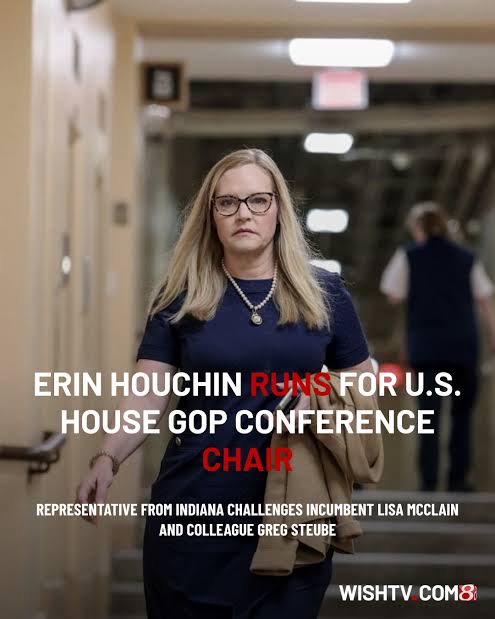
The internal battle for the heart and voice of the House Republican Conference has erupted. In a high-stakes leadership showdown, Indiana Congresswoman Erin Houchin has officially thrown her hat into the ring, directly challenging incumbent Michigan Representative Lisa McClain for the coveted role of House GOP Conference Chair.
As the No. 4 position in House Republican leadership, the Conference Chair is responsible for steering the party’s unified messaging strategy, orchestrating legislative communications, and driving electoral momentum heading into crucial upcoming election cycles.
With the party examining its parliamentary positioning and preparing strategic counter-messaging against the Democratic agenda, Houchin’s challenge highlights a growing appetite among House conservatives for a revamped, aggressive, and modernized communications machine.
1. The Stakes: Why the House GOP Conference Chair Matters

The House Republican Conference Chair serves as the primary mouthpiece for House Republicans. While the Speaker of the House, Majority Leader, and Majority Whip manage floor schedules, vote counts, and legislative bargaining, the Conference Chair ensures that all members speak with a unified, impactful voice to the American public.
Core Responsibilities of the Chair
Unified Party Messaging: Directing the daily and weekly talking points for all House Republican lawmakers.
Media Strategy & Rapid Response: Leading television appearances, digital strategy, press conferences, and rapid-response operations against opposition narratives.
Member Support & Services: Providing conservative lawmakers—especially junior members—with the graphics,messaging toolkits, and data required to connect with their local constituents.
Long-Term Political Positioning: Crafting a cohesive political identity for the conference ahead of legislative battles and general elections.
In times of legislative friction or narrow congressional majorities, the position becomes an invaluable engine for party discipline and publicpublic engagement.
2. Meet the Candidates: Lisa McClain vs. Erin Houchin
+---------------------+-----------------------------------+-----------------------------------+
| Feature             | Rep. Lisa McClain (R-MI)          | Rep. Erin Houchin (R-IN)          |
+---------------------+-----------------------------------+-----------------------------------+
| Current Role        | Incumbent Conference Chair        | U.S. Representative (IN-09)       |
| Key Committees      | Armed Services, Budget            | Rules, Budget, Energy & Commerce  |
| Messaging Focus     | Established track record, coalition| Modernized communications, high-   |
|                     | support across major committee leaders| impact digital rapid response    |
| Announced Backing   | 33+ House Republicans (Cole, Comer)| Rising conservative cohort, junior|
|                     | and newly elected candidates      | member support base               |
+---------------------+-----------------------------------+-----------------------------------+
Lisa McClain: The Incumbent Defender
Representative Lisa McClain of Michigan secured the Conference Chair position by pitching operational stability, strong fundraising, and aggressive defense of the Republican policy platform.
McClain’s campaign highlights strong institutional support:
Prominent Committee Endorsements: Enjoys backed support from senior lawmakers, including Appropriations Committee Chair Tom Cole and Oversight Committee Chair James Comer.
Coalition Building: McClain has worked actively to mentor incoming freshman lawmakers, building a durable coalition across various caucuses within the conference.
Established Record: Serves as a reliable surrogate on national cable news, championing conservative wins and calling out policy failures.
Erin Houchin: The Reform Challenger
Representative Erin Houchin of Indiana entered the race via a direct letter to her colleagues, presenting herself as a dynamic messenger capable of elevating the party’s media footprint.
Key highlights of Houchin’s platform:
Legislative Experience: Brings policy chops from her service on key committees including the House Rules Committee, the Budget Committee, and the Energy and Commerce Committee.
Digital-First Strategy: Advocates for a modern communications structure tailored to digital platforms, podcasts,and direct-to-voter engagement.
Proactive Messaging: Argues that Republicans need a sharper offensive posture to counter Democratic narratives and effectively lay the groundwork for upcoming electoral cycles.
3. Underlying Dynamics Driving the Leadership Fight
This contest is not merely a personality clash; it reflects broader strategic debates within the House Republican Conference over how to project power and maintain message discipline.
                +----------------------------------+
                |  GOP Leadership Challenge Drivers|
                +----------------------------------+
                                 |
        +------------------------+------------------------+
        |                                                 |
        v                                                 v
+-------------------------------+               +-------------------------------+
| Strategic Realignment         |               | Communications Evolution      |
| Shift toward offensive        |               | Transition from traditional   |
| messaging ahead of 2028       |               | press to digital-first media  |
+-------------------------------+               +-------------------------------+
        |                                                 |
        +------------------------+------------------------+
                                 |
                                 v
                +----------------------------------+
                | Coalition Building & Member Services |
                | Empowering rank-and-file voices  |
                +----------------------------------+
Strategic Realignment
As congressional dynamics shift, members are evaluating how best to position the party for future political battles, including looking ahead to the 2028 political cycle. Houchin’s entry signals that a significant segment of the conference feels the party’s messaging apparatus requires a refreshed approach.
Traditional Press vs. Modern Media
A core tension in modern political leadership races centers on media execution. While traditional press conferences remain a staple of Capitol Hill, lawmakers increasingly demand high-yield social media campaigns, rapid-response video clips, and direct digital outreach to capture public attention in a saturated news environment.
4. How the Internal Leadership Election Works
The election for House Republican Conference Chair takes place behind closed doors via secret ballot among all sworn and incoming Republican House members.
Nomination Speeches: Candidates are formally nominated by colleagues during a closed conference meeting.
Member Presentations: Each candidate delivers a final pitch detailing their vision for conference messaging,operations, and member support.
Secret Ballot Vote: Members cast confidential votes. A simple majority of the conference is required to win. If three or more candidates run and no single candidate achieves a majority on the first ballot, the lowest vote-getter is eliminated, and voting continues until a victor emerges.
Because votes are cast by secret ballot, public endorsements do not always guarantee final vote totals, leaving room for late shifts in momentum.
5. Potential Outcomes and What Comes Next
The outcome of the Houchin-McClain contest will shape the conference’s direction heading into crucial legislative sessions:
If McClain Retains the Chair: Reaffirmation of current messaging protocols and institutional continuity,supported by established committee leaders.
If Houchin Prevails: A shift toward digital-first rapid response, reorganized communications toolkits for rank-and-file members, and a revamped media strategy.
Regardless of the winner, the competitive race forces leadership to address member concerns regarding message clarity,media responsiveness, and conference unity.
Frequently Asked Questions (FAQs)
Who is Erin Houchin?
Erin Houchin is a U.S. Representative serving Indiana’s 9th Congressional District. She serves on key House panels, including the Rules, Budget, and Energy and Commerce Committees.
Who is Lisa McClain?
Lisa McClain is a U.S. Representative serving Michigan’s 9th Congressional District and the incumbent House Republican Conference Chair.
What does the House Republican Conference Chair do?
The Conference Chair is the No. 4 leader in the House GOP, responsible for directing overall party messaging, media relations, press briefings, and providing communication tools to Republican lawmakers.
How is the Conference Chair elected?
The Chair is elected by a simple majority vote via secret ballot during a closed-door meeting of all House Republican members.
About the Author