ANTI-ICE PROTESTS EXPOSED: Soros Funding Revealed, Activist Groups Under Scrutiny
Anti-ICE protests have become a major flashpoint in the U.S. immigration debate. Demonstrations opposing Immigration and Customs Enforcement have appeared in several communities as federal immigration enforcement has expanded. At the same time, reports about nonprofit funding have raised questions about whether major philanthropic organizations helped support groups involved in the broader immigration movement.
One name repeatedly appearing in the debate is George Soros and the Open Society Foundations.
Public records and reporting show that Open Society Foundations has provided grants to organizations working on progressive causes, including immigration, civil rights, criminal justice and protest-related issues. Reports have also identified funding relationships involving organizations active in the political environment surrounding anti-ICE demonstrations.
However, an important distinction matters.
Evidence of a grant to an advocacy organization is not the same as evidence that a donor personally organized a particular demonstration. Open Society Foundations says it does not pay people to protest and does not directly train or coordinate protesters. The foundation also says its grantees must follow the law and that it opposes violent protests.
That distinction sits at the center of the current controversy.
Why anti-ICE protests are receiving attention
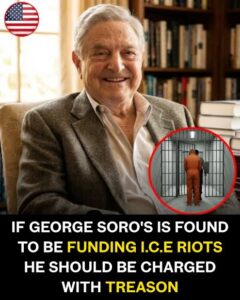
ICE has become one of the most controversial federal agencies in the immigration debate. Supporters of stronger enforcement argue that federal authorities must enforce immigration laws and remove people who are legally subject to removal.
Opponents argue that aggressive enforcement can separate families, disrupt communities and undermine due-process protections.
Those disagreements have produced demonstrations, rallies, community organizing and political campaigns.
The issue became especially visible in Minnesota, where reporting in 2026 examined the funding networks surrounding organizations involved in activism opposing federal immigration enforcement.
A report cited tax filings and other financial records to identify millions of dollars in funding involving progressive foundations and activist organizations. One analysis reported that Open Society Foundations had provided money to the Headwaters Foundation for Justice, which subsequently distributed funding to local organizations.
Other reporting examined organizations such as Indivisible and Sunrise Movement in the context of Minnesota’s political and protest activity.
These financial connections are real subjects for public scrutiny. But interpreting them requires looking at exactly what the money was intended to support.
What the Soros funding records actually show
George Soros is the founder of the Open Society Foundations, a large philanthropic network that supports organizations working on issues including justice, human rights and civil society.
The foundation itself says it awards thousands of grants every year to organizations and individuals around the world. Its grants range from relatively small awards to much larger commitments.
Open Society also openly describes advocacy as part of its work.
Its stated priorities include protecting rights and freedoms, while some grants support organizations involved in public education, advocacy and peaceful protest.
That means claims that Soros-linked philanthropy has supported progressive activism are not based solely on anonymous allegations. The organization publicly acknowledges funding advocacy organizations.
The more difficult question is what conclusions can reasonably be drawn from those grants.
A grant to an organization does not automatically establish that the donor controls every action taken by that organization. Nonprofits can have multiple donors, independent leadership, separate programs and different activities.
That distinction is especially important when discussing protests.
Funding does not automatically prove protest coordination
One of the most repeated claims in political arguments is that a wealthy donor “funded the protests.”
That statement can mean several different things.
It could mean a foundation gave money to an organization that later participated in advocacy.
It could mean an organization receiving foundation money paid for staff, communications or community programs.
It could mean a donor directly financed transportation, signs or protesters at a particular demonstration.
Those are not equivalent claims.
The available evidence supports some of the first category. Reporting has documented funding relationships between progressive foundations and organizations involved in activism surrounding immigration and other political causes.
But Open Society Foundations specifically disputes the stronger allegation that it pays people to protest or directly coordinates protesters.
Therefore, readers should separate documented financial relationships from claims about operational control.
Minnesota became a major case study
Minnesota has received particular attention because of extensive protests surrounding federal immigration enforcement.
Reporting published in 2026 examined nonprofit tax filings and foundation grants involving organizations operating in the state.
One report said Open Society Foundations provided approximately $3.3 million in cash and non-cash assistance to the Headwaters Foundation for Justice since 2014. The same reporting said Headwaters subsequently provided funding to local activist organizations.
Another analysis reported that the Sunrise Movement had received approximately $2 million from Open Society Foundations since 2019, while also identifying grants from other major philanthropic organizations.
These figures are relevant because they demonstrate that large-scale philanthropic funding exists within the progressive activist ecosystem.
At the same time, the presence of multiple funders makes the network more complicated than a single-donor explanation.
Indivisible and other activist organizations
Indivisible has also appeared in reporting about anti-ICE activism.
The organization is part of the broader progressive political movement and has opposed policies associated with the Trump administration. Reporting has identified relationships between Indivisible and philanthropic funding networks.
However, identifying an organization as progressive or identifying a foundation as one of its funders does not establish that every protest involving people associated with that movement was centrally coordinated.
Modern political movements often involve overlapping nonprofits, volunteers, advocacy organizations, donors and informal community networks.
That makes financial transparency particularly important.
What critics are arguing
Critics of the funding networks argue that wealthy donors and foundations can have an outsized influence on political movements.
Their argument generally focuses on the scale of philanthropic resources available to organizations advocating for immigration reform, criminal-justice reform and other progressive causes.
Some critics say funding can help organizations build professional staff, communication networks and organizing capacity.
Reports examining Minnesota’s anti-ICE activism have used financial records to argue that the demonstrations cannot be understood solely as spontaneous grassroots activity.
These are arguments made by critics and reporting organizations. They should not automatically be treated as proof that a centralized conspiracy exists.
What Open Society Foundations says
Open Society Foundations has directly addressed accusations involving protests.
The organization says it does not pay people to protest or directly train or coordinate protesters. It also says that its grantees must comply with the law and that the foundation opposes violent demonstrations.
That statement is important because it directly challenges the strongest version of the allegation.
Open Society does acknowledge supporting organizations that defend the right to protest and amplify dissenting voices.
In other words, there is a difference between supporting organizations that advocate for protest rights and paying individuals to attend a particular demonstration.
The wider political funding debate
The controversy is part of a much larger debate over nonprofit funding in American politics.
Conservative critics have increasingly questioned whether progressive foundations use charitable structures to influence public policy.
Progressive organizations, meanwhile, argue that philanthropic support allows civil-society groups to participate in public debate and defend constitutional rights.
The Trump administration has also increased scrutiny of certain nonprofit organizations.
In August 2026, reporting indicated that the administration was considering tax-related action involving Open Society Foundations and other progressive organizations. The issue has generated legal and political controversy, with critics of the administration arguing that such investigations could threaten nonprofit independence.
The dispute illustrates why nonprofit funding records matter.
They can show who provided money, how much was provided and which organizations received it.
They do not necessarily show that every activity performed by a recipient was ordered or controlled by a donor.
Protest activity versus violent activity
Another important distinction involves peaceful demonstrations and unlawful conduct.
The First Amendment protects peaceful assembly and expression. That protection does not extend to criminal conduct simply because it occurs during a political demonstration.
Therefore, investigations into disorder, property damage, assault or obstruction should focus on specific evidence concerning specific individuals and organizations.
It would be inaccurate to treat every anti-ICE demonstrator as responsible for unlawful activity committed by someone else.
Likewise, documented unlawful conduct should not be dismissed simply because it occurs within a political movement that also contains peaceful protesters.
Open Society Foundations says it opposes violent protests and requires its grantees to comply with the law.
Why the “Soros plot” claim requires caution
The phrase “Soros plot” is politically powerful, but it can blur several different questions.
Did Soros-linked foundations fund progressive organizations?
Yes, financial records and the foundations’ own disclosures establish that Open Society provides grants to organizations working on progressive and civil-society issues.
Have reports connected some organizations involved in anti-ICE activism to that broader funding ecosystem?
Yes. Reporting has identified funding relationships involving organizations active in Minnesota’s protest and immigration-advocacy environment.
Does that prove George Soros personally directed specific anti-ICE demonstrations?
The cited evidence does not establish that conclusion.
Does Open Society say it pays protesters?
No. The foundation explicitly denies paying people to protest or directly coordinating protesters.
These distinctions are essential for accurate reporting.
Following the money matters
Financial transparency remains a legitimate public-interest issue.
When a nonprofit participates in politically significant advocacy, readers can reasonably ask who funds it.
Tax filings, grant databases and nonprofit disclosures can provide useful answers.
They can reveal whether an organization receives support from foundations, individuals, corporations or other nonprofit networks.
However, financial investigations should distinguish between a donor, a grantee and an individual activist.
For example, if Foundation A gives money to Organization B, and Organization B later participates in an advocacy campaign, that does not necessarily prove Foundation A instructed Organization B to conduct that campaign.
More evidence would be required to establish direct coordination.
A broader battle over immigration policy
The anti-ICE controversy reflects a much larger disagreement over immigration policy in the United States.
Supporters of stricter enforcement emphasize border security, removal of people who violate immigration law and public safety.
Opponents emphasize due process, immigrant rights, family unity and limits on federal enforcement.
Political organizations on both sides use fundraising, grassroots organizing, digital campaigns and public demonstrations to advance their positions.
Consequently, protests should be examined in the context of the broader political ecosystem rather than reduced to a single donor.
What readers should watch for next
Future investigations could provide more information about individual organizations, their grant agreements and the use of specific funds.
The most useful evidence would include original tax filings, grant agreements, organizational financial reports and records showing whether a particular grant was intended for protest activity.
Readers should also distinguish between reporting that identifies a financial relationship and reporting that establishes direct coordination.
That distinction can prevent exaggerated conclusions while still allowing legitimate scrutiny.
Conclusion
The debate over anti-ICE protests and Soros-linked funding is based on a real and documented issue: progressive foundations have provided substantial financial support to organizations working on advocacy, immigration and civil-rights causes.
Reports have identified funding relationships involving organizations operating within the broader anti-ICE activism environment, particularly in Minnesota.
However, the evidence currently available does not establish the broadest claim that George Soros personally organized or controlled anti-ICE protests.
Open Society Foundations explicitly says it does not pay people to protest or directly coordinate protesters, while acknowledging that it supports organizations advocating for rights and peaceful protest.
The strongest way to understand the controversy is therefore to follow the documented money, identify the organizations receiving it and examine what their grants were actually used for.
That approach provides a clearer picture than treating every financial relationship as proof of a centralized political plot.
FAQs
What is the controversy over anti-ICE protests?
The controversy concerns demonstrations opposing ICE immigration enforcement and allegations that some activist organizations involved in the broader movement receive financial support from progressive foundations.
Does George Soros fund progressive organizations?
Yes. Open Society Foundations, founded by George Soros, provides grants to organizations working on issues including justice, rights, civil society and advocacy.
Does Soros directly pay anti-ICE protesters?
Open Society Foundations says it does not pay people to protest or directly train or coordinate protesters.
Have Soros-linked foundations funded organizations connected to activism?
Yes. Reporting and publicly available financial information have identified grants from Open Society Foundations to organizations involved in progressive advocacy. Some reporting has connected recipients or related networks to activism surrounding immigration enforcement.
Does nonprofit funding prove that protests are centrally coordinated?
No. A financial relationship between a foundation and a nonprofit does not by itself establish that the foundation directed a particular protest.
Why is Minnesota important in this debate?
Minnesota has been a major site of demonstrations and political conflict surrounding federal immigration enforcement. Reports have examined nonprofit funding and activist networks operating in the state.
Is Open Society Foundations opposed to violence?
Yes. Open Society Foundations states that it opposes violent protests and expects its grantees to comply with the law.
How can readers verify protest-funding claims?
Readers can examine nonprofit tax filings, grant databases, annual reports and original grant disclosures. These sources can help distinguish documented funding relationships from broader claims about coordination.
Are anti-ICE protests only funded by Soros-linked organizations?
No. Reporting identifies multiple foundations, nonprofits, donors and activist networks operating around progressive causes. A single-donor explanation does not capture the entire funding landscape.
What is the key distinction in the Soros funding debate?
The key distinction is between funding an organization that supports a political cause and directly funding or coordinating a particular protest. Evidence for the first does not automatically establish the second.
About the Author