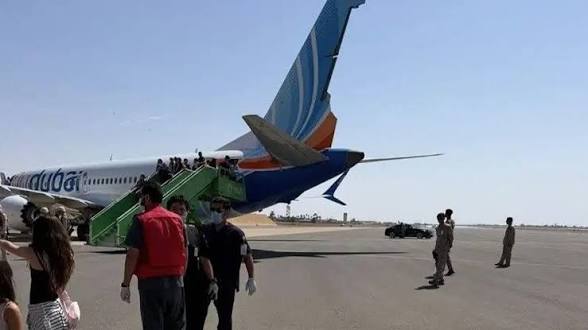
HIJACKING SCARE: Israel-bound flight triggers code 7500, fighter jets scramble, Saudi emergency landing
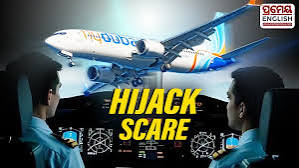
An Israel-bound flydubai flight triggered a major aviation security alert on Wednesday after the aircraft transmitted emergency signals, including code 7500, while flying from Dubai toward Tel Aviv.
The Boeing 737 flight, identified as FZ1073, was eventually diverted to Saudi Arabia and landed safely at Tabuk after a serious incident in the cockpit.
The incident initially raised fears of a possible hijacking. Israeli fighter jets were reportedly scrambled as authorities tried to establish what was happening aboard the aircraft. Later reports indicated that a violent confrontation between the pilots had taken place.
Israeli officials said one pilot allegedly stabbed the other and may have attempted to bring the aircraft down. However, the precise circumstances and motive remain under investigation. Flydubai has confirmed that an incident occurred and that passengers were safe and accounted for.
The dramatic sequence turned a routine Dubai-to-Tel Aviv journey into an international aviation emergency involving Israel, Saudi Arabia and the United Arab Emirates.
What happened on the Israel-bound flight?
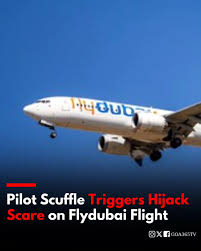
Flight FZ1073 departed Dubai on September 30, 2026, bound for Tel Aviv.
According to reports, the aircraft was carrying more than 170 people. Reuters reported that 172 people were aboard, including 169 Israeli citizens.
Around two and a half hours after departure, the situation changed dramatically.
Flight-tracking data indicated a sharp loss of altitude. Al Jazeera reported that the aircraft dropped more than 14,000 feet in less than 30 seconds. Other reports described an even more dramatic descent from around 34,000 feet.
Passengers reportedly heard shouting and discovered that something was seriously wrong inside the cockpit.
The aircraft then transmitted emergency signals.
What does code 7500 mean?
Code 7500 is an international transponder code associated with unlawful interference or a hijacking situation.
That is why the signal immediately raised concern among aviation and security authorities.
Before the 7500 signal, the aircraft reportedly transmitted code 7700, which indicates a general emergency.
According to Al Jazeera’s reconstruction, the aircraft first transmitted 7700 and later changed to 7500.
The sequence was especially alarming because the aircraft was heading toward Israel, a country with extensive aviation security procedures and a history of aviation-related attacks.
The 7500 signal did not, by itself, establish that a conventional hijacking had taken place. It indicated that authorities should treat the aircraft as facing unlawful interference or a related serious security emergency.
That distinction became important as more information emerged.
Why did Israeli fighter jets scramble?
The 7500 transmission created an immediate security concern.
Israeli authorities reportedly could not initially establish what was happening aboard the aircraft. Because the plane was headed toward Israel and had transmitted a hijacking-related code, Israeli fighter aircraft were scrambled.
The Times of Israel reported that Israeli authorities initially feared a hijacking and sent fighter jets to intercept the aircraft.
The situation was complicated by the aircraft’s changing altitude and difficulties in establishing contact.
From a security perspective, authorities had to consider the possibility that the plane could be under hostile control.
However, the subsequent investigation pointed toward a very different scenario.
What happened inside the cockpit?
Reports indicate that a violent confrontation occurred between the pilots.
Passengers described hearing screams near the front of the aircraft. Videos and eyewitness accounts reportedly showed blood and an injured pilot.
Israeli Prime Minister Benjamin Netanyahu later said that one pilot had stabbed the other and attempted to crash the aircraft. Israeli officials have also suggested that the incident could have been an intentional attack.
However, these remain allegations and investigative findings rather than a final determination.
Flydubai has been more cautious in its public description. The airline confirmed that an incident occurred on the flight and said that the aircraft was secured by crew members who were travelling aboard. It also said all passengers were safe and accounted for.
That difference in wording is important.
The airline has confirmed the emergency and safe landing, while Israeli officials have provided a more detailed account involving an alleged stabbing and possible attempt to crash the plane.
Passengers helped regain control
One of the most striking elements of the incident was the reported intervention of passengers and additional pilots.
As the aircraft descended sharply, people aboard reportedly realised that the plane was not being controlled normally.
Passengers and crew members reportedly managed to reach the cockpit and restrain the person involved in the confrontation.
An off-duty pilot was also reportedly among those who helped stabilise the aircraft.
The Guardian reported that passengers and an off-duty British pilot helped subdue the attacker and that other crew members subsequently stabilised the aircraft.
This intervention appears to have been critical to the safe outcome.
Instead of continuing toward Israel, the aircraft diverted toward northwestern Saudi Arabia.
Why did the plane land in Saudi Arabia?
With the aircraft facing an emergency, the crew sought a safe airport for landing.
The plane eventually landed at Prince Sultan bin Abdulaziz International Airport in Tabuk, Saudi Arabia.
Saudi airport authorities confirmed that the aircraft requested an emergency landing. The airport’s air traffic control centre received the distress call, emergency assistance was mobilised, and the aircraft landed safely.
Both pilots were injured and were taken to hospital for treatment.
Passengers were also assisted inside the airport terminal.
The emergency landing was particularly significant because Saudi Arabia does not have formal diplomatic relations with Israel. Nevertheless, aviation safety considerations took priority, and the aircraft was able to land safely in Saudi territory.
What happened to the passengers?
Despite the frightening incident, passengers survived.
Flydubai confirmed that everyone aboard was safe and accounted for.
After the emergency landing, arrangements were made for passengers to continue their journey.
Reports said passengers later reached Israel on a replacement aircraft.
The incident therefore ended without the mass-casualty scenario that authorities initially feared when the aircraft transmitted the hijacking-related code.
Was this officially a hijacking?
This is one of the most important questions surrounding the incident.
The aircraft transmitted code 7500, which is associated with unlawful interference and commonly linked to hijacking situations.
However, the transmission does not necessarily mean that an organised hijacking occurred.
In this case, subsequent reports indicated that the emergency may have resulted from violence between the pilots.
Al Jazeera specifically noted that there had been no official confirmation of a hijacking attempt at the time of its report.
At the same time, Israeli officials have described the incident in much stronger terms, saying that one pilot may have attempted to crash the aircraft.
Therefore, the safest description is that the flight experienced a serious cockpit security incident that triggered a hijacking alert, rather than treating the exact motive as conclusively established.
Why the sudden altitude drop caused alarm
The aircraft’s rapid descent was another major factor in the emergency.
Flight data cited by Al Jazeera showed the aircraft losing more than 14,000 feet in a very short period.
The Times of Israel reported that the Boeing 737 MAX dropped from roughly 34,000 feet toward much lower altitudes during the crisis.
A sudden descent of that scale can be extremely dangerous.
For passengers, it would also have been difficult to understand what was happening. Reports describe people screaming and fearing that the aircraft was going to crash.
The combination of the altitude loss, cockpit violence, emergency transmissions and loss of normal control created a scenario that authorities had to treat as potentially catastrophic.
Saudi authorities investigate the incident
Saudi authorities became responsible for the aircraft once it landed in Tabuk.
The airport said both pilots had suffered injuries and were transported for medical care. It also confirmed that authorities were continuing their investigation.
Israeli officials have also said they are investigating the incident.
Reuters reported that Saudi authorities arrested and questioned the co-pilot accused of attacking the pilot.
The investigation is expected to examine several questions.
These include how the cockpit confrontation began, how the alleged weapon was obtained, how the aircraft lost altitude, how control was restored and why the emergency signals were transmitted.
Investigators will also need to establish the motive.
Israel considers tighter pilot security checks
The incident has already raised questions about aviation security.
Reuters reported that Israel planned to intensify security checks on pilots flying into the country following the flydubai incident.
Pilot screening already involves extensive procedures in international aviation.
However, the incident highlights a different security challenge.
Traditional aviation security often focuses heavily on preventing passengers from bringing weapons onto aircraft. A cockpit incident involving a crew member raises questions about access, screening, background checks and procedures involving pilots themselves.
The investigation could therefore have implications beyond this single flight.
Flydubai urges caution over speculation
Flydubai has confirmed the incident but has avoided publicly confirming every allegation surrounding the cockpit confrontation.
The airline said its teams were working with the relevant authorities and that further updates would be issued as confirmed information became available.
That approach is significant because several early reports differed in their descriptions of what happened.
Some reports initially described the incident as a fight between pilots.
Later, Israeli officials alleged that one pilot intentionally attacked the other and attempted to crash the aircraft.
As investigators continue their work, confirmed airline statements and official findings will be important in separating established facts from early reports.
A major aviation scare with a safe ending
The FZ1073 incident could have ended very differently.
The aircraft suffered a serious onboard emergency. A hijacking-related transponder code was transmitted. Israeli fighter jets were scrambled. The aircraft experienced a major descent. The cockpit crew was reportedly injured.
Yet the plane reached Saudi Arabia safely.
Passengers and additional crew members reportedly played a role in helping restore control, while Saudi airport authorities quickly prepared for the emergency landing.
The safe landing does not eliminate the questions raised by the incident.
Instead, it makes the investigation even more important.
Authorities now need to establish exactly what happened in the cockpit, why the emergency signals were transmitted and whether the event was an isolated act of violence or part of a broader security threat.
What happens next?
The investigation is likely to involve several authorities and organisations.
Saudi officials will examine the events that occurred aboard the aircraft before and during the emergency landing.
Israeli authorities will investigate the implications for flights carrying Israeli passengers.
Flydubai will also be involved in determining what happened to its crew and aircraft.
Meanwhile, aviation security authorities may review procedures for pilots operating international routes.
The incident could lead to additional checks for crews operating flights into Israel, particularly given the heightened security environment surrounding the region.
For passengers, the main outcome was that the aircraft landed safely and those aboard survived.
For aviation authorities, however, the episode presents a complex security case involving emergency codes, cockpit access, pilot safety, aircraft control and international coordination.
Conclusion
The Israel-bound flight code 7500 incident involving flydubai flight FZ1073 triggered one of the region’s most serious aviation alerts of the day.
The Dubai-to-Tel Aviv flight transmitted emergency signals, including code 7500, prompting Israeli fighter jets to scramble. The aircraft subsequently diverted to Saudi Arabia and made a safe emergency landing in Tabuk.
Reports indicate that a violent cockpit confrontation left both pilots injured and caused a dramatic loss of altitude. Israeli officials have alleged that one pilot attempted to crash the aircraft, while the exact motive and circumstances remain under investigation.
Most importantly, the passengers survived.
The incident also demonstrates why emergency transponder codes are treated so seriously. A 7500 transmission can trigger immediate security responses because authorities cannot initially know whether an aircraft is experiencing a hijacking, unlawful interference or another form of serious cockpit emergency.
As Saudi, Israeli and aviation authorities continue investigating, further confirmed information should clarify exactly what happened aboard FZ1073.
FAQs
What is code 7500 on an aircraft?
Code 7500 is an internationally recognised transponder code used to indicate unlawful interference involving an aircraft, including a potential hijacking situation.
What flight triggered code 7500?
Flydubai flight FZ1073, travelling from Dubai to Tel Aviv, transmitted code 7500 during the September 30, 2026 incident.
Where did the Israel-bound flight land?
The aircraft made an emergency landing at Prince Sultan bin Abdulaziz International Airport in Tabuk, Saudi Arabia.
Were the passengers safe?
Yes. Flydubai said all passengers were safe and accounted for after the aircraft landed in Saudi Arabia.
Why were Israeli fighter jets scrambled?
Israeli fighter aircraft were reportedly scrambled after authorities received the hijacking-related 7500 signal and initially could not determine what was happening aboard the Israel-bound aircraft.
Did a pilot attack another pilot?
Reports from Israeli officials said one pilot allegedly stabbed the other during the flight. Flydubai has confirmed that an incident occurred in the cockpit but has urged caution over premature speculation.
Did the aircraft actually get hijacked?
The aircraft transmitted code 7500, which indicates unlawful interference, but authorities had not conclusively established that a conventional hijacking occurred. Reports instead pointed to a serious confrontation between the pilots.
How much altitude did the plane lose?
Flight-tracking data cited by Al Jazeera indicated that the aircraft lost more than 14,000 feet in less than 30 seconds during the incident.
What happened to the pilots?
Both pilots were injured and taken to hospital after the aircraft landed in Tabuk, according to Saudi airport authorities.
Is the investigation finished?
No. Saudi and Israeli authorities were investigating the incident, while flydubai said further confirmed information would be provided as it became available.
How useful was this post?
Click on a star to rate it!
Average rating 0 / 5. Vote count: 0
No votes so far! Be the first to rate this post.
About the Author

usa5911.com
Administrator
Hi, I’m Gurdeep Singh, a professional content writer from India with over 3 years of experience in the field. I specialize in covering U.S. politics, delivering timely and engaging content tailored specifically for an American audience. Along with my dedicated team, we track and report on all the latest political trends, news, and in-depth analysis shaping the United States today. Our goal is to provide clear, factual, and compelling content that keeps readers informed and engaged with the ever-changing political landscape.