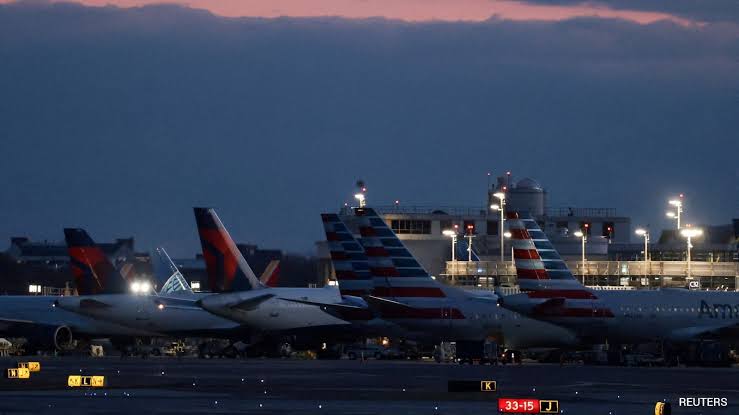
The United States experienced a major aviation disruption on November 13, 2026, after a telecommunications failure forced the Federal Aviation Administration (FAA) to issue a nationwide ground stop. Thousands of passengers faced cancellations, delays, and unexpected travel disruptions as airlines struggled to manage the sudden shutdown.
The incident exposed serious weaknesses in America’s aging air traffic control infrastructure. In particular, problems emerged during work to replace outdated copper telecommunications lines with modern fiber-optic connections.
Transportation Secretary Sean Duffy said a routine equipment upgrade may have triggered a chain reaction across the FAA’s communications network. Officials are investigating whether a faulty router, installation error, or another technical problem caused the failure.
The shutdown lasted nearly five hours. Although the FAA eventually reopened US airspace, the disruption continued affecting airline schedules throughout the weekend.
The incident has raised important questions about the reliability of America’s aviation infrastructure. It has also renewed pressure on the government to accelerate modernization efforts and prevent another nationwide aviation crisis.
What Happened During the US Airspace Shutdown?

The aviation crisis began on Friday, November 13, when the FAA identified serious telecommunications problems affecting the systems used by air traffic controllers.
These systems are essential for maintaining communication between aircraft, pilots, radar facilities, and air traffic control centers. Without reliable data transmission, controllers cannot safely coordinate aircraft movements across busy sections of American airspace.
As the technical problems spread, the FAA faced a difficult decision. It could not confidently establish that the affected systems were operating reliably. Therefore, officials ordered a nationwide ground stop to protect passengers and aviation personnel.
The order prevented departing flights from taking off across the United States.
According to the US Department of Transportation, the disruption affected communications and radar systems used by air traffic controllers. More than 3,500 flights were safely brought to the ground as the FAA worked to isolate the problem.
The ground stop was lifted at approximately 8:15 p.m. Eastern Time on Friday after officials tested the systems and determined that operations could resume safely.
However, reopening the airspace did not immediately restore normal airline operations.
Aircraft and crews were out of position, airport gates became crowded, and passengers faced significant uncertainty about their departure times.
The US Department of Transportation confirmed that more than 8,000 flight operations resumed after the restrictions were lifted.
US Department of Transportation+1
Aging Copper Telecommunications Network Under Scrutiny
One of the biggest concerns following the shutdown involves the age of the telecommunications infrastructure supporting America’s air traffic control system.
The FAA relies on a complex network that connects control towers, regional centers, radar facilities, and other aviation locations.
Some parts of this infrastructure depend on older copper-based communication technology.
Although copper lines have supported telecommunications networks for decades, modern aviation systems increasingly require faster, more reliable digital connections.
Fiber-optic technology offers several advantages, including greater data capacity and improved transmission performance.
However, replacing an operational aviation network is complicated. The FAA cannot simply disconnect its existing infrastructure and install new equipment without carefully managing the transition.
The November 13 incident demonstrated how a seemingly routine upgrade can create serious problems when new equipment interacts with older systems.
Transportation Secretary Sean Duffy explained that a contractor was working to move telecommunications connections from copper lines to fiber.
The work involved transitioning from older transmission technology to modern Internet Protocol-based communications.
Officials said the transition was necessary because some copper infrastructure was becoming obsolete and was being discontinued.
However, something went wrong during the process.
According to the Department of Transportation, a router associated with the transition began generating excessive connection requests. This overwhelmed other routers within the FAA’s network.
The resulting instability affected communications with aircraft and disrupted some radar feeds.
The incident has therefore become a major warning about the risks of modernizing critical infrastructure without sufficient safeguards.
US Department of Transportation+1
How a Router Problem Triggered a Nationwide Ground Stop
The technical explanation provided by federal officials points to a problem involving routers used to manage data across the FAA telecommunications network.
During routine maintenance, equipment was being replaced as part of the transition from copper telecommunications lines to fiber-optic connections.
However, the new equipment reportedly generated an unusually high number of connection attempts.
Secretary Duffy said the affected router was flooding other routers with more than 1,000 connection attempts every four to five seconds.
That unusual activity created instability across the communications network.
The problem was particularly serious because air traffic controllers depend on accurate and timely information.
They need reliable communication channels to coordinate aircraft movements, monitor radar information, and maintain safe distances between planes.
When those systems become unstable, even temporarily, controllers may lose access to information needed to manage traffic safely.
Officials reported that the problem affected 17 of the FAA’s 22 en route centers.
These centers play an important role in managing aircraft traveling between airports across different regions.
The FAA could not immediately identify the exact cause of the technical failure. Consequently, officials decided that grounding departing flights nationwide was the safest available option.
Importantly, the shutdown did not mean that every aircraft already in the sky was suddenly forced into an emergency landing.
Controllers continued managing aircraft safely, and the FAA coordinated the process of bringing flights to the ground.
The distinction matters because the nationwide ground stop primarily prevented departures while aviation authorities worked to restore confidence in the affected systems.
Reuters reported that investigators were examining whether the failure resulted from user error, installation problems, or defective router equipment.
Reuters+1
L3Harris Faces Questions Over Telecommunications Upgrade
The contractor responsible for the telecommunications work has also come under scrutiny.
L3Harris, a major defense and technology company, operates the legacy telecommunications network used by the FAA.
The company has worked with the agency for more than two decades.
According to officials, L3Harris was involved in the maintenance operation that switched telecommunications connections from old copper lines to fiber.
Following the shutdown, Transportation Secretary Sean Duffy questioned whether the contractor had performed the work correctly.
Officials said they were investigating several possibilities.
These include:
A mistake during the installation process.
An error by personnel operating the equipment.
A defective or improperly configured router.
Problems involving compatibility between old and new network equipment.
The government has not established a final cause.
L3Harris said it was taking the incident seriously and supporting the FAA investigation into the circumstances surrounding the November 13 ground stop.
The company also reported that it had completed more than 70% of the planned conversion from legacy copper communications to fiber-optic technology.
This means the modernization project was already well underway when the incident occurred.
However, the failure has raised questions about how contractors test new equipment before connecting it to critical aviation infrastructure.
The investigation will be important in determining whether additional technical safeguards, testing procedures, or contractor oversight are necessary.
It could also influence future government contracts involving the modernization of America’s air traffic control network.
The Times of Israel+1
Thousands of Flights Disrupted Across the United States
Although the FAA lifted the nationwide ground stop on Friday evening, the effects continued throughout Saturday and Sunday.
Airlines faced the difficult task of restoring schedules after thousands of flights were delayed or canceled.
Aviation operations depend on carefully coordinated schedules involving aircraft, pilots, cabin crews, airport staff, and passengers.
When a major disruption occurs, the consequences can continue long after the original technical problem has been resolved.
For example, an aircraft scheduled to depart from one airport may remain stranded elsewhere. Its next scheduled flight can then be delayed or canceled.
Crew scheduling creates another challenge because pilots and flight attendants must comply with working-hour requirements.
Airlines also need to arrange replacement aircraft and communicate new departure information to passengers.
According to reporting by the Associated Press and other outlets, the disruption became one of the longest nationwide ground stops in approximately 25 years.
Flight cancellations and delays affected thousands of travelers.
The disruption also created problems for international passengers whose connecting flights depended on US airport operations.
Airports experienced crowded terminals, long customer-service queues, and uncertainty surrounding departure schedules.
The FAA’s decision to reopen the airspace was an important first step. However, restoring the full flight schedule required additional time and coordination between airlines and airport authorities.
Federal News Network+2
Why the FAA’s Aging Technology Is a Serious Concern
The telecommunications failure has brought renewed attention to the condition of America’s air traffic control infrastructure.
The FAA manages one of the world’s busiest and most complex aviation systems.
Every day, thousands of aircraft depend on its communications, surveillance, and coordination networks.
These systems must operate reliably because even a short interruption can affect aircraft movements across multiple airports.
However, several parts of the infrastructure are decades old.
Officials have acknowledged that maintaining older equipment requires substantial financial investment.
Transportation Secretary Duffy said the FAA spends approximately $1 billion annually maintaining its legacy telecommunications network.
This figure highlights the financial challenge facing the agency.
Rather than operating entirely on modern digital infrastructure, the FAA must maintain older equipment while simultaneously introducing replacement technology.
That creates a difficult transition period.
Older systems may be increasingly expensive to maintain. New systems, meanwhile, can introduce compatibility problems if they are not properly integrated.
The November shutdown demonstrated the importance of managing both sides of that challenge.
Modernization is necessary, but the process must not create additional risks for the aviation network.
The incident also raises questions about whether the government has invested enough in infrastructure maintenance over previous decades.
Reuters+1
Government Responds With Plans to Modernize Air Traffic Control
Following the shutdown, federal officials renewed their commitment to modernizing America’s air traffic control infrastructure.
The Department of Transportation has emphasized that replacing outdated telecommunications technology is necessary to improve reliability and operational efficiency.
Congress has provided $12.5 billion for modernization efforts, according to Secretary Duffy.
The department says significant progress has already been made.
Duffy reported that approximately 69% of the copper communications infrastructure had been replaced with fiber.
The modernization effort also includes upgrades to radio equipment, airport surveillance technology, voice communication systems, and electronic flight strips.
These improvements are intended to reduce dependence on older equipment and provide controllers with more reliable operational information.
However, the government believes additional funding is needed.
Duffy has requested another $50 billion for broader improvements to air traffic control systems and airport infrastructure.
The latest shutdown could strengthen arguments for approving additional investment.
At the same time, lawmakers and aviation experts will likely demand greater accountability for how modernization projects are managed.
Funding alone cannot guarantee success.
The FAA must also ensure that contractors follow appropriate testing procedures and that new equipment works reliably with existing systems.
The November incident demonstrates why technical oversight is just as important as financial investment.
US Department of Transportation+1
Was the US Airspace Shutdown Caused by a Cyberattack?
Another major question following the disruption was whether the telecommunications failure resulted from a cyberattack.
The sudden nationwide ground stop naturally raised security concerns.
America’s aviation infrastructure is considered critical national infrastructure. A serious attack against its communications systems could have significant consequences.
However, federal officials said they had no indication that the incident was caused by a deliberate cyberattack.
Secretary Duffy explained that the problem appeared connected to the equipment and maintenance work being performed during the copper-to-fiber transition.
Homeland Security Secretary Markwayne Mullin also said there was no indication of a malicious act.
Officials reported that isolating the affected equipment helped restore system operations.
This supported the explanation that the disruption was connected to a technical or equipment-related failure rather than a confirmed external attack.
Nevertheless, the investigation remains important.
Government agencies must establish exactly what happened before determining whether additional security measures or contractor requirements are necessary.
For now, the available official information points toward a telecommunications failure during routine maintenance, not a confirmed cyberattack.
US Department of Transportation+1
Previous FAA Failures Raise More Questions
The November 13 shutdown was not the first time an FAA technology problem caused widespread disruption.
In January 2023, a failure involving the agency’s Notice to Air Missions system forced officials to issue a nationwide ground stop.
That incident affected thousands of flights after a problem involving files in the system used to distribute important safety information to pilots.
The FAA later said a contractor had unintentionally deleted files.
Other telecommunications problems have also affected aviation operations.
According to Reuters, previous incidents involved accidental fiber-optic cable cuts, equipment failures, and problems involving network maintenance.
These incidents highlight a recurring concern: America’s aviation network depends on interconnected technology that must remain reliable even when individual components fail.
A problem at one location can sometimes affect operations across a much larger area.
The November shutdown is particularly concerning because the failure occurred during an infrastructure upgrade intended to improve reliability.
It demonstrates that modernization projects need careful planning, independent testing, and effective backup systems.
The government must also ensure that critical aviation services can continue operating when individual network components malfunction.
Without these safeguards, relatively small technical problems could create major nationwide disruptions.
Reuters+1
What Does the Shutdown Mean for American Passengers?
For passengers, the most immediate concern is whether flights will operate according to schedule.
Although the FAA reopened the airspace, airlines needed time to reposition aircraft and crews.
Passengers with connecting flights faced additional uncertainty.
A delayed departure could result in a missed connection, while a canceled flight could require an entirely new travel arrangement.
The disruption also affected international travel.
US airports serve as major connecting points for passengers traveling between Europe, Asia, Latin America, and other destinations.
When American airline operations experience widespread disruption, the consequences can extend beyond US borders.
The FAA’s decision to lift the ground stop therefore did not immediately resolve every passenger’s problem.
Travelers should take several precautions when dealing with the continuing effects of the outage.
Check flight status before leaving home. Airline websites and mobile applications provide updated departure and cancellation information.
Monitor connecting flights. Passengers traveling through major US airports should check every segment of their journey.
Contact the airline about cancellations. Airlines can provide information about rebooking options and alternative routes.
Keep important travel documents accessible. Passengers should retain booking confirmations, identification, and relevant travel information.
Allow additional time at airports. Delays can create longer lines at check-in counters, security checkpoints, and customer-service desks.
The most important point is that passengers should rely on updated airline information rather than assuming that the lifting of the ground stop means every flight has returned to normal.
FAA Says US Air Travel Could Return to Normal by Sunday
By November 15, federal officials were expressing greater confidence about the recovery of American aviation operations.
FAA Administrator Bryan Bedford said the country’s air travel schedule was expected to return to normal by the close of business on Sunday.
However, thousands of passengers were still dealing with the effects of the previous disruptions.
Reports indicated that cancellations continued into Sunday, although the number had declined from the earlier peak.
The recovery depended on airlines restoring aircraft positions, arranging available crews, and clearing passenger backlogs.
This was particularly important because the nationwide shutdown had affected a large number of flights over a relatively short period.
Officials described the worst of the disruption as being behind them.
Nevertheless, the recovery highlighted an important weakness in the aviation industry.
Even after a technical problem is resolved, the operational consequences can continue for days.
A single nationwide interruption can affect airline schedules across multiple countries.
The FAA’s challenge now involves maintaining stable operations while investigators determine precisely what caused the telecommunications failure.
timesofisrael.com+1
What Happens Next in the FAA Investigation?
The investigation into the November 13 shutdown will focus on the technical circumstances surrounding the copper-to-fiber transition.
One of the main questions is whether the router involved in the maintenance operation was defective or improperly configured.
Investigators will also need to examine whether the contractor followed the correct installation and testing procedures.
Another important issue involves the FAA’s existing network architecture.
If a single equipment problem can generate excessive connection requests across multiple facilities, officials may need to reconsider how network traffic is monitored and controlled.
The investigation could examine several areas:
1. Router performance: Investigators will determine why the equipment generated such a high volume of connection attempts.
2. Installation procedures: Officials will examine whether the contractor followed the required technical standards.
3. Network compatibility: Engineers will assess how the new equipment interacted with older telecommunications infrastructure.
4. Backup systems: Authorities will review whether sufficient protections existed to isolate the problem before it spread.
5. Emergency response: Investigators will examine how quickly the FAA identified the disruption and restored reliable operations.
The findings could lead to changes in contractor oversight, equipment testing, and network maintenance procedures.
They may also influence the timing and structure of future infrastructure upgrades.
However, officials have not yet announced a definitive technical conclusion.
It is important to distinguish between the suspected equipment-related cause and the final findings of the investigation.
Why This Incident Could Change America’s Aviation Modernization Plans
The nationwide shutdown could become an important turning point in the debate over aviation infrastructure funding.
For years, the FAA has faced pressure to replace aging technology.
Air traffic controllers depend on a combination of communications equipment, radar systems, computer networks, and operational software.
Some of these systems were designed decades ago.
Keeping them operational requires specialized maintenance and replacement components.
At the same time, the aviation industry continues to grow more dependent on digital technology.
This creates a significant challenge for federal officials.
The government must modernize infrastructure without disrupting the services that millions of passengers depend on.
The November outage provides a clear example of what can happen when that transition goes wrong.
It could encourage lawmakers to examine whether existing modernization funding is sufficient.
It could also increase pressure on contractors to demonstrate that new equipment has been properly tested before being introduced into critical systems.
However, replacing outdated technology is not a simple process.
The FAA must coordinate upgrades across hundreds of facilities while maintaining continuous aviation operations.
That requires careful scheduling, effective backup arrangements, and stronger monitoring systems.
The goal should be a network that can withstand individual equipment failures without creating nationwide disruptions.
The Bigger Lesson From the Nationwide Ground Stop
The November 13 aviation crisis was more than a temporary telecommunications outage.
It exposed the relationship between aging infrastructure and the reliability of essential public services.
Modern aircraft are equipped with sophisticated technology. Airports use advanced digital systems, and airlines increasingly depend on real-time information.
Yet the infrastructure supporting air traffic control still includes older telecommunications components.
That contrast has raised serious questions about America’s readiness to manage future aviation demands.
The shutdown also demonstrated why safety must remain the priority.
The FAA chose to restrict departures rather than risk operating with unstable communications and radar information.
Although the decision created major inconvenience, reliable communication is essential for maintaining safe distances between aircraft and coordinating air traffic.
The next challenge is preventing a similar failure.
The government must determine exactly what happened, hold responsible parties accountable where appropriate, and strengthen the systems used to manage American airspace.
The incident has made one point clear: upgrading old technology is no longer simply an administrative task. It is an essential part of maintaining the reliability of the nation’s aviation system.
Frequently Asked Questions (FAQs)
1. Why was US airspace shut down on November 13, 2026?
The FAA ordered a nationwide ground stop after telecommunications problems affected systems used by air traffic controllers. The disruption involved unstable network communications and some radar data feeds.
2. Did aging copper wires cause the US aviation shutdown?
The outage occurred during work to replace aging copper telecommunications lines with fiber-optic connections. Officials believe a router problem associated with the upgrade triggered the disruption. The exact cause remains under investigation.
3. How long did the nationwide flight shutdown last?
The nationwide ground stop lasted nearly five hours. The FAA lifted the restrictions at approximately 8:15 p.m. Eastern Time on November 13.
4. Were all flights in the United States grounded?
The ground stop prevented departing flights from taking off nationwide. Aircraft already airborne were safely managed by air traffic controllers and brought to the ground as necessary.
5. Was the FAA telecommunications outage caused by a cyberattack?
Federal officials said there was no indication of a cyberattack. Their initial explanation pointed toward a technical failure involving equipment used during telecommunications upgrades.
6. Which company was involved in the telecommunications upgrade?
L3Harris was the contractor involved in the maintenance and telecommunications network work. The company said it was cooperating with the investigation.
7. How many FAA air traffic control centers were affected?
Officials said the telecommunications problems affected 17 of the FAA’s 22 en route centers.
8. When did US flights return to normal?
The FAA lifted the ground stop on November 13. However, cancellations and delays continued over the weekend. FAA Administrator Bryan Bedford expected normal flight schedules to return by the close of business on November 15.
9. How much does the FAA spend maintaining its old telecommunications network?
Transportation officials said the FAA spends approximately $1 billion annually maintaining its legacy telecommunications infrastructure.
10. What is the FAA doing to prevent another nationwide shutdown?
The agency is replacing older copper connections with fiber-optic technology and upgrading communications, radar, and other air traffic control equipment. Officials are also investigating the November failure to identify additional safeguards.
Conclusion
The US airspace shutdown on November 13 exposed significant vulnerabilities in the telecommunications infrastructure supporting American aviation.
A routine effort to replace aging copper lines with fiber-optic technology reportedly triggered a router problem that affected communications and radar information across multiple FAA facilities.
The resulting nationwide ground stop disrupted thousands of flights and left passengers dealing with cancellations and delays.
Although the FAA restored operations within hours, the consequences continued throughout the weekend.
The incident has increased pressure on the government to modernize outdated aviation technology and improve oversight of contractors responsible for critical infrastructure.
For now, investigators must determine exactly what caused the failure and how similar incidents can be prevented.
The central lesson is clear: America’s aviation system needs reliable, modern communications infrastructure to keep passengers safe and flights operating smoothly.
About the Author