China’s expanding military capabilities are again putting Taiwan at the center of global security concerns. Beijing has increased military, maritime and air pressure around the island, while Taiwan and the United States continue strengthening their preparations for a possible crisis.
The latest developments have fueled warnings about the China Taiwan invasion risk, particularly as the People’s Liberation Army improves its ability to operate around the Taiwan Strait. However, claims that an invasion is definitely imminent go beyond the available evidence.
Recent assessments point to a more complicated picture. China is preparing for a range of contingencies, including coercion, blockade, limited military operations and a full-scale invasion. At the same time, experts continue to debate when, or even whether, Beijing would choose to launch a major attack.
That uncertainty is becoming increasingly important for Washington, Taipei and countries across the Indo-Pacific.
China’s Military Buildup Raises Taiwan Concerns
China has spent years modernizing the People’s Liberation Army. The buildup covers missiles, aircraft, naval forces, cyber capabilities, space systems and other military technologies.
The U.S. Department of Defense has described China’s military expansion as a major challenge to Indo-Pacific security. A 2025 Pentagon report said Chinese President Xi Jinping had directed the PLA to be ready for a Taiwan contingency by 2027. That readiness target, however, should not automatically be interpreted as an order to invade in 2027.
This distinction matters.
Military readiness means that a country wants its forces capable of carrying out an operation if political leaders decide to authorize it. It does not necessarily mean that leaders have already decided to begin that operation.
China’s military preparations nevertheless give Beijing more options. Those options could include military exercises, maritime pressure, cyber operations, economic restrictions, a blockade or a much larger military campaign.
Is a Taiwan Invasion Actually Imminent?
The word “imminent” requires caution.
There is significant evidence that China is preparing for a potential Taiwan conflict. There is also evidence that Beijing is increasing pressure below the threshold of full-scale war.
But current expert assessments do not establish that an invasion is about to begin.
A Brookings analysis published in August 2026 said a full-scale Chinese invasion of Taiwan was unlikely by 2027. Another Brookings policy analysis published earlier in 2026 said Beijing had intensified military, economic and diplomatic pressure, while emphasizing that conflict was neither imminent nor inevitable.
At the same time, the U.S.-China Economic and Security Review Commission has warned that the United States and its partners cannot simply assume that a Taiwan crisis would provide months or years of warning.
That creates a difficult strategic problem.
Washington must prepare for a serious contingency without treating every military exercise as proof that an invasion has been ordered.
Beijing’s Gray-Zone Strategy
One of the most important developments is China’s growing use of what analysts call gray-zone pressure.
Gray-zone activity sits between normal competition and open warfare. It can involve military patrols, coast guard operations, air activity, maritime law enforcement, cyber pressure, information campaigns and economic measures.
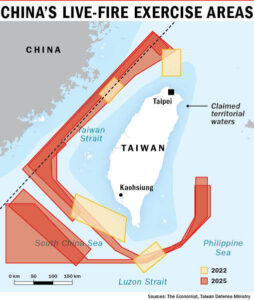
The Center for Strategic and International Studies reported in 2026 that China’s maritime and air pressure against Taiwan had increased significantly. Its research found a major rise in China Coast Guard activity around Taiwan between 2020 and 2025.
This strategy can place pressure on Taiwan without crossing the threshold of a conventional invasion.
For Beijing, such operations can demonstrate military capability and increase pressure on Taipei. For Taiwan, however, repeated activity can force its armed forces to remain on alert.
That creates another strategic challenge: maintaining readiness without allowing routine pressure to become normalized.
Taiwan Is Building Its Own Defenses
Taiwan has also expanded its military preparations.
The island is investing in missiles, drones, air defense, naval capabilities and other systems intended to make an attack more difficult.
In September 2026, Taiwan conducted military drills involving attack drones and conventional weapons. The exercises included anti-air, anti-ship and anti-landing missile systems. Taiwan has increasingly emphasized technologies designed to make its forces more flexible and resilient during a potential conflict.
Taiwan has also conducted exercises focused specifically on responding to a blockade.
In August 2026, Taiwan’s armed forces carried out an anti-blockade drill involving the navy and coast guard. The exercise simulated escorting a merchant vessel through a potential maritime crisis.
The focus on blockade scenarios is significant because a Taiwan crisis would not necessarily begin with troops landing on the island.
A Blockade Could Come Before an Invasion
A full-scale invasion would be an extraordinarily complex military operation.
China would have to move large numbers of troops and equipment across the Taiwan Strait while facing Taiwan’s defenses and potentially outside intervention.
A blockade or quarantine could present a different challenge.
China could attempt to restrict shipping, inspect vessels, impose maritime controls or use military and coast guard forces to pressure Taiwan.
Such an approach could create severe economic disruption without immediately producing the same battlefield conditions as an invasion.
Taiwan’s anti-blockade exercises show that officials are taking this possibility seriously. Reuters reported that Taipei has long been concerned Beijing could use a blockade or quarantine to pressure the island into surrender.
The distinction between blockade and invasion is therefore important when assessing claims about a coming Taiwan war.
China’s New Mobilization Measures
Another development has attracted attention from security analysts.
According to the Institute for the Study of War’s September 4, 2026 China-Taiwan update, China’s National People’s Congress approved revisions to the National Defense Mobilization Law on August 28. The revised law is scheduled to take effect on October 1.
The analysis said the changes could broaden Beijing’s ability to mobilize civilian resources during national-security crises or short-of-war situations. That could potentially provide additional transport and logistical capacity during a Taiwan contingency.
Such legislation does not prove that China has decided to invade Taiwan.
However, it is another example of Beijing developing mechanisms that could support national mobilization if a major security crisis occurred.
The U.S. Faces a Difficult Taiwan Dilemma
Washington faces its own strategic problem.
The United States maintains a long-standing relationship with Taiwan while also maintaining diplomatic relations with Beijing. U.S. policy has historically sought to preserve deterrence and avoid encouraging either a unilateral declaration of Taiwanese independence or a forced change to the status quo.
The precise circumstances under which the United States would intervene militarily remain a major question.
Recent reporting has highlighted uncertainty surrounding Washington’s policy. Reuters reported in September 2026 that U.S. allies in Asia were concerned about President Donald Trump’s approach to Taiwan ahead of a potential meeting with Chinese President Xi Jinping. The report said Taiwan, Japan and other regional actors were watching U.S. statements and arms decisions closely.
This uncertainty is strategically important because deterrence depends partly on what Beijing believes Washington and its partners would do during a crisis.
Economic Warfare Could Be Just as Important
A Taiwan conflict would not be limited to military operations.
Economic warfare could become one of its most consequential dimensions.
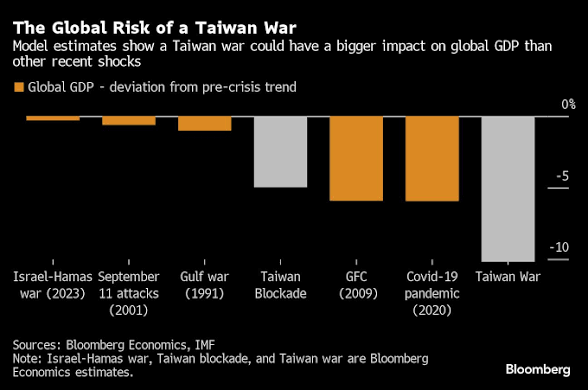
China and the United States are deeply connected through trade, technology, finance and manufacturing. A major confrontation could disrupt supply chains across Asia and beyond.
Taiwan itself has an enormous role in the global semiconductor industry. Any prolonged disruption could affect electronics, automobiles, artificial intelligence systems, telecommunications equipment and other industries.
Sanctions could also become part of the confrontation.
The United States and its allies could impose restrictions on Chinese banks, technology companies, exports or financial transactions. Beijing could respond with its own restrictions against foreign businesses.
The result could be an economic shock extending far beyond East Asia.
Semiconductors Make Taiwan Strategically Important
Taiwan’s semiconductor industry adds another layer to the security debate.
The island is home to some of the world’s most important advanced chip manufacturing capabilities. These chips are used in smartphones, computers, automobiles, data centers, artificial intelligence systems and military technologies.
That means a Taiwan crisis could affect industries that have little direct connection to geopolitics.
A disruption to semiconductor production could create shortages and increase prices.
For Washington, Beijing and other governments, the semiconductor industry therefore has strategic significance.
Taiwan’s technology sector is also one reason the island’s defense has become an economic issue rather than only a military issue.
China’s Economic Leverage
China has its own economic tools.
Beijing can influence trade, investment, critical minerals and manufacturing supply chains. China also has a large domestic market that gives it considerable leverage over multinational companies.
Economic pressure could therefore accompany military activity.
However, economic warfare would also impose costs on China itself.
A major confrontation could reduce foreign investment, disrupt exports, damage financial confidence and create problems for Chinese companies.
This creates a powerful deterrent on both sides.
The economic consequences of war could be so large that governments may have strong incentives to avoid escalation, even while preparing for the possibility.
Military Exercises Are Sending a Message
Military exercises around Taiwan serve several purposes.
They can improve operational readiness. They can test communications and command systems. They can collect intelligence. They can also send political messages.
China’s exercises can demonstrate its ability to operate around Taiwan.
Taiwan’s exercises can demonstrate its ability to respond.
The United States and regional partners can also conduct exercises designed to improve coordination.
But exercises should not automatically be interpreted as evidence that war is about to begin.
Military drills are often part of long-term preparation and signaling.
The challenge for analysts is identifying when routine exercises become part of an actual military mobilization.
Experts Warn About a Crisis, Not Just an Invasion
Some experts have shifted attention away from the question of whether China will immediately invade.
Instead, they are examining how a crisis could develop.
A September 2026 analysis from Taiwan cited Stanford scholar Eyck Freymann arguing that Taiwan and the United States should prepare for crises caused by China’s increasing gray-zone pressure rather than focus exclusively on a full-scale war.
This approach changes the discussion.
A Taiwan crisis could begin with an incident involving aircraft or ships. It could involve a maritime inspection, cyberattack, blockade announcement or sudden military exercise.
Each event could create pressure for the other side to respond.
The danger is that escalation can occur even when neither government initially wants a major war.
What Would an Invasion Look Like?
A Chinese invasion would likely require extensive preparation.
Potential indicators could include large-scale mobilization, unusual movements of military and civilian vessels, logistics preparations, missile deployments, cyber activity and disruptions to normal communications.
However, no single indicator would prove an invasion was coming.
China could also use military demonstrations to create uncertainty without launching an attack.
For this reason, intelligence assessments would likely focus on multiple indicators rather than one dramatic development.
The same principle applies to headlines claiming that an invasion is “days away” or “imminent.”
Such claims require strong evidence.
Why 2027 Keeps Appearing in Taiwan Warnings
The year 2027 has frequently appeared in discussions about Taiwan.
The reason is largely connected to military readiness.
U.S. officials have previously described 2027 as a target for the PLA to possess the capabilities required for a Taiwan operation.
But a capability deadline is not the same as an invasion deadline.
The distinction is crucial.
China could reach a military readiness milestone without using those capabilities.
Likewise, political circumstances, economic conditions, international reactions and assessments of Taiwan’s defenses could influence any future decision by Beijing.
Therefore, treating 2027 as an automatic invasion date would oversimplify the available evidence.
The Biggest Risk May Be Miscalculation
The most immediate danger may not necessarily be a planned invasion.
It could be miscalculation.
China, Taiwan and the United States are operating in a highly contested environment. Aircraft and naval vessels increasingly operate close to one another.
More activity creates more opportunities for accidents or misunderstandings.
A relatively small incident could become politically difficult to contain.
Leaders might face domestic pressure to respond. Military forces could move into more dangerous positions. Communication channels could become strained.
That is why crisis-management mechanisms and clear communication remain important.
What This Means for the United States
For Washington, the Taiwan challenge involves balancing deterrence with escalation management.
The United States must assess Taiwan’s defense requirements while considering the possibility that additional military support could affect China’s calculations.
American officials must also consider U.S. force posture across the Indo-Pacific, relationships with Japan, South Korea, Australia and the Philippines, and the broader economic consequences of a conflict.
Recent reporting indicates that U.S. allies are closely monitoring Washington’s approach.
That means Taiwan policy has consequences well beyond the island itself.
What Happens Next?
The Taiwan Strait is likely to remain one of the world’s most closely watched security flashpoints.
China continues expanding its military capabilities. Taiwan continues strengthening its defenses. The United States and its allies continue examining deterrence and crisis-response options.
At the same time, current evidence does not establish that a Chinese invasion is imminent.
The more defensible conclusion is that Beijing is preparing for a wider range of possible Taiwan contingencies while increasing pressure on the island.
The coming months will therefore be important.
Military exercises, maritime activity, economic policy, diplomatic negotiations and changes in U.S.-China relations could all influence the trajectory.
Conclusion
The China Taiwan invasion risk is a serious international security issue, but it should be separated from claims that an invasion is already imminent.
China’s military buildup is real. Its pressure around Taiwan has increased. Beijing is developing capabilities that could support a blockade or invasion, while Taiwan is expanding its own military preparedness. The United States and its regional partners are also reassessing deterrence.
At the same time, current expert assessments do not establish a fixed invasion date.
The central issue is therefore not simply whether China will invade Taiwan tomorrow. It is whether increasing military pressure, economic competition and political uncertainty could produce a crisis that becomes difficult to control.
For Washington, Taipei and Beijing, deterrence and crisis management will remain critical.
For the global economy, the stakes are enormous.
And for the Indo-Pacific, the Taiwan Strait will remain a major test of whether intense strategic competition can continue without becoming open conflict.
FAQs
Is China preparing to invade Taiwan?
China is developing military capabilities that could be used in a Taiwan contingency. However, current public assessments do not establish that Beijing has ordered an imminent invasion.
Is a Taiwan invasion expected in 2027?
2027 is frequently discussed because U.S. officials have described it as a PLA readiness target. It should not be treated as a confirmed invasion date. Some 2026 expert assessments have said a full-scale invasion by 2027 is unlikely.
What is China’s gray-zone pressure against Taiwan?
Gray-zone pressure includes activities below the level of open warfare, such as military patrols, coast guard operations, air activity, maritime pressure and other coercive measures.
Could China blockade Taiwan instead of invading?
A blockade or quarantine is one possible scenario discussed by Taiwan and security analysts. Taiwan conducted an anti-blockade exercise in August 2026 to prepare for such a contingency.
Why is Taiwan important to the global economy?
Taiwan is a major center of advanced semiconductor manufacturing. A serious disruption could affect electronics, automobiles, artificial intelligence infrastructure and other global industries.
Would the United States defend Taiwan?
U.S. policy involves strategic ambiguity regarding the exact circumstances of American military intervention. Washington’s approach and commitments remain closely watched by Taiwan, China and U.S. allies.
Is a China-Taiwan war inevitable?
No. Analysts continue to debate the risk. A Brookings analysis published in March 2026 stated that conflict was neither imminent nor inevitable.
What is the biggest concern for the United States?
The concerns include Chinese military modernization, gray-zone pressure, a possible blockade, regional escalation, semiconductor disruption and the possibility of a wider U.S.-China confrontation.
What is Taiwan doing to prepare?
Taiwan is strengthening its military capabilities and conducting exercises involving drones, missiles, naval forces and responses to potential blockades.
Could economic warfare accompany a Taiwan conflict?
Yes. A major confrontation could involve sanctions, export restrictions, financial measures, supply-chain disruption and restrictions on critical technologies. Such actions could affect both China and the wider global economy.
About the Author