Geopolitics Breaking News: Houthis Unleash Barrage on Saudi Arabia as US Embassies Placed on High Alert
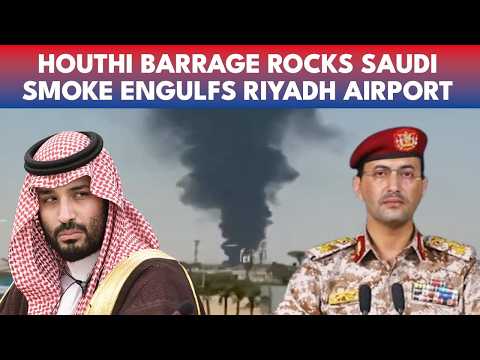
The security situation in the Middle East has entered another tense phase after Yemen’s Houthi movement claimed a series of missile and drone attacks against Saudi Arabia, including targets around the capital Riyadh. Saudi authorities confirmed that a ballistic missile launched toward Riyadh was intercepted, while explosions and smoke were reported near King Khalid International Airport.
The developments have also triggered fresh warnings from the United States. US diplomatic missions across the Middle East have urged American citizens to exercise heightened vigilance, warning that the military conflict involving Saudi Arabia and the Houthis could escalate rapidly.
The latest confrontation is significant because Riyadh had previously faced Houthi attacks during the Yemen war, but the renewed fighting represents a major escalation in the current conflict. Saturday’s reported missile attack was described by international news agencies as the first reported strike threatening Riyadh since the latest escalation began.
Houthis Claim Missile and Drone Operations Against Saudi Arabia
The Houthis said they launched two military operations involving ballistic and cruise missiles as well as drones.
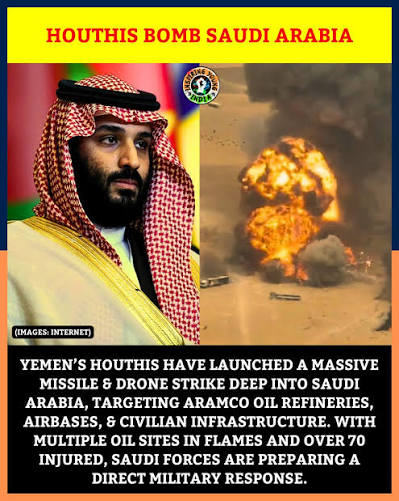
According to the Houthi military statement, one operation targeted what the group described as sensitive sites in Riyadh. The second reportedly targeted facilities belonging to Saudi oil giant Aramco in Yanbu on the Red Sea coast.
Saudi Arabia confirmed that a ballistic missile was fired toward Riyadh. Saudi-led coalition forces said the missile was successfully intercepted and destroyed.
Saudi authorities also reported attempted attacks against civilian and infrastructure targets in several parts of the kingdom.
However, not every Houthi claim has been independently verified. Reports of damage to specific Saudi facilities, particularly claims concerning oil infrastructure, should therefore be treated separately from the confirmed missile interception.
This distinction is important as the conflict develops. Missile launches, air-defense interceptions and official warnings can often be independently reported, while claims about successful strikes against military or energy targets can take longer to verify.
Smoke Reported Near Riyadh Airport
The latest incident created visible signs of the heightened security situation in Riyadh.
Reuters reported images and video showing a large column of black smoke near the airport area. Flames were also seen near what appeared to be fuel-storage infrastructure.
Saudi authorities had issued an overnight warning about a hostile aerial threat. Residents in Riyadh subsequently reported hearing explosions.
The Saudi Civil Defence authorities later issued an all-clear after the threat.
The incident is particularly important because King Khalid International Airport is a major civilian transportation hub. Any sustained threat to aviation infrastructure could affect commercial flights, airspace management and regional travel.
The possibility of disruption has also become a central concern for foreign governments.
US Embassies Issue Heightened Security Warnings
The United States has responded to the escalation with security alerts across several Middle Eastern missions.
US diplomatic missions in countries including Bahrain, Israel, Iraq, Jordan, Kuwait, Lebanon, Oman, Qatar, Saudi Arabia and the United Arab Emirates issued warnings urging Americans to remain vigilant. The alerts highlighted possible flight cancellations, airspace closures and travel disruptions.
The US Embassy in Israel also warned that the military conflict could escalate rapidly.
The embassy noted that the Houthis have previously targeted civilian airports. Americans traveling to or from the region were advised to monitor airport and airline information closely.
These warnings do not necessarily mean that US diplomatic facilities are being evacuated or closed. Instead, they reflect the broader assessment that regional security conditions can change quickly.
That distinction is important because the phrase “US embassies on high alert” can imply an immediate attack against diplomatic compounds. The available reports instead describe heightened security warnings and vigilance measures issued by multiple US missions.
Washington Warns of Possible Rapid Escalation
The US State Department has warned that the Saudi-Houthi conflict has the potential to escalate rapidly.
The warning came as the Houthi movement intensified its military activity against Saudi Arabia.
The State Department has also advised Americans outside the Middle East to seriously reconsider travel to and through the region. The warning reflects concerns about possible airspace closures, flight cancellations and changing security conditions.
The United States had already maintained a Level 3 travel advisory for Saudi Arabia, meaning Americans are advised to reconsider travel. The advisory cites risks including Iranian missile and drone attacks, armed conflict and terrorism.
The latest Houthi-Saudi confrontation therefore comes on top of an already elevated regional security environment.
Why Riyadh Matters in the Current Crisis
Riyadh is not only Saudi Arabia’s political capital. It is also a critical center for government, finance, infrastructure and regional diplomacy.
A sustained campaign targeting the capital could have consequences beyond the immediate military confrontation.
For Saudi Arabia, air-defense capabilities will be particularly important. Intercepting incoming missiles can reduce casualties and damage, but repeated attacks can place pressure on interceptor inventories and defensive systems.
International reporting has indicated that Saudi Arabia has sought additional air-defense support from several countries as the conflict has intensified.
At the same time, Saudi Arabia has continued military operations against Houthi-controlled areas in Yemen.
That creates a cycle in which Houthi attacks can trigger further Saudi military action, potentially widening the confrontation.
Saudi Oil Infrastructure Faces Additional Risk
One of the biggest geopolitical concerns is the potential impact on Saudi Arabia’s energy infrastructure.
Saudi Arabia is one of the world’s largest oil producers and a major exporter. Its facilities on the Red Sea and elsewhere are strategically important to global energy markets.
The Houthis have claimed that their recent operations targeted Saudi oil facilities, including Aramco infrastructure in Yanbu. Saudi authorities have disputed or not independently confirmed some of these claims, meaning reports of specific damage need to be treated cautiously.
Nevertheless, the possibility of attacks on energy infrastructure has already raised concerns about global oil supply.
Even when an attack causes limited physical damage, the perception of increased risk can affect shipping insurance, tanker routes, energy prices and market expectations.
The Red Sea is also a major transportation corridor connecting the Indian Ocean with the Mediterranean through the Suez Canal.
Red Sea Shipping Adds Another Layer of Risk
The Houthi movement has previously attacked commercial shipping in and around the Red Sea, creating major concerns for international trade.
The latest escalation comes as the Houthis have expanded their territorial position along parts of Yemen’s Red Sea coastline. Reporting indicates that the group has also taken control of strategically significant areas, including the port of Mokha and nearby islands.
The Bab al-Mandeb Strait is especially important.
The narrow waterway connects the Red Sea with the Gulf of Aden and serves as one of the world’s key maritime trade routes.
Any prolonged insecurity in the area could force shipping companies to consider longer routes around Africa. That can increase transportation costs and extend delivery times.
Energy shipments are particularly sensitive to these developments.
US-Saudi Relations Face a Complicated Moment
The latest confrontation also highlights the complexity of the US relationship with Saudi Arabia.
Washington remains an important security partner for Riyadh, while the United States has also been attempting to manage its broader military and diplomatic commitments across the Middle East.
Recent reporting indicated that US officials had decided not to directly intervene on Saudi Arabia’s behalf against the Houthi advance inside Yemen after meetings with Houthi representatives in Oman.
That position makes the latest missile attack particularly significant.
Saudi Arabia has to manage the immediate threat while also considering its wider military strategy in Yemen.
For Washington, the challenge involves balancing regional security commitments with the risk of becoming directly involved in another expanding conflict.
Iran’s Role Remains a Central Issue
The Houthis are widely described by international governments and news organizations as an Iran-aligned or Iran-backed movement.
Saudi officials and their allies have repeatedly accused Tehran of supporting Houthi military capabilities.
Iran’s relationship with the Houthis is therefore central to how governments interpret the conflict.
However, describing the Houthis simply as an Iranian proxy can overlook the group’s own political and military objectives in Yemen.
The current confrontation has its own local roots in Yemen’s civil war, while regional rivalries have added another layer.
The conflict therefore involves several overlapping dimensions: Yemen’s internal struggle, Saudi security concerns, Iranian regional influence, Red Sea shipping and the wider confrontation involving the United States and other Middle Eastern powers.
Why the Latest Attack Could Affect Global Markets
The immediate military impact of the Riyadh attack appears limited compared with the potential economic consequences.
Saudi Arabia remains one of the world’s most important oil suppliers.
Markets closely monitor threats to production facilities, export terminals and shipping routes.
If attacks remain isolated and Saudi air defenses continue intercepting incoming weapons, the direct impact on global supply could remain limited.
However, a broader campaign against oil infrastructure or shipping could create more serious consequences.
Potential effects could include:
- Higher shipping insurance costs
- Longer maritime routes
- Greater volatility in oil prices
- Delays in energy deliveries
- Increased security costs for commercial vessels
- Higher transportation expenses
These effects would depend heavily on the duration and geographical spread of the conflict.
What Happens Next?
The immediate question is whether the latest Houthi attacks represent a short-term escalation or the beginning of a broader campaign against Saudi Arabia.
Saudi Arabia has already responded militarily to Houthi advances and attacks.
The Houthis, meanwhile, have demonstrated their ability and willingness to use missiles and drones against targets well beyond Yemen’s immediate borders.
The United States is closely monitoring the situation but has so far emphasized warnings to American citizens and diplomatic security rather than announcing direct military intervention against the Houthis.
The situation could develop in several directions.
One possibility is continued exchanges of missile and drone attacks.
Another is an expansion of Saudi military operations in Yemen.
A third possibility involves diplomatic efforts designed to prevent the conflict from spreading further.
The future of Red Sea shipping will also be closely watched.
International Community Watches the Escalation
The latest fighting has drawn international attention because of the potential impact on civilians, energy infrastructure and maritime trade.
Saudi Arabia has emphasized the need to protect its population and critical infrastructure.
The Houthis say their attacks are responses to Saudi military actions and have presented their operations as retaliation.
Those competing explanations underline the difficulty of separating immediate military events from the broader political conflict.
For international observers, the most important developments to monitor will include verified damage to infrastructure, additional missile launches, changes in airspace restrictions, shipping disruptions and new diplomatic initiatives.
Houthi Attack on Saudi Arabia: Key Facts
The most significant confirmed and reported developments include:
Ballistic missile toward Riyadh: Saudi authorities said a Houthi ballistic missile targeting Riyadh was intercepted and destroyed.
Smoke near the airport: Reuters and other outlets reported visible smoke and flames in the vicinity of Riyadh’s airport.
Houthi claims: The Houthis said they launched missile and drone operations against targets in Riyadh and Yanbu. Some claims remain independently unverified.
US security alerts: Multiple US missions in the Middle East warned Americans to exercise heightened vigilance.
Travel concerns: The US government has urged Americans to reconsider travel to the region amid the possibility of rapid escalation.
Oil concerns: Any sustained threat to Saudi energy infrastructure or Red Sea shipping could have implications for global energy markets.
Conclusion
The latest Houthis attack on Saudi Arabia has pushed the Yemen conflict into another dangerous phase.
The reported missile launch toward Riyadh, the visible smoke near the capital’s airport and the subsequent US security warnings demonstrate the seriousness of the current escalation. Saudi Arabia says its air defenses intercepted the ballistic missile, while the Houthis claim broader attacks against Saudi targets.
At the same time, the US response has focused heavily on security warnings, travel risks and heightened vigilance. US missions across the Middle East have cautioned that conditions could deteriorate quickly.
The wider consequences will depend on what happens next.
If attacks remain limited, the crisis could remain largely contained. If Saudi oil infrastructure, civilian airports or Red Sea shipping routes face sustained attacks, however, the economic and geopolitical consequences could become considerably wider.
For now, the most important developments to watch are further Houthi missile and drone launches, Saudi military responses, US security measures, commercial aviation disruptions and any diplomatic efforts aimed at containing the conflict.
The situation remains fluid, and claims from the opposing sides should continue to be checked against independently verified reporting.
FAQs
1. What happened in Saudi Arabia?
Saudi Arabia said a ballistic missile launched by Yemen’s Houthis toward Riyadh was intercepted and destroyed. Explosions and smoke were reported near the capital’s airport.
2. Did the Houthis attack Riyadh?
The Houthis claimed they launched missile and drone operations against sensitive sites in Riyadh. Saudi Arabia confirmed that a ballistic missile was fired toward the capital but said it was intercepted.
3. Why are US embassies issuing security alerts?
US diplomatic missions across the Middle East have warned Americans to exercise heightened vigilance because the conflict could escalate rapidly and cause flight cancellations, airspace closures and other disruptions.
4. Is Saudi Arabia’s oil supply under threat?
There are concerns because the Houthis have claimed attacks against Saudi energy facilities. However, individual claims about successful strikes and damage should be distinguished from independently verified information.
5. Are flights being affected?
US security warnings specifically mention the possibility of flight cancellations and airspace closures. Travelers have been advised to check directly with airlines and airports for the latest information.
6. What is the Bab al-Mandeb Strait?
The Bab al-Mandeb is a strategically important waterway connecting the Red Sea with the Gulf of Aden. Disruption there can affect international shipping between Asia, Europe and the Middle East.
7. Are the Houthis supported by Iran?
International reporting commonly describes the Houthis as Iran-aligned or Iran-backed. The extent and nature of Iranian support is a major part of regional geopolitical debate.
8. Could the conflict affect global oil prices?
It could, particularly if attacks spread to major production or export facilities or disrupt maritime energy shipments. The actual market impact will depend on the scale and duration of any disruption.
9. Has Saudi Arabia confirmed casualties from the Riyadh missile?
The Saudi reports cited in current coverage said there were no casualties or damage from the intercepted missile itself.
10. What should travelers do?
Travelers should monitor official government advisories, airline notifications and airport announcements because security conditions and flight operations can change rapidly. The US State Department currently advises Americans to reconsider travel to Saudi Arabia.
How useful was this post?
Click on a star to rate it!
Average rating 0 / 5. Vote count: 0
No votes so far! Be the first to rate this post.
About the Author

usa5911.com
Administrator
Hi, I’m Gurdeep Singh, a professional content writer from India with over 3 years of experience in the field. I specialize in covering U.S. politics, delivering timely and engaging content tailored specifically for an American audience. Along with my dedicated team, we track and report on all the latest political trends, news, and in-depth analysis shaping the United States today. Our goal is to provide clear, factual, and compelling content that keeps readers informed and engaged with the ever-changing political landscape.