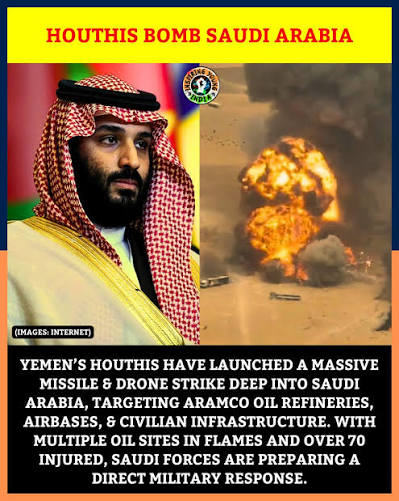
The latest Saudi missile strike Houthi rebels confrontation has pushed Middle East tensions into a more dangerous phase, with Yemen’s Houthi movement claiming missile and drone attacks against targets in Saudi Arabia, including sites linked to the kingdom’s energy infrastructure.
On September 19, the Houthis said they launched ballistic and cruise missiles and drones toward what they described as sensitive sites in Riyadh. They also claimed a separate operation against Saudi Aramco facilities in Yanbu, an important Red Sea energy hub. Saudi Arabia, meanwhile, said its air defenses intercepted a ballistic missile headed toward Riyadh.
The developments matter far beyond Saudi Arabia. The kingdom is one of the world’s most important oil producers and exporters. Any sustained disruption to its production, processing or export infrastructure could place additional pressure on already strained global energy markets.
However, it is important to separate confirmed developments from claims made by the combatants. Saudi authorities confirmed the attempted missile attack on Riyadh. The Houthis claimed damage to Aramco facilities in Yanbu, but independent verification of those claims remains limited.
Saudi Missile Attack Raises New Energy Concerns
The latest escalation comes after weeks of increasingly serious fighting involving Saudi Arabia and the Houthis.
The September 19 incident was particularly significant because Riyadh had not previously been at the center of the latest wave of Houthi attacks. Saudi Arabia confirmed that a ballistic missile was launched toward the capital and said it was intercepted.
Residents reported explosions and smoke near King Khalid International Airport. Reports also indicated disruption to flights at the airport during the incident.
The Houthis claimed responsibility for attacks using multiple types of weapons.
According to the group’s military spokesman, the operation involved ballistic missiles, cruise missiles and drones. The group said one operation targeted sensitive sites in Riyadh, while another targeted Aramco facilities in Yanbu.
The Saudi-led coalition gave a different account, saying attacks against several locations, including Yanbu, Taif, Bisha and Farasan, had been thwarted.
This difference in accounts is important. Military statements made during an active conflict can be difficult to independently verify.
Why Yanbu Matters to Global Oil Markets
Yanbu is particularly important because it sits on Saudi Arabia’s Red Sea coast.
The location gives Saudi Arabia access to an export route that does not depend entirely on shipping crude through the Persian Gulf and the Strait of Hormuz.
That alternative route has become increasingly important because the wider Middle East conflict has already disrupted energy transportation.
A major Saudi East-West Pipeline has also faced disruption after a drone attack earlier in September. The pipeline normally transports crude across Saudi Arabia toward Yanbu on the Red Sea. Reports said repairs could take several weeks.
That development means the latest Houthi claims about Yanbu are receiving particular attention from energy traders and governments.
If attacks were to damage important storage, processing or transportation facilities, the effect could extend beyond Saudi Arabia.
However, the scale of any actual disruption depends on several factors.
These include:
- Whether oil production is physically damaged
- Whether storage facilities are affected
- Whether pipelines remain operational
- Whether tankers can safely reach Saudi ports
- How long repairs take
- Whether Saudi Arabia can redirect exports
- Whether other oil producers can compensate for lost supplies
Therefore, a claimed strike does not automatically mean that global oil supplies have been interrupted.
Global Oil Supply Was Already Under Pressure
The latest Saudi developments are occurring against an already difficult energy backdrop.
The wider conflict involving Iran, the United States and regional actors has affected shipping through major waterways.
The Strait of Hormuz is especially important because it handles a significant share of global oil and liquefied natural gas shipments.
At the same time, the Bab el-Mandeb Strait connects the Red Sea with the Gulf of Aden and remains strategically important for energy and commercial shipping.
The Houthi movement’s expanding activity around the Red Sea has therefore raised concerns about another major transportation chokepoint.
Recent reporting has highlighted the combination of disruptions affecting the Strait of Hormuz and the Red Sea.
This creates a complicated situation for global energy markets.
Oil does not simply move from production fields to consumers. It depends on pipelines, terminals, refineries, ports, tankers, insurance markets and maritime routes.
A disruption at any major point can increase transportation costs and introduce delays.
Earlier Houthi Attacks Also Hit Saudi Energy Infrastructure
The September 19 incident is not the first recent attack involving Saudi energy infrastructure.
Earlier in September, Houthi forces launched attacks against several Saudi locations.
The September 8 attacks reportedly caused fires at oil facilities and utilities in the kingdom’s southern region. Saudi authorities said 73 people were wounded.
The affected area includes Jazan, which has a refinery capable of processing about 400,000 barrels of crude per day.
Those attacks demonstrated why energy infrastructure is becoming a central concern in the expanding conflict.
Oil facilities can be vulnerable to missiles and drones because large storage areas, refineries, pipelines and processing installations are geographically concentrated.
Even limited physical damage can sometimes create larger logistical problems if safety systems require facilities to be temporarily shut down.
What the Houthi Claims Mean for Oil Prices
Oil markets respond not only to actual supply losses but also to expectations of future disruption.
When traders believe that an important producer could lose production or export capacity, prices can rise even before physical supplies disappear.
That is why the latest Saudi developments are being closely watched.
Earlier this month, oil prices rose amid concerns about disruptions to Saudi exports and regional shipping routes. Reports indicated that Brent crude moved above $109 per barrel following the damage to the Saudi pipeline.
The price response to the latest Riyadh incident will depend on whether investors conclude that the attack represents a temporary security incident or the beginning of a sustained campaign against Saudi energy infrastructure.
That distinction is crucial.
A single intercepted missile does not necessarily change global supply fundamentals.
Repeated attacks against oil facilities, however, could have a more significant effect.
Aramco Infrastructure Is a Major Strategic Target
Saudi Aramco operates some of the world’s most important oil infrastructure.
Its facilities include production sites, refineries, storage terminals and export infrastructure.
The company has previously faced attacks that demonstrated how concentrated energy infrastructure can affect global markets.
The Houthis’ decision to claim an attack against Aramco facilities in Yanbu therefore carries considerable geopolitical significance.
At the same time, current reports do not establish the full extent of any damage at the claimed Yanbu target.
The Associated Press reported that the Houthis claimed attacks on Saudi oil facilities, while those claims could not be independently verified.
That uncertainty should remain central when assessing the latest developments.
Riyadh Missile Attack Marks a Wider Escalation
The attempted attack on Riyadh is important for another reason.
The Saudi capital is far from the main areas where Houthi forces traditionally operated.
The emergence of a missile threat toward the capital demonstrates the expanding geographic reach of the conflict.
Saudi authorities said the ballistic missile was intercepted.
Nevertheless, the incident caused air-raid warnings and heightened security concerns in Riyadh.
The attack also occurred near King Khalid International Airport, where smoke was reported and flight operations experienced disruption.
For Saudi Arabia, protecting the capital is therefore becoming another major security priority alongside defending energy infrastructure and shipping routes.
Red Sea Shipping Adds Another Layer of Risk
The oil issue cannot be separated from maritime security.
Saudi Arabia has increasingly relied on Red Sea infrastructure as geopolitical risks have complicated traditional Gulf shipping routes.
The Bab el-Mandeb Strait is a critical maritime passage between the Red Sea and the Gulf of Aden.
Houthi control and military activity in parts of Yemen have increased concerns about shipping security around the waterway.
Recent reporting has also described Houthi territorial gains and intensified fighting in Yemen.
If tanker operators consider the area too dangerous, they may seek alternative routes.
However, alternative routes are generally longer and more expensive.
That can raise:
- Fuel costs
- Insurance premiums
- Shipping times
- Freight expenses
- Energy prices
Those additional costs can eventually affect businesses and consumers.
Could Saudi Arabia Replace Lost Oil Exports?
Saudi Arabia has historically maintained spare production capacity that can provide flexibility during supply disruptions.
However, the current situation involves more than production capacity.
If crude is available underground but pipelines, terminals or shipping routes are damaged, the kingdom may face difficulty moving that oil to international customers.
This distinction between production capacity and export capacity is essential.
For example, damage to a pipeline can restrict the movement of crude even when oil fields themselves remain operational.
Similarly, damage to a port or storage terminal could create bottlenecks.
Therefore, analysts are watching both Saudi production and the condition of its export infrastructure.
Why the Global Economy Is Watching Saudi Arabia
Oil remains central to transportation, manufacturing, electricity generation and petrochemical production.
Higher crude prices can increase costs across many industries.
Airlines can face higher fuel expenses. Trucking companies can see transportation costs rise. Manufacturers may pay more for energy and petroleum-based inputs.
Consumers can eventually experience higher prices for fuel and goods if elevated energy costs persist.
The current situation is therefore not simply a regional military story.
It has potential implications for global inflation, shipping and economic growth.
Still, the final economic effect depends heavily on the duration and scale of any disruption.
Markets React to the Latest Houthi Claims
Financial markets have already responded to the growing security concerns.
Reuters reported that Gulf stock markets declined on September 20 following the Houthi missile and drone claims.
Saudi Arabia’s main stock index closed 0.3% lower, while shares of several companies experienced larger moves. Saudi Aramco recovered from earlier losses and ended the session higher.
The market response illustrates an important point.
Investors are not necessarily assuming that Saudi oil production has been severely damaged.
Instead, markets are attempting to price the possibility of additional disruption.
That distinction matters because geopolitical risk can influence financial markets before the underlying economic damage becomes clear.
What Happens Next?
The next stage of the conflict will depend on the military and diplomatic responses from Saudi Arabia, the Houthis and other regional powers.
Saudi Arabia has already conducted military operations against Houthi positions.
The Houthis, meanwhile, have continued to claim attacks against Saudi targets.
This creates the possibility of a cycle in which attacks produce retaliation, followed by further attacks.
Such a cycle could increase the risks to oil infrastructure and shipping.
International governments are therefore watching developments closely.
The United States has issued security warnings concerning the deteriorating regional situation. Saudi Arabia has also sought additional air-defense support from international partners, according to recent reporting.
Diplomatic efforts could ultimately determine whether the conflict expands further or moves toward de-escalation.
The Biggest Risk Is a Sustained Energy Disruption
The most important question for global oil markets is not whether one missile reaches a particular target.
Instead, the key issue is whether repeated attacks can create a sustained reduction in Saudi production or export capacity.
A prolonged disruption would be considerably more serious than a single intercepted missile.
Several developments would deserve particular attention:
- Damage to major Saudi oil fields
- Extended shutdowns at refineries
- Damage to pipelines
- Disruption at Yanbu
- Attacks on Gulf or Red Sea tankers
- Long-term closure of shipping routes
- Further expansion of the Yemen conflict
If several of these occur simultaneously, the pressure on international oil markets could become substantially greater.
What Consumers Should Watch
Consumers outside the Middle East may not immediately notice the effect of a single attack.
However, sustained disruption could eventually influence fuel prices.
Motorists should watch international crude benchmarks as well as domestic fuel pricing policies.
Businesses that depend heavily on transportation or petroleum products should also monitor shipping costs.
For governments, strategic petroleum reserves may become increasingly important if supply disruptions become prolonged.
At the same time, market participants will continue watching Saudi Aramco’s production and export data for evidence of actual physical losses.
Conclusion
The latest Saudi missile strike Houthi rebels confrontation represents another significant escalation in an already volatile Middle East security environment.
Saudi Arabia has confirmed that a ballistic missile was launched toward Riyadh and intercepted. The Houthis have claimed responsibility for attacks on sensitive sites in the capital and Aramco facilities in Yanbu. Reports of smoke and fire near Riyadh’s airport have been documented, while the extent of damage at the claimed Yanbu targets remains subject to verification.
The energy implications are serious because Saudi Arabia is a major global oil producer and because its Red Sea infrastructure has become increasingly important amid disruption elsewhere in the region.
However, it is too early to conclude that global oil supplies have suffered a major physical loss from the latest Riyadh attack alone.
The crucial indicators will be whether Saudi production continues normally, whether export infrastructure remains operational, and whether attacks continue against oil facilities and shipping routes.
For global energy markets, the greatest concern is therefore sustained disruption rather than one isolated missile incident.
As the conflict develops, developments around Riyadh, Yanbu, the Red Sea and the Strait of Hormuz will remain important indicators for oil prices, shipping costs and broader global economic conditions.
Frequently Asked Questions
1. What happened in the latest Saudi missile attack?
Saudi Arabia said a ballistic missile launched toward Riyadh was intercepted. The Houthis claimed responsibility and said they also launched attacks against other Saudi targets.
2. Did the Houthis attack Saudi oil facilities?
The Houthis claimed that they targeted Aramco facilities in Yanbu. However, the full extent of damage at the claimed site has not been independently verified.
3. Why is Yanbu important for oil supplies?
Yanbu is a major Saudi Red Sea energy hub. Its location provides Saudi Arabia with an important route for moving oil toward international markets without relying exclusively on Gulf shipping routes.
4. Could the attacks increase global oil prices?
Yes, continued attacks could increase oil-price pressure if they cause actual production or export disruptions. Markets can also react to expectations of future shortages.
5. Has Saudi oil production stopped?
There is no evidence from the latest reporting that Saudi Arabia’s entire oil production has stopped. The situation should be distinguished between individual facility disruptions and nationwide production.
6. Why is the Red Sea important for oil shipments?
The Red Sea connects to the Gulf of Aden through the Bab el-Mandeb Strait. The waterway is an important commercial route between the Middle East, Europe and Asia.
7. What happened near Riyadh airport?
Smoke and fire were reported near King Khalid International Airport following the missile incident. Flight operations were disrupted before traffic began returning toward normal.
8. Why are global markets concerned?
Saudi Arabia is a major oil producer, while the wider region contains several critical energy and shipping routes. Additional attacks could therefore increase transportation costs and supply concerns.
9. Is the global oil supply already disrupted?
Global energy transportation has already faced disruptions connected to the wider regional conflict. The latest Houthi-Saudi escalation adds another potential source of risk.
10. What should happen next?
Markets and governments will be watching Saudi oil production, export facilities, pipeline operations, shipping routes and further military developments. These indicators will help determine whether the latest escalation produces a temporary disruption or a longer-lasting energy shock.
About the Author