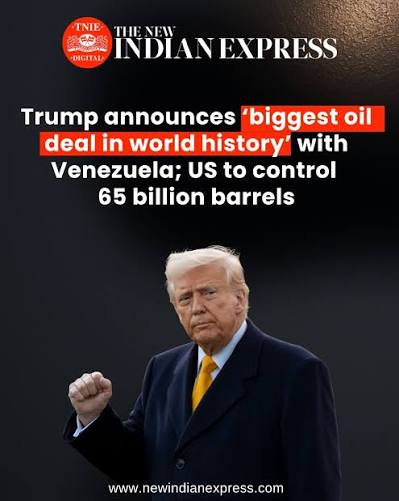
The Trump Venezuela oil deal has emerged as one of the biggest energy developments of 2026, giving the United States majority control over access to more than 65 billion barrels of Venezuela’s proven oil reserves through partnerships with private companies.
President Donald Trump described the agreement as one of the largest oil deals in history. The arrangement is designed to bring American companies deeper into Venezuela’s oil industry, rebuild damaged production infrastructure and create a long-term source of crude for the United States.
The deal is also closely connected to Washington’s energy-security strategy. Trump has said Venezuelan oil will help replenish the U.S. Strategic Petroleum Reserve (SPR), which has fallen sharply after years of emergency releases and supply disruptions. Reuters reported that the SPR stood at about 290 million barrels on August 21, its lowest level in roughly 44 years.
However, the headline figure needs context. The United States has not suddenly acquired 65 billion barrels of ready-to-use crude. The oil remains underground in Venezuela and must be developed, produced, transported and processed. Experts therefore warn that the deal could take years to produce its full economic impact.
What Is the Trump Venezuela Oil Deal?
The Trump Venezuela oil deal is a major energy agreement between the United States and Venezuela involving the development of 17 oil fields.
President Trump announced that the United States had secured majority control over more than 65 billion barrels of Venezuelan proven reserves through partnerships with private businesses. Venezuela’s interim President Delcy Rodríguez later described the agreement as a 25-year energy pact intended to revive the country’s oil industry and increase government revenues.
The fields involved are mainly located in major Venezuelan producing regions, including the Orinoco Belt and Lake Maracaibo.
The agreement is intended to bring new investment, technology and management into an industry that has suffered from years of underinvestment, declining infrastructure, sanctions and operational problems.
Reuters reported that the plan could involve almost $100 billion in investment, while Venezuelan officials estimate around $209 billion in revenue over the life of the agreement based on a benchmark oil price.
Key points of the agreement
- More than 65 billion barrels of Venezuelan proven reserves are involved.
- U.S. interests are expected to receive majority control through private partnerships.
- Seventeen oil fields are included.
- The agreement is expected to last 25 years.
- Production is targeted at approximately 1.5 million barrels per day.
- Nearly $100 billion in investment has been discussed.
- Venezuela expects substantial tax and royalty revenue.
- Trump says Venezuelan crude will help replenish the U.S. Strategic Petroleum Reserve.
These figures make the agreement significant, but many details surrounding its legal structure, ownership and implementation remain under scrutiny.
Why Are 65 Billion Barrels So Important?
The 65 billion-barrel figure is enormous.
Venezuela already has the world’s largest proven crude oil reserves. The U.S. Energy Information Administration estimated that Venezuela had approximately 303 billion barrels of proven crude oil reserves in 2023, representing about 17% of global reserves.
The newly announced agreement therefore covers roughly one-fifth of Venezuela’s total proven reserves.
For comparison, the United States itself has substantially smaller proven reserves. That makes access to Venezuelan resources strategically important for Washington.
But reserves are not the same as immediately available oil.
Much of Venezuela’s crude is extremely heavy and requires specialized infrastructure and refining capacity. The country’s production has remained far below its potential despite its enormous underground resource base.
That distinction is crucial.
The Trump Venezuela oil deal provides access to a huge resource base, but turning those reserves into actual barrels requires billions of dollars in investment, new equipment, functioning pipelines, upgraded production facilities and reliable export infrastructure.
Trump’s Strategic Petroleum Reserve Plan
One of the most important parts of the agreement is its connection to the Strategic Petroleum Reserve.
Trump has announced that the United States intends to use Venezuelan oil to refill the reserve. The announcement comes at a time when U.S. emergency oil inventories are considerably lower than historical levels.
The U.S. Department of Energy describes the Strategic Petroleum Reserve as the world’s largest emergency supply of crude oil. Its purpose is to protect the country against severe petroleum supply interruptions.
Trump’s plan therefore has both an economic and national-security dimension.
If Venezuela can significantly increase production, Washington could potentially have access to additional crude for emergency storage while also increasing the overall supply available to American refiners.
Reuters reported that Trump said the replenishment process would begin soon, although experts cautioned that Venezuela’s production infrastructure must first be rebuilt before large additional volumes become available.
Why the Strategic Reserve Matters Now
The timing of the agreement is particularly important.
The United States has faced significant energy-market disruptions in recent years. The war in Ukraine, sanctions, geopolitical tensions and the current conflict involving Iran have all increased concerns about global oil supplies.
Recent fighting around the Persian Gulf and concerns involving the Strait of Hormuz have also pushed crude prices higher. Reuters reported Brent crude moving above $90 per barrel as tensions escalated at the end of August.
In that environment, rebuilding the Strategic Petroleum Reserve has become a major policy objective.
A larger reserve can give Washington greater flexibility during a major supply disruption.
However, Venezuelan oil cannot instantly refill the reserve. Production must increase first, and transporting Venezuelan crude to appropriate U.S. facilities also requires logistics and refining capacity.
Could the Deal Lower Gas Prices?
Lower gasoline prices are one of the biggest political arguments surrounding the agreement.
Trump has promoted the deal as a way to increase oil supply and eventually reduce energy costs for Americans.
In theory, increased Venezuelan production could add barrels to global markets. Greater supply can reduce upward pressure on crude prices if demand remains stable.
But the effect is unlikely to be immediate.
Energy experts have warned that Venezuela’s infrastructure is too damaged to rapidly increase production by huge amounts. Analysts cited by Business Insider said the oil could take years to translate into significant additional market supply, with estimates ranging from roughly five to 15 years for some projects.
That means consumers should not necessarily expect the Trump Venezuela oil deal to cause an immediate drop in gasoline prices.
Oil prices are determined by global supply and demand. Events in the Middle East, OPEC+ production decisions, refinery capacity, shipping costs, currency movements and geopolitical risks can all influence prices.
Venezuela’s Production Problem
Venezuela’s biggest advantage is the size of its reserves.
Its biggest weakness is its ability to produce them efficiently.
Years of economic crisis, sanctions, declining investment and infrastructure deterioration damaged the country’s oil sector.
The EIA noted that Venezuela possessed around 303 billion barrels of proven reserves but produced only a small fraction of global crude output.
The difference between reserves and production is therefore enormous.
The new agreement attempts to address that gap.
Under the reported plan, production from the targeted fields could eventually reach approximately 1.5 million barrels per day.
If achieved, that would represent a major increase for Venezuela.
It could also create additional export supplies for international markets.
What Does the Deal Mean for Venezuela?
For Venezuela, the agreement represents a potential economic lifeline.
The country’s oil sector remains central to its economy. Higher production could provide government revenue, foreign exchange and investment.
Venezuelan officials have argued that the agreement preserves the country’s sovereignty over its natural resources while opening the sector to foreign capital and technology.
The planned investment could help modernize oil fields, pipelines, processing facilities and export infrastructure.
Higher production could also create employment and increase demand for local services.
But the agreement has generated controversy inside Venezuela.
Critics question whether the arrangement gives foreign interests too much influence over Venezuela’s most valuable natural resource. Others have raised concerns about the legitimacy of the government negotiating the agreement and the lack of transparency around important contractual details.
Legal and Transparency Questions
The deal’s economic potential is matched by major legal questions.
Reuters reported that energy experts and legal scholars have questioned the agreement’s legality, execution and transparency. The precise contractual framework and operational structure have not been fully disclosed.
Questions include:
- Who ultimately owns the operating companies?
- How will profits be divided?
- Which American companies will participate?
- How will Venezuela’s laws apply?
- What happens if a future Venezuelan government challenges the agreement?
- How will environmental obligations be enforced?
- What role will Congress play in the U.S.?
- How will the 25-year arrangement be protected against future political changes?
These questions matter because oil projects require enormous long-term investment.
Companies will be reluctant to spend billions of dollars if they believe future governments could cancel contracts or change the legal framework.
The Role of Private U.S. Companies
The agreement is not simply a direct purchase of Venezuelan oil by the U.S. government.
Instead, the reported structure relies heavily on private companies and partnerships.
That distinction is important.
Private energy companies would be expected to provide capital, technology and operational expertise. The government can facilitate the political and legal environment, but actual oil development requires commercial operators.
Reuters reported that several international companies, including Chevron, Eni, ONGC and others, were moving toward additional agreements under Venezuela’s updated energy framework.
This could transform Venezuela’s oil industry from an isolated sector into a larger international investment market.
Is This a “Huge Win” for Trump?
Politically, the agreement gives Trump several arguments to present as victories.
First, it strengthens his energy-security message.
Second, it provides a potential source of additional crude at a time when oil prices are elevated.
Third, it offers a pathway to replenish the Strategic Petroleum Reserve.
Fourth, it could strengthen U.S. influence over one of the world’s largest oil-producing countries.
Fifth, if Venezuelan production rises substantially, American companies could gain access to major long-term energy projects.
However, whether the deal becomes a genuine long-term victory will depend on execution.
A headline involving 65 billion barrels is impressive, but the economic value of those barrels depends on how much can actually be produced profitably.
Why the Deal Is Not the Same as Owning 65 Billion Barrels
This is perhaps the most important point for readers.
The United States has not physically taken possession of 65 billion barrels of crude.
The agreement concerns access and majority control involving reserves in Venezuelan oil fields.
Oil reserves remain underground until companies invest money to extract them.
This process can involve:
- Drilling wells.
- Repairing existing production systems.
- Building or upgrading pipelines.
- Securing electricity and water supplies.
- Transporting crude to export terminals.
- Processing heavy crude.
- Finding suitable refineries.
- Financing long-term operations.
- Managing political and legal risks.
Therefore, the headline figure represents potential energy resources, not an immediate stockpile.
Impact on Global Oil Markets
The agreement could eventually have a significant impact on global oil markets.
If Venezuela successfully raises production toward 1.5 million barrels per day, more crude could enter international markets.
That could be especially important if other producers experience disruptions.
The impact would depend on the timing and scale of production growth.
A rapid increase could put downward pressure on crude prices. A slower increase would have a smaller effect.
At the same time, Venezuela’s heavy crude may require specific refining capacity. Not every refinery can process the same type of oil efficiently.
This means infrastructure and refinery compatibility will remain critical.
The Geopolitical Importance
The Trump Venezuela oil deal is about more than petroleum.
It could reshape relations between Washington and Caracas.
For decades, Venezuela has been one of the world’s most strategically important oil producers, while relations with the United States have frequently been tense.
A deeper U.S. role in Venezuela’s energy industry could increase Washington’s influence across Latin America.
It could also reduce Venezuela’s dependence on other international partners.
For the United States, closer involvement could strengthen its position in the Western Hemisphere’s energy system.
That makes the agreement strategically important even beyond the number of barrels involved.
Major Risks Ahead
Despite the enormous potential, the deal faces several risks.
1. Infrastructure
Venezuela’s oil infrastructure requires major investment.
2. Political uncertainty
Future governments could challenge current agreements.
3. Legal disputes
Questions surrounding ownership and contracts could create litigation.
4. Heavy crude
Venezuelan oil requires specialized processing.
5. Investment risk
Companies may hesitate to commit billions without strong legal protections.
6. Oil price volatility
If global oil prices fall significantly, some projects may become less profitable.
7. Public opposition
Critics in Venezuela have already accused the agreement of undermining national sovereignty.
These factors could determine whether the deal becomes a historic energy transformation or remains primarily a political headline.
What Happens Next?
The next stage will focus on implementation.
Investors will need to determine which fields can be developed first. Infrastructure projects will need financing. Production targets will have to be tested against actual field conditions.
American and international companies will also have to evaluate the legal protections available under Venezuela’s new energy framework.
Meanwhile, Washington will be watching oil prices and domestic fuel costs closely.
If production increases, some Venezuelan crude could eventually move toward U.S. markets and the Strategic Petroleum Reserve.
But the timeline remains uncertain.
Bottom Line
The Trump Venezuela oil deal is a major development in global energy politics.
The agreement gives U.S. interests majority control or access involving more than 65 billion barrels of Venezuelan proven oil reserves, while Venezuela expects billions of dollars in investment and government revenue. The plan also targets production growth and could eventually provide crude for rebuilding the U.S. Strategic Petroleum Reserve.
The deal is significant because Venezuela possesses the world’s largest proven oil reserves, estimated at about 303 billion barrels.
Yet the headline number should not be misunderstood.
The 65 billion barrels are underground reserves, not an instantly available U.S. oil stockpile.
The real test will be whether American and international companies can successfully rebuild Venezuela’s oil industry, increase production, overcome infrastructure problems and operate under a stable legal framework.
If those challenges are overcome, the agreement could become one of the most consequential energy partnerships of Trump’s presidency.
If they are not, the 65-billion-barrel headline could prove much easier to announce than to deliver.
FAQs About the Trump Venezuela Oil Deal
1. What is the Trump Venezuela oil deal?
The Trump Venezuela oil deal is a major U.S.-Venezuela energy agreement involving development of 17 Venezuelan oil fields and U.S. majority control or access involving more than 65 billion barrels of proven reserves.
2. Does the U.S. own 65 billion barrels of Venezuelan oil?
Not in the sense of physically owning 65 billion barrels already extracted and stored in the United States. The agreement concerns access and majority control involving oil reserves that remain underground in Venezuela.
3. How much oil does Venezuela have?
The U.S. Energy Information Administration estimated Venezuela had approximately 303 billion barrels of proven crude oil reserves in 2023, the world’s largest proven reserve base.
4. Will Venezuelan oil refill the U.S. Strategic Petroleum Reserve?
Trump has said Venezuelan oil will be used to replenish the Strategic Petroleum Reserve. However, significant production and logistical work will be required before large additional volumes can reach U.S. storage.
5. How long will the Venezuela-U.S. energy agreement last?
Venezuela’s interim President Delcy Rodríguez has described the energy agreement as lasting 25 years.
6. How much oil could Venezuela produce under the deal?
The agreement reportedly targets production of approximately 1.5 million barrels per day from the participating fields.
7. Could the deal lower U.S. gasoline prices?
Potentially, but not immediately. More Venezuelan production could increase global supply, but experts warn that infrastructure investment and development could take years.
8. Why does Venezuela need U.S. investment?
Venezuela has enormous oil reserves but has experienced years of underinvestment, infrastructure deterioration, sanctions and production problems. Foreign investment could provide capital, technology and operational expertise needed to increase output.
9. Why is the deal controversial?
Critics have raised questions about Venezuelan sovereignty, transparency, legal authority, ownership structures and the long-term stability of the agreement. Reuters reported that lawyers and energy experts have questioned several aspects of the arrangement.
10. Is the Trump Venezuela oil deal already producing 65 billion barrels?
No. The 65 billion barrels refers to proven reserves associated with the agreement. Those barrels must still be extracted, processed and transported before they become usable crude supplies.
About the Author