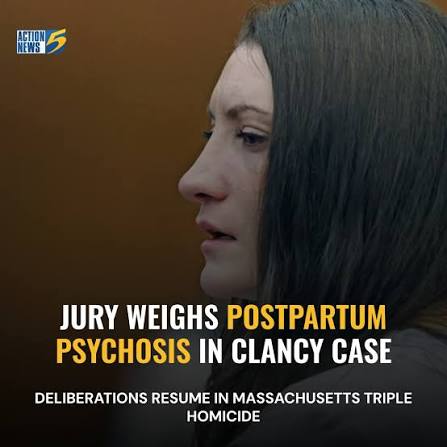
The Lindsay Clancy trial has reached a critical stage as jurors returned Monday, August 31, for their third day of deliberations. The Massachusetts jury is deciding whether Clancy should be held criminally responsible for the deaths of her three young children in January 2023.
The central issue is not whether Clancy caused the children’s deaths. Both sides have acknowledged that she killed them. Instead, jurors must determine whether a severe mental illness, particularly postpartum psychosis, prevented her from understanding the nature and wrongfulness of her actions.
The case has attracted national attention because it combines a devastating family tragedy with difficult questions about mental illness, criminal responsibility and the treatment of postpartum psychiatric conditions.
Recent reports said the jury had deliberated for two days without reaching a verdict before returning Monday. The jury’s decision could determine whether Clancy is convicted of murder or another offense, or found not criminally responsible because of mental illness.
Lindsay Clancy Trial Enters Third Day of Deliberations

The jury began deliberating after more than five weeks of testimony and closing arguments from both sides. On Friday, jurors completed their second day without reaching a verdict and were scheduled to return Monday.
The third day of deliberations places renewed attention on the evidence surrounding Clancy’s mental state before, during and after the killings.
According to recent reports, the jury has been examining evidence that includes prescription medication, physical evidence from the home and details surrounding Clancy’s suicide attempt. Jurors had also requested to review certain physical evidence during their deliberations.
The length of deliberations does not necessarily indicate which way the jury is leaning. Complex criminal cases can require extensive discussion, particularly when jurors must evaluate competing medical opinions and determine a defendant’s mental state at a specific point in time.
What Happened to Lindsay Clancy’s Children?
Lindsay Clancy is accused of killing her three children, Cora, Dawson and Callan, at the family’s home in Duxbury, Massachusetts, in January 2023.
The children were 5 years old, 3 years old and 8 months old.
According to prosecutors, Clancy strangled the children with exercise bands before attempting to take her own life. She survived the suicide attempt but suffered severe injuries and is now paralyzed from the waist down, according to trial reporting.
The facts surrounding the deaths have been among the most emotionally difficult parts of the trial. Jurors heard testimony from first responders, family members, medical professionals and other witnesses.
Clancy’s former husband, Patrick Clancy, also gave emotional testimony about the events and the discovery of the children. His testimony and the 911 response became important parts of the prosecution’s presentation.
Postpartum Psychosis Is at the Center of the Defense
The defense has built its case around postpartum psychosis, a rare but serious psychiatric condition that can occur after childbirth.
Defense attorney Kevin Reddington argued that Clancy experienced a profound break from reality. The defense says her condition was connected to psychiatric problems that developed after the birth of her third child.
The defense has also argued that Clancy experienced symptoms including hallucinations and delusional thinking. One theory presented to jurors was that she believed a voice was directing her actions.
The defense has portrayed the tragedy as the result of a severe mental health crisis rather than a rational and deliberate decision.
In closing arguments, Reddington told jurors that Clancy’s mental state had deteriorated dramatically and argued that inadequate treatment contributed to the crisis. Reuters reported that the defense characterized her as suffering from postpartum psychosis when the killings occurred.
What Is Postpartum Psychosis?
Postpartum psychosis is a rare psychiatric emergency that can develop after childbirth. It is different from the more common “baby blues” and postpartum depression.
People experiencing postpartum psychosis may develop severe symptoms such as hallucinations, delusions, confusion, extreme mood changes or loss of contact with reality.
The condition is considered a medical emergency because symptoms can become severe very quickly.
In the Lindsay Clancy trial, however, the medical question is more specific. Jurors are not simply deciding whether Clancy experienced mental health problems. They must determine whether her mental condition affected her criminal responsibility at the time of the killings.
That distinction is central to the case.
Prosecutors Challenge the Postpartum Psychosis Defense
Prosecutors acknowledge that Clancy experienced significant mental health difficulties. However, they argue that mental illness does not automatically mean a person cannot be held criminally responsible.
The prosecution’s case focuses heavily on Clancy’s actions before, during and after the killings.
Prosecutors have argued that her behavior showed planning and awareness. They contend that she deliberately created an opportunity to be alone with the children and then carried out the killings.
The prosecution also challenged the claim that Clancy was responding to a hallucinated voice.
Assistant District Attorney Jennifer Sprague argued during closing arguments that Clancy’s actions were deliberate rather than the product of a complete break with reality. Prosecutors also questioned the timing and credibility of the claimed voice, pointing to the broader evidence presented during the trial.
This creates the fundamental conflict the jury must resolve.
The defense asks jurors to focus on Clancy’s impaired mental state.
The prosecution asks jurors to focus on her behavior and evidence that they say demonstrates awareness, planning and responsibility.
The Role of Mental Illness in Criminal Responsibility
The Lindsay Clancy trial highlights an important difference between having a mental illness and being legally not responsible for a crime.
A defendant may have a diagnosed psychiatric disorder and still be found criminally responsible.
An insanity defense generally requires a much more significant finding about the defendant’s mental state. Depending on the applicable legal standard, jurors may need to determine whether the defendant understood the nature or wrongfulness of the conduct.
That is why the medical testimony in this case has been so important.
Experts offered different interpretations of Clancy’s psychiatric condition and her behavior. Jurors must now evaluate that testimony alongside physical evidence, witness accounts and Clancy’s actions.
Why the Jury Has Taken So Long
The jury has heard testimony from more than 80 witnesses during a trial that lasted roughly five weeks. That is a substantial amount of evidence to consider.
AP reported that jurors heard extensive testimony concerning Clancy’s mental health, the deaths of her children, her treatment and the events surrounding her suicide attempt.
Jurors may need to consider several different questions.
First, they must evaluate what Clancy did.
Second, they must determine what her mental state was at that precise time.
Third, they must decide whether that mental state meets the legal standard required for a finding of lack of criminal responsibility.
These questions are complicated because psychiatric symptoms can fluctuate. A person may appear organized at one moment while experiencing severe symptoms at another.
That is one reason expert testimony has played such a major role in the trial.
Evidence About Medication
Medication has also been an important issue.
The defense has argued that Clancy’s psychiatric treatment and medications may have contributed to her deteriorating condition. Her lawyers have pointed to treatment decisions and the progression of her symptoms as part of their explanation for what happened.
Prosecutors have offered a different interpretation of the same evidence.
During deliberations, jurors requested to examine prescription pill bottles and other physical evidence, according to recent reporting.
That request does not reveal what the jurors believe. It does, however, show that medication and the circumstances surrounding Clancy’s mental health remain significant considerations in the case.
What the Prosecution Says About Planning
One of the prosecution’s most important arguments concerns planning.
Prosecutors have pointed to actions they say demonstrate that Clancy deliberately created circumstances in which she could carry out the killings.
They have also referenced internet searches and other evidence that they argue supports their interpretation of events.
The prosecution’s theory is that Clancy was experiencing depression and hopelessness but remained capable of making decisions and understanding what she was doing.
That distinction matters because the jury is not being asked simply whether Clancy was mentally unwell.
Instead, jurors must determine whether her illness eliminated the level of criminal responsibility required under Massachusetts law.
What the Defense Says About Planning
The defense interprets the same behavior differently.
Reddington has argued that actions that may appear organized from the outside can occur during a severe psychiatric episode.
The defense says Clancy’s illness distorted her perception of reality and affected her ability to make rational decisions.
The argument is essentially that apparent planning should not automatically be interpreted as proof of a normal, rational mental state.
The defense has also emphasized Clancy’s psychiatric history, treatment and symptoms before the killings.
According to trial reporting, the defense portrayed the tragedy as the result of a catastrophic mental health crisis and argued that Clancy was not acting with ordinary awareness of reality.
The Jury Must Separate Emotion From the Law
The Lindsay Clancy case is emotionally overwhelming.
Three young children died, and the person accused of killing them was their mother.
However, jurors must make their decision based on evidence and the legal instructions given by the judge.
They cannot decide the case solely because the deaths were horrific. They must determine whether the prosecution has established the required elements of the offenses and whether the defense’s claim of lack of criminal responsibility has been established under the applicable legal standard.
That makes the jury’s task particularly difficult.
Possible Outcomes in the Lindsay Clancy Trial
There are several possible outcomes.
The jury could find Clancy guilty of murder if prosecutors prove the required elements beyond a reasonable doubt.
Depending on the charges and jury findings, a lesser homicide verdict may also be possible.
Another major possibility is a finding that Clancy is not criminally responsible because of mental illness.
AP reported that the jury is considering a range of potential outcomes, including murder, manslaughter and a finding of not guilty by reason of insanity.
A finding of not criminally responsible would not necessarily mean Clancy simply walks free. Such a result can lead to psychiatric commitment and continued evaluation under Massachusetts law.
What Happens After the Verdict?
If the jury reaches a guilty verdict, the case would move toward sentencing.
If the verdict is not guilty by reason of insanity or lack of criminal responsibility, the legal process would be different and could involve psychiatric confinement.
The exact consequences would depend on the verdict and the court’s orders.
Until the jury reaches a verdict, speculation about the final outcome remains premature.
Why the Case Has Sparked a Mental Health Debate
The Lindsay Clancy trial has become bigger than a single criminal case.
It has generated discussion about postpartum mental health, psychiatric treatment, maternal healthcare and the ability of healthcare systems to recognize severe psychiatric symptoms.
The case has also raised questions about how society responds when a mother experiences an extreme mental health crisis.
Experts and advocates have stressed that postpartum psychosis is rare but serious and that severe psychiatric symptoms following childbirth require urgent medical attention.
At the same time, the legal system must independently determine criminal responsibility in an individual case.
Those two issues should not be confused.
Recognizing postpartum psychosis as a serious medical condition does not automatically determine the legal outcome of the Clancy trial.
The Broader Significance of the Case
The trial has drawn comparisons with other high-profile cases involving mothers and severe postpartum psychiatric illness.
The most frequently discussed comparison is Andrea Yates, who was convicted after killing her five children in Texas in 2001. Her case also involved claims of severe postpartum psychosis.
The Clancy case is different, however, because every defendant’s mental state, medical history and circumstances must be assessed individually.
The case may nevertheless influence public discussion about how postpartum psychiatric disorders are recognized and treated.
It also demonstrates the difficult intersection between medicine and criminal law.
Medical experts can explain symptoms and diagnoses, but jurors ultimately decide the legal question of criminal responsibility.
No Verdict Yet as Day 3 Continues
As jurors resume deliberations on Monday, attention remains focused on whether they can reach a unanimous decision.
Recent reports confirmed that the jury had not reached a verdict after the first two days of deliberations. The jury returned Monday for Day 3.
The continuing deliberations do not provide a clear indication of the eventual outcome.
A lengthy discussion could mean jurors are carefully reviewing complicated evidence. It could also reflect disagreements about the appropriate verdict.
Until jurors announce their decision, both possibilities remain open.
Lindsay Clancy Trial: What to Watch Next
The most important development will be the jury’s verdict.
Observers will also be watching for any additional jury requests for evidence, legal instructions or clarification from the judge.
If the jury asks to review particular evidence, that could indicate which portions of the trial are receiving close attention, although it would still be impossible to reliably predict the verdict from such requests.
The case has already featured extensive testimony about mental health, medication, family life and the events of January 2023.
Now, the final decision rests with the jury.
Frequently Asked Questions
What is the Lindsay Clancy trial about?
The Lindsay Clancy trial concerns the deaths of her three children in Duxbury, Massachusetts, in January 2023. Clancy is accused of killing the children and has pleaded not guilty by reason of lack of criminal responsibility. The central issue is whether she should be held legally responsible for her actions.
Why is postpartum psychosis important in the Lindsay Clancy trial?
Postpartum psychosis is central to the defense because Clancy’s lawyers argue that she experienced a severe psychiatric episode that caused her to lose contact with reality. The defense says this condition affected her ability to understand or control her actions.
How many days have jurors deliberated?
Jurors began deliberations after closing arguments and returned Monday, August 31, for their third day. They had completed two days without reaching a verdict before returning for Day 3.
Has the Lindsay Clancy jury reached a verdict?
No verdict had been announced in the latest reports available on August 31, 2026. The jury was continuing its third day of deliberations.
What happened to Lindsay Clancy after the killings?
After the children’s deaths, Clancy attempted suicide. She survived but suffered severe injuries and has been reported as paralyzed from the waist down.
What does the prosecution argue?
Prosecutors argue that Clancy’s mental health problems did not prevent her from understanding her actions. They point to evidence they say demonstrates planning, awareness and deliberate conduct.
What does the defense argue?
The defense argues that Clancy suffered from severe postpartum psychosis and related psychiatric problems. Her attorneys say her illness caused a profound break from reality and made her legally not responsible for the killings.
Could Clancy be found not criminally responsible?
Yes. A finding of not guilty by reason of insanity or lack of criminal responsibility is among the possible outcomes being considered by the jury. Such an outcome can involve psychiatric commitment rather than ordinary release.
Why has the case received national attention?
The case combines the deaths of three children with a major legal and medical debate over postpartum psychosis, psychiatric treatment and criminal responsibility. It has also raised broader questions about maternal mental health care.
When will the Lindsay Clancy trial verdict be announced?
There is no guaranteed timetable for a verdict. The jury can continue deliberating until it reaches a decision or the court takes another appropriate step. As of the latest August 31 reports, deliberations were continuing.
Final Takeaway
The Lindsay Clancy trial has entered one of its most consequential moments as jurors resume Day 3 of deliberations.
At the heart of the case is a difficult question: was Clancy legally responsible for her actions, or did severe postpartum psychosis make her unable to understand the wrongfulness of what she was doing?
The defense has emphasized psychiatric symptoms, medication and an alleged break from reality. Prosecutors have focused on planning, behavior and evidence they say demonstrates awareness.
After weeks of testimony and competing expert opinions, the jury must now weigh the evidence and apply the law.
For now, there is no verdict. The jury’s decision will determine the next chapter of a case that has already generated intense public discussion about criminal responsibility, postpartum psychosis and the urgent need to recognize severe maternal mental health problems.
About the Author