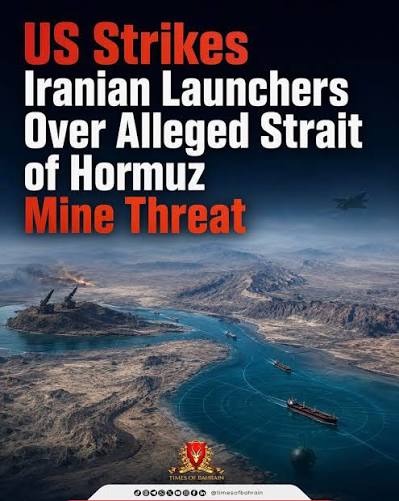
A major new military confrontation has pushed tensions in the Middle East back to the center of global attention after U.S. forces targeted Iranian launchers near the strategically vital Strait of Hormuz.
According to reports from U.S. military officials, American forces struck two Iranian launchers on Larak Island after Islamic Revolutionary Guard Corps, or IRGC, personnel were allegedly observed preparing rockets connected to the deployment of sea mines into the Strait of Hormuz.
The development marked a significant escalation after a period of relatively reduced direct military action between the United States and Iran. The incident immediately raised concerns about retaliation, regional security and the future of commercial shipping through one of the world’s most important maritime chokepoints.
Iran responded angrily to the strikes and reported casualties, while Iranian retaliation against U.S. positions in the region was also reported. The situation has created fresh uncertainty for governments, shipping companies and global energy markets.
The Strait of Hormuz is critically important because a major share of the world’s energy supplies normally passes through the narrow waterway. Any military activity involving sea mines, missiles or attacks on shipping can therefore have consequences far beyond the Middle East.
This latest Military Update: US Forces Target IRGC Launchers story is not simply about one military strike. It represents a broader struggle over maritime security, freedom of navigation and military influence in the Persian Gulf.
US Forces Target IRGC Launchers on Larak Island
The reported U.S. operation focused on two Iranian launchers located on Larak Island, a strategically important location near the Strait of Hormuz.
U.S. officials said the action was taken after IRGC personnel were observed preparing rockets carrying or intended to deploy sea mines into the waterway.
The American military viewed the alleged mine deployment as a direct threat to international shipping.
Sea mines are particularly dangerous because they can remain hidden beneath the surface of the water. Unlike a missile attack, which may be detected by radar systems, a naval mine can create a persistent danger for commercial vessels long after it has been deployed.
For this reason, any attempt to place mines near major shipping routes can quickly disrupt maritime traffic.
The U.S. decision to strike the launchers therefore appeared designed to prevent a potential mining operation before the mines could enter critical shipping lanes.
The operation was also significant because it represented renewed direct U.S. military action against Iranian targets after a period of reduced confrontation.
The strike immediately changed the military situation around the Strait of Hormuz.
Why the Sea Mine Threat Is So Serious
The reported sea mine threat is at the heart of the latest crisis.
Sea mines can be deployed in several ways, including from ships, submarines and other delivery systems. Their purpose is to damage or destroy vessels operating in a particular area.
Even the possibility that mines have been placed in a major shipping route can have serious consequences.
Commercial shipping companies may delay voyages.
Insurance costs may rise.
Navies may need to conduct mine-clearance operations.
Oil and gas shipments may be redirected or postponed.
The Strait of Hormuz is particularly vulnerable because it is a narrow and strategically sensitive waterway.
If ships believe that mines are present, maritime traffic can slow dramatically.
That creates a major strategic advantage for any country capable of threatening navigation through the area.
However, it also creates enormous economic risks for the country responsible.
Disrupting the Strait of Hormuz could affect global oil markets, regional economies and international trade.
That is why the alleged preparation to deploy sea mines triggered such a strong military response.
Strait of Hormuz Becomes the Center of the Crisis
The Strait of Hormuz has long been one of the most strategically important waterways in the world.
It connects the Persian Gulf with the Gulf of Oman and provides a route for major international energy shipments.
For decades, military planners have viewed the waterway as a potential flashpoint during any serious confrontation involving Iran and the United States.
Iran has repeatedly emphasized its ability to influence security in the surrounding waters.
The United States and its allies, meanwhile, have consistently argued that international shipping must be allowed to move freely.
This disagreement has produced repeated confrontations.
The latest incident shows how quickly the situation can escalate.
A reported attempt to prepare sea mines led to U.S. military action.
That action was followed by Iranian anger and reported retaliation.
The cycle demonstrates the central danger of the Hormuz crisis: every military move can produce another response.
Iran Responds After U.S. Strikes
Iran strongly condemned the American military action.
Iranian authorities and IRGC-linked sources reported casualties from the strike, although details surrounding the exact number and circumstances varied across reports.
Tehran also signaled that the U.S. action would not go unanswered.
Reports indicated that Iranian forces launched retaliatory attacks toward U.S. military positions in the region.
The exchange increased fears that a limited operation could develop into a wider confrontation.
Iran’s strategy has historically relied on a combination of missiles, drones, naval capabilities and regional military partnerships.
That means any escalation involving direct strikes on Iranian territory creates the possibility of responses across multiple locations.
U.S. military facilities in the wider Middle East have therefore remained under increased security pressure.
The danger is not limited to one battlefield.
A confrontation near the Strait of Hormuz can affect Jordan, the Gulf states, Iraq and other parts of the region.
Could the Conflict Spread Further?
The biggest question now is whether the latest confrontation will remain limited.
At the moment, both Washington and Tehran face difficult strategic choices.
The United States wants to prevent attacks on shipping and protect its military personnel.
Iran wants to demonstrate that it can respond to attacks and defend its military interests.
Both sides may attempt to avoid a full-scale regional war.
However, avoiding escalation becomes difficult once missiles and military strikes are exchanged.
A single successful attack causing major casualties could trigger a much larger response.
Another danger involves miscalculation.
Military commanders often have limited time to make decisions during an active crisis.
A radar signal, drone movement or missile launch can quickly be interpreted as a major threat.
That can lead to retaliatory action before diplomatic channels have time to intervene.
For this reason, the US Forces Target IRGC Launchers operation could have consequences well beyond Larak Island.
What Makes Larak Island Strategically Important?
Larak Island is located close to the Strait of Hormuz and sits in a strategically sensitive maritime environment.
Military equipment positioned in this area can potentially influence activity in nearby waters.
The island’s location makes it important for surveillance, missile operations and naval activity.
For the United States, Iranian military systems positioned near the strait are a major concern because of their potential ability to threaten commercial vessels.
For Iran, these locations are part of a broader defensive network designed to protect its coastline and project military power.
This creates a permanent strategic tension.
The same geography that gives Iran defensive advantages also makes the region a priority for U.S. military surveillance.
As a result, military activity near Larak Island is closely monitored.
The latest strike demonstrates how rapidly intelligence observations can turn into military action.
Shipping Companies Face a New Security Challenge
The immediate military consequences are only one part of the story.
The commercial consequences could also be significant.
Shipping companies operating near the Strait of Hormuz must consider several risks.
These include:
- Possible sea mines
- Missile attacks
- Drone activity
- Military interception
- Navigation restrictions
- Higher insurance costs
A shipping company does not need to lose a vessel before suffering economic damage.
The possibility of an attack can be enough to change business decisions.
Ships may wait outside dangerous areas.
Companies may choose longer routes.
Insurance providers may increase premiums.
Energy markets may react to uncertainty.
These factors can affect consumers far from the Middle East.
Higher transportation costs can eventually influence global prices.
Oil Markets Watch the Hormuz Crisis Closely
Energy markets are particularly sensitive to developments in the Strait of Hormuz.
Oil traders closely monitor any event that could threaten production or transportation.
Even if oil facilities are not directly attacked, a disruption in shipping can create major market concerns.
The latest reports of military action and the alleged sea mine threat therefore attracted immediate international attention.
Markets often react not only to confirmed disruptions but also to the possibility of future problems.
If traders believe shipping could become more dangerous, oil prices can rise.
However, the long-term impact depends on several factors.
These include:
- Whether shipping lanes remain open.
- Whether additional mines are discovered.
- Whether the United States conducts further strikes.
- Whether Iran launches additional retaliation.
- Whether regional governments become directly involved.
The situation remains highly unpredictable.
The Role of U.S. Central Command
U.S. Central Command, commonly known as CENTCOM, plays a central role in American military operations across much of the Middle East.
The command is responsible for coordinating military activity and protecting U.S. interests in a region containing major military bases and strategic waterways.
In this case, U.S. officials said the action against the Iranian launchers was connected to preventing a potential threat to maritime navigation.
CENTCOM has repeatedly emphasized the importance of maintaining security in international waters.
Mine warfare is particularly challenging because it requires specialized detection and removal operations.
Clearing mines can involve naval vessels, aircraft, divers and advanced underwater technology.
The process can also take considerable time.
Preventing mines from entering major shipping lanes is therefore often considered easier than removing them later.
That strategic calculation appears to have played an important role in the latest U.S. action.
Iran’s IRGC Remains a Major Military Factor
The Islamic Revolutionary Guard Corps is one of the most important military institutions in Iran.
It operates alongside Iran’s regular armed forces and plays a major role in missile development, naval operations and regional military strategy.
The IRGC Navy has developed capabilities specifically suited to operations in the Persian Gulf.
These include fast boats, missiles, drones and asymmetric warfare tactics.
Sea mines are also considered part of the broader range of maritime tools that can complicate enemy naval operations.
This means that any confrontation involving the IRGC near the Strait of Hormuz is likely to receive serious attention from the United States.
The latest strike was therefore strategically important.
It directly targeted equipment reportedly associated with a possible mine deployment.
That sent a clear message about Washington’s willingness to act against perceived maritime threats.
Diplomatic Efforts Face a Difficult Test
Military action is only one part of the crisis.
Diplomacy remains essential.
Regional governments have strong reasons to prevent a larger conflict.
A wider war could threaten infrastructure, energy production and economic stability across the Middle East.
Countries in the Gulf are particularly concerned about the possibility of becoming directly involved.
Many host foreign military facilities while also maintaining economic relationships with neighboring countries.
This creates a difficult balancing act.
Diplomats may now attempt to reduce tensions through indirect communication.
However, diplomatic efforts become more difficult after casualties occur.
Public pressure can force governments to adopt tougher positions.
That makes compromise politically challenging.
The next few days could therefore be important in determining whether the crisis stabilizes or expands.
What Happens Next?
Several scenarios are possible.
Scenario One: Limited Retaliation
Iran and the United States could exchange limited strikes and then reduce military activity.
This would be the least dangerous scenario.
Scenario Two: Continued Military Exchanges
Both sides could continue targeting military assets while avoiding major civilian infrastructure.
This could create a prolonged cycle of retaliation.
Scenario Three: Maritime Escalation
Additional attacks or mine incidents could further disrupt shipping through the Strait of Hormuz.
This could have major economic consequences.
Scenario Four: Regional Expansion
A major attack on U.S. personnel or Iranian infrastructure could draw additional countries into the conflict.
This would represent the most dangerous outcome.
At present, it is impossible to know which scenario will develop.
The situation remains highly fluid.
Conclusion
The latest military confrontation near the Strait of Hormuz represents another dangerous moment in the ongoing U.S.-Iran crisis.
The decision by U.S. forces to target Iranian launchers reportedly linked to a potential sea mine deployment demonstrates how seriously Washington views threats to international shipping.
Iran’s response has increased fears of a wider military escalation.
The central issue remains the security of the Strait of Hormuz.
If shipping routes remain open and diplomacy succeeds, the immediate crisis could eventually be contained.
However, further missile strikes, drone attacks or sea mine incidents could quickly change the situation.
For now, the world is watching developments around Larak Island and the Strait of Hormuz closely.
The US Forces Target IRGC Launchers operation has once again shown that a conflict involving military assets near one of the world’s most important waterways can have consequences for the entire international community.
The coming days will determine whether this confrontation becomes another limited exchange or the beginning of a much broader regional escalation.
FAQs
1. Why did US forces target the IRGC launchers?
U.S. officials said the launchers were targeted after IRGC personnel were allegedly observed preparing rockets associated with
deploying sea mines into the Strait of Hormuz.
2. Where did the U.S. strikes take place?
The reported strikes targeted two Iranian launchers on Larak Island near the Strait of Hormuz.
3. Why are sea mines dangerous?
Sea mines can remain hidden underwater and damage or destroy ships. Their presence can also force commercial vessels to avoid important shipping routes.
4. Why is the Strait of Hormuz so important?
The Strait of Hormuz is one of the world’s most important maritime chokepoints and is a major route for international energy shipments.
5. Did Iran respond to the U.S. strikes?
Iran condemned the strikes, reported casualties and subsequent retaliatory military action against U.S. positions in the region was reported.
6. Could this lead to a wider Middle East war?
Yes. Further attacks, major casualties or miscalculations could increase the risk of a broader regional conflict.
7. How could the crisis affect oil prices?
Any threat to shipping through the Strait of Hormuz can create concerns about energy supplies, potentially increasing oil prices and transportation costs.
8. What is the IRGC?
The Islamic Revolutionary Guard Corps is a major Iranian military organization involved in missile, naval and regional security operations.
9. What happens if sea mines block shipping routes?
Ships may be delayed or redirected while military forces conduct mine-clearance operations. Insurance and transportation costs can also increase.
10. What should the world watch next?
Key developments include possible Iranian retaliation, additional U.S. military operations, the security of commercial shipping and renewed diplomatic efforts to prevent wider escalation.
About the Author