Chopper Downing Bombshell: Trump Reveals ‘Remarkable’ New Details
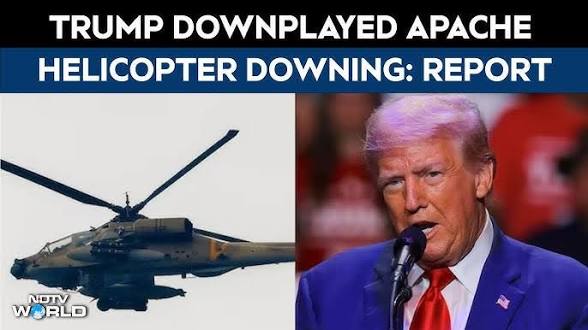
The mystery surrounding the downing of a U.S. Army Apache helicopter near the Strait of Hormuz has taken a dramatic turn after President Donald Trump revealed what he described as “remarkable” new details about the incident. The development has intensified international attention, raised fresh questions about regional security, and increased fears of a wider confrontation involving the United States and Iran.
What initially appeared to be a military aviation incident has now become one of the most closely watched geopolitical stories of the year. According to Trump, the Apache helicopter was brought down during a mission in a highly contested area near the Strait of Hormuz, one of the world’s most strategically important waterways. He later disclosed new information suggesting the crew survived under extraordinary circumstances and that the rescue operation represented a significant military achievement.
As details continue to emerge, analysts are examining the implications for U.S.-Iran relations, military strategy, global energy markets, and regional stability.
What Happened Near the Strait of Hormuz?

The incident occurred during a patrol mission near the Strait of Hormuz, a narrow maritime passage through which a significant portion of the world’s oil supply travels. Initial reports indicated that a U.S. Apache helicopter had gone down, but officials were cautious about identifying the exact cause.
Soon afterward, Trump stated that Iranian forces had shot down the aircraft while it was conducting operations over the region. He described the helicopter as a “highly sophisticated Apache” and emphasized that the United States would be compelled to respond to the attack.
The revelation immediately raised tensions across the Middle East and triggered concerns among international observers who feared a rapid escalation between Washington and Tehran.
Trump’s ‘Remarkable’ New Details
In a subsequent interview, Trump shared additional details that transformed the story from a simple military loss into a tale of survival and rescue.
According to the president, an Iranian drone reportedly struck the Apache helicopter and became lodged in the aircraft. In an extraordinary twist, the explosive device allegedly failed to detonate despite the impact. Trump described the outcome as “a miracle,” noting that the pilots were operating under life-threatening conditions.
The helicopter crew reportedly managed to maintain control long enough to perform an emergency crash landing into the sea. Despite the severe danger, both aviators survived the ordeal.
Trump praised the pilots for their courage and professionalism, portraying their actions as an example of exceptional military training and determination.
The Dramatic Rescue Mission
One of the most remarkable aspects of the incident was the rescue operation that followed.
Reports indicate that the downed crew spent approximately two hours awaiting extraction after entering the water. During that time, military planners launched a rescue effort unlike any previously documented in modern combat operations.
The rescue reportedly involved an autonomous surface vessel, an advanced sea drone designed for military missions. The unmanned craft successfully reached the stranded pilots and transported them to safety before a helicopter completed the final extraction.
Military observers have described the operation as a significant milestone in autonomous warfare technology. If confirmed as reported, it would represent one of the first successful combat rescues involving an autonomous maritime vehicle.
Why the Strait of Hormuz Matters
The location of the incident is critical to understanding its broader significance.
The Strait of Hormuz serves as one of the world’s most important energy chokepoints. A substantial percentage of globally traded oil passes through the waterway every day. Any disruption in the region can have immediate consequences for energy markets and international trade.
For decades, the strait has been a flashpoint for tensions involving Iran, the United States, and regional allies. Military patrols, naval deployments, and aerial surveillance missions are common due to the strategic importance of the area.
The Apache helicopter was reportedly conducting operations in this highly sensitive environment when the incident occurred.
U.S. Response to the Helicopter Downing
Following confirmation of the incident, the United States launched what officials described as proportional retaliatory strikes against Iranian military targets. The response reportedly focused on radar installations, air-defense systems, and related military infrastructure.
Administration officials emphasized that the operations were intended as defensive measures rather than the beginning of a broader war. However, the strikes nevertheless marked a significant escalation in tensions.
Trump defended the response, arguing that the United States could not allow attacks on its military personnel to go unanswered.
Iran’s Position
Iranian officials have disputed elements of the U.S. narrative while acknowledging the broader confrontation.
According to reports, Iranian representatives claimed that the helicopter incident was not an intentional act of aggression. Some officials argued that foreign military activity near Iranian territory inherently carries risks and warned against further escalation.
At the same time, Tehran has maintained that it remains open to diplomatic solutions while preserving its right to defend national interests.
These differing accounts have complicated efforts to determine exactly what occurred and how future incidents might be prevented.
Impact on U.S.-Iran Relations
The helicopter downing comes at a particularly sensitive moment in U.S.-Iran relations.
Recent months had seen intermittent diplomatic efforts aimed at reducing tensions and stabilizing the region. However, the Apache incident has cast doubt on the durability of those efforts.
Many analysts believe the event could become a defining moment in the current phase of the relationship between the two countries. The combination of military confrontation, retaliatory strikes, and political rhetoric has significantly increased uncertainty.
Military Technology Under the Spotlight
The incident has also highlighted the growing role of advanced military technology in modern warfare.
The Apache helicopter is considered one of the most capable attack helicopters in service today. Its sophisticated sensors, weapons systems, and battlefield capabilities have made it a cornerstone of U.S. Army aviation operations.
At the same time, the reported use of autonomous rescue technology demonstrates how warfare is evolving beyond traditional platforms. The sea drone involved in the rescue operation could become a model for future search-and-rescue missions in contested environments.
Defense experts are closely studying the operation to understand its implications for future military planning.
Economic and Global Implications
The downing of the helicopter has implications far beyond military strategy.
Financial markets reacted quickly to news of the incident and the subsequent retaliation. Concerns over potential disruptions to energy supplies contributed to volatility in oil prices.
Because the Strait of Hormuz remains a crucial route for global commerce, any prolonged instability could affect shipping, fuel costs, inflation, and economic growth worldwide.
Governments across Europe, Asia, and the Middle East have urged restraint while monitoring developments closely.
International Reaction
World leaders and international organizations have expressed concern over the rapidly evolving situation.
Several countries have called for de-escalation and renewed diplomatic engagement. Regional governments have also increased military readiness in response to fears that additional confrontations could occur.
The United Nations and multiple international partners continue to encourage dialogue aimed at preventing a broader conflict.
What Happens Next?
The future trajectory of the crisis remains uncertain.
Key questions remain unanswered:
- Will additional military exchanges occur?
- Can diplomatic channels prevent further escalation?
- How will Iran and the United States respond to future incidents?
- What impact will the confrontation have on global energy markets?
For now, both nations appear to be balancing military readiness with diplomatic messaging. While leaders on both sides have signaled a willingness to defend their interests, they have also left the door open for negotiations.
Conclusion
The “Chopper Downing Bombshell” has rapidly evolved into a major international story with significant military, political, and economic implications.
President Trump’s revelation of new details—including the reported drone strike, miraculous survival of the crew, and unprecedented autonomous rescue operation—has transformed the incident into one of the most dramatic military episodes of the year.
As investigations continue and diplomatic efforts unfold, the world will be watching closely to see whether the crisis leads to further confrontation or renewed efforts toward regional stability.
Frequently Asked Questions (FAQs)
What is the Chopper Downing Bombshell?
The phrase refers to new revelations surrounding the downing of a U.S. Apache helicopter near the Strait of Hormuz and the dramatic rescue of its crew.
What new details did Trump reveal?
Trump stated that an Iranian drone allegedly struck the helicopter and became lodged in it without exploding, allowing the pilots to survive.
Were the Apache helicopter pilots injured?
Reports indicate that both crew members survived and were rescued safely.
How were the pilots rescued?
According to reports, an autonomous sea drone helped rescue the pilots before they were extracted by military forces.
Why is the Strait of Hormuz important?
The Strait of Hormuz is one of the world’s most critical shipping lanes and a major route for global oil exports.
Did the United States respond militarily?
Yes. The U.S. conducted retaliatory strikes against Iranian military targets following the helicopter incident.
Could the incident lead to a larger conflict?
Analysts warn that the confrontation increases regional tensions, though both sides have indicated some interest in avoiding a full-scale war.
How useful was this post?
Click on a star to rate it!
Average rating 0 / 5. Vote count: 0
No votes so far! Be the first to rate this post.
About the Author

usa5911.com
Administrator
Hi, I’m Gurdeep Singh, a professional content writer from India with over 3 years of experience in the field. I specialize in covering U.S. politics, delivering timely and engaging content tailored specifically for an American audience. Along with my dedicated team, we track and report on all the latest political trends, news, and in-depth analysis shaping the United States today. Our goal is to provide clear, factual, and compelling content that keeps readers informed and engaged with the ever-changing political landscape.