Military First: Sea Drone Pulls Off Dramatic Rescue Of US Troops Near Oman Coast
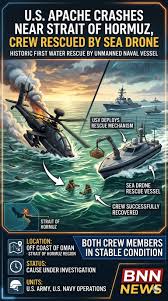
Military technology took a dramatic leap forward this week when a U.S. Navy sea drone successfully rescued American troops stranded in waters near the coast of Oman. The operation, believed to be the first of its kind, demonstrated how autonomous systems are rapidly transforming both combat and rescue missions.
The groundbreaking rescue occurred after a U.S. Army AH-64 Apache helicopter went down near the Strait of Hormuz during a patrol mission. Two crew members found themselves stranded in the water while military forces launched an urgent search-and-rescue operation. Instead of relying solely on traditional rescue assets, commanders deployed an unmanned surface vessel that ultimately became the hero of the mission.
The successful operation has sparked intense discussion among military experts, defense analysts, and policymakers around the world. Many view the incident as a glimpse into the future of warfare, where autonomous platforms may play a larger role in saving lives and executing critical missions.
What Happened Near Oman?
According to reports, the Apache helicopter crashed during operations in waters near Oman and the strategically important Strait of Hormuz. The region remains one of the world’s most sensitive maritime corridors, handling a significant portion of global energy shipments and often serving as a flashpoint for geopolitical tensions.
Following the crash, military personnel immediately launched rescue efforts. Time was critical because the crew members were floating in open waters and vulnerable to weather conditions, maritime hazards, and potential security threats.
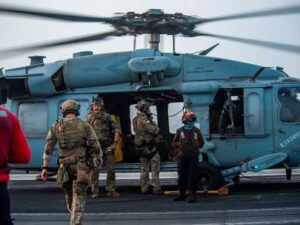
Fortunately, a U.S. Navy autonomous surface vessel operating nearby was able to respond rapidly. The drone vessel reached the stranded soldiers, recovered them from the water, and transported them to a safe location where they could be transferred to a helicopter and evacuated for medical evaluation. Officials later confirmed that the crew members were in stable condition.
Why This Rescue Is A Military First
Military officials and defense observers have described the operation as historic because it represents one of the first publicly reported cases in which an unmanned surface vessel directly participated in a real-world rescue of military personnel.
Autonomous systems have been used for surveillance, intelligence gathering, mine detection, reconnaissance, and combat support for years. However, using a sea drone to locate, recover, and transport personnel during an active rescue mission marks a major milestone in military innovation.
The success of the mission demonstrates that unmanned systems can do more than collect information or monitor threats. They can also perform life-saving operations that traditionally required manned ships or aircraft.
Meet The Drone That Made History
The rescue reportedly involved a Corsair unmanned surface vessel, a sophisticated autonomous platform developed for long-range maritime operations. The vessel is designed to operate independently across large areas of ocean while maintaining communication with military command centers.
Unlike traditional rescue boats, the drone vessel requires no onboard crew. It can navigate autonomously, respond to mission instructions, and operate in challenging maritime environments.
Key capabilities include:
Long-range maritime patrol
Autonomous navigation
Persistent surveillance
Rapid-response operations
Integration with military command networks
Support for rescue and security missions
Military planners have long envisioned these capabilities, but the Oman rescue offered a real-world demonstration of their practical value.
The Role Of Task Force 59
The operation highlighted the growing importance of the U.S. Navy’s Task Force 59, a specialized unit dedicated to integrating autonomous technologies into naval operations.
Established to accelerate innovation, Task Force 59 has become a testing ground for unmanned maritime systems throughout the Middle East. The unit operates under U.S. Naval Forces Central Command and has spent years experimenting with drones, artificial intelligence, and autonomous vessels.
Its mission focuses on:
Maritime security
Intelligence gathering
Persistent surveillance
Rapid-response capabilities
Autonomous fleet development
The successful rescue near Oman may become one of the task force’s most significant achievements to date.
Why The Strait Of Hormuz Matters
The location of the incident adds another layer of significance.
The Strait of Hormuz is one of the world’s most strategically important waterways. A substantial percentage of global oil exports passes through the narrow corridor connecting the Persian Gulf to international markets.
Because of its importance, the region often hosts military patrols, surveillance missions, and naval operations conducted by multiple countries. Any incident in the area attracts international attention.
The Apache helicopter was reportedly conducting patrol activities when the crash occurred. Although the cause remains under investigation, officials have not yet publicly released definitive findings.
How Autonomous Rescue Could Change Warfare
Military experts believe this incident could reshape future search-and-rescue doctrine.
Traditional rescue operations often expose additional personnel to danger. Pilots, sailors, and rescue teams may face hostile conditions while attempting to save others.
Autonomous rescue platforms offer several advantages:
Reduced Risk To Human Rescuers
Unmanned vessels can enter dangerous environments without placing additional personnel in harm’s way.
Faster Response Times
Drones stationed near operational areas can respond immediately when emergencies occur.
Continuous Availability
Unlike human crews, autonomous systems can remain on patrol for extended periods.
Lower Operational Costs
Operating unmanned vessels can reduce expenses associated with staffing and maintaining traditional rescue platforms.
Expanded Coverage
Multiple autonomous systems can monitor large areas simultaneously.
The Oman rescue provides a practical example of how these benefits could translate into real-world success.
Artificial Intelligence And The Future Battlefield
The incident also highlights the growing role of artificial intelligence in military operations.
Modern sea drones increasingly rely on AI-powered navigation systems, sensor integration, and automated decision-support tools. These technologies enable vessels to interpret environmental data, avoid obstacles, and complete complex missions with limited human intervention.
Defense agencies worldwide are investing heavily in autonomous systems because they offer new ways to enhance operational effectiveness while reducing risk.
The rescue near Oman demonstrates that AI-driven technologies are no longer experimental concepts. They are becoming operational tools capable of delivering tangible results in critical situations.
Global Military Implications
The success of the operation will likely be studied by armed forces around the world.
Countries including the United States, China, the United Kingdom, and several NATO allies are investing billions in autonomous maritime technologies. Military planners see unmanned systems as essential components of future naval operations.
Potential applications include:
Search and rescue
Maritime security
Intelligence collection
Anti-submarine warfare
Mine countermeasures
Logistics support
Combat missions
The Oman rescue may accelerate efforts to expand these capabilities.
Public Reaction And Expert Analysis
Defense analysts have praised the mission as a proof of concept for autonomous rescue technologies.
Many experts note that while drones have become commonplace in aerial surveillance and combat operations, maritime autonomy remains a relatively new frontier. Successful real-world missions help validate years of investment and development.
Supporters argue that the operation demonstrates how emerging technologies can save lives while enhancing military effectiveness.
Critics, however, caution that autonomous systems must still prove their reliability across a wider range of operational scenarios before they can replace traditional rescue assets.
Regardless of the debate, the rescue has become a landmark moment in military technology.
What Happens Next?
Investigators continue examining the cause of the Apache helicopter crash. Meanwhile, military officials are expected to analyze every aspect of the rescue operation to identify lessons learned and opportunities for future improvements.
The incident will likely influence future procurement decisions, operational planning, and autonomous system development across the U.S. military.
As technology continues advancing, missions that once seemed futuristic are becoming reality.
Conclusion
The dramatic rescue of U.S. troops near the Oman coast represents far more than a successful recovery mission. It marks a turning point in military innovation and showcases the growing potential of autonomous systems.
By deploying a sea drone to save stranded soldiers, the U.S. Navy demonstrated that unmanned vessels can play a direct role in protecting human life. The mission highlights how artificial intelligence, autonomous navigation, and advanced maritime technologies are reshaping the future of warfare and rescue operations.
While investigations into the helicopter crash continue, one fact is already clear: the rescue near Oman will be remembered as a milestone in military history and a glimpse into the future of naval operations.
FAQs
What happened near the Oman coast?
A U.S. Army Apache helicopter crashed near Oman, and a U.S. Navy sea drone helped rescue the two crew members from the water.
Why is this rescue considered historic?
It is considered a military first because an unmanned surface vessel directly participated in rescuing stranded military personnel during a real-world operation.
What type of drone performed the rescue?
Reports identified the vessel as a Corsair autonomous surface drone operated through U.S. Navy unmanned systems programs.
What is Task Force 59?
Task Force 59 is a U.S. Navy unit focused on integrating autonomous technologies and unmanned systems into maritime operations.
Were the rescued soldiers injured?
Officials reported that the rescued crew members were in stable condition following the operation.
Why is the Strait of Hormuz strategically important?
The Strait of Hormuz is one of the world’s most critical shipping routes and serves as a major corridor for global energy exports.
How useful was this post?
Click on a star to rate it!
Average rating 0 / 5. Vote count: 0
No votes so far! Be the first to rate this post.
About the Author

usa5911.com
Administrator
Hi, I’m Gurdeep Singh, a professional content writer from India with over 3 years of experience in the field. I specialize in covering U.S. politics, delivering timely and engaging content tailored specifically for an American audience. Along with my dedicated team, we track and report on all the latest political trends, news, and in-depth analysis shaping the United States today. Our goal is to provide clear, factual, and compelling content that keeps readers informed and engaged with the ever-changing political landscape.