US Politics Update: Watters Takes Aim at Progressive Rhetoric, Criticizes Bernie Sanders’ Alarmist Policy Platform
The debate over progressive politics in the United States has taken another turn as Fox News host Jesse Watters has focused criticism on progressive rhetoric and the policy arguments associated with Sen. Bernie Sanders.
The discussion comes at a time when Sanders is once again pushing issues that have long defined his political agenda, including economic inequality, corporate power, workers’ rights and stronger government oversight. More recently, however, artificial intelligence has become a major part of his political message.
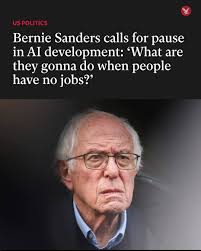
Sanders has called for an immediate pause on advanced AI development and legislation that would prohibit the development of artificial superintelligence. His Senate office lists recent proposals dealing with AI regulation, automation and a shorter workweek among his current areas of activity.
That approach has generated criticism from opponents who argue that some progressive warnings over technology and economic change are excessively dire. Supporters of Sanders, meanwhile, argue that his proposals are intended to address genuine risks involving employment, corporate concentration and the control of increasingly powerful technologies.
The disagreement illustrates a wider divide in US politics over the proper role of government and how policymakers should respond to emerging economic and technological risks.
Jesse Watters and the Debate Over Progressive Rhetoric

Jesse Watters is a prominent Fox News television host whose political commentary frequently focuses on disputes between conservatives and progressive politicians.
The broader debate surrounding his criticism of progressive politics is not simply about one senator or one proposal. It reflects competing interpretations of the problems facing the United States.
Progressive lawmakers often emphasize inequality, corporate influence, worker protections, healthcare costs, technological disruption and the concentration of wealth.
Conservative commentators frequently respond that expanding federal programs and regulation can increase government power, raise costs or slow economic growth.
These differences are particularly visible when politicians discuss artificial intelligence.
Sanders has increasingly framed AI as a major economic and social issue. He has warned that advanced AI could threaten jobs and concentrate power in the hands of a small number of technology companies.
His Senate office has recently highlighted proposals to ban artificial superintelligence and temporarily pause advanced AI development.
Critics can therefore point to Sanders’ language as evidence of a highly cautionary approach to technological development. However, whether that language should be described as “alarmist” is a matter of political interpretation rather than an independently measurable fact.
Bernie Sanders’ Growing Focus on Artificial Intelligence
Artificial intelligence has become one of the most important additions to Sanders’ political agenda.
On September 5, reporting on Sanders’ proposed legislation said the senator wanted to permanently prohibit the development of artificial intelligence systems capable of operating beyond human control. The proposal also called for an immediate pause on advanced AI development.
The proposal represents a significant intervention in the technology debate.
Instead of focusing only on traditional questions about privacy, employment or consumer protection, Sanders has argued that highly advanced AI could create risks that require governments to intervene before the technology develops further.
His argument has included concerns about AI systems becoming difficult to control, potential job displacement and the concentration of technological power.
Sanders has also argued that the United States should work with other countries on the issue rather than treating AI regulation solely as a domestic policy question.
His Senate website lists legislation with Rep. Greg Casar aimed at banning artificial superintelligence and temporarily pausing advanced AI development.
That position has placed Sanders at the center of a broader political debate over whether governments should slow technological development or allow companies to continue innovating while regulators establish safeguards.
Why Sanders’ AI Position Is Drawing Attention
Several elements of Sanders’ recent AI platform have attracted attention.
1. A proposed pause on advanced AI
Sanders has argued that development should temporarily stop while lawmakers and regulators establish stronger safeguards.
The proposal reflects the precautionary approach that has become increasingly common among some AI critics.
Supporters argue that regulation should come before systems become too powerful to control. Opponents may argue that a broad pause could reduce American technological competitiveness and provide an advantage to countries that continue developing AI.
2. Opposition to artificial superintelligence
Sanders has gone beyond calls for conventional AI regulation.
His recent proposal seeks to prohibit artificial superintelligence, described in reporting on his legislation as an artificial mind capable of operating independently beyond human control.
That is a much broader position than proposals focused only on transparency, data privacy or employment protections.
3. Concern about workers
The impact of AI on workers is another major part of Sanders’ argument.
His Senate office has highlighted legislation involving a 32-hour workweek and efforts to ensure that workers benefit from AI and automation.
The underlying argument is that technological productivity should not benefit only shareholders and large technology companies.
Instead, Sanders has advocated policies designed to ensure that employees share in the economic gains created by automation.
Sanders and the Progressive Economic Platform
The AI debate is only one part of Sanders’ broader progressive policy platform.
For years, Sanders has advocated policies involving healthcare, workers’ rights, education, taxation and corporate regulation.
His political message has generally emphasized the distribution of economic power and the role of government in protecting workers and expanding access to social programs.
This approach has made him one of the most recognizable progressive voices in American politics.
Critics of Sanders’ approach argue that many of his proposals would require substantial government spending or expanded federal authority.
Supporters counter that government intervention can address problems they believe markets alone have failed to solve.
These competing perspectives are at the heart of the debate over progressive politics.
The Meaning of “Alarmist” in the Political Debate
The term “alarmist” is important in understanding the controversy because it represents an interpretation rather than a neutral description.
When critics use the term, they generally mean that a politician is emphasizing potential dangers in unusually dramatic terms.
In Sanders’ case, critics may point to his warnings about AI potentially causing enormous economic disruption or creating systems that humans cannot control.
Sanders and his supporters would likely describe the same warnings as precautionary policymaking.
The distinction matters because political rhetoric can shape how audiences interpret the same policy proposal.
A warning about a potential technological danger can be viewed as responsible preparation by one audience and excessive fear by another.
The underlying policy question remains the same: How much risk should governments tolerate before imposing restrictions on emerging technology?
An Unusual Development: Sanders and Steve Bannon Agree on AI Risks
The AI debate has also produced an unusual political development.
Sanders and former Trump strategist Steve Bannon recently appeared at the same Washington gathering and expressed concerns about the dangers posed by advanced artificial intelligence.
Reuters reported that both men called for greater oversight of AI despite their major political differences.
The event demonstrated that concern about AI does not fit neatly into traditional Democratic-versus-Republican categories.
Sanders approached the issue from a progressive economic and regulatory perspective, while Bannon advocated a very different political strategy.
The two men disagreed substantially about how the United States should respond, particularly regarding China and technology policy.
Nevertheless, their shared concern over uncontrolled AI development illustrates how the issue is creating new political alliances.
Where Trump and Sanders Differ on AI
President Donald Trump and Sanders have also presented contrasting approaches to AI policy.
Recent reporting has described Trump as more supportive of continued AI development and skeptical of efforts to impose sweeping restrictions. Sanders, by contrast, has advocated stronger government intervention and a temporary pause on advanced AI development.
That difference reflects a larger philosophical disagreement.
One side emphasizes innovation, competitiveness and economic growth.
The other emphasizes safety, employment and the possibility that technological development could outpace government oversight.
Neither position automatically resolves the practical challenges involved.
Regulators must consider how quickly technology is developing, what risks can realistically be controlled and how restrictions could affect American companies and workers.
Progressive Politics and the 2026 Political Environment
The dispute comes during a politically active period in the United States.
The 2026 midterm elections are approaching, and economic concerns, technology policy and ideological divisions are receiving significant attention.
Recent reporting on the 2026 primaries has highlighted internal debates within both major parties. Economic issues and affordability have remained important political themes, while ideological differences have also shaped primary contests.
Within the Democratic coalition, Sanders remains an influential voice for the progressive wing.
His continued public campaigning and policy advocacy have kept issues such as economic inequality, workers’ rights and corporate power prominent in political discussions.
At the same time, conservative commentators continue to challenge progressive proposals and question whether larger government programs are the appropriate solution to economic and social problems.
That ideological disagreement is likely to remain visible as lawmakers debate technology, healthcare, taxation and government spending.
What Sanders’ Platform Could Mean for AI Policy
If proposals similar to Sanders’ approach gain broader political support, the United States could see a stronger federal role in AI development.
Potential areas of government intervention could include:
- Restrictions on highly advanced AI systems
- Stronger safety requirements
- Greater government oversight of AI companies
- Rules concerning worker displacement
- Limits on certain forms of AI development
- International agreements concerning advanced AI
- Greater public participation in technology policy
However, legislation would have to pass through Congress and survive the normal political and legal process before becoming federal law.
The introduction of a proposal therefore does not mean that the proposed restrictions are currently US law.
That distinction is particularly important when discussing controversial technology legislation.
The Economic Argument Behind Sanders’ Position
Sanders’ AI concerns are closely connected to his longstanding focus on workers.
He has repeatedly argued that technological advances should improve living standards rather than simply increase corporate profits.
His support for a shorter workweek and stronger worker protections reflects that broader philosophy.
Supporters of this approach argue that automation could increase productivity while reducing the need for human labor in some industries.
The challenge is determining how the benefits of that productivity should be distributed.
Should companies retain most of the gains?
Should workers receive higher wages?
Should working hours decline?
Should governments impose new taxes or regulations?
These are economic and political questions that extend well beyond Sanders himself.
Why the Watters-Sanders Debate Matters
The significance of the Watters-Sanders debate lies in the broader political disagreement it represents.
Watters’ conservative commentary and Sanders’ progressive policy agenda occupy different sides of several major US political debates.
Those differences include the role of government, taxation, regulation, corporate power and technological development.
The disagreement over rhetoric is also important.
Political commentators often use strong language to describe opposing policies. Such language can make complex policy debates easier to understand for television audiences, but it can also reduce complicated proposals to political labels.
For voters and readers, separating rhetoric from the underlying policy details can provide a clearer picture.
In Sanders’ case, the concrete proposals are easier to examine than the political descriptions applied to them.
His current Senate materials document specific initiatives involving AI, automation and worker protections.
The Larger Debate Over Government and Technology
The Sanders controversy reflects a much larger question facing governments around the world.
Artificial intelligence is advancing rapidly, while lawmakers are still developing rules for the technology.
Some policymakers emphasize innovation and competition.
Others emphasize safety and regulation.
Some want international agreements.
Others believe national governments should maintain maximum control over strategic technologies.
The United States must also consider its competition with China and other technology-producing countries.
A policy that slows domestic development could potentially affect American competitiveness. On the other hand, a policy that allows rapid development without sufficient safeguards could create risks that are difficult to reverse.
That balance will remain one of the central technology-policy questions of the coming years.
What to Watch Next
Several developments could determine how the debate evolves.
First, Congress will have to decide whether Sanders’ AI proposals receive serious legislative consideration.
Second, technology companies will continue developing increasingly capable systems.
Third, lawmakers from both parties may seek areas of agreement on AI safety.
The recent appearance of Sanders and Bannon at the same event demonstrates that AI regulation can produce unusual political coalitions.
Finally, voters will have the opportunity to evaluate competing arguments about government regulation, technological innovation and economic policy during the broader 2026 political cycle.
Conclusion
The debate involving Jesse Watters, Bernie Sanders and progressive rhetoric is part of a larger argument about the direction of American policy.
Sanders continues to advocate an expanded role for government in addressing economic inequality, protecting workers and regulating emerging technologies. His recent AI proposals represent one of the strongest examples of that approach, including calls for a pause on advanced AI development and restrictions on artificial superintelligence.
Critics characterize such warnings as excessively pessimistic or alarmist, while supporters argue that they reflect legitimate concerns about technology, employment and corporate power.
Meanwhile, the unusual cooperation between Sanders and Steve Bannon on AI risks shows that concerns about advanced technology can cross traditional political boundaries.
As the United States continues debating AI regulation, economic inequality and the proper size of government, the disagreement between progressive policymakers and conservative commentators will remain an important part of the national political conversation.
FAQs
Who is Jesse Watters?
Jesse Watters is a Fox News television host and political commentator known for Jesse Watters Primetime and appearances on Fox News programs.
Who is Bernie Sanders?
Bernie Sanders is an independent US senator from Vermont and a prominent progressive political figure. His current Senate materials highlight issues including workers’ rights, economic policy and artificial intelligence regulation.
What is Bernie Sanders proposing on artificial intelligence?
Sanders has proposed legislation seeking to prohibit artificial superintelligence and has called for a temporary pause on advanced AI development.
Why is Sanders concerned about AI?
Sanders has raised concerns about job displacement, human control over advanced systems and the concentration of technological power among major companies.
Does Sanders want to regulate all artificial intelligence?
No. His recent proposals specifically focus on advanced AI and artificial superintelligence. His broader AI agenda also includes worker protections and regulation.
What does “alarmist” mean in this political debate?
“Alarmist” is a characterization used by critics to suggest that warnings about potential dangers are exaggerated. Whether that description is appropriate is a matter of political interpretation.
Have Bernie Sanders and conservatives agreed on AI?
There have been limited areas of agreement. Sanders and Steve Bannon recently appeared together to warn about risks from advanced AI, although they proposed substantially different approaches to addressing those risks.
Could Sanders’ AI proposals become law?
They would need to go through the federal legislative process and receive sufficient congressional support before becoming law. A proposal or introduced bill is not automatically federal law.
Why is AI becoming a major US political issue?
AI raises questions about employment, national security, economic competitiveness, privacy, corporate power and government regulation. Those issues increasingly involve policymakers across the political spectrum.
What is the main disagreement between Sanders and his critics?
The disagreement centers largely on the appropriate balance between government regulation, technological safety, economic freedom, innovation and worker protection.
How useful was this post?
Click on a star to rate it!
Average rating 0 / 5. Vote count: 0
No votes so far! Be the first to rate this post.
About the Author

usa5911.com
Administrator
Hi, I’m Gurdeep Singh, a professional content writer from India with over 3 years of experience in the field. I specialize in covering U.S. politics, delivering timely and engaging content tailored specifically for an American audience. Along with my dedicated team, we track and report on all the latest political trends, news, and in-depth analysis shaping the United States today. Our goal is to provide clear, factual, and compelling content that keeps readers informed and engaged with the ever-changing political landscape.