FRANCE VIOLENT PROTESTS: Hundreds Arrested As Historic Buildings Burn And Looters Target Cities Amid Mass Unrest
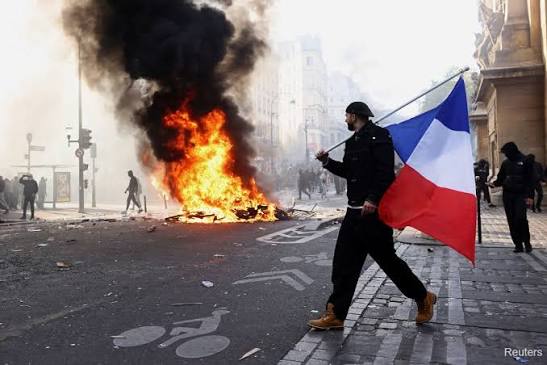
France is facing a major public order crisis after nationwide demonstrations against rising living costs and declining public services escalated into violent clashes, arson and widespread looting. On October 17, 2026, hundreds of thousands of people took to the streets, with violence reported in Paris, Marseille, Lyon, Bordeaux and several other cities.
Authorities reported around 1,200 arrests following the unrest. Police officers were injured, businesses suffered extensive damage, and fires engulfed public buildings. One of the most serious incidents involved the historic city hall in Limoges, where a major fire caused devastating damage to the landmark.
However, the protests were not entirely violent. Many demonstrators participated peacefully to demand better public services, improved school conditions and relief from rising household expenses. The violence came as some groups clashed with police, attacked public property and targeted shops.
According to reports published on October 18 by Reuters, Euronews and other news organisations, the unrest has increased pressure on President Emmanuel Macron’s government. The authorities now face two major challenges: restoring public order and responding to the economic and social concerns behind the demonstrations.
Why Are Protests Spreading Across France?
The current unrest reflects several connected concerns. These include the rising cost of living, pressure on public services, school conditions and dissatisfaction with government spending priorities.
The demonstrations initially gained momentum through student protests. Over time, they attracted support from workers, trade unions and other people concerned about their financial future.
1. Rising cost of living
Many French households are struggling with everyday expenses. Higher costs for essential goods, energy and transport can place significant pressure on people with limited incomes.
For these households, even small price increases can affect their ability to pay bills and meet basic needs. As a result, demands for higher purchasing power have become a central part of the demonstrations.
Protesters want the government to address these financial pressures. They also want policies that protect ordinary workers and families from further economic hardship.
However, the government must balance these demands against budget limits and other public spending commitments. That disagreement has added to the political tension.
2. Poor school conditions and teacher shortages
Education has also played a major role in the movement. Student protests raised concerns about underfunded schools, inadequate facilities and shortages of teachers.
These problems can affect classroom learning, increase pressure on existing staff and widen differences between schools in wealthier areas and those in disadvantaged communities.
Students and supporters have called for better educational facilities and more resources. In addition, some demonstrators have linked these demands to wider concerns about inequality.
The movement subsequently expanded beyond education. Rising living costs and proposed government spending measures helped bring more people into the streets.
3. Opposition to government spending plans
France’s public finances have become another source of disagreement. Government efforts to control spending can create tension when citizens believe that essential services already lack sufficient resources.
Critics argue that cuts or spending restrictions could worsen conditions in schools and other public institutions. Meanwhile, the government must consider how to finance public services while managing its budget.
These competing priorities have helped turn local protests into a broader political movement.
According to reporting by the Associated Press and Reuters, the demonstrations brought together people with different concerns, even though many shared frustration about economic pressure and the quality of public services.
Historic Limoges City Hall Damaged by Fire
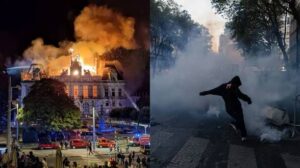
One of the most alarming incidents occurred in Limoges, where a fire severely damaged the city’s historic town hall.
The building, inaugurated in 1883, represents an important part of the city’s architectural and civic heritage. Reports said masked individuals set a municipal police vehicle on fire before entering the building and starting a blaze.
The fire caused catastrophic damage. Reports published on October 18 indicated that significant parts of the structure, including the roof and bell tower, had collapsed.
Why the damage matters
Historic public buildings are more than administrative spaces. They often preserve the history, identity and shared memories of a community.
Damage to such a landmark therefore affects residents beyond the immediate cost of repairs. It can also destroy architectural features and historical materials that may be difficult or impossible to replace.
The incident has intensified concerns about the scale of the unrest. It has also raised questions about how authorities can protect public institutions when large demonstrations turn violent.
Investigators will need to establish responsibility for the fire and determine the full extent of the damage. Meanwhile, residents face the loss of a significant civic landmark.
Looting and Arson Spread Across Major French Cities
Limoges was not the only city affected. Reports described vandalism, fires, damaged public buildings and looted shops across several urban centres.
Although the incidents varied by location, the overall pattern showed how quickly demonstrations could become dangerous when violent groups moved through crowded streets.
Paris: Shops targeted and streets damaged
Paris experienced clashes between police and groups of demonstrators. Some individuals threw projectiles, set vehicles on fire and broke into commercial premises.
Shops selling clothing, electronics and luxury goods were among the reported targets. Police deployed tear gas and other crowd-control measures as confrontations intensified.
The damage also affected public spaces. Burned vehicles, broken windows and debris left parts of the capital requiring extensive clean-up work.
Paris Mayor Emmanuel Grégoire described the destruction as severe, according to international reporting. The violence also created difficulties for residents, workers and business owners trying to move through affected neighbourhoods.
Marseille: City hall and local businesses affected
In Marseille, demonstrators reportedly forced their way into the city hall building and damaged its interior. Graffiti and other vandalism added to the disruption.
The unrest also affected nearby businesses and public facilities. Such incidents can interrupt municipal services and create additional costs for local taxpayers.
Authorities must now assess the damage and determine which areas require repairs or security improvements.
Local officials have also faced pressure to support businesses that lost stock, suffered property damage or had to close during the unrest.
Lyon: Tourist office set ablaze
Lyon also experienced serious violence. Reports said a tourist office at Place Bellecour was looted and set on fire.
The incident was particularly concerning because tourist facilities help visitors navigate the city and provide information about local attractions.
Damage to these facilities can disrupt tourism and harm businesses that depend on visitors. Restaurants, hotels, shops and transport providers may also experience reduced activity when travellers avoid areas affected by unrest.
Bordeaux and other cities
Bordeaux, Lille, Nice, Nantes, Toulouse and Strasbourg were among the other cities mentioned in reports of looting or related disturbances.
In Bordeaux, a group reportedly entered the local prefect’s residence and caused damage. Elsewhere, shops and public buildings were targeted.
These incidents demonstrate the geographical scale of the crisis. Nevertheless, reports of violence in several locations do not mean that every neighbourhood or demonstration experienced the same level of disorder.
Many people attended peaceful marches. The actions of those who committed arson, assaulted others or looted shops should not be confused with the conduct of all demonstrators.
Around 1,200 Arrests Reported as Police Respond to Violence
The scale of the violence has placed French law enforcement under considerable pressure. Prime Minister Sébastien Lecornu said approximately 1,200 people had been arrested following the demonstrations on October 17.
The Interior Ministry also reported injuries among police officers. Figures reported by Reuters and Euronews indicated that around 150 officers and gendarmes were injured, although figures and incident reports may change as authorities update their assessments.
How police responded
Police deployed specialist units to areas where confrontations became intense. Officers used tear gas and water cannon in some locations to disperse groups throwing projectiles or attacking property.
However, crowd-control tactics have also attracted scrutiny. Reports described serious injuries to demonstrators, including a 17-year-old who lost his right hand after an incident involving a crowd-control grenade in Saint-Étienne.
The incident has raised questions about the use of such weapons during demonstrations. Investigations and official reviews will be important in establishing the circumstances and determining whether any rules were breached.
Authorities must protect residents, emergency workers and public property. At the same time, they must respect the right to peaceful protest and ensure that police operations remain lawful and proportionate.
What happens after an arrest?
An arrest does not automatically mean that a person is guilty of a crime. French authorities must investigate the circumstances, gather evidence and follow the country’s legal procedures.
People suspected of arson, assault, theft or damage to public property may face prosecution if the evidence supports charges.
Investigators may examine surveillance footage, witness statements and other available evidence to identify those responsible for individual incidents.
The government has promised accountability for people involved in violence. However, the legal process must distinguish between peaceful demonstrators and individuals suspected of criminal acts.
President Macron Condemns the Violence
President Emmanuel Macron has strongly condemned the destruction caused during the demonstrations.
In a message reported by Reuters, Macron said that those responsible for attacking public institutions, damaging businesses and looting shops would face prosecution and punishment.
His response reflects the government’s determination to restore public order. Nevertheless, the scale of the demonstrations also highlights the challenge of addressing public frustration without escalating tensions further.
Prime Minister calls for accountability
Prime Minister Sébastien Lecornu has also rejected the violence and said the government would not be intimidated.
He blamed criminal groups and what he described as the ultra-left for contributing to the disorder. These statements form part of the government’s political response, while responsibility for individual offences must still be established through investigations.
The government faces pressure to prevent further destruction. At the same time, it must respond to the concerns that brought so many people onto the streets.
Support promised for affected businesses
The economic impact of the unrest is another major concern.
Economy Minister Roland Lescure pledged support for business owners who suffered losses. Local authorities have also discussed assistance for affected businesses.
Such support may help owners repair damaged premises, replace stock and resume trading. However, the overall cost will depend on the extent of the destruction and the assistance available.
For small businesses, even a short closure can create serious financial difficulties. Lost sales, repair bills and insurance disputes may continue long after the streets have been cleared.
How the Protests Could Affect France’s Economy
The immediate consequences are visible in burned vehicles, damaged buildings and looted shops. However, the economic effects may continue for weeks or months.
Small businesses face mounting losses
Retailers are among the businesses most directly affected by looting and vandalism.
A damaged storefront can force a shop to close while owners arrange repairs. Stolen merchandise and broken equipment create additional costs.
Businesses may also face higher insurance expenses or uncertainty over whether their policies cover particular losses.
For independent retailers, these expenses can threaten the future of the business. Larger companies may have more resources to absorb losses, but they can still face significant disruption.
Tourism could suffer
France attracts visitors from around the world. Its historic buildings, museums, restaurants and shopping districts are important parts of the tourism economy.
Images of fires and violent clashes may cause some travellers to reconsider their plans or avoid particular areas.
However, the long-term impact will depend on how quickly authorities restore normal conditions. Clear safety information, functioning transport services and repaired public facilities can help rebuild confidence.
Public spending may come under pressure
The destruction of public buildings creates costs for local and national authorities.
Emergency response, structural inspections, clean-up operations and reconstruction require funding. These expenses can compete with other public priorities, including education and local services.
That creates a difficult situation. Some of the original protests concerned the quality of public services, yet the damage caused by violence may require additional spending to repair the same communities.
Political Tensions Rise Ahead of France’s Presidential Election
The unrest is unfolding at a sensitive moment in French politics, with the next presidential election approaching in 2027.
The demonstrations have created a new challenge for Macron’s government. They have also given political parties an opportunity to promote different explanations for the crisis.
Some politicians emphasise law enforcement, public safety and punishment for looters. Others focus on economic inequality, living costs and pressure on schools and public services.
These differences matter because the protests do not have a single cause or represent one unified political position.
A difficult choice for the government
The government must restore order while considering whether policy changes could ease public frustration.
A response focused only on policing may not resolve concerns about prices, school conditions or public spending. Conversely, economic reforms alone will not address immediate threats to public safety.
Officials therefore face two connected tasks: enforcing the law and rebuilding confidence in public institutions.
The coming weeks may reveal whether the government prioritises additional security measures, financial support, public-service investment or a combination of approaches.
What Happens Next?
France now faces the challenge of moving from emergency response to recovery.
First, authorities must secure damaged buildings, investigate fires and identify people suspected of committing crimes. Firefighters, municipal workers and other emergency personnel also need safe access to affected areas.
Second, local governments must assess damage to public facilities and arrange repairs. Businesses will need time and financial support to reopen where premises have been damaged.
Third, the government will need to address the economic and social concerns raised during the demonstrations.
This does not mean that officials must accept violence as a legitimate form of protest. Rather, restoring order and addressing peaceful public demands are separate responsibilities that can be pursued together.
Ultimately, the scale of the recovery will depend on whether further clashes occur, how much damage authorities discover and whether the government can reduce tensions.
The France violent protests have exposed serious divisions over living standards, public services and political priorities. Their long-term significance will depend not only on the arrests and damage, but also on how France responds to the underlying grievances.
Frequently Asked Questions (FAQs)
1. Why are violent protests happening in France?
The demonstrations began with concerns about school conditions and teacher shortages before expanding to include rising living costs, declining purchasing power and dissatisfaction with public services and government spending plans.
2. How many people have been arrested in France?
French Prime Minister Sébastien Lecornu reported approximately 1,200 arrests following the October 17, 2026, demonstrations. Authorities may update the figures as investigations continue.
3. Which historic building was damaged by fire?
The historic city hall in Limoges was severely damaged by a major fire. The building was inaugurated in 1883, and reports said parts of its roof and bell tower collapsed.
4. Which French cities experienced unrest?
Reports described violence or damage in Paris, Marseille, Lyon, Bordeaux, Limoges and other cities, including Lille, Nice, Nantes, Toulouse and Strasbourg.
5. Were all the demonstrations violent?
No. Hundreds of thousands of people took part in demonstrations, and many marches remained peaceful. Violence occurred in particular locations when some groups clashed with police, looted shops or attacked public buildings.
6. What has President Emmanuel Macron said about the unrest?
Macron condemned attacks on public institutions and businesses and said those responsible would face prosecution and punishment.
7. How have the protests affected businesses?
Looting, fires and vandalism damaged shops and other commercial premises. Affected businesses may face lost sales, repair costs, stolen stock and temporary closures. Authorities have pledged support for business owners who suffered losses.
8. Could the unrest affect France’s tourism industry?
Yes. Images of violence and damaged landmarks could affect visitor confidence in some areas. The longer-term impact will depend on the speed of recovery and whether authorities can maintain safe conditions.
9. What caused the protests to spread beyond student groups?
Concerns about education overlapped with wider frustration over living costs, purchasing power and public services. This brought students, workers, unions and other demonstrators into a broader movement.
10. What happens next in France?
Authorities are expected to continue investigating suspected offences, assess damage, restore affected public facilities and support businesses. The government will also face pressure to address economic concerns and prevent further violence.
How useful was this post?
Click on a star to rate it!
Average rating 0 / 5. Vote count: 0
No votes so far! Be the first to rate this post.
About the Author

usa5911.com
Administrator
Hi, I’m Gurdeep Singh, a professional content writer from India with over 3 years of experience in the field. I specialize in covering U.S. politics, delivering timely and engaging content tailored specifically for an American audience. Along with my dedicated team, we track and report on all the latest political trends, news, and in-depth analysis shaping the United States today. Our goal is to provide clear, factual, and compelling content that keeps readers informed and engaged with the ever-changing political landscape.